
 Worksheets
Periodic Trends
Total questions: 36
Worksheet time: 36mins
Name
Class
Date
1.
The atom with the largest atomic radius in Group 18 is -
a)
Ar
b)
He
c)
Kr
d)
Rn
2.
The atom with the largest atomic radius in Period 4 (row 4) is -
a)
K
b)
Kr
c)
Fe
d)
Fe
3.
The element with the smallest ionization energy in Period 6 is -
a)
Rn
b)
Cs
c)
Os
d)
Tm
4.
The energy required to remove electrons is the definition of:
a)
Electronegativity
b)
Atomic Number
c)
Atomic Radius
d)
Ionization
5.
What is the name of family I
a)
Alkaline Earth Metals
b)
Boron Family
c)
Alkali Metals
d)
Halogen Family
6.
Group B is known as the:
a)
Inner Metals
b)
Transition Metals
c)
Weirdos
d)
Changelings
7.
Electronegativity is...
a)
the ability of an atom to attract/ accept electrons
b)
the ability of an atom to lose electrons
c)
the energy required to remove an electron from a specific atom
d)
how easy it is to make friends.
8.
Families all have similar
a)
Names
b)
atomic numbers
c)
atomic masses
d)
properties
9.
Which has the greater Electronegativity:
N or C?
N or C?
a)
C
b)
N
10.
Electronegativity __________ from left to right within a period and __________ from top to bottom within a group.
a)
decreases, increases
b)
increases, increases
c)
increases, decreases
d)
stays the same, increases
11.
Which of the following will have a larger radius than Zinc?
a)
Gallium
b)
Aluminum
c)
Magnesium
d)
Strontium
12.
Which of the following will have a lower ionization energy than Scandium (Sc)?
a)
Helium (He)
b)
Titanium (Ti)
c)
Calcium (Ca)
d)
Magnesium (Mg)
13.
Which atom has the largest atomic radius?
a)
potassium
b)
rubidium
c)
francium
d)
cesium
14.
Atoms that have a high electronegativity, _______________.
a)
give up their electrons more easily.
b)
hold on to their electrons more tightly.
c)
have more electron shells.
15.
Ionization energy is...
a)
the energy required to add an electron to a specific atom
b)
how much energy it takes to remove an electron from an atom
c)
the energy required to shield the outer electrons from the nucleus
d)
a measure of the ability of an atom to attract electrons
16.
Which statement correctly and completely identifies a trend?
a)
Atomic radius decreases across a period and increases down a group.
b)
Electronegativity decreases across a period and decreases down a group.
c)
Ionization energy increases across a period and increases down a group.
d)
Ionic radius increases across a period and increases down a group.
17.
The element with the largest electronegativity in the halogens is -
a)
At
b)
F
c)
Cl
d)
Br
18.
The element with the lowest electronegativity in Period 3 is -
a)
Na
b)
Cl
c)
Ar
d)
Mg
19.
Which periodic group has the smallest atomic radius?
a)
Alkali metals
b)
Halogens
c)
Noble Gases
d)
Transition metals
20.
Atomic radius generally increases as we move __________.
a)
down a group and from right to left across a period
b)
up a group and from left to right across a period
c)
down a group and from left to right across a period
d)
up a group and from right to left across a period
21.
Of the halogens, which has the smallest radius?
a)
F
b)
Br
c)
He
d)
At
22.
Which element in Period 2 has the greatest atomic radius?
a)
Be
b)
C
c)
Na
d)
Li
23.
In the modern periodic table elements are arranged by:
a)
atomic mass
b)
atomic number
c)
valence electrons
d)
number of isotopes
24.
What is a cation's charge?
a)
positive
b)
negative
c)
neutral
d)
depends on the element
25.
What is an anion's charge?
a)
positive
b)
negative
c)
neutral
d)
depends on the element's charge
26.

Name group 2 on the periodic table.
a)
alkali metals
b)
alkaline earth metals
c)
noble gases
d)
transition metals
27.

Name groups 3 - 12 on the periodic table.
a)
noble gases
b)
halogens
c)
metalloids
d)
transition metals
28.
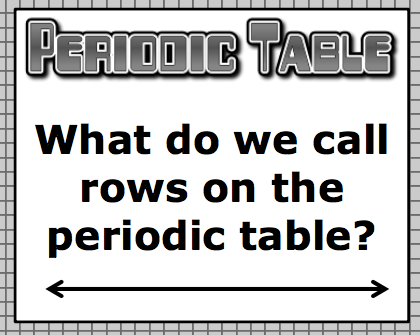
a)
Periods
b)
Groups
29.
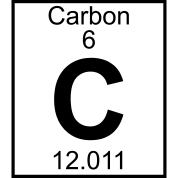
What does the 6 represent?
a)
atomic mass
b)
atomic number
c)
element name
d)
chemical symbol
30.
What does 12.011 represent?
a)
atomic mass
b)
atomic number
c)
element name
d)
chemical symbol
31.
What does the C represent?
a)
atomic mass
b)
atomic number
c)
element name
d)
chemical symbol
32.
What group on the Periodic Table contains the elements of the alkaline earth family?
a)
1
b)
2
c)
17
d)
18
33.
Argon (Ar)
a)
alkali metal
b)
alkaline earth metal
c)
halogen
d)
noble gas
34.
Which element is not in the Alkali metal family?
a)
Li
b)
H
c)
Fr
d)
Cs
35.
Which is a metal?
a)
Rhodium (Rh)
b)
Arsenic (As)
c)
Hydrogen
d)
Argon (Ar)
36.
Which is an alkaline earth metal?
a)
Calcium
b)
Rubidium
c)
Carbon
d)
Iodine
100 %

