wayground logo

Free Printable Worksheets

NEW

Font size

S
M
L
XL
Worksheets

A-Level - DNA Replication and Protein Synthesis

Total questions: 70

Worksheet time: 1hrs 5mins

Name
Class
Date
1.
At what point in the cell cycle does DNA replication occur and why?
a)
before a cell divides, to provide each of the two resulting cells with a complete set of DNA instructions
b)
before a cell divides, to ensure that the DNA will fit into the resulting cells
c)
during cell division, to ensure that the DNA will fit into the resulting cells
d)
after a cell divides, to provide each of the two resulting cells with a complete set of DNA instructions 
2.
Which choice describes DNA after replication has taken place?
a)
one molecule with two original strands and one molecule with two new strands
b)
two molecules, each with one original and one new strand
c)
two molecules, each with two new strands
d)
 two molecules, each with two old strands
3.
The sequence of DNA below is part of a gene. How many amino acids are coded for by this segment? 
a)
4
b)
8
c)
12
d)
20
4.
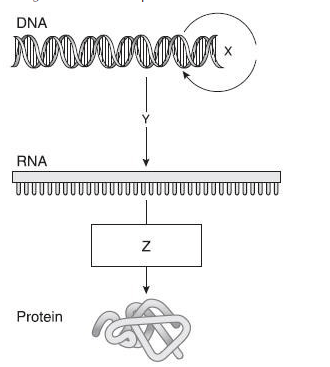
 A diagram of a cellular process is shown below. Which of the following identifies the process shown at point Z?
a)
Translation
b)
Translocation
c)
Replication
d)
Transcription
5.
Which of the following would most likely cause a mutation?
a)
 the placement of ribosomes on the endoplasmic reticulum
b)
the insertion of a nucleotide into DNA
c)
the movement of transfer RNA out of the nucleus
d)
 the release of messenger RNA from DNA
6.
Which of the following carries amino acids to the site of protein synthesis? 
a)
mRNA
b)
rRNA
c)
tRNA
d)
nRNA
7.
Genes for medically important proteins can be cloned and inserted into bacteria, as shown in the diagram below. Why can bacteria recognize a human gene and then produce a human protein?
a)
 DNA replication in bacteria and humans is the same.
b)
. Bacterial cells contain the same organelles as human cells. 
c)
The basic components of DNA are the same in humans and bacteria.
d)
Bacterial cells and human cells contain the same kind of chromosomes.
8.
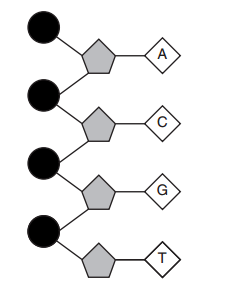
The diagram below represents a portion of a DNA molecule. The letters represent different types of 
a)
sugar molecules
b)
nitrogen bases
c)
enzymes
d)
proteins
9.

If the DNA sequence is TAC the mRNA bases will be...

a)

AAU

b)

AUG

c)

GUU

10.

If a DNA sequence is AAG, what will the mRNA complimentary base pairs be?

a)

CUC

b)

TTC

c)

UUC

d)

AAG

11.

The building blocks of proteins are...

a)

sugars

b)

enzymes

c)

amino acids

d)

DNA

12.

Transcription occurs in the __________, translation occurs in the _____________

a)

nucleus, ribosome

b)

ribosome, nucleus

13.

For Species A , transcribe the 2 DNA codons into mRNA that are missing below.


DNA base sequence GAC TGA CTC CAC TAA

mRNA base sequence CUG _____ GAG ____ AUU

amino acid sequence LEU THR GLU VAL ILE

a)

ACT and GUA

b)

ACU and GTA

c)

ACU and GUG

d)

ACU and GTG

14.
Which sequence of complementary DNA bases would pair with this partial strand
ATG TGA CAG?
a)
ATG TGA CAG
b)
TAC ACT GTC
c)
GTA AGT GAC
d)
CAT TCA CTG
15.
In a molecule of double-stranded DNA, the amount of adenine present is always equal to the amount of _________.
a)
cytosine
b)
guanine
c)
thymine
d)
uracil
16.
What determines the code, or information, of a DNA molecule?
a)
the shape (structure) of the nitrogen bases
b)
the order (sequence) of the nitrogen bases
c)
the color of the nitrogen bases
d)
the frequency (number) of nitrogen bases
17.

A process in which DNA has the unique ability to make an exact copy of itself.

a)

Replication

b)

Translation

c)

Transcription

d)

Protein Synthesis

18.
What are the three components of a nucleotide?
a)
sugar, hydrogen, nitrogen base
b)
sugar, oxygen, nitrogen base
c)
sugar, phosphate, nitrogen base
d)
sugar, phosphate, protein
19.

What is the correct order to make a protein?

a)

Protein, DNA, RNA

b)

RNA, DNA, Protein

c)

DNA, RNA, Protein

d)

Protein, RNA, DNA

20.

In what process is mRNA synthesized?

a)

Transcription

b)

Translation

c)

DNA Replication

d)

Mitosis

21.

Where does TRANSCRIPTION occur?

a)

Nucleus

b)

Ribosome

c)

Cytoplasm

d)

Mitochondria

22.

How many codons equals 1 amino acid?

a)

1

b)

2

c)

3

d)

4

23.

On which molecule can an anticodon be found?

a)

mRNA

b)

DNA

c)

tRNA

d)

rRNA

24.

TRANSCRIBE this DNA sequence: TACGTTACT

a)

AUGCAAUGA

b)

ATGCAATGA

c)

AUGGATUGA

d)

TACGTTACT

25.
Does the order of amino acids in a protein matter?
a)
YES!
b)
NO!
26.

The important enzyme related with transcription is;

a)

gyrase

b)

DNA polymerase

c)

RNA polymerase

d)

ligase

27.
The process of going from DNA to mRNA is called
a)
Transcription
b)
Translation
c)
Transportation
d)
Transient
28.
The process where mRNA is read and made into an amino acid chain.
a)
Transcription
b)
Translation
c)
Transportation
d)
Transient
29.
How many amino acids are coded for by this sequence of nucleotides:
ATG GGA ACT CCA
a)
4
b)
2
c)
6
d)
12
30.
This molecule carries genetic information from the nucleus to the ribosomes in the cytoplasm.
a)
rRNA
b)
tRNA
c)
mRNA
d)
DNA
31.
Which of these nitrogenous bases is NOT in RNA?
a)
Uracil
b)
Thymine
c)
Cytosine
d)
Guanine
32.
In RNA, Uracil pairs with ______. 
a)
cytosine
b)
adenine
c)
guanine
d)
thymine
33.
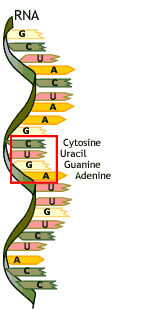
which process is shown?
a)
diffusion
b)
repiration
c)
recombination
d)
translation
34.
Which process?
a)
mutation
b)
transcription
c)
respiration
d)
translation
35.
DNA holds the code for
a)
lipids
b)
carbohydrates
c)
protein
d)
sugar
36.

What is the location in the cell for translation?

a)

nucleus

b)

mitochondria in cytoplasm

c)

ribosome in cytoplasm

d)

chloroplast in cytoplasm

37.
What is the three base sequence of mRNA that codes for a single amino acid?
a)
Anticodon
b)
Codon
c)
Protein
38.
What 3 things make up a nucleotide?
a)
Sugar, Phosphate, Nitrogen Base
b)
Sugar, Hydrogen, Carbon
c)
Carbon, Phosphate, Nitrogen
d)
mRNA, tRNA and rRNA
39.
How many base pairs would be needed to chain together 3 amino acids?
a)
3
b)
6
c)
9
d)
12
40.
What is assembled during transcription?
a)
transfer RNA
b)
messenger RNA
c)
DNA replication
d)
court proceedings
41.
What is made during translation?
a)
transfer RNA
b)
messenger RNA
c)
Proteins
d)
Spanish Rice
42.
What stores the code for making an individual protein?
a)
DNA
b)
a gene
c)
a chromosome
d)
transfer RNA
43.
What makes DNA different from RNA?
a)
they type of phosphate
b)
the type of sugar
c)
having C pair with G
d)
Having A's
44.
Deoxyribose is the sugar in RNA
a)
True
b)
False
45.
The site of protein synthesis?
a)
nucleus
b)
ER
c)
Ribosome
d)
Golgi Body
46.

The picture below shows the steps of DNA replication beginning with step one and ending with step three.


​Because you are reusing the old, or parent, DNA strand DNA replication is said to be

a)

Semi- Conservative

b)

Semi-discontinuous

c)

Continuous

d)

Fully-Conserveative

47.

The picture below shows an enzyme unwinding and unzipping DNA.

​What is the name of this enzyme?

a)

DNA Helicase

b)

DNA Ligase

c)

DNA polyermase

d)

RNA Polymerase

48.

Match he nucleotide with its complementary nucleotide. (DNA to DNA).


Adenine -

a)

Thymine

b)

Guanine

c)

Cytosine

49.

Match he nucleotide with its complementary nucleotide. (DNA to DNA).


Cytosine-

a)

Thymine

b)

Guanine

c)

Adenine

50.

Which enzyme is responsible for adding the free nucleotides to the replicating DNA? ​

a)

DNA Helicase

b)

DNA Ligase

c)

DNA polyermase

d)

RNA Polymerase

51.

The directionality of DNA is said to be ___________, because it is side by side by goes in opposite directions.

a)

Anti-directional

b)

Parallel

c)

Anti-parallel

d)

Anti-uniform

52.
What is the backbone of DNA made of?
a)
Nitrogen bases
b)
Amino acids
c)
Double H
d)
Sugar & Phosphate
53.
Why is it crucial that living things are able to replicate their DNA?
a)
Each cell must have its own DNA
b)
Less copies of DNA are needed when a new cell is created
c)
A cell needs multiple copies of DNA
d)
Only muscle cells need DNA 
54.
In DNA, Adenine pairs with ___________. 
a)
Guanine
b)
Cytosine
c)
Thymine
d)
Uracil
55.
DNA has a _____________ structure. 
a)
double helix
b)
single strand
c)
ring 
d)
chain
56.
In RNA, Uracil pairs with ______. 
a)
cytosine
b)
adenine
c)
guanine
d)
thymine
57.
The mRNA leaves the ________ to find the ribosome to make proteins.
a)
cell
b)
nucleotide
c)
nucleus
58.

DNA holds the code for making

a)

lipids

b)

carbohydrates

c)

proteins

d)

sugars

59.

Choose the sequence of the mRNA strand that would be match up with to the following strand:

GTAGTCA

a)

UATUAGA

b)

ACGACTG

c)

CAUCAGU

d)

CATCAGT

60.
The main function of tRNA is to...
a)
carry a message that, when translated, forms proteins
b)
form a portion of ribosomes
c)
string together complementary RNA and DNA strands
d)
bring amino acids from the cytoplasm to the ribosomes
61.
Contains the bases adenine, uracil, cytosine and guanine
a)
DNA
b)
RNA
c)
Both
62.
DNA travels outside of the nucleus.
a)
true
b)
false
63.
Messenger RNA carries a copy of the DNA code.
a)
true
b)
false
64.
Where do cells get the information to make proteins?
a)
RNA
b)
DNA
c)
phosphate group
65.
How does RNA differ from DNA?
a)
RNA contains uracil and deoxyribose
b)
RNA contains ribose and thymine
c)
RNA contains uracil and ribose
d)
RNA contains adenine and ribose
66.
How would the DNA sequence GCTATA be transcribed to mRNA?
a)
GCUAUA
b)
CGATAT
c)
CGAUAU
d)
GCUTUT
67.

What enzyme does transcription use?

a)

DNA polymerase

b)

ligase

c)

RNA polymerase

d)

helicase

68.

Why must transcription occur where DNA can be found?

a)

because DNA can't leave

b)

because ribosomes are in the nucleus

c)

because DNA polymerase is found there

d)

because helicase unzips the DNA

69.

How many nucleotides equal 1 amino acid?

a)

1

b)

2

c)

3

d)

4

70.

A polypeptide is a sequence of ____________________ held together by a ______________ bond.

a)

amino acids; peptide

b)

fatty acids; ionic

c)

proteins; hydrogen

d)

fatty acids; covalent