
 Worksheets
Bio Basic Chem
Total questions: 71
Worksheet time: 45mins
Name
Class
Date
1.
What type of bond results from shared electrons?
a)
Covalent Bond
b)
Ionic Bond
c)
Hydrogen Bond
d)
Water Bond
2.
What type of bond is formed when a positive ion and negative ion stick together?
a)
Covalent Bond
b)
Ionic Bond
c)
Water Bond
d)
Hydrogen Bond
3.
What is an ion?
a)
A small atom
b)
A large atom
c)
A neutral atom
d)
A charged atom
4.
Which subatomic particle is neutral?
a)
Neutron
b)
Positron
c)
Proton
d)
Electron
5.
Which subatomic particle is positive?
a)
Electron
b)
Proton
c)
Neutron
d)
Quark
6.
Which subatomic particle is negative?
a)
Proton
b)
Neutron
c)
Electron
d)
Negatron
7.
What two subatomic particles are found in the nucleus?
a)
Protons and Electrons
b)
Neutrons and Electrons
c)
Protons and Neutrons
d)
Electrons only
8.
Where are electrons located?
a)
In the electron clouds
b)
In the nucleus
c)
In the protons
d)
Paired with the neutrons
9.
What is the charge of a proton?
a)
Neutral
b)
Depends on the location
c)
Positive
d)
Depends on the size
10.
If an atom has 5 protons and 4 electrons, what is its charge?
a)
Neutral
b)
Positive
c)
Negative
d)
Unknown
11.
If an atom has 8 protons and 10 electrons, what is its charge?
a)
Positive
b)
Neutral
c)
Negative
d)
It depends on its size
12.
Which of these would be a positive ion?
a)
An atom with 6 protons and 5 electrons
b)
An atom with 5 protons and 6 electrons
c)
An atom with 5 protons and 5 electrons
d)
An atom with 6 protons and 6 electrons
13.
An ion is formed when an atom gains or loses
a)
electrons.
b)
protons.
c)
bonds.
d)
neutrons.
14.
Why is water necessary to your body?
a)
It forms the solutes in blood plasma.
b)
It prevents large changes in blood pH.
c)
It dissolves nonpolar fats and oils.
d)
It dissolves and transports substances.
15.
Which phrase best describes atoms?
a)
smallest basic units of matter
b)
parts of a nucleus
c)
single-celled organism
d)
positively charged particles
16.
Which of the following cannot be broken down by ordinary chemical means?
a)
element
b)
bond
c)
molecule
d)
compound
17.
The three particles that make up atoms are
a)
protons, neutrons, solvents
b)
protons, electrons, solutions
c)
protons, neutrons, soltuions
d)
protons, neutrons, and electrons
18.
Compounds that form hydrogen ions in solution is
a)
a solution
b)
a base
c)
an acid
d)
a proton
19.
Which is more acidic?
a)
pH of 1
b)
pH of 6
c)
pH of 7
d)
pH of 12
20.
Which is more basic?
a)
pH of 7
b)
pH of 12
c)
pH of 6
d)
pH of 1
21.
what does S stand for?
a)
salt
b)
sodium
c)
sulfur
d)
spit
22.
C stands for?
a)
cat
b)
calcium
c)
carbon
d)
crypton
23.
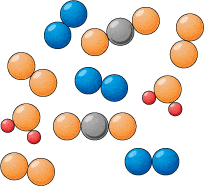
These are found on the Periodic Table.
a)
elements
b)
mixtures
c)
compounds
24.
P stands for
a)
Phosphorus
b)
Potassium
c)
Possum
25.

What is the atomic number of carbon?
a)
6
b)
12
c)
12.011
26.

What is the atomic mass of carbon?
a)
6
b)
12
27.

How many electrons would be in an atom of fluorine?
a)
9
b)
18
c)
18.998
d)
10
28.
Which of the following is a mixture
a)
Carbon
b)
Water
c)
Air
d)
Sugar
29.

How many neutrons would be in an atom of Fluorine?
a)
9
b)
10
c)
19
d)
18.998
30.
A(n) _____ is a unique substance that forms when two or more elements combine chemically.
a)
element
b)
compound
c)
mixture
d)
all of the above
31.
The rate of a chemical reaction is NOT affected by which of the following:
a)
temperature
b)
concentration
c)
particle size (surface area)
d)
All of these affect reaction rates
32.
The rate of a reaction increases as temperature__________________.
a)
Decreases
b)
Increases
c)
Stays the Same
33.
A ______________ is a substance that increases the rate of a reaction without being used up during the reaction.
a)
catalyst
b)
product
c)
reactant
d)
solute
34.
Catalysts permit reactions to proceed along a ___________energy path.
a)
lower
b)
higher
35.
Usually lowering the temperature will slow down a reaction.
a)
false
b)
true
36.
Exothermic reactions release heat to the surroundings.
a)
true
b)
false
37.
A catalyst increases the efficiency of collisions between reactants.
a)
true
b)
false
38.
Enzymes are considered to be
a)
Lipids
b)
Carbohydrate
c)
Protein
d)
Nucleic Acid
39.
What is the purpose of an enzyme?
a)
give permission for the reaction
b)
raise activation energy
c)
speed up reactions
d)
control how many reactions occur
40.
Where do substrates bind on an enzyme?
a)
voltage-gated channels
b)
surface receptor
c)
calcium channels
d)
active site
41.
Enzymes are capable of increasing the rate of a chemical reaction within a living cell. Enzymes accomplish this through which of the following means?
a)
reducing the number of products
b)
reducing the activation energy
c)
increasing the temperature of the cell
d)
increasing the concentration of reactants
42.

What is structure A?
a)
Substrate
b)
Active site
c)
Enzyme
d)
Products
43.

What is structure D?
a)
Substrate
b)
Active site
c)
Enzyme
d)
Products
44.

What is structure C?
a)
Substrate
b)
Active site
c)
Enzyme
d)
Products
45.
How do enzymes speed up chemical reaction?
a)
Increasing activation energy
b)
Decreasing activation energy
c)
Increasing deactivation energy
d)
Decreasing deactivation energy
46.
What is a substance called if it speeds up a chemical reaction?
a)
reusable
b)
catalyst
c)
specific
d)
fragile
47.
Each enzyme only has 1 substrate that will fit its active site. What is this called?
a)
reusable
b)
catalyst
c)
specific
d)
fragile
48.
Once a new product leaves an enzyme, the enzyme is unchanged and ready for the next substrate. What is this called?
a)
reusable
b)
catalyst
c)
specific
d)
fragile
49.

The graph shows how enzymes affect reactions in cells. Which statement best summarizes the information shown in the graph?
a)
Enzymes increase the energy of the reactants.
b)
Enzymes decrease the energy level of the products.
c)
Enzyme decrease the activation energy of the reaction.
d)
Enzymes reverse the direction of the reaction.
50.

Which of the following conclusions can be drawn from this graph?
a)
The optimum pH of the enzyme is 6.6.
b)
The optimum pH of the enzyme is 5.8
c)
The enzyme’s activity increases as pH increases 5.0 to 9.0
d)
The enzyme’s activity is greater around pH of 8.0 .
51.
What is the name for the mechanism of enzyme activity?
a)
Lock and key
b)
jigsaw puzzle
c)
hammer and nail
d)
two hands pattern
52.
The "lock and key hypothesis" attempts to explain the mechanism of?
a)
Vacuole formation
b)
Pinocytosis
c)
Sharing of electrons
d)
Enzyme specificity
53.
When the reaction absorbs heat and feels cold, it's called a(n):
a)
Endothermic reaction
b)
Exothermic reaction
54.
When the reaction that happens releases heat and therefore feels warm is called a(n):
a)
Endothermic reaction
b)
Exothermic reaction
55.
If the reaction releases heat, it's called a:
a)
Endothermic reaction
b)
Exothermic reaction
56.
How many elements are in C6H12O6?
a)
1
b)
2
c)
3
d)
4
57.
How many atoms of carbon (C) are in C6H12O6?
a)
3
b)
6
c)
12
d)
24
58.
Element or compound?
H2O
H2O
a)
element
b)
compound
59.
Element or compound?
O2
O2
a)
Element
b)
Compound
60.
Which of the following is a compound?
a)
Co
b)
O2
c)
C
d)
CO2
61.

The red numbers in the image below represent ________
a)
subscripts
b)
coefficients
c)
I don't know, and don't want to try
d)
None of the answers are correct
62.

The blue numbers in the image below represent ________
a)
I don't know, and don't want to try
b)
coefficients
c)
subscripts
d)
none of the answers are correct
63.
In the equation, 2Mg + O2 ---> 2MgO, which are the reactants?
a)
Mg and O
b)
MgO
c)
Mg and MgO
d)
O and MgO
64.
In a chemical reaction, everything to the rightof the arrow is called ______________.
a)
Products
b)
Yields
c)
Molecules
d)
Reactants
65.
How many atoms of aluminum are on each side of the following equation: 4Al + 3O2 --> 2Al2 O3
a)
2
b)
6
c)
1
d)
4
66.
Is the following equation balanced or unbalanced?
Fe + S --> FeS
Fe + S --> FeS
a)
balanced
b)
unbalanced
67.
How many atoms are there TOTAL in:
H2SO4
H2SO4
a)
6
b)
5
c)
7
d)
3
68.
How many Sodium (Na) are in 6NaCl?
a)
1
b)
12
c)
6
69.
How many O's are in Al₂(SO₄)₃
a)
4
b)
12
c)
7
d)
24
70.
How many O's are in Al₂(SO₄)₃
a)
4
b)
12
c)
7
d)
24
71.
How many Magnesium are in 10MgCl2?
a)
10
b)
5
c)
20
100 %

