wayground logo

Free Printable Worksheets

Font size

S
M
L
XL
Worksheets

Oceanography Quarter 1 Review

Total questions: 108

Worksheet time: 1hrs 26mins

Name
Class
Date
1.
When humans burn fossil fuels, most of the carbon quickly enters the                       as carbon dioxide.
a)
Water
b)
Atmosphere
c)
Sun
d)
Air
2.
All of the carbon in existence is continually recycled in the carbon cycle
a)
True
b)
False
3.
Which of the following removes carbon from the atmosphere?
a)
Combustion
b)
Respiration
c)
Photosynthesis
d)
Death
4.
Carbon can be found in...
a)
The atmosphere
b)
Soil
c)
Fossil fuels
d)
All of the above
5.
What type of plate boundary is this?
a)
Plate
b)
Divergent
c)
Convergent
d)
Transform
6.
What type of event will occur at this boundary?
a)
Earthquake
b)
Volcano Eruption
c)
Tornado
d)
Mountain Building
7.
A divergent boundary occurs when plates ....
a)
Pull apart
b)
Come together
c)
Slide past each other
d)
subducting
8.
Which of the following is the name of the ancient supercontinent formed 28 Million Years ago.
a)
Pangea
b)
Gondwanda
c)
Laurasia
d)
Neverland
9.
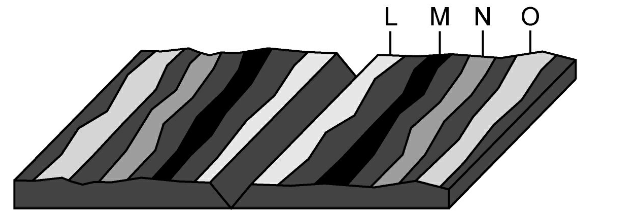
Where would the oldest rock be found?
a)
L
b)
M
c)
N
d)
O
10.
How is it possible for new crust to be formed without increasing the surface area of the Earth?
a)
Crust is destroyed at the same time it is created
b)
New crust is underwater where it sinks
c)
New crust breaks more easily than old crust
11.
Mountains are created when....
a)
Two continental plates collide
b)
Two oceanic plates pull apart
c)
An Oceanic plate subducts under a Continental Plate
d)
Two continental plates pull apart
12.
The outside layer of the earth is called ______________________.
a)
core
b)
crust
c)
mantle
d)
outer core
13.
This famous transform fault is located in the western United States creates significant earthquake activity for California
a)
New Madrid
b)
Denali Fault
c)
Ramapo Seismic Zone
d)
San Andreas
14.
What force causes tides to happen on the earth?
a)
The pull of the gravity from the moon on the earth
b)
People jumping up and down on the surface of the earth 
c)
The sun orbiting around the earth 
d)
The animals in the ocean 
15.

What is the driving force of tidal movement?

a)

earth's gravity

b)

moons' gravity

c)

Sun's gravity

d)

ocean's gravity

16.

Which layer would photosynthesis take place?

a)

surface mixed zone

b)

transition zone

c)

deep zone

d)

all of the above

17.
Ocean acidification begins with 
a)
pollution from ships
b)
carbon dioxide released from combustion
c)
dumping of waste from cities into the ocean
18.
Carbon dioxide and seawater combine to form
a)
calcium carbonate
b)
carbon monoxide
c)
carbonic acid 
19.
Marine organisms make their shells from calcium and
a)
chloride
b)
carbonate
c)
seawater
20.
An example of a marine organism that needs calcium carbonate 
a)
a crab
b)
a shark
c)
an octopus
21.
Very slight increases in the acidity of seawater __________  marine organisms that make shells.
a)
doesn't bother
b)
has no effect on 
c)
is unhealthy and stresses
22.

Which molecule makes water acidic?

a)

Carbonate Ions

b)

Carbon Dioxide

23.

What happens to 1/4 of the greenhouse gases in the atmosphere?

a)

It is released into space.

b)

It gets absorbed by the ocean.

24.
As the ocean becomes more acidic, the pH of the water
a)
increases
b)
decreases
25.

A pH of 3 is how much more acidic than a pH of 6?

a)

10

b)

30

c)

300

d)

1000

26.

What do some marine creatures do with the carbonate ion?

a)

use it as a food source

b)

use it as a defense mechanism

c)

use it to build shells and exoskeletons

d)

use it to cool body temperatures

27.
Warm ocean currents generally come from
a)
The North Pole
b)
The South Pole
c)
The Equator
d)
Both A and B
28.

______ causes surface currents.

a)

The Coriolis Effect

b)

gravity

c)

density differences

d)

wind

29.

As plants and animals in the ocean die, the nutrients produced from their decay _____.

a)

are recycled by the Global Conveyor Belt

b)

sink to the bottom

c)

are destroyed by sunlight

d)

become coral reefs

30.

Nutrients are brought to the surface for phytoplankton to use at _______.

a)

gyres

b)

eddies

c)

upwellings

d)

the equator

31.

_______ causes the Coriolis Effect

a)

Earth's rotation

b)

gravity

c)

wind

d)

density

32.

What is continental slope?

a)

steep slope to basin floor

b)

abrupt change in slope at edge of shelf, leading to rapid increase in depth

c)

nearly flat land-border sloping gently

d)

Submarine canyons

33.

A flat plain on the ocean crust is a

a)

active margin

b)

passive margin

c)

abyssal plain

d)

continental divide

34.

Which type of crust is thicker?

a)

Oceanic

b)

Outer core

c)

Inner core

d)

Continental

35.

Which type of crust is more dense?

a)

Oceanic

b)

Continental

c)

Abyssal Plain

d)

Earthquake

36.

What is the largest geological feature on Earth?

a)

Smoky Mountains

b)

Grand Canyon

c)

Mid-Ocean Ridge

d)

Subduction Zone

37.

What creates new ocean floor?

a)

Convergent plate boundaries

b)

San Andres Fault

c)

Hydrothermal Vents

d)

Divergent plate boundaries

38.

The technology that was used after WWII that discovered mid-ocean ridges

a)

CVD

b)

Sonar

c)

CVS

d)

Thermometer

39.

When the Moon is in its first quarter and third quarter phases, the gravitational forces of the Sun and the Moon pull at 90 degree angles from one another. This means that when the Moon is in its first quarter and third quarter phases,

a)

high tides are at their lowest levels

b)

high tides are experienced worldwide at the same time

c)

low tides are experienced worldwide at the same time

d)

low tides are at their lowest levels

40.

The flattest part of the ocean basin

a)

trench

b)

seamount

c)

continental rise

d)

abyssal plain

41.

mass of moving ocean water

a)

wave

b)

current

c)

tide

42.

periodic rising and falling of the water level of the oceanwave

a)

current

b)

wave

c)

tide

43.

rhythmic movement that carries energy through matter or space

a)

current

b)

wave

c)

tide

d)

salinity

44.

How many tides do we have in 24 hours?

a)

1

b)

2

c)

3

d)

4

45.

What causes surface currents?

a)

moon's gravitational pull

b)

wind

c)

temperature

d)

salinity

46.

top of a wave is called the

a)

crest

b)

trough

c)

wavelength

d)

waveheight

47.

bottom of a wave

a)

crest

b)

trough

c)

wavelength

d)

waveheight

48.

distance from one wave to the next

a)

crest

b)

trough

c)

wavelength

d)

waveheight

49.
A[n] ______________ tide occurs when the sun is at right angles to the line between Earth and the moon. 
a)
high
b)
neap
c)
low
d)
spring
50.
A[n] ___________ tide occurs when the sun, Earth, and the moon are nearly in a line. 
a)
spring
b)
high
c)
low
d)
neap
51.
The bulge of water on the side of the Earth closest to the moon produces ___________.
a)
high tide
b)
low tide
c)
neap tide
d)
spring tide
52.
Which body has the greater effect on Earth's tides?
a)
Sun
b)
Saturn
c)
Moon 
d)
Venus
53.
The Moon has a greater influence on Earth tides than the Sun because...
a)
it is smaller than the Sun
b)
it revolves around the Earth
c)
it is closer to the Earth
54.
What are tides?
a)
They are the rising and falling of ocean water.
b)
They are the rising and falling of ocean birds.
c)
They are the rising and falling of aquatic water.
d)
The freezing and melting of arctic ice
55.
The difference in levels of ocean water at high and low tides is the _________________.
a)
low tide
b)
tidal range
c)
high tide
d)
slack water
56.
How do surface ocean waves form? 
a)
Wind blowing across the surface
b)
Time wind blows
c)
Strength of the wind 
d)
Wind when blows upwards off the water
57.
What happens to pressure as you go deeper into the ocean? 
a)
increases
b)
decreases
c)
stays the same
d)
doubles
58.
Where on the ocean floor does sea floor spreading occur? 
a)
trench
b)
volcanic island
c)
Mid Ocean Ridge
d)
continental slope
59.
Where on the ocean floor does subduction occur? 
a)
volcanic island
b)
abyssal plain
c)
Mid Ocean Ridge
d)
trench 
60.
What are the positions of the Earth, Sun and Moon during a neap tide? 
a)
straight line
b)
right angle
c)
acute angle
d)
obtuse angle
61.
What are the positions of the Earth, Sun and Moon during a spring tide? 
a)
straight line
b)
right angle
c)
acute angle
d)
obtuse angle
62.
What are the differences in high tide and low tide during a neap tide?
a)
very small difference
b)
no difference
c)
extreme differences
63.
What are the differences in high tide and low tide during a spring tide?
a)
very little differences
b)
no difference
c)
extreme differences
64.
TRUE or FALSE
The depth of the ocean floor varies.
a)
TRUE
b)
FALSE
65.
Organisms that do not decompose can be buried and become what?
a)
water
b)
nutrients
c)
air
d)
fossil fuels
66.
How does excess (too much) carbon dioxide in the atmosphere change the ocean?
a)
it reduces the pH of the water
b)
it makes the water warmer
c)
it makes the water cooler
d)
it raises the pH of the water
67.
What feature is marked by letter A?
a)
Continental slope
b)
Continental shelf
c)
Continental rise
d)
continent
68.
What seafloor feature is marked with the letter G?
a)
Mid-ocean ridge
b)
submarine canyon
c)
abyssal plain
d)
deep ocean trench
69.
What seafloor feature is marked with the letter D?
a)
Deep ocean trench
b)
Submarine Canyon
c)
Mid-ocean Ridge
d)
None of the above
70.

Which of the following would decrease as a diver travels deeper into the ocean? (Choose all of the correct answers!)

a)

Pressure

b)

Light

c)

Temperature

d)

Salinity

71.

The ability of water molecules to stick to each other, creating surface tension is called:

a)

Cohesion

b)

Adhesion

c)

Insulation

d)

Ph

72.

The fact that water can stick to other substances is called:

a)

Ph

b)

Adhesion

c)

Cohesion

d)

Insulation

73.

Heat Capacity is a measure of the heat required to raise the temperature of 1g of a substance by 1°C.


So...

True or False:

Water has a very high heat capacity, which means it resists changing temperature when heat is added or removed.

a)

True

b)

False

74.

Why does ice float on water?


a)

When it freezes it becomes less dense

b)

When it freezes it becomes more dense

c)

When it freezes its density stays the same

75.

Water is a universal solvent because it...

a)

It can be found anywhere

b)

It freezes when it gets cold

c)

Floats when frozen

d)

Dissolves more substances than anything else

76.

Why does water move from the roots to the leaves of plants?

a)

Water is pushed by solutes

b)

Capillary action pulls the water molecules up like a chain

c)

Water is pulled by gravity

d)

Water cannot move up roots to leaves

77.

The ability of water molecules to stick to each other, creating surface tension is called:

a)

Cohesion

b)

Adhesion

c)

Insulation

d)

Ph

78.

The fact that water can stick to other substances is called:

a)

Ph

b)

Adhesion

c)

Cohesion

d)

Insulation

79.

Heat Capacity is a measure of the heat required to raise the temperature of 1g of a substance by 1°C.


So...

True or False:

Water has a very high heat capacity, which means it resists changing temperature when heat is added or removed.

a)

True

b)

False

80.

Why does ice float on water?


a)

When it freezes it becomes less dense

b)

When it freezes it becomes more dense

c)

When it freezes its density stays the same

81.

Water is a universal solvent because it...

a)

It can be found anywhere

b)

It freezes when it gets cold

c)

Floats when frozen

d)

Dissolves more substances than anything else

82.

Why does water move from the roots to the leaves of plants?

a)

Water is pushed by solutes

b)

Capillary action pulls the water molecules up like a chain

c)

Water is pulled by gravity

d)

Water cannot move up roots to leaves

83.
A(n) ______ is a substance with a pH less than 7
a)
Acid
b)
Alkaline
c)
Base
d)
Buffer
84.
A(n) _______ is a substance with a pH greater than 7.
a)
Base
b)
Acid
c)
Buffer
d)
Water
85.
What is the only substance with a neutral pH of 7?
a)
Milk
b)
Orange Juice
c)
Water
d)
Blood
86.
Why does ice stay at the top of oceans instead of sinking to the bottom?
a)
 Ice is colder than liquid water.
b)
Ice is less dense than liquid water.
c)
Ice is more dense than liquid water.
d)
Ice is warmer than liquid water.
87.
 Many fish and aquatic plants can survive a cold winter because the layer of ice that forms at the top of the lake insulates the water below and prevents the lake from freezing solid. What unique property of water contributes to this effect? 
a)
Water absorbs heat when it evaporates and forms a gas 
b)
 Water expands and becomes less dense when it freezes.
c)
Water molecules completely separate into ions in solutions.
d)
 Water forms hydrogen bonds with ions and other polar substances. 
88.

What molecule is this?

a)

calcium

b)

hydrogen

c)

helium

d)

water

89.

A paperclip floating on water is an example of what property of water?

a)

capillary action

b)

surface tension

c)

universal solvent

d)

specific heat index

90.

Water drops being attracted to each other is an example of ____________.

a)

capillary action

b)

adhesion

c)

specific heat index

d)

cohesion

91.

The place where two plates come together is known as a _______

a)

transform boundary.

b)

divergent boundary.

c)

convergent boundary.

d)

rift valley.

92.
What are the two types of crust
a)
continental and oceanic
b)
ocean and upper
c)
lower and upper
d)
pizza and subway
93.
What is Pangaea?
a)
the name of a German scientist
b)
the name of the super-continent that existed millions of years ago
c)
another name for continental drift
d)
the name of an ancient fossil
94.
What is the name of the plate boundary that slides past each other?
a)
Divergent
b)
Convergent
c)
Transform
d)
Mr. C the Slide Man
95.
Originally the Continental drift theory was not well received by other scientist.  Why? 
a)
There was a competing theory at the time that was more believable. 
b)
There was no data showing the continents ever moved. 
c)
The scientists did not know the force responsible for moving the continents. 
d)
The scientist presenting the data was unreliable.  
96.
Who is the German Scientist that came up with the theory of the Continental Drift? 
a)
Albert Einstein 
b)
Ms. Stukel 
c)
Galileo
d)
Alfred Wegener
97.

Which statement best describes why fossils of the same land-dwelling species have been discovered in both South America and Africa?

a)

The organism migrated to two continents

b)

The organisms were separated by the formation of new mountain ranges

c)

The organisms became extinct due to climate change on these continents

d)

These organisms once lived on one large landmass that later split into two continents

98.
In a longitudinal wave, the particles move...?
a)
back and forth
b)
up and down
c)
vertically
d)
in the direction of the hertz
99.
All waves carry
a)
energy
b)
light 
c)
matter
d)
particles
100.
What kind of wave is pictured below?
a)
compressional wave
b)
transverse wave
c)
sound wave
d)
mechanical wave
101.
Which type of wave is pictured here?
a)
Longitudinal
b)
Transverse
c)
Light 
d)
Electromagnetic
102.

Which type of wave moves parallel to the direction of the wave?

a)

transverse

b)

longitudinal

c)

surface

d)

electromagnetic

103.

Sound waves are which type of waves?

a)

transverse

b)

seismic

c)

longitudinal

d)

frequency

104.

Shaking a rope up and down produces which type of wave?

a)

transverse

b)

amplitude

c)

longitudinal

d)

period

105.
What are the components of a tide pool?
a)
Rocks
b)
Water
c)
Plants & Animals
d)
All the above
106.

The two different states of the Intertidal Zone include:

a)

Low tide and the splash zone

b)

Low tide and medium tide

c)

Low tide and high tide

d)

High tide and the splash zone

107.

Species living in the Intertidal Zone must be able to survive which changes?

a)

Moisture

b)

Temperature

c)

Salinity

d)

All of the above

108.

Besides fluctuations in salinity and water levels, intertidal organisms must also withstand wide variations in:

a)

Temperature.

b)

Light level.

c)

Sediment deposition.

d)

Current velocity.