
 Worksheets
Unit 1 Review - Chem 150
Total questions: 56
Worksheet time: 2hrs 57mins
Name
Class
Date
1.
Wood burned in a fireplace
a)
Chemical Change
b)
Physical Change
2.
Ice melting
a)
Chemical Change
b)
Physical Change
3.
Cake batter baked in an oven
a)
Chemical Change
b)
Physical Change
4.
Rust on an iron fence
a)
Chemical Change
b)
Physical Change
5.
How many sig figs are there?
100.00
100.00
a)
1
b)
3
c)
4
d)
5
6.
How many sig figs are there?
100000000
100000000
a)
1
b)
9
c)
10
7.
How many sig figs are there?
4004
4004
a)
1
b)
2
c)
3
d)
4
8.
How many sig figs are there?
5.00000008
5.00000008
a)
2
b)
6
c)
9
9.
How many sig figs are there?
0.00400
0.00400
a)
1
b)
3
c)
5
d)
6
10.
How many significant figures does the following number have? 0.02
a)
1
b)
2
c)
2
d)
4
11.
How many significant figures does the following number have? 0.020
a)
1
b)
2
c)
3
d)
4
12.
Calculate 923 g ÷ 20312 cm3 and give your answer with the correct number of significant figures.
a)
0.04 g/cm3
b)
0.045 g/cm3
c)
0.0454 g/cm3
d)
0.05 g/cm3
13.
Calculate 1.23 m x 0.89 m and give your answer with the correct number of significant figures.
a)
1.0 m2
b)
1.1 m2
c)
1.0947 m2
d)
1.095 m2
14.
Calculate 7.987 m - 0.54 m and give your answer with the correct number of significant figures.
a)
7.45 m
b)
7.447 m
c)
7.4 m
d)
7.5 m
15.
Calculate 5.50 cm + 5.5 cm and give your answer with the correct number of significant figures.
a)
11 cm
b)
11.0 cm
c)
11.00 cm
d)
11.000 cm
16.
Calculate 12.34 + 1.234 + 0.1234 and give your answer with the correct number of significant figures.
a)
13.6974
b)
13.697
c)
13.70
d)
13.7
17.
All of the following have one significant figure except:
a)
100 cm
b)
0.0001 cm
c)
2 cm
d)
2.00 cm
18.
Calculate 0.020 cm x 50 cm x 11.1 cm and give your answer with the correct number of significant figures.
a)
10 cm3
b)
11.1 cm3
c)
11 cm3
d)
11. cm3
19.
Round the following value to 4 significant figures: 120.15
a)
120.15
b)
1202
c)
1201
d)
120.2
e)
121.5
20.
How many cm3 is 100 mL? (your answer should only be the number no units for this to grade it right. In a test you will be expected to include units)
(a)
21.
Scientific Notation is made up of two number parts. The second part is a power of base 10.
a)
True
b)
False
22.
When writing a number in scientific notation, the first number must be greater than 1, but less than 10.
a)
False
b)
True
23.
The rule of scientific notation is to write all exponents with a base of ____.
a)
50
b)
5
c)
100
d)
10
24.
ANY number raised to a power of 0 will be....
a)
10
b)
itself
c)
1
d)
0
25.
When your exponent is negative, you move your decimal....
a)
to the right
b)
to the left
c)
to both sides
d)
nowhere.... the decimal goes nowhere
26.
Write in standard form:
8 x 10⁴
8 x 10⁴
a)
8,000
b)
80,000
c)
.00008
27.
How would you write 4.3756 x 10⁴ in standard form?
a)
437,560,000
b)
0.00043756
c)
43,756
d)
4,3756
28.
Which number is correctly written in scientific notation?
a)
5.67 x 10⁵
b)
56.7 x 10³
c)
0.567 x 10⁶
29.
Which of the following is correct scientific notation?
a)
20.35 x 10⁴
b)
.2035 x 104
c)
2035 4
d)
2.035 x10⁴
30.
How would you write 4.3756 x 10⁴ in standard form?
a)
437,560,000
b)
0.00043756
c)
43,756
31.
Convert to scientific notation:
520,000,000
520,000,000
a)
52 x 107
b)
5.2 x 10⁷
c)
5.2 x 10⁸
d)
0.52 x 10⁹
32.
Write 0.00000707 in scientific notation.
a)
7.07 x 10⁻⁶
b)
7.07 x 10⁶
c)
707 x 108
d)
707 x 10-8
33.

This bullseye demonstrates...
a)
High Accuracy & High Precision
b)
High Accuracy & Low Precision
c)
Low Accuracy & High Precision
d)
Low Accuracy & Low Precision
34.
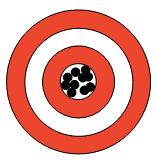
?
a)
High Accuracy & High Precision
b)
High Accuracy & Low Precision
c)
Low Accuracy & High Precision
d)
Low Accuracy & Low Precision
35.

Describe the accuracy and precision of the image
a)
Accurate and Precise
b)
Accurate and not precise
c)
Not Accurate and Precise
d)
not accurate and not precise
36.

This image is an example of...
a)
precision ONLY
b)
accuracy ONLY
c)
BOTH precision and accuracy
d)
NEITHER precision and accuracy
37.
A set of data are all close to each other, but they are not close to the actual value. This set of data can be described as...
a)
accurate
b)
precise
c)
both precise and accurate
38.
A set of data are all close to each other, and they are close to the actual value. This set of data can be described as...
a)
accurate
b)
precise
c)
both precise and accurate
39.
The prefix "centi" means:
a)
100
b)
1/100
c)
one thousand
d)
1/1000
40.
The prefix "milli" means:
a)
1000
b)
1/1000
c)
1,000,000
d)
1/1,000,000
41.
The prefix "kilo" means:
a)
100
b)
1/100
c)
1/1000
d)
1000
42.
Convert 300 meters to centimeters:
a)
3000 cm
b)
0.3 cm
c)
30,000 cm
d)
3 cn
43.
convert 650 m to km
a)
6.5
b)
0.65
c)
65
d)
0.065
44.
1 kg is equal to ______
a)
1000 mg
b)
100 g
c)
1000 g
d)
100 mg
45.
7254 g=_____kg
a)
725.4
b)
72.54
c)
7.254
d)
0.7254
46.
Convert 0°C to Fahrenheit
a)
0°F
b)
1.8°F
c)
32°F
d)
3.2°F
47.
Which of the follow represents a normal body temperature of 98.6°F in °Celsius?
a)
37°C
b)
370°C
c)
72.5°C
d)
72.6°C
48.
100 Celsius is ? Kelvin
a)
173 K
b)
373K
c)
273 K
d)
0 K
49.
Convert 72⁰F to Celsius
a)
2.2⁰C
b)
222⁰C
c)
22.2⁰C
d)
161.6⁰C
50.
What is the formula for density?
a)
density = mass x volume
b)
density = mass / volume
c)
density = mass + volume
d)
density = mass - volume
51.
Jack has a rock. The rock has a mass of 14g and a volume of 2cm3. What is the density of the rock?
a)
7 mL
b)
7 g/cm3
c)
28 g/cm3
d)
1/7 g/cm3
52.
Frank has a paper clip. It has a mass of 9g and a volume of 3cm3. What is its density?
a)
3 g/cm3
b)
1/3 g/cm3
c)
27 g/cm3
d)
39 g/cm3
53.
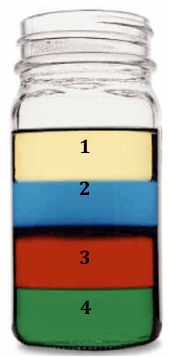
Put the liquids in order from most dense to least dense?
a)
4, 3, 2, 1
b)
1, 2, 3, 4
c)
3, 4, 2, 1,
d)
4, 3, 1, 2
54.
If an object has a density of .6 g/mL and you put it into water, will it sink or float?
a)
sink
b)
float
55.
If an object has a density of 3.6 g/mL and you put it into water, will it sink or float?
a)
sink
b)
float
56.
If a cube has a density of 2.56 g/cm3 and a mass of 25 grams, what is the volume of the cube?
a)
2.56 cm3
b)
25 cm3
c)
9.8 cm3
d)
0.10 cm3
100 %

