
 Worksheets
Periodic Table
Total questions: 55
Worksheet time: 38mins


Which of the following statements regarding electronic orbitals is/are correct?
Each p-orbital can hold a maximum of six electrons.
The 3p-orbitals have a higher energy level than the 3s-orbital.
The three 3p-orbitals have slightly different energy levels.
The 1s-orbital has the same size and shape as the 2s-orbital.
What is the Aufbau principle?
Within an energy level, s orbitals are the lowest energy, followed by p, d and then f. F orbitals are the highest energy for that level.
The lower the principal quantum number (n) the lower the energy.
All three.
The Aufbau Principle states that electrons enter the lowest energy orbitals first.

Identify the rule that is being violated
Aufbau's Principle
Hund's Rule
Pauli's Exclusion Principle
Heisenberg uncertainty principle

What is incorrect about this orbital diagram?
Both arrows in the filled 2p box should be pointing the same direction
There is nothing incorrect with this diagram
In the there should only be 1 arrow in the first 2p box and one in the 2nd 2p box
All the arrows should be pointing the same direction.
All orbitals of equal energy (degenerate orbitals) are occupied by one electron before any single orbital is occupied by a second electron.
Aufbau Principle
Pauli's Exclusion Principle
Hund’s Rule
Core Notation
No two electrons in the same atom can have the same four quantum numbers.
Aufbau Principle
Pauli's Exclusion Principle
Hund’s Rule
Noble gas notation
Chemists can identify the composition of some unknown salts by conducting a flame test. When potassium salts are heated in a flame, a purple color is observed.
This is due to the movement of electrons between energy levels. What is the electron configuration of a potassium atom at ground state?
1s2; 2s2; 2p6; 3s2; 3p6; 4d1
1s2; 2s2; 2p6; 3s2;3p6; 3d1
1s2; 2s2; 2d6; 3s2; 3d6; 4s1
1s2; 2s2; 2p6; 3s2; 3p6; 4s1

Write the electronic configuration for sodium Na (Z=11)
1s2 2s2 2p6
1s2 2s2 2p6 3s2
1s2 2s2 2p6 3s1
1s2 2s2 2p6 3s2 3p4
In 1s2, the 1 means
there is 1 electron
the electrons are in the 1st energy level
the shape is circular
there is a -1 charge
The electronic configuration of element Q is shown below:
1s22s22p63s23p63d104s2. Which of the following is true for Q?
It is located in Period 4
It is a group II element
It has a low melting point
It is a poor electrical conductor
Chloride ion exhibits the same electronic configuration as that of :
F-
Ne
Ca2+
Al3+
3. Below shows the symbols representing elements and their respective proton numbers.
Element P= 8 protons
Element Q = 10 protons
Element R = 11 protons
Element S = 13 protons
Which of the following indicates the increasing order of atomic sizes of the elements in the above table?
P<Q<R<S
Q<P<S<R
S<R<Q<P
R<S<P<Q
Which statement best describe Group 2 elements from top to bottom of periodic table?
The number of principal quantum number increases, and the number of valence electrons increases.
The number of principal quantum number increases, and the number of valence electrons remain the same.
The number of principal quantum number remains the same, and the number of valence electrons increase.
The number of principal quantum number remains the same , and the number of valence electrons decrease.
As the element of Group 1 of the Periodic Table are considered from top to to bottom, the first ionization energy of each successive element will decrease. The decrease is due to
Decreasing radius and decreasing shielding effect
Decreasing radius and increasing shielding effect
Increasing radius and decreasing shielding effect
Increasing radius and increasing shielding effect
What type of oxide is:
Potassium oxide
Amphoteric Oxide
Basic Oxide
Neutral Oxide
Acidic Oxide
What type of oxide is:
Water
Amphoteric Oxide
Basic Oxide
Neutral Oxide
Acidic Oxide
What type of oxide is:
Nitrogen Dioxide
Amphoteric Oxide
Basic Oxide
Neutral Oxide
Acidic Oxide
What type of oxide is:
Copper (II) Oxide
Amphoteric Oxide
Basic Oxide
Neutral Oxide
Acidic Oxide
Amphoteric oxides are substances that
Reacts with acids only
Reacts with bases only
Reacts with acids and bases
Do not react with acids or bases
A basic oxide reacts with an acid to give
salt
carbon dioxide
water
hydrogen
Select the statements that are true of basic oxides.
They are oxides of metals.
They dissolve in water to form acids.
They react with acids to form salt and water.
They react with bases to form salts and water.
Which statement is false of acidic oxides?
They are oxides of non-metals.
They dissolve in water to form acids.
They do no react with acids or alkalis.
They react with alkalis to form salt and water.
Which is the ionic equation of the reaction between hydrochloric acid and sodium hydroxide?
Na+ (aq) + Cl- (aq) --> NaCl (aq)
H+ (aq) + OH- (aq) --> H2O (l)
H- (aq) + OH+ (aq) --> H2O (l)
ZnO is an oxide that can react with acids and bases, as shown in the following equations:
ZnO + HSO --> ZnSO + H2O
ZnO +2NaOH -->Na2ZnO2 +H2O
What name is given to an oxide that reacts with both acids and bases?
neutral
acidic
precipitate
amphoteric
displacement
Which of the following oxides is most likely to be an acidic oxide?
CuO
Na2O
MgO
CO2
Which of the following oxides is most likely to be an basic oxide?
Al2O3
H2O
MgO
CO2
Metal oxides are basic because .....
they form alkaline solutions
they form acidic solutions
they are simple
they are dull
Which of the following pairs of compounds contain only acidic oxides?
MgO and SO3
SO3 and Cl2O7
Al2O3 and SiO2
Na2O and Cl2O7
Which of the following elements has the highest ratio of the second ionization energy to the first ionization energy?
Sodium
Magnesium
Sulphur
Chlorine
Select all that explain the ionization energy trend within periods
electrons are closer to the nucleus
their is a weak pull between electrons from the nucleus, making them easily moveable
feel more of a pull from nucleus, making them harder to move
electrons are further from the nucleus
Explain why ionization energy decreases as you go down a group.
Outer electrons are further away from the nucleus you go down a group
Electrons feel less pull from the nucleus as you go down a group
Electrons are easier to remove as you go down a group
All of the above

Which of the following lists the atoms in order of increasing Ionization energy?
calcium, iron, copper
copper, iron, calcium
calcium, copper, iron
iron, copper, calcium
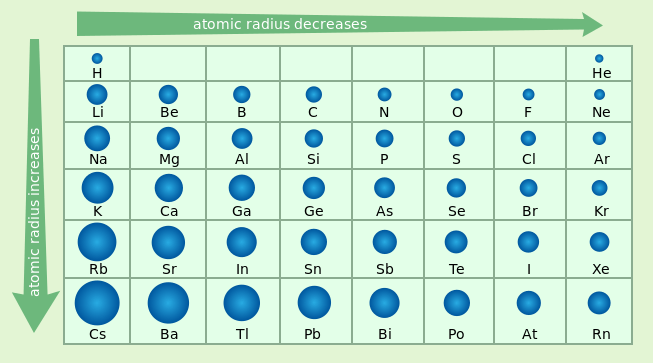
Atomic size generally increases as we move __________.
down a group and from right to left across a period
up a group and from left to right across a period
down a group and from left to right across a period
up a group and from right to left across a period

What is first ionization energy?
minimum energy required to remove 1 mole of electron from 1 mole of neutral gaseous atom in its excited state state
minimum energy required to remove 1 mole of electron from 1 mole of neutral gaseous atom in its ground state
maximum energy required to remove 1 mole of electron from 1 mole of neutral gaseous atom in its excited state
maximum energy required to remove 1 mole of electron from 1 mole of neutral gaseous atom in its ground state
What are/is the factors that influence the ionisation energy? (you may click more than one)
Atomic Size
Effective Nuclear Charge
Shielding effect
Orbital stability
Explain why ionization energy decreases as you go down a group.
Outer electrons are further away from the nucleus you go down a group
Attraction between nucleus and the remaining electrons becomes weaker as you go down a group
Electrons are easier to be removed as you go down a group
All of the above
Which equation correctly describes the first ionization energy of X?
X --> X- + e-
X --> X+ + e-
X --> X- + e+
X + e- --> X-
X + e- --> X+
Successive ionization energies for an element in Period 4 were determined experimentally and found to be: IE1=600 kJ/mol, IE2=1800 kJ/mol, IE3=2700 kJ/mol, IE4=11,600 kJ/mol and IE5=15,000 kJ/mol. What element is this?
germanium
selenium
gallium
silicon
phosphorous
The successive ionization energy of electrons in element R are increasing but the fifth ionization energy of element R shows a drastic increased. This is because
the screening effect of the inner electrons
the fifth electrons is in the outermost shell
the fifth electrons is from the inner shell
the fifth electrons is nearer to the nucleus

