wayground logo

Free Printable Worksheets

Font size

S
M
L
XL
Worksheets

Unit 3: Quantitative Chemistry

Total questions: 56

Worksheet time: 1hrs 4mins

Name
Class
Date
1.
Which number is correctly written in scientific notation?
a)
5.67 x 10⁵
b)
56.7 x 10³
c)
0.567 x 10⁶
2.
Write in standard form: 
6.254 x 10⁶
a)
6,254,000
b)
6,254,000,000
c)
625,400
3.
Write in standard form: 
7.3003 x 10⁻⁵
a)
.000073003
b)
.0000073003
c)
730,030
4.
Write in scientific notation: 
540,020,000
a)
5.4002 x 10⁸
b)
5.4 x 10⁸
c)
5.4002 x 10⁴
5.
Write in scientific notation: 
0.0079245
a)
7.9245 x 10⁻³
b)
7.9245 x 10⁻²
c)
7.9245 x 10³
6.
1 kg =
a)
10g
b)
100g
c)
1000g
d)
10,000g
7.
1 m =
a)
100cm
b)
10cm
c)
1000cm
d)
10mm
8.
What piece of equipment (tool) is used to measure volume  more accurately?
a)
Graduated Cylinder
b)
Meter Stick
c)
Triple-Beam Balance
d)
Beaker
9.
What piece of equipment (tool) is used to measure length?
a)
Graduated Cylinder
b)
Meter Stick
c)
Triple-Beam Balance
10.
how close a measurement is to the true value for the  quantity.
a)
accuracy 
b)
precision
11.
how close a set of measurements is to one another, regardless of whether the measurements are correct.
a)
accuracy 
b)
precision
12.
What is the measurement using the correct number of sig. figs.?
a)
39.5 mL
b)
40 mL
c)
39 mL
d)
40.0 mL
13.
What is the measurement using the correct number of sig. figs.?
a)
8.5mL
b)
8.50mL
c)
8.45mL
d)
8.4mL
14.
What is the measurement using the correct number of sig. figs.?
a)
89cm
b)
88.9cm
c)
88.90cm
d)
88cm
15.
What is the reading of the meniscus?
a)
36mL
b)
45mL
c)
35.0mL
d)
30.5mL
16.
How many significant figures: 216 m
a)
1
b)
2
c)
3
d)
0
17.
How many significant figures: 153.0 mL
a)
1
b)
2
c)
3
d)
4
18.
How many significant figures: 1000 mL
a)
1
b)
2
c)
3
d)
4
19.
How many significant figures: 100.000 cL
a)
1
b)
3
c)
5
d)
6
20.
How many significant figures: 0.010 L
a)
1
b)
2
c)
3
d)
4
21.

How many significant figures: 450 m

a)

3

b)

2

c)

1

d)

0

22.
How many sig figs are there?
0.000008
a)
1
b)
2
c)
6
d)
7
23.
How many sig figs are there?
4004
a)
1
b)
2
c)
3
d)
4
24.
How many sig figs are there?
0.00400
a)
1
b)
3
c)
5
d)
6
25.
How many sig figs are there?
0.0009009090000
a)
3
b)
10
c)
14
26.
How many sig figs are there?
4000.
a)
1
b)
3
c)
4
27.

Record answer to the proper number of significant figures: 3.35 + 1.4 + 3.65 =

a)

8.9

b)

8.22

c)

8.43

d)

8.4

28.

Record answer to the proper number of significant figures: 13.59 cm + 23.25 cm + 21 cm =

a)

57.84 cm

b)

57.8 cm

c)

57 cm

d)

58 cm

e)

60 cm

29.

Record answer to the proper number of significant figures: 8.24 mg + 2.0 mg =

a)

10.24 mg

b)

10.2 mg

c)

10.3 mg

d)

10 mg

e)

10.20 mg

30.

Record answer to the proper number of significant figures: 38 g  ÷\div  7 mL =

a)

5.42857143 g/mL

b)

5.4286 g/mL

c)

5.43 g/mL

d)

5.4 g/mL

e)

5 g/mL

31.
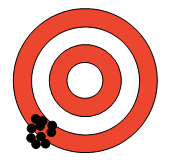
This bullseye demonstrates...
a)
High Accuracy & High Precision
b)
High Accuracy & Low Precision
c)
Low Accuracy & High Precision
d)
Low Accuracy & Low Precision
32.
When a measurement is repeatable and consistent it is said to have...
a)
High precision
b)
Low precision
c)
High accuracy
d)
Low accuracy
33.
A set of data are all close to each other, but they are not close to the actual value.  This set of data can be described as...
a)
accurate
b)
precise
c)
both precise and accurate
34.
A set of data are not close to each other, but the average of the data is very close to the actual value.  This set of data can be described as...
a)
accurate
b)
precise
c)
both precise and accurate
35.

Measurements: 24.9, 25.2, 25.1, 24.8

True Value: 25.0

These measurements are…

a)

Accurate, but not precise

b)

Precise, but not accurate

c)

Both precise and accurate

d)

Neither precise nor accurate

36.

Does this image show results that are accurate and/or precise?

a)

Accurate, but not precise

b)

Precise, but not accurate

c)

Both precise and accurate

d)

Neither precise nor accurate

37.

Does this image show results that are accurate and/or precise?

a)

Accurate, but not precise

b)

Precise, but not accurate

c)

Both precise and accurate

d)

Neither precise nor accurate

38.

Does this image show results that are accurate and/or precise?

a)

Accurate, but not precise

b)

Precise, but not accurate

c)

Both precise and accurate

d)

Neither precise nor accurate

39.

A student's measured length during a science experiment was 12.00 cm. The actual size was 14.25 cm.


What was the percent error?


*Hint: You now know how to calculate error, and you should know how to calculate a percent, so put the two together to find this answer.

a)

15.79%

b)

18.75%

c)

2.25%

40.

Jessie estimates the weight of her cat to be 8 pounds. The actual weight of the cat was 10 pounds.


What was the percent error?


*Hint: You now know how to calculate error, and you should know how to calculate a percent, so put the two together to find this answer.

a)

15%

b)

20%

c)

25%

d)

30%

41.

Which is the more precise measurement?

a)

4 mL

b)

4.3 mL

c)

4.32 mL

d)

4.300 mL

42.

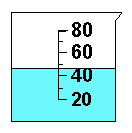
Based on the markings of this beaker, what is the estimated volume?

a)

48 mL

b)

48.2 mL

c)

48.25 mL

d)

0.04 L

43.

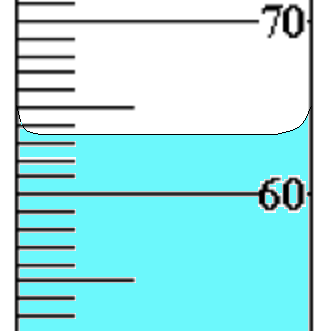
Based on the markings of this graduated cylinder, what is the estimated volume?

a)

63.5 mL

b)

63 mL

c)

63.55 mL

d)

0.063 L

44.

Which Student is the most Precise?

a)

Alex

b)

Shandra

c)

Luis

45.

Engineers must be able to clearly communicate their solution process and their proposed solution. When problem solving requires measurements and/or calculations, engineers must take care to ….

a)

use clear definitions

b)

state the meaning of variables

c)

be careful about specifying units

d)

calculate accurately

e)

express answers with a degree of precision appropriate for the problem context

46.

The deer population is estimated to be 17,600 in northern Illinois, but an actual count was 21,300. What is the percent error?

a)

21%

b)

17.37%

c)

17.4%

d)

21.02%

47.
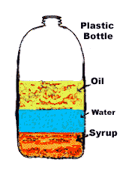
Which liquid is the least dense?
a)
oil
b)
water
c)
syrup 
d)
plastic bottle
48.
Jack has a rock. The rock has a mass of 14 g and a volume of 2 cm3. What is the density of the rock?
a)
7 mL
b)
7 g/cm3
c)
28 g/cm3
d)
1/7 g/cm3
49.
Why do some substances float on water?
a)
they are warmer than water
b)
they are cooler than water
c)
they are more dense than water
d)
they are less dense than water
50.
What is the measuring unit for mass?
a)
centimeter 
b)
millimeter 
c)
grams 
d)
pounds
51.
Helium balloons rise on earth because
a)
helium is less dense than air
b)
helium is more dense than air
c)
helium is cooler than air
d)
helium is warmer than air
52.

If an object has a density of .6 g/mL and you put it into water, will it sink or float? (Hint: density of water = 1 g/mL)

a)

sink

b)

float

53.

Convert 2.5 grams into milligrams. (practice dimensional analysis by showing work)

a)

25 mg

b)

25,000 mg

c)

250 mg

d)

2500 mg

54.

The length of a desk is 3.5 feet. How many centimeters is the length? Practice dimensional analysis by showing work!

(2.54 cm = 1 inch)

a)

60

b)

120.23

c)

106.68

d)

117.12

55.

How many minutes are in 1 year? (practice dimensional analysis by showing work)

a)

I can't count that high.

b)

525,600min

c)

52,560min

d)

31,536,000min

56.

How many kilograms of calcium are there in 173 pounds of calcium? Practice dimensional analysis by showing work. (1 pound = 454 grams; 1 kg = 1000 g)

a)

1.10 kg

b)

78.5 kg

c)

110 kg

d)

78500 kg