
 Worksheets
QCE chem unit 3 topic 1 equilibrium
Total questions: 102
Worksheet time: 2hrs 10mins
Which of the following is true?
Energy is found only in living objects
Energy is a fuel
Energy is a substance or fluid
Energy is associated only with movement
Any store of energy may be transferred into another store

A dynamic equilibrium can be achieved...
2SO2(g)+O2(g)⇌2SO3(g)
Removing O2(g) will
shift equilibrium forward
shift equilibrium reverse
no shift
2SO2(g)+O2(g)⇌2SO3(g)
Adding O2(g) will
shift equilibrium forward
shift equilibrium reverse
no shift
2SO2(g)+O2(g)⇌2SO3(g)
Adding SO2(g) will
shift equilibrium forward
shift equilibrium reverse
no shift
N2 (g) + 3 H2 (g) <−> 2 NH3 (g)
If the pressure in the system is increased, which substance will increase in concentration?
For the reaction...
N2 (g) + 3 H2(g) ⇌ 2 NH3 (g)
If the pressure in the system is increased, which substance(s) will increase in concentration?
N2
H2
N2 and H2
NH3
What is the effect of increasing the pressure on the following equilibrium: 2NO(g) + O2 (g) ⇌2NO2(g)?
The yield of NO2 increases
The yield of NO2 decreases
The reaction is slower
The concentration of O2 increases.
2SO2(g)+O2(g)⇌2SO3(g)
Adding SO3(g) will
shift equilibrium right
shift equilibrium left
increase K
have no change
SO2 + O2 <=> SO3
If the equilibrium position shifts to the right, the concentration of O2 will ___________.
For the reaction...
N2 + O2 <=> 2NO: Δ H = +182 kJ mol-1. (Forward reaction is endothermic)
If the temperature is increased the equilibrium position will shift _______.
to the left
to the right
to the left and right
neither left nor right
why is medium temperature used in the Haber process?
low temperature will form more ammonia
high temperature will form more hydrogen and nitrogen
the rate slows down
to increase the rate but not negatively affecting the yield
What is the purpose of a catalyst on an equilibrium reaction?
to increase the rate of forward reaction
to increase rate of backward reaction
in increase both forward and backward reaction rates
no effect

2SO2(g)+1O2(g) ⇌ 2SO3(g) + Heat
Increasing the pressure on the system will...
shift equilibrium right
shift equilibrium left
slow rate of reaction
have no change

CoCI42- +6H2O →Co(H2O)62+ + 4CI-.
What would happen when H2O is added?
Position of equilibrium will shift to left (and become more blue)
Position of equilibrium will shift to right (and become more pink)
Keq will increase as H2O is added
Position of equilibrium will shift to left to reduce the added H2O
Decreasing volume of container will
SO2 + O2 <−> SO3
If the equilibrium shifts to the right, the concentration of O2 will ___________.
N2 (g) + 3H2 (g) < -> 2NH3 (g) + Heat
Removing H2
Shift Left
Shift Right
2SO2(g)+O2(g) ⇌ 2SO3(g) + Heat
Increasing the temperature will...
shift equilibrium right
shift equilibrium left
increase pressure
have no change
CoCI42- +6H2O →Co(H2O)62+ + 4CI-.
What would happen when H2O is added?
Position of equilibrium will shift to left (and become more blue)
Position of equilibrium will shift to right (and become more pink)
Keq will increase as H2O is added
Position of equilibrium will shift to left to reduce the added H2O
2SO2(g) + O2(g) ⇌ 2SO3(g) + Heat
Using a catalyst
shift equilibrium right
shift equilibrium left
increase the rate of reaction
have no change
2 NO(g) + O2(g) ⇌ 2 NO2(g)

SO2 (g) + NO2 (g) <=> SO3 (g) + NO (g)
had reached a state of equilibrium, was found to contain
0.40 mol L-1 SO3 , and 0.30 mol L-1 NO,
0.15 mol L-1NO2 , and 0.20 mol L-1 SO2.
Calculate the equilibrium constant for this reaction.
Fe3O4(s) + 4H2(g) <=> 3Fe(s) + 4H2O(g)
Kc =
4Br2(g) + CH4(g) ↔ 4HBr(g) + CBr4(g)
A Bronsted Lowry acid:
donates H+ to another substance
accepts H+ from another substance
produces H+
produces OH-
A Bronsted Lowry base:
donates H+ to another substance
accepts H+ from another substance
produces H+
produces OH-
In the equation below, what is the Bronsted Lowry acid (donates H+)?
HCl + NH3 → Cl- + NH4+
HCl
NH3
Cl-
NH4+
In the equation below, what is the Bronsted Lowry base (accepts H+)?
HCl + NH3 → Cl- + NH4+
HCl
NH3
Cl-
NH4+
Which reactant in the following equation is a Bronsted Lowry acid?
H2O + HCl → H3O+ + Cl-
Water
Hydrogen chloride
Hydronium
Chloride
Which product in the following equation is a conjugate base?
H2O + HCl → H3O+ + Cl-
Water
Hydrogen chloride
Hydronium
Chloride
What is the Bronsted Lowry base in the following equation?
PO4-3 + HNO3 → NO3- + HPO4-2
PO43-
HNO3
NO3-
HPO42-
What is the conjugate acid in the following equation?
PO4-3 + HNO3 → NO3- + HPO4-2
PO43-
HNO3
NO3-
HPO42-
What is the conjugate base in the following reaction?
HCO3- + HCl → H2CO3 + Cl-
HCO3-
HCl
H2CO3
Cl-
HSO4- + H2O → H3O+ +SO42-
Identify the Bronsted Lowry Acid in the above reaction.
HSO4-
H2O
H3O+
SO42-
CO32- + H2O → HCO3- + OH-
Using the above reaction, which compound is the conjugate base?
CO32-
H2O
HCO3-
OH-
Which of the following is the correct definition for a strong acid?
Partially dissociates into ions when dissolved in water and the change is not reversible
Fully dissociates into ions when dissolved in water and the change is not reversible
Fully dissociates into ions when dissolved in water and the change is reversible
Partially dissociates into ions when dissolved in water and the change is reversible
Which of the following is the correct balanced equation showing the dissociation of sulfuric acid into ions?
H2SO4 (aq) → H+ (aq) + SO4–(aq)
H2SO4 (aq) ⇌ 2H+ (aq) + SO42- (aq)
HSO4 (aq) → H+(aq) + SO4–(aq)
H2SO4 (aq) → 2H+ (aq) + SO42- (aq)
Which of the following statements is true?
If the H+ ion concentration in a solution increases by a factor of 10, the pH of the solution increases by 1
If the H+ ion concentration in a solution increases by a factor of 10, the pH of the solution decreases by 1

An acid of concentration 1 mol/dm3 has a pH of 2. The acid is diluted to a concentration of 0.01 mol/dm3. What is its new pH?
3
4
2
1
What is the Charge of a Proton?
Positive
Negative
Neutral
What is the Charge of an Electron?
Positive
Negative
Neutral
What does the Nucleus of an atom contain?
Proton and Neutron
Electron and Neutron
Proton and Electron
What ions do Metals form when they react?
Negative
Positive
Select all the properties of a Metal:
Brittle
Malleable
Strong
Conductive
--hydrochloric acid--
--hydrobromic acid--
--hydroiodic acid--
H2SO4, HNO3
--sulfuric acid--
--nitric acid--
Is this acid monoprotic, diprotic or triprotic
Hydrochloric Acid HCl
Monoprotic acid
Diprotic acid
Triprotic acid
Not an acid
Is this acid monoprotic, diprotic or triprotic
Phosphoric Acid H3PO4
Monoprotic acid
Diprotic acid
Triprotic acid
Not an acid
Is this acid monoprotic, diprotic or triprotic
Sulfuric Acid H2SO4
Monoprotic acid
Diprotic acid
Triprotic acid
Not an acid
Is this acid monoprotic, diprotic or triprotic
Hydrogen Sulfide H2S
Monoprotic acid
Diprotic acid
Triprotic acid
Not an acid
Is this acid monoprotic, diprotic or triprotic
Acetic Acid CH3COOH
Monoprotic acid
Diprotic acid
Triprotic acid
Not an acid
Is this acid monoprotic, diprotic or triprotic
Phosphorous acid H3PO3
Monoprotic acid
Diprotic acid
Triprotic acid
Not an acid
Is this acid monoprotic, diprotic or triprotic
Chromic acid H2CrO4
Monoprotic acid
Diprotic acid
Triprotic acid
Not an acid
Concentration is
the amount of solute in the solvent
the amount of solvent in the solute
a measure of how strong an acid or base is
the size of the particles in a solution
Which solution is more concentrated?
Solution 1:
500 mL of water
100 g of salt
pH = 3
Solution 2:
500 mL of water
90 g of salt
pH = 2.4
Solution 1
Solution 2
They have the same concentration
I have no idea
Neutral solutions have a pH of:
0
1
7
14
Which is true?
pH of less than 7 is basic; pH of more than 7 is acidic
pH of less than 7 is acidic; pH of more than 7 is basic
What is the molarity of hydroxide ions in a solution with a pH of 4?
1.0 X 10⁻⁴
1.0 x 10⁻¹⁰
10
1.0 x 10⁻¹⁴
Pure water (H2O) has a pH of 7 and would be classified as...
a base
a neutral substance
both an acid and a base
an acid
Acidic solutions exhibit a higher ratio of H3O+ ions, known as...
neutrons
hydroxide
electrons
hydronium

Buffer is defined as
ability to change a pH
ability to prevent pH from decreasing
ability to resist a pH increase
minimizes the changes in the concentrations of H+ and OH-
Why do cells need a buffer system?
Chemical processes in the cell are sensitive to the concentration of H+ and OH-
Cells do not have a buffer system
Cells need acids and bases to survive
The pH range of cells can withstand large changes
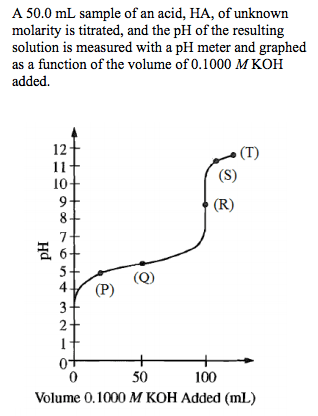
Which point on the titration curve corresponds to the point at which the moles of the added strong base are equal to the moles of the weak acid initially present?
Q
R
S
T
At which point on the titration curve will pH = pKa?
Q
R
S
P

Which acid base pair produced this titration curve?
HCI + KOH
HCI + NH3
CH3COOH + KOH
CH3COOH + NH3
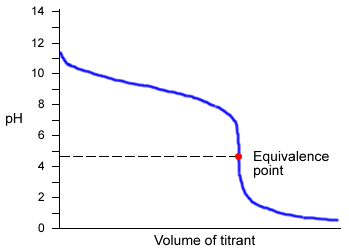

Which curve is produced by the addition of a strong acid to a strong base?
A
B
C
D
To prepare a solution of accurately known volume, use a
measuring cylinder
beaker
concial flask
volumetric flask
To deliver a fixed accurate volume of a solution, use a
pipette
burette
dropper
beaker
A standard solution is a solution with accurately known concentration.
True
False
What is volumetric analysis?
Estimate no of moles of component in the compound
Estimate the amount of component in the compound.
Estimate the volume of a component in the compound.
Estimate mass of a component in the compound.

What is the reading on this burette?
24.2 mL
24.0 mL
25.8 mL
23.9 mL
Volumetric analysis can be defined as_____________
The determination of the identity of the solution
The determination of the mole of a mixture with a known solution
The determination of the concentration of a solution using a solution of known concentration
A chemical used to show the end point of titration is called
base
indicator
pipette
acid
The burette readings should be recorded to
2 significant figures
3 significant figures
2 decimal points
3 decimal points
20 cm3 of 1 mol dm–3 CH3COOH(aq) and 10 cm3 of 1 mol dm–3 H2SO4(aq) require the same number of moles of NaOH for complete neutralization.
True
False
3.75 dm3 of distilled water are added to 250.0 cm3 of 3.20 mol dm–3 sodium hydroxide solution. What is the molarity of the diluted solution?
0.200 mol dm-3
0.213 mol dm-3
2.00 mol dm-3
2.13 mol dm-3
Which of the following pairs of solutions, when mixed, would give a neutral solution?
100 cm3 of 1 mol dm–3 H2SO4(aq) and 100 cm3 of 1 mol dm–3 NaOH(aq)
100 cm3 of 1 mol dm–3 H2SO4(aq) and 100 cm3 of 2 mol dm–3 NaOH(aq)
100 cm3 of 2 mol dm–3 H2SO4(aq) and 50 cm3 of 2 mol dm–3 NaOH(aq)
200 cm3 of 2 mol dm–3 H2SO4(aq) and 100 cm3 of 1 mol dm–3 NaOH(aq)
25.0 cm3 of sodium hydroxide solution is tritrated against 0.200 mol dm–3 hydrochloric acid until the indicator just changes colour. 27.5 cm3 of the acid are required to reach the end point.
Phenolphthalein is used as an indicator in the above experiment. What will be its colour change at the end point?
From red to yellow
From red to colourless
From yellow to colourless
From yellow to red
25.0 cm3 of sodium hydroxide solution is tritrated with 0.200 mol dm–3 hydrochloric acid until the indicator just changes colour. 27.5 cm3 of the acid are required to reach the end point.
What is the molarity of the sodium hydroxide solution?
0.100 mol dm-3
0.110 mol dm-3
0.200 mol dm-3
0.220 mol dm-3

In an experiment, 30.0 cm3 of a monobasic acid HA(aq) were titrated with 0.100 mol dm–3 NaOH(aq). The following graph shows the variation of pH of the solution mixture during the titration:
What is the concentration of HA(aq)?
7.50 x 10⁻⁵ mol dm–3
1.50 x 10⁻⁴ mol dm–3
7.50 x 10⁻² mol dm–3
1.50 x 10⁻¹ mol dm–3

