wayground logo

Free Printable Worksheets

NEW

Font size

S
M
L
XL
Worksheets

Interim Review

Total questions: 42

Worksheet time: 1hrs 3mins

Name
Class
Date
1.

What types of energy does the toy oven use to bake the cakes?

a)

Light and sound

b)

Electrical and thermal

c)

Thermal and mechanical

d)

Mechanical and electrical

2.

Which activities on the list are examples of the use of mechanical energy?

a)

Activities 1, 4, and 6

b)

Activities 2, 4, and 5

c)

Activities 1 and 2

d)

Activities 3, 5, and 6

3.

What form of energy does the sun give?

a)

sound and thermal

b)

light and thermal

c)

mechanical and light

d)

thermal and mechanical

4.
The energy of motion.
a)
Potential Energy
b)
Kinetic Energy
5.
Potential energy is related to 
a)
position or height of an object
b)
speed of an object
6.
Kinetic energy is related to 
a)
position or height of an object
b)
speed of an object
7.
How does potential energy become kinetic energy?
a)
When something hot touches something cool, the potential energy in the hot object is turned into kinetic energy in the cool object
b)
When an outside force acts upon an object with potential energy, that force turns the potential energy into kinetic energy
c)
Potential energy becomes kinetic when an object remains in place and continues to build up more and more energy
d)
Potential energy has no relation to kinetic energy
8.
At which point is potential energy greatest?
a)
W
b)
X
c)
Y
d)
Z
9.
At which point is kinetic energy greatest? 
a)
W
b)
X
c)
Y
d)
Z
10.
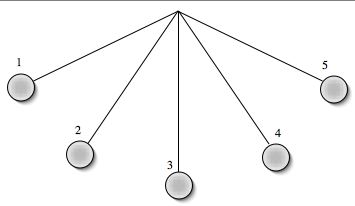
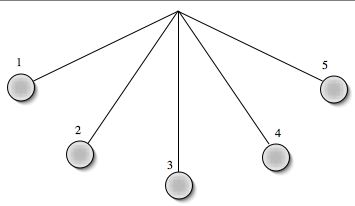
When a pendulum swings, at which point is kinetic energy highest?
a)
1
b)
2
c)
3
d)
4
11.
When a pendulum swings, at which point is potential energy at its greatest?
a)
1
b)
2
c)
3
d)
4
12.

What is the correct unit for energy?

a)

meters (m)

b)

kilogram meters per second (kg m/s)

c)

Newtons (N)

d)

Joules (J)

13.
Gravitational potential energy depends on the ________ and ________ of the object. 
a)
Height and mass
b)
Friction and movement
c)
Mass and Movement
d)
Height and Friction 
14.
What kind of heat transfer happens when the sun heats your body?
a)
Conduction
b)
Radiation
c)
Convection
d)
Density
15.
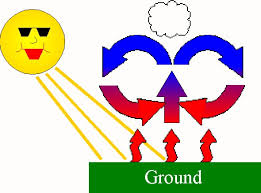
Warm air rises and the cool air sinks demonstrates this type of heat transfer. 
a)
conduction
b)
convection
c)
radiation
d)
Insolation 
16.
When you iron a shirt, the shirt gets warm.  This type of heat transfer is an example of
a)
condensation
b)
conduction
c)
convection
d)
radiation
17.
Warm air is __________ dense than cold air and rises creating convection currents.
a)
more
b)
less
18.
What is the definition of CONDUCTION?
a)
When heat is transferred from objects like rays of light or electromagnetically.
b)
a  hot liquid or air that  expands, becomes less dense, and rises or becomes more dense, and sinks.
c)
When heat transfers from objects that are touching.
d)
When heat transfers through the heater or AC in your house.
19.
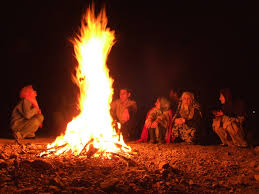
A group of friends gather around a fire to stay warm.  This is an example of
a)
conduction
b)
convection
c)
radiation
20.
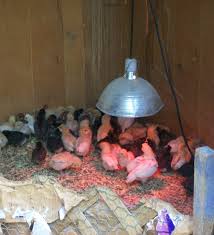
The baby chickens are kept warm from the heat lamps. This demonstrates what kind of heat transfer? 
a)
conduction
b)
convection
c)
radiation
21.
The transfer of heat by currents through liquids of gases is called
a)
Perspiration
b)
Radiation
c)
Conduction
d)
Convection
22.
A crayon placed on a dark driveway in bright sunlight melted into a colorful puddle. What caused the crayon to melt?
a)
Solar radiation heated the driveway and then heat transferred to the crayon by conduction.
b)
Solar radiation heated the driveway and then heat transferred to the crayon by radiation.
c)
Solar convection heated the driveway and then heat transferred to the crayon by radiation.
d)
Solar convection heated the driveway and then heat transferred to the crayon by conduction.
23.
Which statement is true?
a)
The quicker a molecule moves, the colder it is.
b)
The slower a molecule moves, the warmer it is.
c)
The quicker a molecule moves, the warmer it is
d)
The movement of a molecule doesn't affect its temperature
24.

Which best explains why a wooden spoon can be used to stir hot soup on the stove?

a)

Wood is a good conductor of heat and transfers energy to the spoon.

b)

Wood is a poor conductor of heat and transfers energy to the spoon.

c)

Wood is a good conductor of heat and does not allow the transfer of energy to the spoon.

d)

Wood is a poor conductor of heat and does not allow the transfer of energy to the spoon.

25.

Why does an ice cube melt when dropped into hot liquid?

a)

The liquid absorbs heat from the ice.

b)

Heat from the liquid transfers to the ice.

c)

Heat from the ice transfers to the liquid.

d)

Cold from the ice transfers into the liquid.

26.

Sarah is stirring her hot chocolate with a metal spoon, and she notices that the spoon is getting hot. This is most likely caused by which type of heat?

a)

conduction

b)

convection

c)

radiation

d)

insulation

27.

What is different about each type of electromagnetic wave traveling in a vacuum?

a)

frequency

b)

wavelength

c)

both of the above

d)

neither of the above

28.

Which part of the electromagnetic spectrum has a higher frequency than visible light?

a)

radio

b)

microwave

c)

infrared

d)

x-ray

29.
Sound waves are 
a)
longitudinal
b)
trasnverse
c)
beach
d)
not really waves
30.
Frequency is a measure of...
a)
length of the wave
b)
height of the wave
c)
number of waves a second
d)
number of waves an hour
31.
A longitudinal's wave....
a)
moves at 90o to the direction of travel
b)
moves in the same direction as travel
c)
doesn't move
d)
is a standing wave
32.
electromagnetic waves with the longest wavelengths are
a)
gamma rays
b)
x-rays
c)
infrared waves
d)
radio waves
33.
Material (matter) through which a wave travels
a)
medium
b)
Doppler Effect
c)
sound
d)
pitch
34.
The part of a longitudinal wave where the particles of the medium are close together.
a)
rarefaction
b)
compression
c)
crest
d)
trough
35.
A part in a longitudinal wave where the particles are spread apart
a)
compression
b)
rarefaction
c)
crest
d)
trough
36.
Highest point of a wave
a)
crest
b)
trough
c)
wavelength
d)
frequency
37.
A student placed a pencil in a cup of water.  The pencil appears broken because light-
a)
always travels in a straight line
b)
bends when it passes through water
c)
makes the water in the glass evaporate
d)
reflects the pencil on the water's surface
38.

What type of wave spreads out and goes through an opening or around corner?

a)

Reflection

b)

Refraction

c)

Interference

d)

Diffraction

39.

How are electromagnetic waves different from other waves?

a)

They have very short wavelengths

b)

They transmit energy instead of matter

c)

They can travel through a vacuum

40.
a)

absorption

b)

diffraction

c)

reflection

d)

refraction

e)

transmission

41.

Which transverse wave has the highest frequency?

a)

1

b)

2

c)

3

d)

4

42.
Bottom of the wave
a)
Crest
b)
Trough
c)
Frequency
d)
Wavelength