Wayground logo

Free Printable Worksheets

Font size

S
M
L
XL
Worksheets

Biology Unit 2 Test - Microscopes, Cells, cell transport

Total questions: 55

Worksheet time: 33mins

Name
Class
Date
1.

What characteristic defines this organism as prokaryotic?

a)

It has a nucleus and organelles

b)

Ability to respond

c)

Shape and size

d)

Lacking a nucleus and organelles

2.

Which structures are found in plant cells, but not in animal cells?

a)

Cell membranes and mitochondria

b)

Mitochondria and chloroplasts

c)

Cell walls and cytoplasm

d)

Chloroplasts and cell walls

3.
Which cellular structure in plants is responsible for photosynthesis?
a)
Nucleus
b)
Cell membrane
c)
Mitochondrion
d)
Chloroplast
4.

What is the function of the cell membrane, in ALL living organisms?

a)

Makes energy

b)

Makes proteins

c)

Transportation of materials

d)

Regulates the transport of materials into and out of the cell.

5.

Control Center of cell is

a)

Nucleus

b)

Nucleolus

c)

Mitochondria

d)

Chloroplast

6.

Protein Factory of cell

a)

Nucleus

b)

Ribosome

c)

Mitochondria

d)

ER

7.

Responsible for transportation through the cell; also the factory for the production of proteins and lipids

a)

Golgi Bodies

b)

Ribosome

c)

Mitochondria

d)

Endoplasmic Reticulum

8.

Powerhouse of cell

a)

Golgi Bodies

b)

Ribosome

c)

Vacoule

d)

Mitochondria

9.

Area ribosomes are made

a)

Nucleolus

b)

Chloroplast

c)

Vacoule

d)

Mitochondria

10.

What kind of transport does not require energy?

a)

Active

b)

Exocytosis

c)

Passive

d)

endocytosis

11.
What structure of the cell forms a frame that holds the cell up in the cytoplasm?
a)
centrioles 
b)
cell wall 
c)
flagella 
d)
cytoskeleton 
12.

Which of the following is the best example of osmosis?

a)

Glucose being pumped across the membrane by a protein

b)

Water moving though the cell membrane

c)

Oxygen and carbon dioxide moving through a cell membrane

d)

Photosynthesis

13.

Movement of materials into the cell that requires energy is

a)

exocytosis

b)

endocytosis

c)

osmosis

d)

simple diffusion

14.

What is an isotonic solution?

a)

Solutes are equal inside and outside the cell

b)

When the solution has more solute

c)

When the solution has less solute

15.
Active transport does not require energy.
a)
True 
b)
False 
16.

Which of the following is correct about the Golgi apparatus

a)

Digests waste materials

b)

Protection and Support

c)

Modifies and packages molecules

d)

cellular movement

17.
Molecules using simple diffusion move from 
a)
high to low concentrations 
b)
low to high concentrations 
c)
no concentrations  
d)
both concentrations  
18.
Osmosis is the movement of... 
a)
salt 
b)
sugar 
c)
water 
d)
none of these 
19.
Movement of particles from high to low concentration. 
a)
Passive Transport
b)
Active Transport
20.
Osmosis is a form of ______________. 
a)
Passive Transport
b)
Active Transport
21.
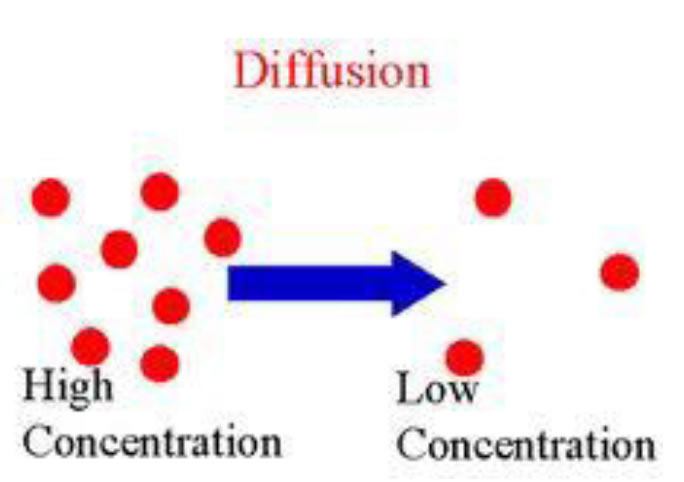
a)
Passive Transport
b)
Active Transport
22.
Exocytosis
a)
Passive Transport
b)
Active Transport
23.
The cell membrane is selectively permeable, which means...
a)
All materials can enter and leave the cell
b)
Certain things can enter while others cannot
c)
The cell manually sorts through all materials
d)
Only certain cells can interact with the cell.
24.

A molecule that diffuses with a concentration gradient goes from an area of ______ concentration into an area of ______ concentration.

a)

high, low

b)

low, high

c)

passive, active

d)

active, passive

25.
ALL living cells have this in common
a)
Nucleus
b)
Cell Membrane
c)
Cell Wall
d)
Mitochondria
26.
A cell will _____________________ in a hypertonic solution.
a)
swell
b)
shrink
c)
will not change
d)
will explode
27.
A cell will __________________ in a hypotonic solution.
a)
swell and perhaps burst (lyse)
b)
shrink
c)
the size of the cell will not change
d)
the size of the cell will change from large to small and from small to large
28.
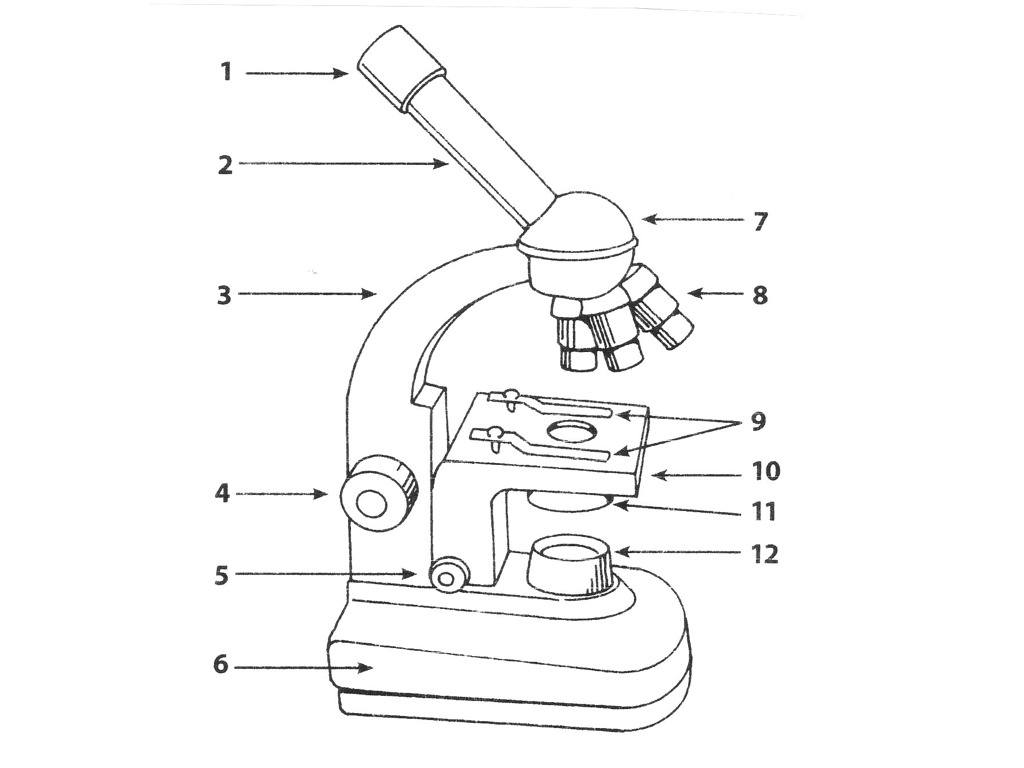
What is the name of the structure labeled #10?
a)
objective lens
b)
ocular lens
c)
aperture
d)
nosepeice
29.
What is the function of the structure labeled #10?
a)
controls amount of light that passes through the slide
b)
it is used to change the magnification of the object
c)
it holds that slide in place
d)
it is used to carry the microscope
30.
What is the name of the structure labeled #4?
a)
stage
b)
course adjustment knob
c)
fine adjustment knob
d)
aperture
31.
what is the function of the structure labeled #4?
a)
used with meduim and high power objectives to bring an object into focus
b)
used with low power objective to bring an object into focus
c)
used with all objectives to brign an object into focus
d)
it is used to change the magnification of the object
32.
while focusing a microscope on high power a student crushed the cover slip. The student probably
a)
closed the diaphragm
b)
turned up the light intensity
c)
rotated the eyepiece
d)
used the course adjustment knob
33.
A microscope has an ocular magnification of 10 and a high power objective magnification of 50. What is the highest total magnification of the microscope?
a)
500x
b)
400x
c)
50x
d)
40x
34.
A microscope is an instrument that.
a)
makes faraway objects look closer.
b)
makes small objects appear larger.
c)
decreases the size of small objects.
d)
increases the size of small objects.
35.
If your teacher asks you to move a microscope to table, how do you carry it?
a)
by the body tube and the eyepiece
b)
with one hand
c)
one hand on the arm and the other under the base
d)
with one hand on the base and the other on the eyepiece.
36.

These are used to hold the slide in place:

a)

rotating nosepiece

b)

objective lenses

c)

stage clips

d)

adjustment knobs

37.
When you focus on a new specimen, always begin with
a)
low power and coarse adjustment.
b)
low power and fine adjustment
c)
high power and coarse adjustment
d)
high power and fine adjustment
38.

____ is credited with being the first scientist to observe cork cells.

a)

Leewenhoek

b)

Shleidon

c)

Hooke

39.
Which statement is a part of the cell theory?
a)
all cells come from preexisting cells
b)
bacteria are prokaryotic cells
c)
eukaryotic cells are complex
d)
humans are multicellular
40.

Robert Hooke named the small compartments that made up the cork __________after the rooms monks lived in.

a)

organelles

b)

membranes

c)

mocroscopes

d)

cells

41.

This scientist observed live cells in pond water and called them "animalcules":

a)

Hooke

b)

Leeunwenhoek

c)

Virchow

d)

Schwann

42.
All organisms are made of:
a)
organelles
b)
cytoplasm
c)
DNA
d)
cells
43.
The Cell Theory states...
a)
atoms create all matter
b)
living things evolve
c)
the cell is the backbone of all matter
d)
cells are the basic unit of structure and organization of organisms
44.

Identify #1 on the Eukaryote cell shown:

a)

cell membrane

b)

ribosome

c)

cytoplasm

d)

cytoskeleton

45.

Identify #2 on the Eukaryote cell shown:

a)

cell membrane

b)

ribosome

c)

cytoplasm

d)

cytoskeleton

46.

Identify #3 on the Eukaryote cell shown:

a)

chloroplast

b)

ribosome

c)

golgi body

d)

mitochondria

47.

Identify #4 on the Eukaryote cell shown:

a)

Rough E.R.

b)

Smooth E.R.

c)

golgi body

d)

mitochondria

48.

Identify #5 on the Eukaryote cell shown:

a)

Rough E.R.

b)

Smooth E.R.

c)

ribosome

d)

mitochondria

49.

Identify #7 on the Eukaryote cell shown:

a)

lysosome

b)

vacuole

c)

golgi body

d)

mitochondria

50.

Identify #8 on the Eukaryote cell shown:

a)

cytoplasm

b)

vacuole

c)

golgi body

d)

cytoskeleton

51.

Identify #9 on the Eukaryote cell shown:

a)

Rough E.R.

b)

lysosome

c)

nucleus

d)

Smooth E.R.

52.

Identify #10 on the Eukaryote cell shown:

a)

Rough E.R.

b)

lysosome

c)

nucleus

d)

Smooth E.R.

53.

Identify #11 on the Eukaryote cell shown:

a)

Rough E.R.

b)

lysosome

c)

nucleus

d)

Smooth E.R.

54.

What is number 14 pointing to?

a)

cytoplasm

b)

mitochondria

c)

nucleus

d)

chloroplast

55.

This is a/an _ cell.

a)

Plant

b)

Animal