
 Worksheets
3.1 Relations and functions
Total questions: 39
Worksheet time: 1hrs 9mins


R: {0, 1, 2, -4}
R:{1, -3, -4}
R:{1, -3, -4}
R:{0, 1, 2, 3, 4}
What is f(6) for the function f(x)=3x-8
-8
10
-144
answer not here
f(4)=

Interpret the y-intercept of the graph.
All those polled used a social networking site 8 months after February 2005.
About 8% of those polled used a social networking site in February 2005.
No one used a social networking site in February 2005.
There were 8 social networking sites in February 2005.

Identify the independent and dependent variables.
game; score
score; game

Identify the independent and dependent variables.
time; temperature
temperature; time


List the ordered pairs
(1,3), (2,6), (3,9), (4,12)
(3,1), (6,2), (9,3), (12,4)
Input and Output
Output and Input

List the ordered pairs
Input and Output
(0,12), (2,10), (4,8), (6,6)
(12,0), (10,2), (8,4), (6,6)
(6,6)

List the ordered pairs
Input and Output
(-1, 1), (-2, 1), (-3,2), (-4,2)
(1,1) (2,4)
(1,-1), (1,-2), (2,-3), (2,-4)
A relation pairs each input with exactly one output is a
congruence
similarity
function
mathematical equation

Determine if the relations is a function and describe the pattern
Yes it is a function, input goes up 1 and output goes up by 15
Yes it is a function, input goes up 15 and output goes up by 1
Not a function, input goes up 1 and output goes up by 15
Not a function, input goes up by 15 and output goes up by 1

Determine if the relation is a function
Not a function, each input has more than one output
Yes it is a function, because each input has exactly on output
Not a function, input is equal to output
Yes it is a function, -1/2 is a fraction of 2
Which of the relations below is a function?
{(2, 3), (3, 4), (5, 1), (2, 4)}
{(2, 3), (3, 4), (6, 2), (7, 3)}
{(2, 3), ( 3, 4), (6, 2), (3, 3)}
Given the relation A = {(5, 2), (7, 4), (9, 10), (x, 5)}. Which of the following values for x will make relation A a function?
7
9
4
The following relation is a function.
{(10, 12), (5, 3), (15, 10), (5, 6), (1, 0)}
True
False
Which of the relations below is a function?
{(1, 1,), (2, 1), (3, 1), (4, 1), (5, 1)}
{(2, 1), (2, 2), (2, 3), (2, 4), (2, 5)}
{(0, 2), (0, 3), (0, 4), (0, 5), (0, 6)}

Is the relation depicted in the table below a function?
Yes
No
Cannot be determined from a table

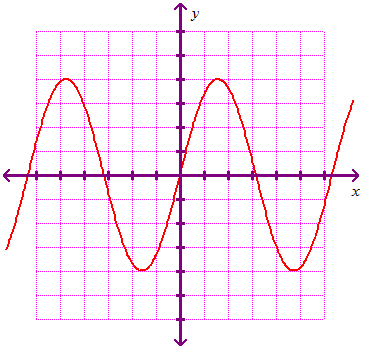
The graph of a relation is shown below. Is the relation a function?
Yes
No
Cannot be determined from a graph

The graph of a relation is shown below. Is the relation a function?
Yes
No
Cannot be determined from a graph
Which graph represents a function?


What is the domain?
the set of all x-values
the set of all y-values
What is the range?
the set of all x-values
the set of all y-values
A relation where every input in matches with exactly one output is called what?
Relation
Linear
Exponential
Function

R: {0, 1, 2, -4}
R:{1, -3, -4}
R:{1, -3, -4}

