
 Worksheets
Plate Tectonics
Total questions: 51
Worksheet time: 8hrs 43mins


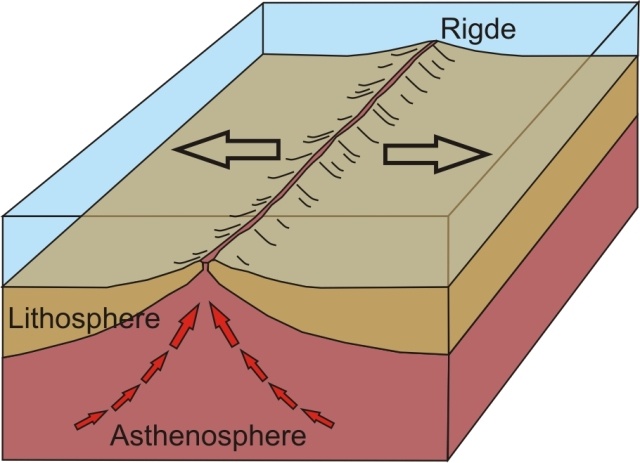
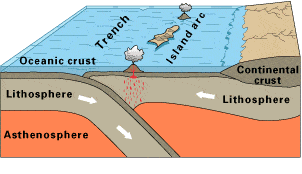
Observe this diagram of a plate boundary. One statement BEST describes what is happening. It is that
the oceanic crust is melting.
the denser ceanic crust is subducting under the less dense oceanic crust
the tectonic plates are moving away from each other.
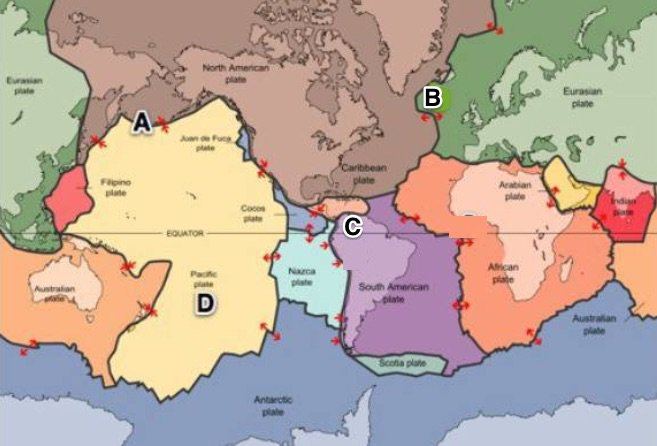
Where would sea floor spreading most likely occur?
At convergent boundaries (oceanic vs. oceanic)
At convergent boundaries (oceanic vs. continental)
At divergent plate boundaries (oceanic vs. oceanic)

New oceanic crust (sea floor) is created at this boundary.
Divergent Oceanic
Divergent Continental
Convergent Oceanic
Continental plates are ______ dense and ________ than ocean plates.
more; thinner
more; thicker
less; thicker
Ocean plates are _______ dense and _______ than continental plates
less; thinner
more; thinner
more; thicker


According to the continental drift hypothesis, the presence of similar fossils in South America and Africa supports which scientific idea?
Species of animals probably traveled between continents on natural rafts (such as trees destroyed in tsunamis).
Land bridges once existed that connected the continents.
South America and Africa were once connected together.

This picture is an example of which type of evidence?
matching fossil
climate change
matching land formation

What does the theory of continental drift state?
The continents were once joined in a super-continent and have moved over time
Continents are stationary and do not move
The Earth is broken into lithospheric plates that move due to convection currents
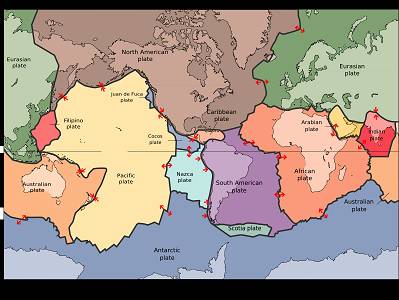
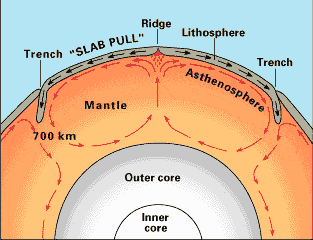
What is the source of energy that drives plate movement?
the subducton of the sea floor
the different densities of the oceanic and crustal plates
convection currents in the asthenosphere
Scientists use which kind of waves to determine the properties of Earth’s internal layers?
light waves
sound waves
seismic waves
Scientists use ______ to map the ocean floor
radar
pulsar
sonar
The OLDEST seafloor is located
closest to the mid-ocean ridge.
farthest from the mid-ocean ridge.
east of Hawaii
Which of the following supports the theory of seafloor spreading?
Correlation of rock layers
Crustal slab pull
Magnetic reversals recorded in rocks

Seafloor spreading...
creates new oceanic crust
destroys or recycles crust
creates new continental crust
Rock at the mid ocean ridges...
is the oldest rock on the earth.
is older than continental rock.
is younger than continental rock.
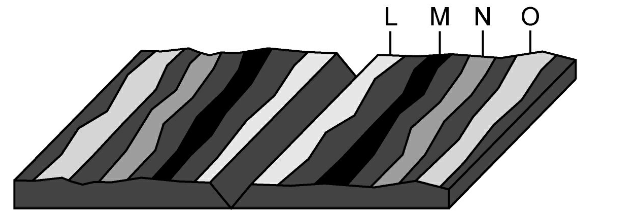
The magnetic pattern of ocean-floor rocks on one side of an ocean ridge is_____________.
a mirror image of that on the other side
younger than other side
at right angles to the ridge
A change in Earth' s magnetic field is called a
magnetic reversal
subduction
paleomagnetism
Because Wegener could not explain how/why the continents were moving, his hypothesis was
Accepted
Rejected

Undersea mountain chain where new ocean floor is produced at a divergent plate boundary is a ____________
seafloor spreading
deep ocean trench
Mid-ocean ridge
Process by which molten material adds new oceanic crust to the ocean floor is
sea-floor spreading
mid-ocean ridge
subduction
During sea-floor spreading, crust is
destroyed
created
Magnetometer
A plate boundary where two plates move past each other in opposite directions
Device used to map the ocean floor that detects small changes in magnetic fields.
a switch in the direction of Earth's magnetic field so that the magnetic north pole becomes the magnetic south pole and the magnetic south pole becomes the magnetic north pole.
Paleomagnetism
The name of the single landmass that broke apart 200 million years ago and gave rise to today's continents
a switch in the direction of Earth's magnetic field so that the magnetic north pole becomes the magnetic south pole and the magnetic south pole becomes the magnetic north pole.
The study of the alignment of magnetic minerals in rock, specifically as it relates to the reversal of Earth's magnetic poles; also the magnetic properties that rock requires during formation
imaginary line on a map that shows points of the same age; formed at the same time
Subduction
Magnetometer
Isochron

The average density of continental crust is 2.8 g/cm3 and the average density of oceanic crusts is 3.2 g/cm3. If these two plates came together, what would happen?
The two plates would push apart and form a rift zone.
The oceanic plate would rise up over the continental plate.
The oceanic plate would sink under the continental plate.
The gradual movement of the continents across the Earth's surface through geological time
Plate tectonics
Continental Drift
Sea-floor Spreading

Mountains and Mountain ranges are created by what kind of plate boundaries?
Continental and Continental Divergent
Oceanic and Continental Convergent
Continental and Continental Convergent
A subduction zone is formed...
when one tectonic plate sinks below another
at every type of divergent plate boundary
at every type of convergent plate boundary
Which of the following provide evidence to support the theory of plate tectonics: (Select all that apply)
Continental plates fit together like puzzle pieces
Younger rocks are found closer to mid-ocean ridges and older rocks are found farther apart (evidence for seafloor spreading)
There are matching mountains and rock formations on separate continents
There are similar fossils found on separate continents
Which of the following is NOT part of the theory of plate tectonics?
Earth's surface is made up of plates
There are 2 types of plates: oceanic and continental plates
Earth plates are stationary and do not move around

