
Font size
 Worksheets
001_Introductions
Total questions: 156
Worksheet time: 2hrs 49mins

What is Plant Taxonomy?
Identification of plants
Naming of plants
Classification of plants
All of the above
Identify the person who developed the binomial system for naming plants.


Which name starts with a lower case letter?
Common Name
Genus
Species
Vernacular name
Which is the correct order?
Kingdom Phylum Order Class
Class Order Family Genus
Domain Phylum Kingdom Species
Order Family Species Genus
Tick the dicot plants.


Which is correct scientific name for mango?
Ficus religiosa
Prunus persica
Mangifera indica
Pyrus malus
Which is correct scientific name for mango?
Ficus religiosa
Prunus persica
Mangifera indica
Pyrus malus
How many petals are there in Hibiscus
4
5
6
8
Numerous
What is synandrous androecium?
(a)
Fused calyx lobes are called
(a)
The plant kingdom is divided into two main groups:
flowering & non-flowering
spores & seeds
trees & plants
conifers & flowering plants
Flowering plants are called:
pretty
monocotyledons
dicotyledons
angiosperms
Plants that reproduce from seeds can be further divided into:
monocots & dicots
angiosperms & dicotyledons
conifers & flowering plants
spores & conifers
What is a minute, typically single-cell reproductive unit capable of giving rise to a new individual without sexual fusion?
embryo
seed
spore
angiosperm
Conifers (pine trees) reproduce by making:
male & female cones
spores
angiosperms
runners
Flowering plants (angiosperms) are split into two further categories called:
monocotyledons & tricotyledons
dicotyledons & monocotyledons
protists & spores
seeding & seedless
What is NOT a characteristic of a monocot plant?
parallel veins
flowers in multiples of three
Fibrous Roots
Taproots
What is a characteristic of a dicot plant?
leaf veins resemble a net of web
leaf veins are parallel
Fibrous root system
flowers in multiples of three
What is a characteristic of a dicot plant?
leaf veins resemble a net of web
leaf veins are parallel
Fibrous root system
flowers in multiples of three
What is a characteristic of a monocot plant?
Fibrous root system
taproot
leaf veins resemble a net/web
Embryo has 2 cotyledons
What is the difference between a monocot (corn) plant seed & a dicot (bean) plant seed?
(monocot) corn seed is bigger then a (dicot) bean seed
(monocot) corn seed is always yellow where a (dicot) bean seed can be many different colors
(monocot) corn seed has a single cotyledon, while a (dicot) bean seed has two cotyledons
(monocot) corn seed germinates at a lower temperature than a dicot (bean) seed
The vascular structure of a dicot (bean) plant is:
vascular bundles in a ring
vascular bundles are scattered
no noticeable vascular pattern
vascular pattern varies by species
Monocot leaf structures have:
veins resembling a net or web
veins parallel to each other
are non-vascular
veins perpendicular to each other
Which of the following plants do NOT reproduce using spores?
Algae
Strawberries
Ferns
Mosses
Fibrous roots, scattered vascular structures, parallel leaf veins, & a single cotyledon embryo are all examples of a ______________.
Monocot plant
Dicot plant
Tricot plant
angiosperm
taproot system, vascular bundles in a ring, net like leaf veins, and an embryo with two cotyledons are all characteristics of a ___________.
monocot
dicot
angiosperm
tricot


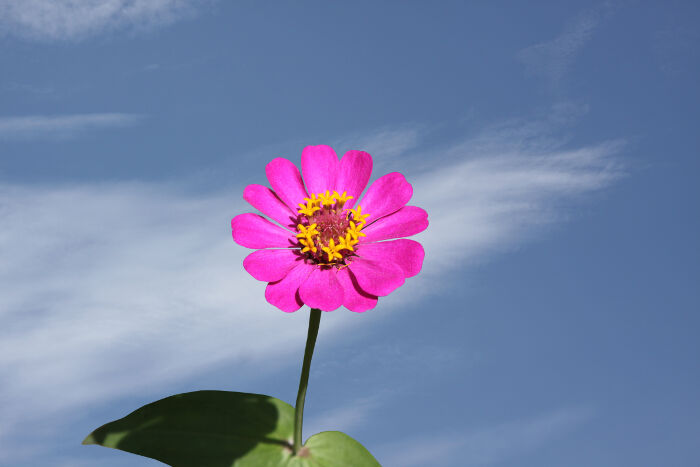


Which plant below would scientist group with watermelon plants?
fern
rose
pine tree
apple tree

Classify the plant.
Flowering
Non-Flowering
Identifies plants according to physical characteristics
Plant Classification
Descriptive Classifcation
Botanical Classification
None of the Above
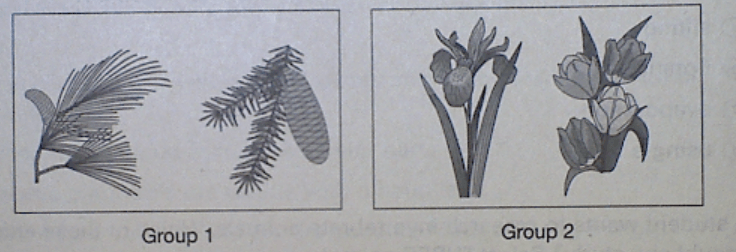
A student researches four plants that are in the same group. He sorts the plants into two smaller groups.
How does the student MOST LIKELY sort the plants?
by seed size
by flower shape
by whether they have cones or flowers
by whether they produce seeds or spores
Using water from the soil, carbon dioxide from the air, and energy from the sun to make food
classification
xylem
photosynthesis
fertilization
Which of the following is true of ferns and daisies?
Ferns have flowers and daisies do not.
Ferns have stems and daisies do not.
Ferns do not produce seeds and daisies do.
Ferns do not produce spores and daisies do.
Plants that go dormant, or leafless, during the year are considered
deciduous.
herbaceous.
evergreen.
woody.
Plants that hold onto their leaves throughout the year are considered
deciduous.
herbaceous
coniferous
woody
Which of the following is an example of a gymnosperm?
moss
monocot
conifer
fern
Vascular, seeded plants that contain seeds in cones are:
angiosperms
gymnosperms
deciduous
moss

In a non-vascular plant how does water move?
through the roots
from cell to cell
through the xylem and phloem
from the roots to the flower

In which type of plant does water/food move through xylem and phloem?
seed plants
vascular plants
non-vascular
both vascular and non-vascular

Non-vascular plants do not have roots, stems, or leaves. Which is a non-vascular plant?
fern
moss
ivy vine
tree
Seedless vascular plants reproduce by...
Seeds
Spores
Pollen
Rhyzoid
Seedless vascular plants have real roots, stems and leaves.
True
False

Completes lifecycle in one growing season
Annual
Bienniel
Perennial
None of the Above
Indefinite growth, produces seeds annually
Annual
Biennial
Perennial
None of the Above
Requires two growing seasons to produce seeds
Annual
Biennial
Perennial
None of the Above
Identifies plants by their use and lifecycle
Botanical classification
Descriptive classification
Plant classification
None of the Above
Package containing an embryo and food
Seed
Root
Stem
Flower
Plant in the spring and harvest in the fall
Summer annual
Winter annual
Spring annual
Fall annual
Plant in the fall and harvest in the spring
Summer Annual
Winter Annual
Spring Annual
Fall Annual
Most specific classification level
Kingdom
Class
Family
Species
Means of grouping plants according to their similarities
Botanical Classification
Descriptive Classification
Plant Classification
None of the Above
All plants are classified based on ...
Whether they have vascular tissue or not
Whether they have flowers or not
Whether they have cuticle or not
Whether they do photosynthesis or not
Which of the following are classified as non-vascular? (Select all that apply)
Mosses
Quillworts
Hornworts
Club Mosses
Which of the following describes the production of leaves in ferns?
Leaves (fronds) are the first to develop along with the stem.
Leaves (fronds) are grown out the of the stem of the fern as it grows and develops.
Leaves (fronds) unroll from the fiddlehead as it grows and develops.
Leaves (fronds) are grown out of the branches of the plant.
Describe the specialized pollinator of the cycad.
The cycad pollinates through a release of pollen through the air.
The cycad pollinates through the use of a species of beetles.
The cycad pollinates through the use of a species of bees.
The cycad pollinates through the use of a species of ladybugs.
Plants that produce seeds formed by cones or cone-like structures are classified as
gymnosperms
angiosperms
bryophytes
nonvascular
The true mosses are nonvascular plants that lack xylem and phloem.
True
False
Plants that produce seeds that are not covered by fruits or specialized structures are
gymnosperms
angiosperms
bryophytes
nonvascular
If you were to go outside and pick up a random plant, it is most likely a(n).....these are the most abundant plants found
angiosperm
bryophyte
gymnosperm
gnetophyte
Which of the following would you be least likely to see in South Carolina?
angiosperms
gymnosperms
bryophytes
gnetophytes
How are coniferous trees classified/identified?
Their cone shape
Their leaves
The shape of their branches
Whether they are vascular or non-vascular
Which of the following is known as the "resurrection plant", for its ability to come back to life in the presence of water?
Mosses
Club mosses
Spike Mosses
Quillworts
Why are there no tall bryophytes? (Talked about this in class)
There are no tall bryophytes because of the lack of vascular tissue.
There are no tall bryophytes because they don't have stems.
There are no tall bryophytes because technically they aren't plants.
Several of the plants that we talked about are evergreens, like gymnosperms. What does it mean when a plant is identified as an evergreen?
Usually stay green all year round
Usually stay green during the summer and spring
Usually stay green during the winter when other plants are not green
Usually stay green through their reproductive phase
Why would most bryophytes grow in moist or damp areas?
These plants lack vascular tissue, so they need to be close to a water source.
These plants don't have stems, so they need to be near water.
These plants need humid hot temperatures to grown and that's found in damp areas.
What type of conifer has leaves that appear to be in a bundle?
Fir tree
Pine tree
Cypress tree
Cedar trees
What is the purpose of cones?
Allows gymnosperms (conifers) to reproduce
Acts as a protectant to conifer leaves
Acts as the fruit of the conifer tree and they are eaten in some cultures
Cones have no real purpose to the growth and development to plants.
Q1. In pteridophytes, asexual reproduction occurs by ....................
Spore formation
zygote formation
None of the above
__________ is member of Angiosperm
fern
cycus
pinus
Mango
________ have roots like Rhizoid.
Thallophyta
Bryophyta
Gymnosperm
Monocot
The stem of plant is hollow in ___________
Bamboo
Banana
Onion
Rose
___________ plants have well-developed roots, stem and leaves. But, do not bear flowers and fruits
Gymnosperm
Angiosperm
Pterodophytes
None of the above
Capsules present in the plant belongs to _______
Thallophyta
Bryophyta
Pterodophyta
Angiosperm
The plants whose seeds can be divided into two equal halves _______
Monocot
Dicot
both
Leaves of __________ have brown spot on their posterior part
Fern
cycus
pine
hibiscus

Name the type of the stem
tree
herb
shrub
creeper

Name the type of the stem
shrub
tree
herb
crawler

Name the type of the stem
tree
creeper
shrub
crawler

Name the type of the stem
creeper
herb
tree
shrub

Name the type of the stem
tree
shrub
herb
crawler

Name the type of the stem
creeper
crawler
shrub
herb

Name the type of the stem
shrub
herb
creeper
crawler

Name the type of the stem
shrub
crawler
creeper
herb

Name the type of the stem
herb
shrub
creeper
crawler

Name the type of the stem
shrub
tree
climber
creeper

Name the type of the stem
climber
herb
creeper
shrub

Name the type of the stem
crawler
creeper
shrub
herb

Name the type of the stem
creeper
shrub
crawler
herb

Can you find the group or type of this plant?
Herb
Shrub
Deciduous
Evergreen
Choose the plants that are herb.


1. Evergreen trees have needle - like or scaly leaves.
False
True

The tree of this fruit belongs to which group or type?
Creepers
Shrubs
Deciduous
Evergreen

Choose the type or group of this plant.
Deciduous
climber
shrub
Herb

1. The national tree of UAE is ghaff tree and it is a (a) tree.

These flat broad leaves belongs to which group or type of tree?
Shrubs
Deciduous
Herbs
Evergreen

Plants have been broadly divided into how many groups or type?
2
3
5
4

Deciduous loses its (a) in winter.

1. Shrub plants branches are near the base of the (a) .
Jose rolls up a paper towel and puts it in a straw. He puts the straw in a glass of water and observes the movement of water from the glass up the towel. What plant part does Jose's model represent?
Stem
Seeds
Leaves
Flower
Some plants produce seeds, which come in a variety of sizes and shapes. No matter what a seed looks like, they all have the same function. Which answer best describes the function of a seed?
Seeds produce flowers to attract bees.
Seeds make energy for the plant.
Seeds grow into a new plant.
Seeds collect water from the ground.
What is the main role for the flower of the plant?
It collects nutrients.
It lets the plant make food.
It helps the plant reproduce.
It supports the plant.
Which plant part protects the seed and helps with seed dispersal?
Leaf
Stem
Fruit
Flower
The Opuntia is a type of cactus plant and is most often found in very dry climates. They can survive in the desert because they can store water. Most people do not know this, but they actually produce fruit. That is where they get their nickname, prickly pear. What is the best classification of the Opuntia?
Plants that produce spores.
A type of fern.
Non flowering plants.
Flowering plants.
Plant kingdom consists of 3 main phyla ........
(select all that apply)
Bryophyta
Spermatophyta
Thallophyta
Tracheophyta

