wayground logo

Free Printable Worksheets

Font size

S
M
L
XL
Worksheets

Semester 2 Review

Total questions: 161

Worksheet time: 10hrs 29mins

Name
Class
Date
1.
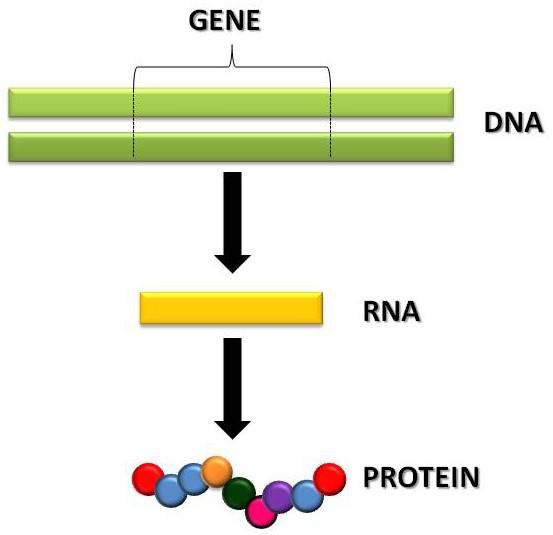
Which of the following sequences of processes correctly reflects the central dogma?
a)
protein synthesis, transcription, translation
b)
protein synthesis, translation, transcription
c)
transcription, translation, protein synthesis
d)
translation, transcription, protein synthesis
2.
A molecule of DNA is made up of _________.
a)
amino acids and proteins
b)
ATP and enzymes
c)
paired nucleotides
d)
receptor enzymes
3.

A polypeptide is a sequence of ____________________ held together by a ______________ bond.

a)

amino acids; peptide

b)

fatty acids; ionic

c)

proteins; hydrogen

d)

fatty acids; covalent

4.
Which of the following best describes how DNA and RNA are similar?
a)
they both contain A and T
b)
They both have a double helix
c)
They are both composed of 5 different nucleotides
d)
they both have C and G
5.
The central dogma of biology states that information flows in one direction from 
a)
nuclei to RNA to cytoplasm
b)
ribosomes to proteins to DNA
c)
genes to nuclei to ribosomes
d)
DNA to RNA to proteins
6.
In a plant cell, in which two organelles can ribosomes be found?
a)
mitochondria and chloroplasts
b)
mitochondria and lysosomes
c)
chloroplasts and vacuoles 
d)
chloroplasts and lysosomes
7.
What is the function of the smaller unit of the ribosome? 
a)
read the transfer RNA (tRNA)
b)
support the larger unit of the ribosome
c)
read the messenger RNA (mRNA)
d)
take in nutrients for the ribosome
8.
What is the function of the smaller unit of the ribosome? 
a)
read the transfer RNA (tRNA)
b)
support the larger unit of the ribosome
c)
read the messenger RNA (mRNA)
d)
take in nutrients for the ribosome
9.
The process of reading mRNAs to make proteins is called...
a)
Replication
b)
Transcription
c)
Translation
d)
Cell Division
10.
Which of the following carries amino acids to ribosomes?
a)
ribosomal RNA (rRNA) molecules 
b)
transfer RNA (tRNA) molecules
c)
messenger RNA (mRNA) molecules 
11.
ATCAGTGAT A codon is a sequence of three nucleotides that code for an amino acid. If the DNA sequence shown here goes through transcription and translation, how many amino acids will result from this sequence?
a)
5
b)
4
c)
2
d)
3
12.
RNA is read in sections called:
a)
Triplets
b)
Genes
c)
Codons
d)
Genes
13.
Translation is a process that produces
a)
mRNA
b)
Protein
c)
Polypeptide Chains
d)
tRNA
14.
Amino acids are joined together in order to form
a)
DNA
b)
ribosomes
c)
proteins 
d)
RNA
15.
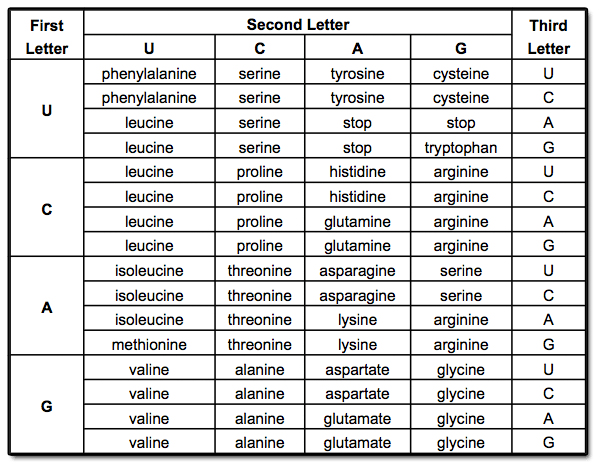
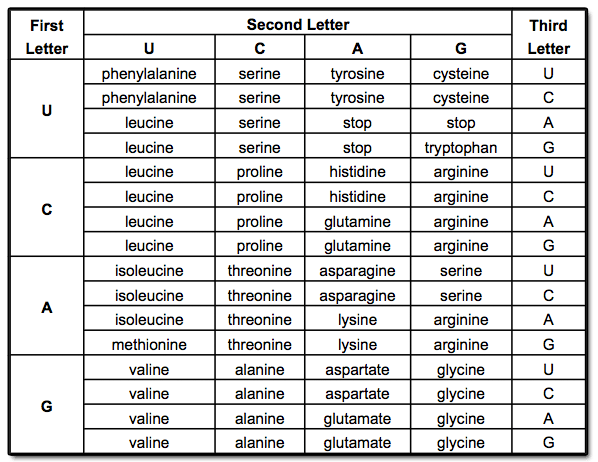
What amino acid is represented by the codon UUA?
a)
Phenylalanine
b)
Tyrosine
c)
Leucine
d)
Stop codon
16.
What is the correct amino acid sequence for the mRNA code AUGCCAGUAUGA
a)
Met-Pro-Ala-Val
b)
Met-Pro-Val
c)
Tyr-Gly-His
d)
Tyr-Gly-Arg-His
17.

A geneticist was analysing a nucleotide sequence from a prokaryotic cell and identified a region of interest. She thought the region appeared to be an operon. What genetic features define an operon?

a)

multiple promoters for open reading frames

b)

a promoter, multiple genes involved in the same biochemical pathway, and a terminator sequence

c)

a ribosomal binding site, a single start codon and a single stop codon

d)

a promoter, a protein and a Shine-Dalgarno sequence

e)

a ribosomal binding site and an oriC sequence

18.

You are examining a bacterial sequence for a site that may initiate translation and you identify a Shine-Dalgarno (SD) sequence. What is a SD sequence?

a)

a short sequence that acts as a ribosomal binding site

b)

another name for a stop codon

c)

the reading frame of a gene

d)

a promoter sequence containing -10 and -35 elements

e)

none of the above

19.

Enzyme that catalyses the transfer of functional group of atoms from one molecule to another. This enzyme is

a)

Isomerases

b)

Transferases

c)

Oxidoreductase

d)

Lyases

20.
What 3 letters do enzymes typically end in?
a)
-ose
b)
-ase
c)
-ese
d)
-tic
21.
Some bacteria live in hot springs. Their cells contain enzymes that function best at temperatures of 70 °C or higher. At the temperature of 50 °C, how will the enzymes in these bacterial cells most likely be affected?
a)
The enzymes will be destroyed by lysosomes
b)
The enzymes will lose their bond structure and fall apart.
c)
The enzymes will require less energy to function than at 70 °C.
d)
The enzymes will not increase the rate of reactions as much as they would at 70 °C. 
22.
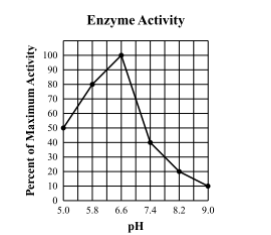
The graph below shows how the activity of an enzyme changes over a range of pH values. Which of the following conclusions can be drawn from this graph?
a)
The optimum pH of the enzyme is 6.6.
b)
The optimum pH of the enzyme is 5.8
c)
The enzyme’s activity continually increases as pH increases from 5.0 to 9.0
d)
The enzyme’s activity is greater around pH of 8.0 than around pH of 5.0.
23.
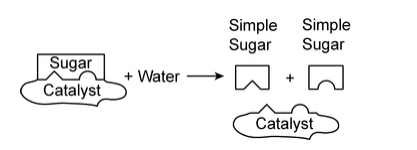
The diagram below illustrates a biochemical process that occurs in organisms. What is another name for the substance labeled "catalyst"?
a)
Enzyme
b)
inorganic compound
c)
Hormone
d)
Antibody
24.
Which of the following best explains why enzymes are necessary for many cellular reactions?
a)
Enzymes supply the oxygen necessary for the reactions
b)
 Enzymes change reactants from solid to liquids during the reactions.
c)
The reactions take up too much space in the cell if the enzymes are missing.
d)
The reactions are too slow to meet the needs of the cell if enzymes are missing. 
25.
What will most likely happen if an appropriate enzyme is added to a chemical reaction? 
a)
The reaction rate will increase.
b)
The equilibrium of the reaction will be maintained. 
c)
The reaction rate will decrease.
d)
The reaction will stop. 
26.

Enzymes speed up the rate of reaction by _________ the activation energy (EA).

a)

increasing

b)

decreasing

27.
What is a peptide bond?
a)
Bond that holds two amino acids together.
b)
A bond that holds hydrogen and oxygen molecules together.
c)
A bond that holds the phosphate group of one nucleotide and a sugar of a neighboring nucleotide.
d)
A bond that is formed by the sharing of electrons.
28.
When a protein unfolds, it is
a)
Denatured
b)
Building
c)
Adding amino acids
d)
Making food
29.
The two types of folding in the secondary structure are.....
a)
alpha-helix & beta-pleated sheets
b)
polypeptide & nucleotide
c)
globular & fibrous
30.

which of the following terms refers to the order in which amino acids are linked together in a protein.

a)

Primary

b)

Secondary

c)

Tertiary

d)

Quaternary

31.

The entire polypeptide forms a three-dimensional structure

a)

Primary

b)

Secondary

c)

Tertiary

d)

Quaternary

32.

Two or more polypeptides attached together and work as one unit

a)

Primary

b)

Secondary

c)

Tertiary

d)

Quaternary

33.
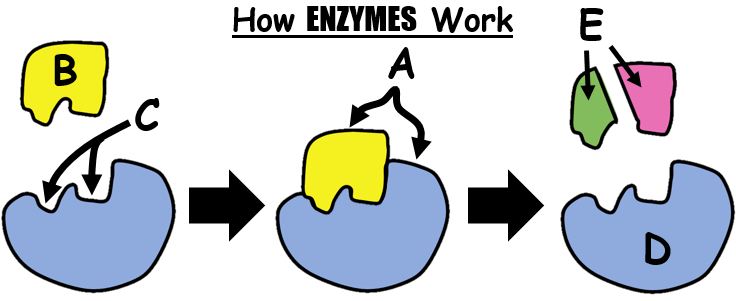
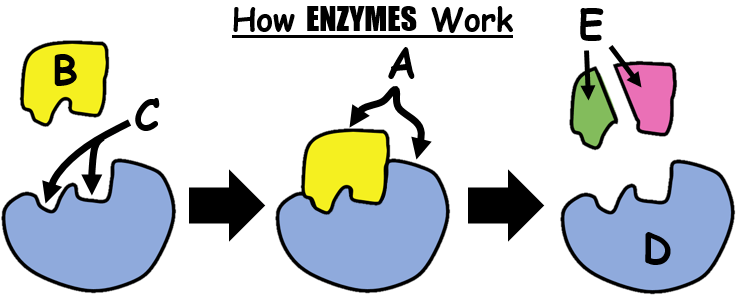
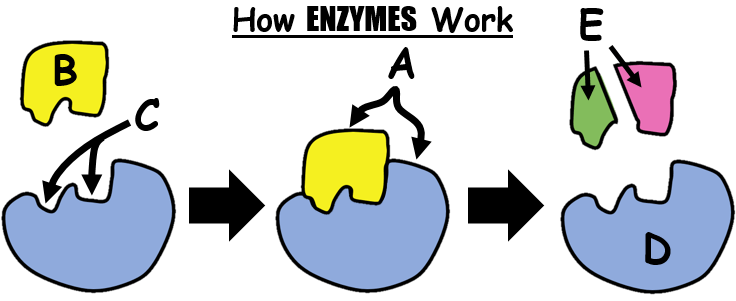
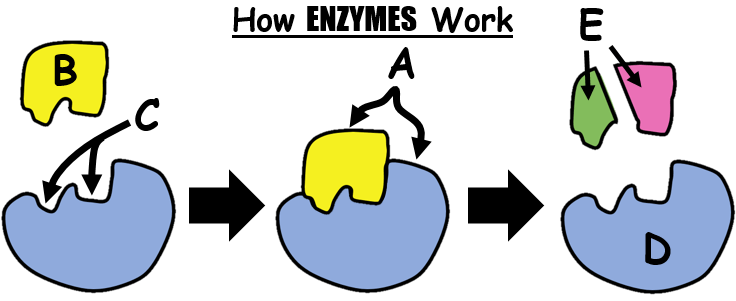
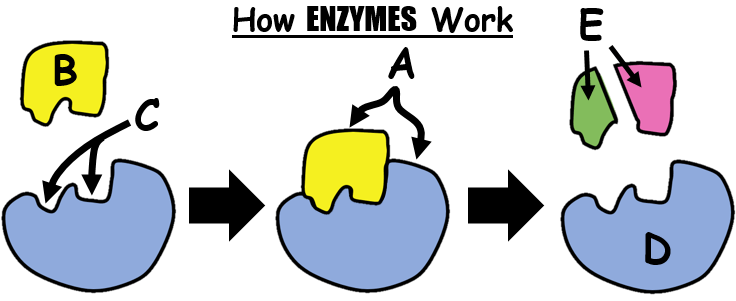
In the diagram, what is letter A? 
a)
product
b)
substrate
c)
enzyme-substrate complex
d)
active site
34.
What happens when enzymes are heated to a high temperature?
a)
The enzymes die.
b)
The shapes of the enzyme are altered denature
c)
The enzymes' amino acid sequence changes.
d)
The enzymes remain the same
35.
Which of these is most likely an enzyme?  
a)
Sucrose
b)
Galactose
c)
Fructose
d)
Amylase
36.
Letter D...
a)
active site
b)
enzyme
c)
substrate
d)
products
37.
Letter B...
a)
active site
b)
enzyme
c)
substrate
d)
products
38.
Letter E...
a)
active site
b)
enzyme
c)
substrate
d)
products
39.
Letter C...
a)
active site
b)
enzymes
c)
substrate
d)
products
40.
Which enzyme is most efficient in a basic solution?
a)
A
b)
B
41.
When a molecule can occupy the same active site as the substrate, a situation called __________________ can result
a)
Competitive lnhibition
b)
Allosteric Regulation
c)
Non-Competitive Inhibition
d)
Feedback Inhibition
42.
what impedes enzymatic reactions by binding to another part of the enzyme?
a)
noncompetative inhibitor
b)
competative inhibitors
c)
coenzymes
d)
cofactors
43.

Consider the following: “Succinate dehydrogenase catalyzes the conversion of succinate to fumarate. The reaction is inhibited by malonic acid, which resembles succinate but cannot be acted upon by succinate dehydrogenase. Increasing the ratio of succinate to malonic acid reduces the inhibitory effect of malonic acid”.

Which of the following is correct?

a)

Succinate dehydrogenase is the enzyme, and fumarate is the substrate

b)

Succinate dehydrogenase is the enzyme, and malonic acid is the substrate

c)

Succinate is the substrate, and fumarate is the product

d)

Fumarate is the substrate, and malonic acid is a non-competitive inhibitor

44.

State the function of X

a)

Binding site of substrate

b)

Binding site of cofactor

c)

Binding site of reactant

d)

Binding site of inhibitor

45.
What type of organic compound are enzymes?
a)
Protein
b)
Carbohydrate
c)
Lipid
d)
Nucleic Acid
46.
What cell part builds enzymes?
a)
Ribosome
b)
Rough ER
c)
Nucleus
d)
Golgi Apparatus
47.
What is the best pH for pepsin?
a)
3
b)
7
c)
11
d)
0
48.
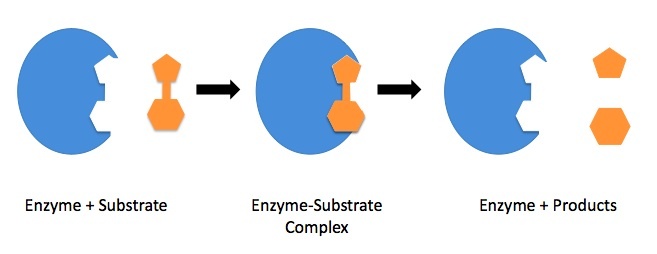
What happened here?
a)
An enzyme sped up a chemical reaction.
b)
An enzyme denatured.
c)
A substrate was turned into a product.
d)
An active site has attached to a product.
49.
what does a promoter do?
a)
it allows a gene to be transcribed
b)
it creates a DNA segment
c)
it is another word for ribosomes
d)
it is another word for RNA
50.
A protein that binds to the operator and blocks the RNA polymerase
a)
regulator
b)
repressor
c)
activator
d)
corepressor
51.
In the lac operon model the genes within the operon will be expressed if:
a)
lactose is absent in the cell
b)
glucose is present in the cell
c)
lactose is present in the cell
52.
Identify the SUBSTITUTION mutation from the following DNA sequence: 
ATG CCA AAT
a)
ATG TCA AAT
b)
ATG CCT AAA T
c)
ATC CA  AT
d)
ATG CCA AAT
53.
What is the name given to part of a DNA molecule that codes for a protein?
a)
Glucose
b)
Chromosome
c)
Gene
d)
Phosphate
54.
Which of the following statements regarding mRNA is correct?
a)
Exons are included in the protein sequence, while introns are left out
b)
Introns are included in the protein sequence, while exons are left out
c)
Exons and Introns can both be included or left out depending on the protein
d)
Exons and Introns are both part of the mRNA sequence, but only exons are part of the rRNA and tRNA
55.
How can a person's muscle cells have the same exact DNA sequences as their nerve cells even though the look and perform completely different?
a)
The two different cells become mutated
b)
The proteins expressed in each cell are different
c)
They actually have different DNA in the two types of cells.
d)
The genome of the different cells changes
56.

What is the name of the stretch of DNA where RNA polymerase binds?

a)

operator

b)

promoter

c)

enhancer

d)

regulatory gene

57.

The "on/off" switch for an operon is called the

a)

promoter

b)

enhancer

c)

operator

d)

gene

58.

The purpose of the lac operon is to produce enzymes that

a)

synthesize lactose

b)

use lactose

c)

synthesize tryptophan

d)

use tryptophan

59.

In eukaryotic cells, the ____________ are segments of mRNA that are cut out of the final transcript.

a)

promoters

b)

poly A tails

c)

exons

d)

introns

60.
Which RNA bases would pair with TACGAA in transcription
a)
AUGCUU
b)
ATGCTT
c)
GCATCC
d)
GCAUCC
61.
The production of mature mRNA in eukaryotes involves
a)
cutting introns out and spicing exons together
b)
adding the 5' cap
c)
adding the 3' poly A tail
d)
all of these are correct
62.
What amino acid sequence will be produced based on the mRNA codon sequence
5'-AUG-UCU-UCG-UUA-UCC-UUG-3'
a)
met-ser-leu-ser-leu-ser
b)
met-ser-ser-leu-ser-leu
c)
met-leu-phe-arg-glu-glu
d)
met-glu-arg-arg-glu-leu
63.
The anticodon is located on 
a)
DNA
b)
mRNA
c)
tRNA
d)
rRNA
64.

Altered gene whose sequence of bases differs from the previous sequence.

a)

exon

b)

intron

c)

mutation

d)

transcription error

65.

Mutation that arises as a result of anomalies in normal biological processes, such as mistakes made during DNA replication.

a)

Induced mutation

b)

spontaneous mutation

66.

Environmental agent that causes mutations leading to the development of cancer.

a)

carcinogens

b)

activators

c)

mutagens

67.

Change of one base only in the sequence of bases in a gene.

a)

substitution

b)

point mutation

c)

frameshift mutation

d)

deletion

68.

Insertion or deletion of at least one base so that the reading frame of the corresponding mRNA changes.

a)

substitution

b)

point mutation

c)

deletion

d)

frameshift mutation

69.
Which of the following mutations would be MOST likely to have a harmful effect on an organism?
a)
a deletion of three nucleotides near the middle of a gene.
b)
a single nucleotide deletion in the middle of an intron.
c)
a single nucleotide deletion near the end of a coding sequence.
d)
a single nucleotide insertion downstream of, and close to, the start of the coding sequence.
70.

What is genetic transformation?

a)

A prokaryotic cell turning into a eukaryotic cell

b)

Foreign DNA being inserted into a plasmid

c)

A host organism taking in foreign DNA

d)

A gene being mutated

71.

Which is not a characteristic of prokaryotic cells?

a)

contains a nucleus

b)

contains plasmid DNA

c)

single-celled

d)

enclosed by a cell wall

72.

Which image is a plasmid?

a)
b)
c)
d)
73.

The plasmids scientists use in a lab are MOST COMMONLY found in

a)

plants

b)

animals

c)

archaea

d)

bacteria

74.

When bacteria is able to take up DNA, it is considered

a)

permeable

b)

semi-permeable

c)

competent

d)

curated

75.

What is the relationship between proteins and traits?

a)

Proteins carry the genetic information that is responsible for traits.

b)

Traits control protein expression.

c)

Proteins produced by expression of genes result in traits

76.

The transfer of genetic material from one cell to another cell through Bacteriphage is called

a)

Conjugation

b)

Tranduction

c)

Transformation

d)

Recombination

77.

Which of the following processes brings about an exchange of genetic information between bacterial cells?

a)

binary fission

b)

mutualism

c)

conjugation

d)

replication

78.

process by which bacteria reproduce asexually

a)

binary fission

b)

conjugation

c)

endospore

d)

nitrogen fixation

79.

Simple form of sexual reproduction

a)

conjugation

b)

nitrogen fixation

c)

binary fission

d)

endospore

80.

process by which some bacteria convert N2 gas into ammonia

a)

nitrogen fixation

b)

conjugation

c)

binary fission

d)

reverse transcriptase

81.
______________ is a type of bacterial reproduction that moves a plasmid from one bacteria to another by a virus.
a)
Transduction
b)
Transformation
c)
Conjugation
82.

______________ is a type of bacterial reproduction that involves two bacteria sharing genetic information on plasmids via a pilus.

a)

Transduction

b)

Transformation

c)

Conjugation

83.

______________ is a type of bacterial reproduction that involves bacteria absorbing DNA fragments from the environment.

a)

Transduction

b)

Transformation

c)

Conjugation

84.
Process by which bacteria reproduce asexually
a)
binary fission
b)
transduction
c)
transformation
85.
What structure connects the two bacteria cells during conjugation?
a)
pilus
b)
flagella
c)
ribosome
d)
cytoplasm
86.
Which of the following processes does not increase bacterial genetic diversity?
a)
Transductions
b)
Conjugation
c)
Binary fission
d)
Transformation
87.

Transduction occurs when ________________.

a)

None of these.

b)

a virus accidentally transfer bacterial DNA to another bacterium.

c)

a plasmid is transferred from one bacteria to another.

d)

bacteria take up DNA from the environment.

88.

Transformation occurs when ________________.

a)

None of these.

b)

a virus accidentally transfers bacterial DNA to a another bacterium.

c)

a plasmid is transferred from one bacteria to another.

d)

bacteria take up DNA from the environment.

89.
What process is occurring in the diagram?
a)
transduction
b)
transformation
c)
conjugation
d)
binary fission
90.

A mutation in which only one nucleotide is altered is called a:

a)

Frameshift Mutation

b)

Deletion Mutation

c)

Point Mutation

d)

Insertion Mutation

91.
Which of the following would result in a frameshift mutation?
a)
Insertions only
b)
Substitution only
c)
Deletion only
d)
Insertions and Deletions
92.
What mutation has occurred here? 
T-G-A-C-C-A
T-G-A-G-C-A
a)
Substitution
b)
Deletion
c)
Insertion
d)
Frameshift 
93.
DNA molecule segment is : TTACGCAAG
The mutated DNA segment is TTCGCAAG. This is an example of ___ mutation.
a)
Substitution
b)
Deletion
c)
Insertion
d)
Inversion
94.
Why are insertion and deletion (frameshift) mutations so harmful?
a)
They change all of the codons from the mutation on down the line, which changes the amino acid sequence
b)
They insert things that an organism doesn't need.
c)
They often delete things that organisms need.
d)
Insertion and deletions are not any more harmful than substitution mutations.
95.

Identify the DELETION mutation from the following:

ATG CCA AAT

a)

ATG TCA AAT

b)

ATG CCT AAA T

c)

ATC CA AT

d)

ATG CCA AAT

96.

What type of mutation is shown in the diagram?

a)

Point mutation - missense

b)

Frameshift Mutation - deletion

c)

Frameshift Mutation - addition

d)

Point mutation - nonsense

97.

A circular piece of DNA, found in bacteria, is called:

a)

A plasmid

b)

mRNA

c)

Ribosome

d)

Nucleotide

98.

What codon is required for a protein to be synthesized?

a)

UAG

b)

UGG

c)

AUG

d)

UAA

99.

The failure of one or more pairs of homologous chromosomes or sister chromatids to separate "normally" during meiosis is called _____________________.

a)

nondisjunction

b)

anaphase I

c)

nondiploidy

d)

karyotype

100.
A type of substitution in which no  amino acids change is called 
a)
Missense
b)
Nonsense
c)
Silent
d)
Deletion
101.
TTACGAAAG - original
TTAUCAAAG  - mutated 
The example above is what type of mutation?
a)
Silent
b)
Deletion
c)
Nonsense
d)
Missense
102.
What is a codon?
a)
It is a three letter section of bases that are read by ribosomes to stamp amino acids into a protein
b)
They are the codes on the DNA (hence "code-on"
c)
It is a type of mutation that occurs when there has been a substitution, deletion or insertion.
d)
It is a made up word for this quiz. Nice try, Jewett.
103.
Would a mutation in the DNA of a skin cell be passed on to an organism's offspring?
a)
Yes, because any change to the DNA is passed on to the offspring
b)
Maybe. Sex cells only use half of the body's genetic code. It might get the copy of a gene that wasn't mutated.
c)
No. Only mutations that occur in the gametes (sex cells) are passed on to the offspring
d)
Without knowing the animal, it would be hard to tell whether or not the mutation would be passed on.
104.
Cause cancer
a)
Chemical Mutagen
b)
Carcinogens
c)
Allergens
d)
Teratogens
105.
Cause mutations in DNA
a)
Endocrine Disruptors
b)
Chemical Mutagen
c)
Neurotoxins
d)
Carcinogen
106.
Cause birth defects
a)
Carcinogen
b)
Teratogens
c)
Endocrine Disruptors
d)
Allergens
107.
Example of mutagens
a)
all
b)
x-rays
c)
ultraviolet radiation
d)
tobacco
108.
Mutations can result from
a)
insertion of nitrogen bases
b)
substitution of nitrogen bases
c)
deletion of nitrogen bases
d)
all of these other answers
109.

Which is an example of a chemical mutagen?

a)

sugar

b)

chocolate

c)

insulin

d)

alcohol

110.
UV-induced pyrimidine dimers are repaired using photoreactivation
a)
True
b)
False
111.

What is the mechanism of action of UV rays as mutagen?

a)

Insertion mutation

b)

Deletion

c)

Formation of thymine dimers

d)

Cleavage of backbone

112.

Which molecules slip between DNA bases ?

a)

Alkylating agents

b)

Deaminating agents

c)

Intercalating agents

d)

All of these

113.

What is the main enzyme that plays the major role in formation of thymine dimer?

a)

a) DNA glycosylase

b)

b) DNA photolyase

c)

c) DNA gyrase

d)

d) DNA ligase

114.
What type of cells are spermatids?
a)
diploid
b)
Haploid 
c)
somatic
d)
stem
115.
The part of a flower that produces the male reproductive cells (pollen).
a)
anther
b)
style
c)
stigma
d)
filament
116.

What part of the flower produces eggs?

a)

ovary

b)

petal

c)

anther

d)

stamen

117.
What is the male reproductive part of the flower?
a)
carpel
b)
stamen
c)
ovary
118.

What is the female reproductive part of a flower called?

a)

anther

b)

pistil

c)

sepal

119.
faster population growth rate
a)
r strategy
b)
k strategy
120.
slower growth rate of the population
a)
k strategy
b)
r strategy
121.
shorter time to reach maturity
a)
r strategy
b)
k strategy
122.

higher reproductive rate (many offspring)

a)

k strategy

b)

r strategy

123.
longer time to reach maturity
a)
k strategy
b)
r strategy
124.

Stable, predictable environment favour this strategy- it is more effective to invest resources in becoming more competitive

a)

r strategy

b)

K strategy

125.

Which type of survivorship curve represents an k-selected species?

a)

Type I survivorship curve

b)

Type II survivorship curve

c)

Type III survivorship curve

126.

Bacteria, algae, and dandelions are an example of

a)

r-selected species

b)

k-selected species

c)

s-selected species

127.

This type of species population is controlled by density-dependent factors

a)

r-selected

b)

k-selected

c)

j-selected

128.

Which of the following is not a characteristic of rapidly growing populations?

a)

Short generation time

b)

Long length of reproductive life

c)

Low fecundity

d)

Reproduce early in life

129.

A J-curve represents

a)

exponential growth

b)

logistic growth

c)

no growth

130.

As a population reaches carrying capacity what happens to fecundity?

a)

Increases

b)

decreases

131.

Which type of species would you expect to have a s-curve graph?

a)

k-selected

b)

r-selected

c)

s-selected

132.
The efficiency of energy transfer from a lower trophic level to the next highest level is roughly
a)
1%
b)
10%
c)
100%
d)
1000%
133.
Organisms that create their own energy from sunlight or chemicals
a)
Herbivore
b)
Omnivore
c)
Autotroph
d)
Heterotroph 
134.
Eat primary consumers (can be carnivores and omnivores)
a)
Tertiary Consumers
b)
Secondary Consumers
c)
Quaternary Consumers 
d)
Top Predators 
135.

Which of the following is a TRUE statement about trophic levels?

a)

Predators are not included

b)

Primary producers are at the top of the pyramid

c)

The number of organisms decreases as you move up the pyramid

d)

The energy increases as you move up the trophic levels

136.
In the energy pyramid here, how much of the energy in each level gets lost as heat or used by the organism for survival?
a)
80%
b)
90%
c)
10%
d)
20%
137.

Animals that only eat producers (also known as herbivores)

a)

Producers

b)

Primary Consumers

c)

Secondary Consumers

d)

Tertiary Consumers

138.
In the food web shown, the snail would be considered...
a)
primary consumer
b)
secondary consumer
c)
tertiary consumer
d)
producer
139.

How are primary consumers different from secondary consumers?

a)

Primary consumers eat only plants;secondary consumers eat other consumers.

b)

Primary consumers eat other consumers;secondary consumers eat only plants.

c)

primary consumers eat plants and other consumer;secondary consumers eat plants and decompose matter

d)

Primary consumers eat plants and decompose matter ;secondary consumers consumers eat plants and other consumers.

140.
Temperature, light, air, water, and soil are all  _____  parts of the environment
a)
alive
b)
biotic 
c)
abiotic
d)
living
141.
What is the term used to describe all living things in an ecosystem?
a)
Biotic Factors
b)
Abiotic Factors
c)
Environmental Factors
d)
Population
142.

Which of the fallowing has only abiotic factors?

a)

Sunlight, algae, and temperature

b)

Guppy, crab, oxygen

c)

Sunlight, soil, and weather

d)

Algae, temperature, and dog

143.
Remora are small fish with a sucker-like organ that allows them to attach themselves to larger animals like a shark.  By doing this, the remora is able to gain protection from the presence of the shark while helping the shark stay clear from parasites.  This relationship shows _?
a)
 parasitism
b)
mutualism       
c)
commensalism
d)
predation
144.
In an ecosystem, members of the lizards are observed eating members of the insect population.  In this same ecosystem, birds are also observed using insects as a food source.  The relationship between lizards and birds would best be described as –
a)
predator
b)
 competitive
c)
parasitic
d)
mutualistic
145.
Different species are most likely to compete for resources in an ecosystem if both species attempt to –
a)
occupy the same niche.
b)
successfully reproduce.
c)
live in different habitats.         
d)
find different food sources.   
146.
Animals of the same species would most likely compete over a limited amount of -
a)
minerals
b)
Oxygen
c)
sunlight
d)
mating partners
147.
The collection of all of the biotic and abiotic factors in an area describes -
a)
community
b)
population
c)
ecosystem
d)
organism
148.
When a pine tree grows real tall and blocks sunlight to another pine tree it is _______ competition.
a)
Interference
b)
Intraspecific
c)
Interspecific
d)
Exploitative
149.

Which factor promotes competition between organisms in an ecosystem?

a)

cycling of minerals

b)

limited resources

c)

decomposition of organic matter

d)

presence of saprophytes

150.

Two closely related species of birds live in the same tree. Species A feeds on ants and termites, while Species B feeds on caterpillars. The two species coexist successfully because

a)

each occupies a different niche

b)

they interbreed

c)

they use different methods of reproduction

d)

birds compete for food

151.

Which of these is NOT an example of interspecific competition?

a)

Oysters and barnacles competing for settling space on the rocky shore

b)

Goats and sheep in the same paddock competing for grass

c)

Ferns and kawakawa competing for shaded locations in a forest

d)

Stags competing for mates

152.

the differentiation of niches that enables similar species to coexist in a community

a)

character displacement

b)

climax community

c)

resource partitioning

d)

pioneer species

153.
The ecological niches of three bird species are shown in the diagram. What is the advantage of each bird species having a different niche?
a)
As more birds feed higher in the tree, available energy increases.
b)
More abiotic resources are available for each bird.
c)
Predators are less likely to feed on birds in a variety of locations.
d)
There is less competition for food.
154.

What is a keystone species?

a)

A species that helps to hold an ecosystem together

b)

A species that lives in or around rocks

c)

Keys and stones have nothing to do with ecology

d)

A keystone isn't a living thing, it's just a stone

155.
Based on the graph shown, how can you tell sea otters are a keystone species?
a)
as the sea otter population decreases, biodiversity increases
b)
as sea otter population increases, biodiversity increases
c)
changes in the sea otter population have little effect on biodiversity 
d)
the sea otter population dereases due to the presence of urchins
156.
When a specific population grows past the ecosystem's carrying capacity, what happens to the population?
a)
Density Independent limiting factors start to occur resulting in the population going farther above carrying capacity.
b)
Density Dependent limiting factors start to occur resulting in the population going back below carrying capacity.
c)
The population will go extinct due to lack of resources
d)
The population grows then finds a new carrying capacity
157.
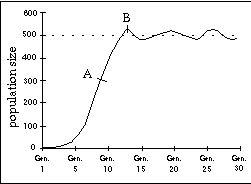
What is the carrying capacity of the graph?
a)
around 500
b)
more than 500
c)
less than 500
d)
around 600
158.
The total number of individuals a habitat can survive with the resources it has available.
a)
Carrying capacity
b)
Limiting factors
c)
Resources
d)
Population
159.
Excessive amounts of rain caused a flood in the southwest United States that resulted in substantial amounts of deaths in the rabbit population? This situation is an example of a density _____________ limiting factor.
a)
density-independent
b)
density-dependent
c)
density- too high
d)
density- too low
160.

Natural disasters can be considered limiting factors.

a)

true: density independent limiting factors

b)

false; natural disasters are not limiting factors

c)

true: density dependent limiting factors

d)

false: because Mrs. Schaffer said

161.

A lion and a cheetah attempt to occupy the same niche. The more aggressive lion survives; the cheetah does not.

a)

Density-Dependent: Competition

b)

Density-Independent: Competition

c)

Density-Dependent: Predator-Prey

d)

Density-Independent: Predator-Prey