
 Worksheets
year 11 Transport
Total questions: 173
Worksheet time: 2hrs 55mins
the boss of the body is the ___________
heart
brain
spinal cord
the face
Which type of cell is found in the greatest numbers in blood?
Red blood cell
White blood cell
Platelets
What happens to breathing and heart rate during exercise?
Breathing rate increases and heart rate decreases
They both increase
They both decrease
How do you calculate cardiac output?
Cardiac output = stroke volume / heart rate
Cardiac output = heart rate / stroke volume
Cardiac output = stroke volume X heart rate
How do you calculate surface area to volume ratio?
Surface area / volume
Surface area - volume
Surface area + volume
Why is the left wall of the heart have a thicker layer of muscle than the right side?
To stop the blood flowing backwards
To push the blood with more force at high pressure so it goes to all body cells.
To push the blood at high pressure to the lungs.
Why is there a limit to cell size in multicellular organisms?
As size of cells increase, their surface area to volume ratio also increases meaning substances would diffuse too slowly into the cell.
As size of cells increase, their volume decreases meaning substances would diffuse too slowly into the cell.
As size of cells increase, their surface area to volume ratio decreases meaning substances would diffuse too slowly into the cell.
Name 2 human excretory organs.
Heart and lungs
Brain and heart
Kidneys and lungs
What is the name of the liquid part of the blood?
Platelets
Plasma
Red blood cells
Give one adaptation of alveoli for efficient gas exchange.
Alveoli have a one cell thick lining for a short diffusion pathway.
Alveoli have a small surface area for fast diffusion of oxygen.
Alveoli have many a thick lining for a long diffusion pathway.
What do platelets do?
They stick together and make fibres that make scabs (blood clots) that stop pathogens entering the blood or stop you bleeding to death.
They form your immune system and destroy pathogens.
They carry oxygen around the body attached to haemoglobin.
What other names are given to red blood cells and also white blood cells?
Lymphocytes (red blood cells) and phagocytes and erythrocytes (white blood cells).
Erythrocytes (red blood cells) and phagocytes and lymphocytes (white blood cells).
Phagocyctes (red blood cells) and lymphocytes and erythrocytes (white blood cells).
What do phagocytes do?
Engulf (surround) microbes and digest them.
Produce antibodies.
Release a toxin that kills pathogens.
Why do arteries have a thick muscle layer?
To provide energy for the blood vessel.
To prevent the blood flowing backwards.
To help withstand the high pressure blood, also to contract to control blood flow.
List the structures in the circulatory system the blood travels through from vena cava to aorta.
Vena cava, lungs, pulmonary vein, left atrium, left ventricle, aorta, right atrium, right ventricle, pulmonary artery,
Vena cava, left atrium, right ventricle, pulmonary vein lungs, pulmonary artery, right atrium, left ventricle, aorta
Vena cava, right atrium, right ventricle, pulmonary artery, lungs, pulmonary vein, left atrium, left ventricle, aorta
Where would you find alveoli and what do they do?
In the arteries, they stop the artery from bursting.
In the heart, and they stop the blood flowing backwards
In the lungs and they are they site of gas exchange
Why do veins and the heart have valves?
To stop the backflow of blood
To contract to push the blood under high pressure
To cause the pulse
What type of blood vessel surround alveoli and other tissues in the body?
Capillaries
Arteries
Veins
Why is energy required by the body?
For creating glucose and oxygen
For respiration
For movement (muscle contraction) and keeping warm.
Give the word equation for aerobic respiration.
Glucose + carbon dioxide --> oxygen + water
Glucose --> lactic acid
glucose + oxygen --> carbon dioxide + water
What are the differences between anaerobic and aerobic respiration?
Anaerobic respiration takes place in mitochondria, releases less energy and forms lactic acid that causes cramp. Aerobic respiration occurs in cytoplasm, releases more energy and forms carbon dioxide and water which do not cause cramp.
Anaerobic respiration takes place in cytoplasm, releases less energy and forms lactic acid that causes cramp. Aerobic respiration occurs in mitochondria, releases more energy and forms carbon dioxide and water which do not cause cramp.
Anaerobic respiration takes place in cytoplasm, releases less energy and does not cause cramp. Aerobic respiration occurs in mitochondria, releases more energy and causes cramp.

Observe the image well. Then choose the correct statement.
A is an artery since it has the biggest lumen to carry more blood.
A is a vein since it is very elastic.
B is an artery because it has thick muscular and elastic walls.
B is a vein since all veins have a small lumen
Capillaries are the link between arteries and veins. Capillaries are efficient because: (Tick all the right answers)
1 cell thick for a short diffusion distance
Blood in them travels at a very high speed to ensure diffusion
Blood in them travels at a very low speed to ensure diffusion
The network of capillaries creates a large SA for efficient diffusion.
Name the main artery of the human body.
Pulmonary Artery
Hepatic Artery
Aorta
The vein that is rich in digested nutrients such as glucose and AA is:
Hepatic Vein
Renal Vein
Vena Cava
Hepatic Portal Vein
The blood vessel with high levels of urea is the
Renal Vein
Hepatic Vein
Hepatic Artery
In the heart which ventricle has the thickest wall?
left ventricle
right ventricle
In the elderly persons, the pulse rate tends to fall with age. This means that:
They would have enough oxygen circulating around their body.
They can feel fatigued due to less oxygen circulating around their body.
They are more prone to diseases.
If a doctor needs to take a sample of blood from a patient, the blood vessel he would use is the:
artery
vein
Mammals have a double circulatory system. This means that
Oxygenated blood passes twice through the heart
Deoxygenated blood passes twice through the heart
The heart pumps deoxygenated blood to lungs and oxygenated blood to rest of body
a mixture of oxygenated and deoxygenated blood is pumped out of heart to the rest of body
Tissue fluid is:
The fluid found around organs
A link between body cells and blood and consists of plasma without any plasma proteins
The fluid found in all cells
The blood vessel with high levels of urea is the
Renal Vein
Hepatic Vein
Hepatic Artery
Observe the image well. Then choose the correct statement.
A is an artery since it has the biggest lumen to carry more blood.
A is a vein since it is very elastic.
B is an artery because it has thick muscular and elastic walls.
B is a vein since all veins have a small lumen
Arteries have a thick elastic wall to:
Carry oxygenated and deoxygenated blood to all parts of body.
Pump the blood to rest of body.
Withstand the high pressure exerted by the blood.
Capillaries are the link between arteries and veins. Capillaries are efficient because: (Tick all the right answers)
1 cell thick for a short diffusion distance
Blood in them travels at a very high speed to ensure diffusion
Blood in them travels at a very low speed to ensure diffusion
The network of capillaries creates a large SA for efficient diffusion.
Name the main artery of the human body.
Pulmonary Artery
Hepatic Artery
Aorta
The vein that is rich in digested nutrients such as glucose and AA is:
Hepatic Vein
Renal Vein
Vena Cava
Hepatic Portal Vein
In the heart which ventricle has the thickest wall?
left ventricle
right ventricle
In the elderly persons, the pulse rate tends to fall with age. This means that:
They would have enough oxygen circulating around their body.
They can feel fatigued due to less oxygen circulating around their body.
They are more prone to diseases.

Graph A shows the heartbeat of:
A trained person because the heart is beating faster at each level of exercise.
An untrained person because the heart is beating faster at each level of exercise.
An untrained person because it shows the smallest recovery time.
A trained person because trained persons always experience a long recovery period after exercise.
The blood vessel that carries deoxygenated blood to the lungs is the:
Pulmonary artery
Pulmonary vein
Vena cava
Aorta
Athletes with high cholesterol levels in their blood may experience fatigue because:
Enough oxygen is reaching their muscles.
Less oxygen is available for anaerobic respiration.
Less oxygen is available for aerobic respiration.
An athlete training for the Olympic games was told it is better if he trains at high altitudes. This is because:
The body will build more white blood cells to fight off pathogens
The body will build more platelets to avoid loss of blood in case of injury during the games.
The body will build more red blood cells to carry more oxygen molecules.
A blood sample showed that the white blood cell count was very high. Explain this result.
The body needed to build more energy
The body needed to carry nutrients around the body
The body was healthy, and no signs of infections were visible.
The body was fighting off pathogens.
The presence of valves in the heart prevents
Oxygenated blood from mixing with deoxygenated blood
Backflow of blood
A rise in the blood pressure
The liquid part of the blood is known as:
blood
tissue fluid
plasma
Platelets are necessary:
To avoid entry of pathogens
To avoid loss of WBC
To avoid loss of blood
To avoid entry of pathogens and to avoid loss of blood.
Tick all the substances that may be carried by the plasma
dissolved nutrients
carbon dioxide
oxygen
urea
nitrogen
Tissue fluid is:
The fluid found around organs
A link between body cells and blood and consists of plasma without any plasma proteins
The fluid found in all cells
Mammals have a double circulatory system. This means that
Oxygenated blood passes twice through the heart
Deoxygenated blood passes twice through the heart
The heart pumps deoxygenated blood to lungs and oxygenated blood to rest of body
a mixture of oxygenated and deoxygenated blood is pumped out of heart to the rest of body
If a doctor needs to take a sample of blood from a patient, the blood vessel he would use is the:
artery
vein

The recovery time after strenuous exercise is important to:
pay off the oxygen debt experienced during exercise
to ensure anaerobic respiration occurs
have a stronger pulse
Which blood vessel carries blood at the highest pressure?
Arteries
Veins
Capillaries
Which blood vessel contains valves?
Arteries
Veins
Capillaries
Which blood vessel carries blood away from the heart?
Arteries
Veins
Capillaries
Which blood vessel carries blood towards the heart?
Arteries
Veins
Capillaries
Which component of blood is responsible for transporting oxygen?
Red Blood Cells
White Blood Cells
Platelets
Plasma
Which component of blood contains phagocytes and lymphocytes?
Red Blood Cells
White Blood Cells
Platelets
Plasma
Which component of blood is the liquid part of blood?
Red Blood Cells
White Blood Cells
Platelets
Plasma
What is the function of phagocytes?
Transport oxygen around the body
Engulf and digest pathogens
Produce antibodies which destroy pathogens
Clot together to prevent bleeding
What is the function of lymphocytes?
Transport oxygen around the body
Engulf and digest pathogens
Produce antibodies which destroy pathogens
Clot together to prevent bleeding
What blood vessel transports oxygenated blood from the lungs to the heart?
Vena Cava
Aorta
Pulmonary Vein
Pulmonary Artery
What blood vessel transports oxygenated blood from the heart to the body?
Vena Cava
Aorta
Pulmonary Vein
Pulmonary Artery
What blood vessel transports deoxygenated blood from the heart to the lungs?
Vena Cava
Aorta
Pulmonary Vein
Pulmonary Artery
What blood vessel transports deoxygenated blood from the body to the heart?
Vena Cava
Aorta
Pulmonary Vein
Pulmonary Artery
What blood vessel provides the heart with its own blood supply?
Vena Cava
Aorta
Coronary Artery
Pulmonary Artery
Which chamber of the heart receives blood from the vena cava?
Right Atrium
Right Ventricle
Left Atrium
Left Ventricle
Which chamber of the heart receives blood from the lungs?
Right Atrium
Right Ventricle
Left Atrium
Left Ventricle
Which chamber of the heart sends blood to the aorta?
Right Atrium
Right Ventricle
Left Atrium
Left Ventricle
Which chamber of the heart sends blood to the lungs?
Right Atrium
Right Ventricle
Left Atrium
Left Ventricle

A
B
C
D
A student read out about various systems of the human body and claimed that the digestive system alone can pass nutrients to every cell of the body. Is the claim made by the student correct?
Yes; the stomach of the digestive systems helps in the delivery of nutrients to all body cells.
Yes; the small intestine of the digestive system absorbs the nutrients from the food and delivers to it all cells.
No; the digestive system passes nutrients into the blood, which is then delivered to body cells through the circulatory system.
No; the heart is a component of the circulatory system, which directly absorbs nutrients from the stomach and delivers to all body cells.
Siddhant got an injury on his knee while playing football in the ground. Blood oozed out from the injured site, but after a few minutes, he observed a brown colored clot on the same site. Which component of the blood might have formed this clot?
Plasma
Platelets
Red blood cells
White blood cells
A patient was facing trouble in breathing. On diagnosis, the doctor examined that the hemoglobin content in the patient’s body is less than the normal range. What role does hemoglobin play in breathing?
Haemoglobin helps in the transportation of oxygen to all body cells.
Haemoglobin prevents clot formation inside the respiratory tract.
Haemoglobin helps the lungs to take in more air from the surroundings.
Haemoglobin fights against germs that enter into the respiratory tract.

The table list some characteristic features of a blood vessel. Which of the following will have all these characteristics features?
Only pulmonary vein
Only pulmonary artery
All veins except the pulmonary vein
All arteries except the pulmonary artery
A student observed the cross-section of two blood vessels A and B with the help of a microscope.
The table lists the observations made by the student.
A- THICK AND ELASTIC
B- THIN
What conclusion can be made about the type of blood carried out by blood vessels A and B
A –oxygen-rich; B- oxygen-rich
A –carbon-dioxide rich; B- oxygen-rich
A –oxygen-rich; B- carbon-dioxide rich
A –carbon-dioxide rich; B- carbon-dioxide rich
A person placed his index finger of the right hand on the inner side of his left wrist, and then he felt some throbbing movements. What terminology can be used for these movements, and what could be the reason for feeling them?
Pulse; due to flow of blood into veins
Pulse; due to flow of blood into arteries
Pulse rate, due to flow of blood into veins
Pulse rate, due to flow of blood into arteries

The table shows the number of pulse beats counted by two students from their left hand for 2 minutes.
What likely be concluded from this observation?
The pulse rate of student A is higher than the normal pulse rate.
The pulse rate of student B is lower than the normal pulse rate.
The pulse rate of student A and student B is equivalent to the normal pulse rate.
The pulse rate of both student A and student B is higher than the normal pulse rate.
People use water pumps in their houses to circulate water in the house pipes. If our blood vessels are compared to water pipes and blood to water, then what organ of the human body acts as a water pump and circulates blood throughout the body?
Heart
Kidney
Lungs
Liver
A student was provided with a three-dimensional model of a human circulatory system. The teacher asked the student to identify the heart from all the structures involved in the model. How would the student be able to locate the heart in the circulatory system?
A structure that is located in the chest cavity with its lower tip slightly tilted towards the left
A structure that is located in the chest cavity with its upper tip slightly tilted towards the left
A structure that is located in the abdominal cavity with its lower tip slightly tilted towards the right
A structure that is located in the abdominal cavity with its upper tip slightly tilted towards the left
The human heart contains four chambers, two atria, and two ventricles. A partition separates these chambers from each other. Why is the partition between these chambers necessary?
To maintain the pressure of blood in each chamber of the heart
To avoid mixing of oxygenated blood with the deoxygenated blood
To increase the volume of all chambers so that more blood can be pumped
To provide more volume to oxygenated blood than the deoxygenated blood
A deficiency in which of the following may result in a person’s blood failing to clot properly?
antibodies
fibrinogen
haemoglobin
protease
Which component of blood contains phagocytes and lymphocytes?
Red Blood Cells
White Blood Cells
Platelets
Plasma
Which component of blood clots together to stop bleeding?
Red Blood Cells
White Blood Cells
Platelets
Plasma
What is the function of lymphocytes?
Transport oxygen around the body
Engulf and digest pathogens
Produce antibodies which destroy pathogens
Clot together to prevent bleeding
Which type of cell is found in the greatest numbers in blood?
Red blood cell
White blood cell
Platelets
What happens to breathing and heart rate during exercise?
Breathing rate increases and heart rate decreases
They both increase
They both decrease
Why is the left wall of the heart have a thicker layer of muscle than the right side?
To stop the blood flowing backwards
To push the blood with more force at high pressure so it goes to all body cells.
To push the blood at high pressure to the lungs.
Why is there a limit to cell size in multicellular organisms?
As size of cells increase, their surface area to volume ratio also increases meaning substances would diffuse too slowly into the cell.
As size of cells increase, their volume decreases meaning substances would diffuse too slowly into the cell.
As size of cells increase, their surface area to volume ratio decreases meaning substances would diffuse too slowly into the cell.
Name 2 human excretory organs.
Heart and lungs
Brain and heart
Kidneys and lungs
What is the name of the liquid part of the blood?
Platelets
Plasma
Red blood cells
What do platelets do?
They stick together and make fibres that make scabs (blood clots) that stop pathogens entering the blood or stop you bleeding to death.
They form your immune system and destroy pathogens.
They carry oxygen around the body attached to haemoglobin.
What other names are given to red blood cells and also white blood cells?
Lymphocytes (red blood cells) and phagocytes and erythrocytes (white blood cells).
Erythrocytes (red blood cells) and phagocytes and lymphocytes (white blood cells).
Phagocyctes (red blood cells) and lymphocytes and erythrocytes (white blood cells).
What do phagocytes do?
Engulf (surround) microbes and digest them.
Produce antibodies.
Release a toxin that kills pathogens.
Why do arteries have a thick muscle layer?
To provide energy for the blood vessel.
To prevent the blood flowing backwards.
To help withstand the high pressure blood, also to contract to control blood flow.
Why do veins and the heart have valves?
To stop the backflow of blood
To contract to push the blood under high pressure
To cause the pulse
What type of blood vessel surround alveoli and other tissues in the body?
Capillaries
Arteries
Veins
Compare to a vein an artery has
a thinner wall
a wall with more elastic tissue
a wider lumen
valves
The blood vessel with high levels of urea is the
Renal Vein
Hepatic Vein
Hepatic Artery
Which of the following statements is true regarding the lymphatic system?
It destroys the immunological defence in body.
It transports interstitial fluids back to the blood.
It transports plasma cells to the site of infection in the body.
It filters the antigen that enters the body from respiratory system.
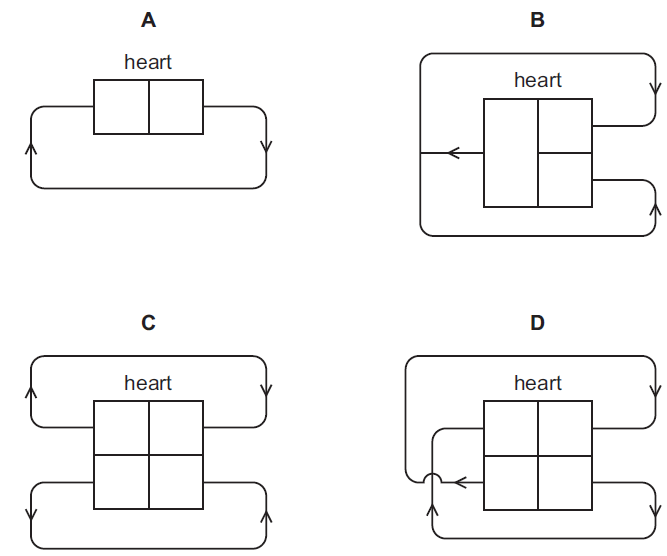
Which diagram shows the human double circulatory system?
A
B
C
D
How often must a blood cell in the renal artery pass through the heart before it again reaches the renal artery?
once
twice
three times
four times
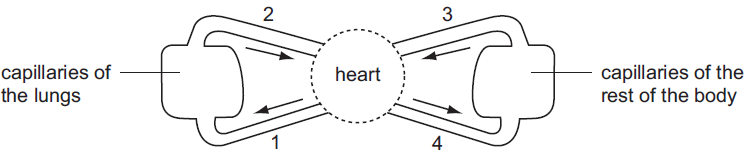
The diagram shows a double circulatory system. Which vessels carry oxygenated blood?
1 and 2
1 and 4
2 and 3
2 and 4

The diagram shows some parts from the blood of a mammal.
Which part would contain the breakdown products of bacterial cells?
A
B
C
D
Which describe the structure and function of a red blood cell?
structure: cell contents are dead
function: transport of water
structure: has a nucleus
function: produces antibodies
structure: has cilia
function: moves particles in the respiratory tract
structure: has no nucleus
function: transport of substances
Which group contains substances that are all carried in the blood?
Amino acids, carbon dioxide and cellulose
Glucose, glycogen and lactic acid
Oestrogen, oxygen and starch
Salts, testosterone and urea

The photograph shows human blood cells as seen under a microscope at high power.
Which are red cells?
P and Q
Q and R
R and S
S and P

The diagram represents some human organs and their blood vessels.
Immediately after taking an alcoholic drink, how would the levels of alcohol compare in blood vessels P, Q and R?
P: high
Q: medium
R: high
P: medium
Q: high
R: low
P: low
Q: low
R: medium
P: high
Q: low
R: low

The photograph shows two blood cells, X and Y.
What are the functions of cells X and Y?
cell X: carries out phagocytosis
cell Y: carries oxygen
cell X: carries oxygen
cell Y: produces antibodies
cell X: carries oxygen
cell Y: carries carbon dioxide
cell X: produces antibodies
cell Y: carries oxygen
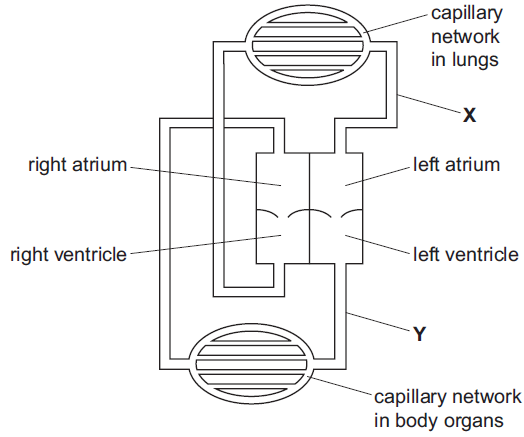
The diagram shows the circulatory system of a mammal.
What describes the blood in vessels X and Y?
X: deoxygenated
Y: deoxygenated
X: deoxygenated
Y:oxygenated
X:oxygenated
Y: deoxygenated
X: oxygenated
Y: oxygenated

The diagram shows human blood as seen through a light microscope.
A person’s blood is unable to clot.
Which component of the blood is not functioning properly?
A
B
C
D
Which chamber of the heart has the most muscular wall?
left atrium
left ventricle
right atrium
right ventricle
A deficiency in which of the following may result in a person’s blood failing to clot properly?
antibodies
fibrinogen
haemoglobin
protease
Which is a function of some white blood cells?
to carry glucose
to carry oxygen
to produce antibiotics
to produce antibodies

The diagram shows the vessels associated with the flow of fluids to and from body cells.
Which is the lymph vessel?
A
B
C
D
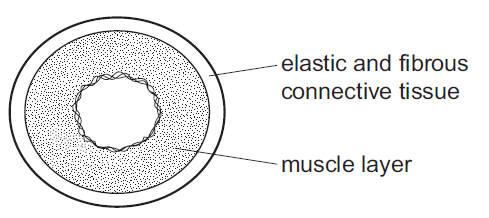
The diagram shows a cross-section through a human blood vessel.
Which type of blood vessel does the diagram show?
an artery
a capillary
a vein
a ventricle
What happens when the left ventricle contracts?
atrioventricular valves: closed
semilunar valves: closed
atrioventricular valves: closed
semilunar valves: open
atrioventricular valves: open
semilunar valves: closed
atrioventricular valves: open
semilunar valves: open

The diagram shows human blood cells, as seen under a microscope.
What is the function of cell X?
to carry glucose
to carry oxygen
to defend against disease
to make the blood clot

The diagrams show some components of the blood of a mammal.
Which component causes the blood to start clotting?
A
B
C
D
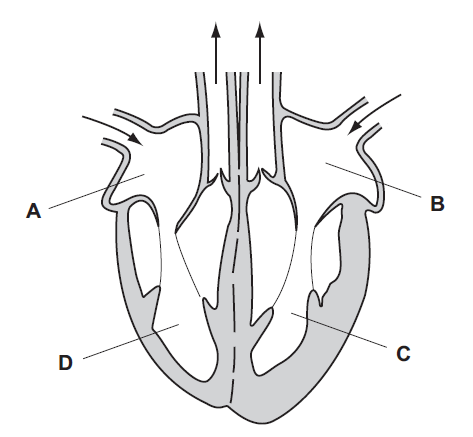
The diagram shows the directions of blood flow through a heart.
Which chamber of the heart receives blood directly from the lungs?
A
B
C
D

The fish heart has ... cavities and is pierced ...
two... only by venous blood.
four ... by venous and arterial blood alternately.
two ... by venous and arterial blood, alternately.

The circulatory systems are...
open
closed
intermediate

Which type of blood vessel has a thick elastic wall?
Veins
Arteries
Capillaries

Through which chamber does oxygenated blood enter after leaving the lungs?
Left ventricle
Right ventricle
Left atrium

Choose the options that reflect the advantages of double circulation.
Blood travels through the heart twice for each complete circuit of the body.
Does not require complex organs.
Can incrase pressure of a blood flow.
Slow movement of blood.
How many fluids circulate in an open circulatory system?
None
One
Two

What is the fluid that circulates in an open circulatory system?
Blood
Blood and lymph
Hemolymph
what type of circulatory system does an earthworm have?
Open circulatory system
Closed circulatory system
Simple circulatory system
What is the role of arteries and veins in the systemic circulatory system?
Transporting blood to all parts of the body
Transport of blood to the lungs
Transporting blood to the lungs and all parts of the body

In amphibians, circulation is ..... and blood circulates with higher pressure than in .....
double and complete ..... earthworm
double and incomplete ..... fish
double and complete ... mammals
Blood capillaries result from branching from ..... and blood circulates in them with ..... pressure.
Arteries ..... low
Veins ..... low
Veins ..... high
Consider the following statements about blood circulation in tuna.
I- In tuna, the circulation is simple, which causes the blood to circulate with low pressure.
II- In the parallel and compact blood vessels there is heat transfer between warm blood originating from the gills and cold blood originating from the tissues.
III- In the gills, water and blood circulate in the same direction.
II and III are true, I is false.
I and II are true, III is false.
I is true, II and III are false.
III is true, I and II are false.

A transport system is complete
when there is no mixing of arterial and venous blood in the heart.
when it consists of two atria and one ventricle.
when there is mixing of arterial and venous blood in the heart.
when it consists in two atria and two ventricles.

The animal in which the exchanges illustrated in the figure occur has a circulatory system ..... , which allows a greater ..... of blood.
(a)

The diagram shows a section through the heart. Which is mitral valve in the right side of the heart?
A
B
C
D

The diagram shows human blood cells as seen under microscope. What is the function of cell X?
to carry carbon dioxide
to phagocyte pathogens
to produce antibodies
to prevent the blood lot
Which chamber of the heart has the most muscular wall?
left atrium
right atrium
left ventricle
right ventricle
What is the advantage of a double circulatory system in mammals?
Blood can flow down the body on the left and up the body on the right
Blood can flow more slowly along the circulatory system
Blood pressure stays the same throughout the circulatory system
Oxygenated blood and deoxygenated blood are kept separate

Diagram shows a circulatory system. Which vessels carry oxygenated blood?
1 and 3
1 and 4
2 and 3
2 and 4
What happens to the heart valves when the ventricles contract?
mitral valves close, semilunar valves close
mitral valves close, semilunar valves open
mitral valves open, semilunar valves close
mitral valves open, semilunar valves open
What is the fluid in the blood called?
lymph
mucus
plasma
tissue fluid
In a drop of human blood, which of the cell is the most numerous?


The red color of the red blood cell is derived from the presence of
Eosin
Globulin
Haemoglobulin
Iron

Diagram shows human blood vessel. What will happen if structure X is not functioning?
Blood flow increases
Blood pressure increases
Blood flows in one direction
Blood flows backwards
What is the role of pacemaker in the heart?
It decreases the pressure in the ventricles
It stops the backflow of blood in the heart
It increases the blood flow through the coronary artery
It regulates the rate of heart muscles contraction

The following statement shows the characteristics of blood in the blood vessel X. What is X?
Hepatic vein
Hepatic portal vein
Renal vein
Pulmonary vein

Tachycardia is one of the heart disease caused by failure of structure X in the heart. What is structure X?
Sinoatrial node
Atrioventricular node
Purkinje Fibres
Bundle of His

Diagram shows an open circulatory system for an insect. What is the colorless fluid inside X?
Blood plasma
Haemolymph
Lymph
Tissue fluid
What is the normal blood pressure for human?
80/120 mmHg
120/80 mmHg
120/100 mmHg
80/100 mmHg
A doctor listened to Ahmad's heartbeat by using a stethoscope. He heard the 'lub-hiss, lub-hiss' sound instead of the normal 'lub-dup' sound. Which of the following is most likely to cause the 'hiss' sound?
Clogged coronary artery
A defective semilunar valve
High blood pressure
A damaged pacemaker

Diagram shows a longitudinal cross section of human heart. Which of the part A, B, C and D pumps the blood to all the parts of the body?
A
B
C
D
Why is the left wall of the heart have a thicker layer of muscle than the right side?
To stop the blood flowing backwards
To push the blood with more force at high pressure so it goes to all body cells.
To push the blood at high pressure to the lungs.
What is the name of the liquid part of the blood?
Platelets
Plasma
Red blood cells
List the structures in the circulatory system the blood travels through from vena cava to aorta.
Vena cava, lungs, pulmonary vein, left atrium, left ventricle, aorta, right atrium, right ventricle, pulmonary artery,
Vena cava, left atrium, right ventricle, pulmonary vein lungs, pulmonary artery, right atrium, left ventricle, aorta
Vena cava, right atrium, right ventricle, pulmonary artery, lungs, pulmonary vein, left atrium, left ventricle, aorta
Name the main artery of the human body.
In which way is the pulmonary artery different from the other arteries?

The diagram shows part of the human circulatory system. Which part carries oxygenated blood at low pressure?
A
B
C
D
Why do arteries have a thick muscle layer?
To provide energy for the blood vessel.
To prevent the blood flowing backwards.
To help withstand the high pressure blood, also to contract to control blood flow.
What part of the heart delivers unoxygenated blood to the lungs?
Pulmonary artery
Pulmonary vein
Aorta
Left Ventricle
Pulmonary veins take unoxygenated blood away from the heart.
True
False
Circulatory system consists of the heart, blood vessels and
White blood cell
Plasma
Blood
platelets
What part of the heart delivers oxygenated blood to the heart?
Pulmonary artery
Pulmonary vein
Aorta
right ventricle
what is the sound that is made by heart
yup-yap
lub-dup
lub-dub
nub-mub

A
B
C
D

A
B
C
D

A
B
C
D

A
B
C
D

A
B
C
D

A
B
C
D

A
B
C
D

A
B
C
D

A
B
C
D

A
B
C
D

