wayground logo

Free Printable Worksheets

NEW

Font size

S
M
L
XL
Worksheets

Newton's Laws of Motion Practice Quiz

Total questions: 56

Worksheet time: 28mins

Name
Class
Date
1.
"For every action, there is an equal and opposite reaction."
a)
Newton's 1st Law
b)
Newton's 2nd Law
c)
Newton's 3rd Law
d)
Newton's 4th Law
2.
Force = Mass x Acceleration
a)
Newton's 1st Law
b)
Newton's 2nd Law
c)
Newton's 3rd Law
d)
Newton's 4th Law
3.
"An object in motion (or at rest) will to stay in motion (or at rest) until an outside force acts upon it."
a)
Newton's 1st Law
b)
Newton's 2nd Law
c)
Newton's 3rd Law
d)
Newton's 4th Law
4.
The tendency of an object to resist changes in its motion is...
a)
inertia
b)
force
c)
acceleration
d)
velocity
5.

Any push or pull on an object...

a)

force

b)

velocity

c)

inertia

d)

momentum

6.
F=MA
An object of mass 10 kg is accelerated upward at 2 m/s2.  What force is required? 
a)
20 N
b)
2 N
c)
5 N
d)
0 N
7.
A cannonball with a mass of 10 kg is flying at an acceleration of 5 m/sec/sec. What is it's force?
a)
50 Newtons
b)
5 Newtons
c)
20 Newtons
d)
9.5 Newtons
8.

In the picture, the balloon releases air in one direction and the car moves in the other direction. Which law explains this?

a)

Newton's 1st Law

b)

Newton's 2nd Law

c)

Newton's 3rd Law

d)

Newton's 9th Law

9.
How much force is needed to accelerate a 2 kg physics book to an acceleration of 6 m/s/s?
a)
36 N
b)
12 N
c)
3 N
d)
0.33 N
10.

An object's resistance to changing motion is called...

a)

gravity

b)

acceleration

c)

inertia

d)

mass

11.

Velocity measures ____________________ and _______________________.

a)

speed and direction

b)

inertia and friction

c)

gravity and mass

d)

speed and mass

12.
If a 10 kilogram object accelerates suddenly at 15 m/s2, how much force was applied to the object?
a)
150 Newtons
b)
15 Newtons
c)
150 kilograms
d)
100 kilograms
13.

Newton's First Law says that "Objects in motion stay in motion and objects at rest stay at rest unless..."

a)

acted on by an unbalanced force.

b)

gravity happens.

c)

nothing else happens.

d)

acted on by a balanced fore.

14.

A car traveling 65 mph is an example of its ________.

a)

force

b)

speed

c)

acceleration

d)

velocity

15.

What will be the effect on the boy in the picture if the driver stops quickly?

a)

Because of inertia he will remain in the same position.

b)

He will be pushed back into the car seat.

c)

He will move from one side of the car seat to the other.

d)

He will move forward pressing against the seatbelt.

16.

Which of Newton’s Laws explains a rocket’s movement during launch?

a)

Newton's First Law of Motion

b)

Newton's Second Law of Motion

c)

Newton's Third Law of Motion

d)

Newton's Fourth Law of Motion
17.
What law of motion does this picture represent?
a)
Newtons 1st law
b)
law of gravity 
c)
Newtons 4th law 
d)
Newtons 2nd law
18.
What law of motion does this picture represent?
a)
Newtons 1st law
b)
Newtons 4th law 
c)
Newtons 3rd law 
d)
Newtons 2nd law
19.
A net force of 15 N is exerted on an encyclopedia to cause it to accelerate at a rate of 5 m/s2. Determine the mass of the encyclopedia?
a)
 m = 3.0 kg
b)
m = 4.0 kg 
c)
m = 3.0 ml 
d)
m = 30.0 g
20.
Pushing a child on a swing is easier than pushing an adult on the same swing, because the adult has more mass and requires more force to accelerate.
a)
Newton's 1st Law
b)
Newton's 2nd Law
c)
Newton's 3rd Law
21.
When you step on a Lego. You push on the Lego and the Lego pushes back on you.
a)
Newton's 1st Law
b)
Newton's 2nd Law
c)
Newton's 3rd Law
22.
This person bought coffee and put it on the seat next to them. If they stopped quickly and the coffee spilled which law would that represent?
a)
Newton's 1st Law
b)
Newton's 2nd Law
c)
Newton's 3rd Law
23.
Newton’s first law of motion is also called the law of ________?
a)
Mass
b)
Inertia
c)
Force
d)
Velocity
24.
Slamming on the brakes in a moving car makes a passenger move forward against his or her seat belt because
a)
the passenger has the inertia to keep moving forward
b)
the passenger is being pushed by the seats of the car
c)
the passenger is better able to stop themselves in this manner
d)
the passenger has an equal and opposite force supporting their weight
25.
How long will an object remain at rest, according to Newton's First Law of Motion?
a)
it can't rest
b)
until noon
c)
until an unbalanced force occurs
d)
as long as there are unbalanced forces acting on it 
26.
For every _______ there is an equal and opposite ________. 
a)
reaction, action
b)
action, action
c)
reaction, reaction
d)
action, reaction
27.
You are sitting in a car that isn't moving; the car accelerates. Your body is pushed back. Explain. 
a)
newtons
b)
vector
c)
inertia
d)
gravity
28.
Why is it harder to push a van filled with bowling balls than it is to push a van with basketballs?
a)
The mass of the car is greater than the mass of the basketballs
b)
The mass of the bowling balls is greater than the mass of the basketballs
c)
The van with the basketballs is bigger than the van with the bowling balls
d)
It should be equally as hard to push the two vans
29.
You are holding a bowl of hot soup while standing in the kitchen. As you begin to move, the soup spills out of the bowl. Upon reflection you realize that
a)
the soup spilled because of air resistance
b)
if you had traveled faster this wouldn't have happened
c)
the soup wanted to stay where it was, but you moved the bowl
d)
the soup and the bowl act as one body with the same velocity
30.
Why do you lean towards the left when a car turns right
a)
because of inertia
b)
because of gravity
c)
because of buoyancy
d)
because of velocity
31.
A wheelbarrow is experiencing two forces. One is pushing 5N east and another 5N west. What is true about the motion of the wheelbarrow?
a)
it isn't moving
b)
it is accelerating
c)
it is slowing down
d)
its speed is constant
32.
A 260.5N unbalanced force applied to push a chair across the room causing an acceleration of 4.2 m/s2. What is the mass of the chair?
a)
62.02 kg
b)
63.69 kg
c)
263.3 kg
d)
1123.5 kg
33.
When a Civil War era cannon is fired, the force of the gas produced by exploding powder propels the cannonball forward at a high speed. According to Newton's 3rd law
a)
the cannon itself moves backward
b)
the cannon itself does not move due to inertia
c)
the cannon itself moves forward as well with the momenturm
d)
the cannon itself moves forward with the inertia of the cannonball
34.
When you push a boat off from the dock, you are demonstrating Newton's 3rd Law of Motion. It simply states that for every action there is an equal and opposite _______________?
a)
Motion
b)
Change
c)
Reaction
d)
Push
35.
If a 10 kilogram object accelerates suddenly at 15 m/s^2, how much force was applied to the object?
a)
150 Newtons
b)
15 Newtons
c)
150 kilograms
d)
100 kilograms
36.
If a force of 50 Newton's was applied to an object with a mass of 500 grams, what will the object's acceleration be?
a)
10 m/s^2
b)
.1 m/s^2
c)
100 m/s^2
d)
1 m/s^2
37.
45 m/s2 is the... 
a)
Mass
b)
Force 
c)
Acceleration
d)
weight
38.
Unit of mass
a)
m/s 2
b)
m/s
c)
newtons
d)
kg
39.
A force of 250 N is applied to an object that accelerates at a rate of 5 m/s2.  What is the mass of the object? To solve this problem you must do - 
a)
250 ÷ 5
b)
5 ÷ 250
c)
250 x 5
40.
The masses of four objects are given in this table. If all objects are struck with the same amount of force, which one will have the greatest acceleration?
a)
Object 1
b)
Object 2
c)
Object 3
d)
Object 4
41.
Examine the table provided. Which of the objects is producing the greatest force?
a)
Soccer Ball
b)
Tennis Ball
c)
Marble
d)
Ping-Pong Ball
42.
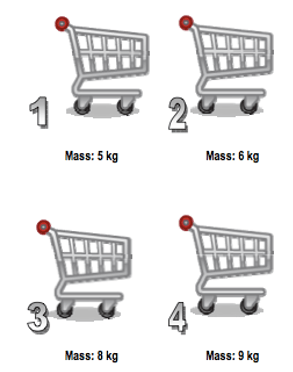
A force of 90N is applied to each cart below, which one will accelerate the fastest?
a)
Cart 1
b)
Cart 2
c)
Cart 3 
d)
Cart 4
43.
What is the SI unit used to measure force? 
a)
pounds 
b)
grams 
c)
newtons 
d)
kg/ m2
44.
Unbalanced forces make an object:
a)
Come to rest
b)
move at constant velocity
c)
accelerate
d)
explode
45.
A basketball with a mass of 0.60 kg is accelerated with a force of 10.8 N. If resisting forces are ignored, what is the acceleration of the basketball to the nearest m/s2?
a)
16 m/s2
b)
17 m/s2
c)
18 m/s2
d)
19 m/s2
46.
What is the name of this graph?
a)
line plot
b)
line graph
c)
bar graph
d)
frequency table
47.
What is the independent variable?
a)
cost of mowing
b)
Moe's Mowing Service
c)
$18
d)
Mowing Time
48.
What is the main purpose of a line graph?
a)
to compare two things
b)
to show trends over time
c)
to have an independent variable
d)
so you don't have to read words
49.
On a graph, which axis shows the independent variable?
a)
x-axis
b)
y-axis
c)
neither
d)
it changes
50.
On a graph, which axis shows the dependent variable?
a)
x-axis
b)
y-axis
c)
neither
d)
it changes
51.
What was the dependent variable in this experiment?
a)
Force
b)
Stretch Distance
c)
Type of Spring Used
52.
What was the independent variable in this experiment?
a)
Force
b)
Stretch Distance
c)
Type of Spring Used
53.
Identify the independent variable:
The height of bean plants depends on the amount of water they receive. 
a)
The bean seed
b)
The amount of water provided daily
c)
The amount of sunlight they're exposed to daily
d)
How tall they grow by the end of the experiment
54.
What is the independent variable? Does T.V. time affect the reading scores of 4th graders?
a)
T.V time
b)
reading scores
c)
grade of student
d)
time outside
55.
On the coordinate plane, which line is the x-axis?
a)
Horizontal Line (Side to Side)
b)
Vertical Line (Up and Down)
56.
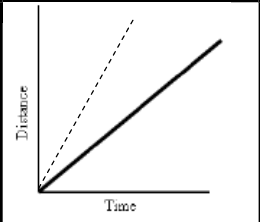
What does this graph represent?
a)
Constant Speed
b)
Acceleration
c)
Not moving