Wayground logo

Free Printable Worksheets

Font size

S
M
L
XL
Worksheets

Yr 12 Genetic Change Quiz

Total questions: 100

Worksheet time: 2hrs 14mins

Name
Class
Date
1.

Mutations can benefit humans because they can:

a)

Cause illness

b)

Make an organism more suited to live in its environment.

c)

Make organisms live shorter lives

d)

Cause organisms to grow extra limbs.

2.

A mutation is defined as:

a)

A change in the cell's structure

b)

Anything that changes in an embryo

c)

Any change in the physical features of a human

d)

A change in the DNA sequence

3.
What causes mutations?
a)
Mistakes in replication or environmental substances
b)
The amino acids
c)
Passed down by genetics
d)
It's how your born
4.

A mutation can occur if a base pair is ____________, deleted, or substituted for another.

a)

modified

b)

added

c)

transferred

5.

A mutation in which only one nucleotide is altered is called a:

a)

Frameshift Mutation

b)

Deletion Mutation

c)

Point Mutation

d)

Insertion Mutation

6.

ATTTGAGCC- Original

ATTGAGCC - Mutated

The example above is an example of a

a)

Insertion

b)

Point mutation

c)

Deletion

d)

Substitution

7.

In order for offspring to get a genetic mutation, the mutation must occur in what type of cell?

a)

Cells with no nucleus.

b)

Any body cell after birth.

c)

Cells with no cell wall or cell membrane.

d)

Cells like eggs or sperm cells that are undergoing reproduction.

8.
original chromosome
ABC-DEF
mutated chromosome
ABBC-DEF
a)
duplication
b)
point
c)
frameshift
9.
Why are insertion and deletion (frameshift) mutations so harmful?
a)
They change all of the codons from the mutation on down the line, which changes the amino acid sequence
b)
They insert things that an organism doesn't need.
c)
They often delete things that organisms need.
d)
Insertion and deletions are not any more harmful than substitution mutations.
10.
ATTTGAGCC- Original
ATTGAGCC - Mutated
The example above is an example of a 
a)
Insertion- Frameshift
b)
Deletion- Substitution
c)
Deletion -Frameshift
d)
All of the above
11.
What do helpful mutations do? 
a)
Increases chances of survival 
b)
Decreases changes of survival 
c)
Increases chances of developing cancer
d)
Decreases skills
12.
This type of substitution codes for a stop codon
a)
Missense
b)
Nonsense
c)
Silent
d)
Deletion
13.

Which type of mutation is MOST LIKELY to cause the greatest disruption?

a)

Frameshift

b)

Silent

c)

Point

14.

Which Karyotype displays a female with Down syndrome?

a)
b)
c)
d)
15.
Which mutation will cause translation to stop? 
a)
Mutations 1 and 3 only
b)
Mutation 1 only
c)
Mutation 2 only
d)
Muations 1, 2, 3
16.

What type of mutation is shown in the diagram?

a)

Point mutation - missense

b)

Frameshift Mutation - deletion

c)

Frameshift Mutation - addition

d)

Point mutation - nonsense

17.

What mutation only affects the individual in which they occur?

a)

Mutation in Somatic Cells

b)

Mutation in Germ Cells

c)

Mutation in Reproductive Cells

d)

Mutation in Dead Cells

18.

Failure of homologous chromosomes

to separate during meiosis.

Results in gametes with either one extra or one missing chromosome.

a)

Translocation

b)

Nondisjunction

c)

Replication

d)

Transcription

19.

UV light from the sun is an example of a ___________ because it can cause mutations.

a)

Mutagen

b)

Mutation

c)

Meiosis

20.
Why is the order of amino acids so important?
a)
The order of amino acids dictates what shape the protein will fold into.
b)
It is not important. The protein folding chamber will force the protein to fold into the correct shape.
21.
What is a Gene?
a)
A segment of RNA that encodes for a protein
b)
A chromosome
c)
A segment of DNA that encodes for a protein
d)
Your genome
22.

A flash flood carried a raft of Amazon ants away from their original population. There is enough distance between the two groups, that they will never meet in nature again. What type of isolation is this?

a)

Behavioral isolation

b)

Temporal isolation

c)

Geographic isolation

23.

A gene pool consists of

a)

all of the genes, including all the different alleles, that are present in a population

b)

some of the genes, including the different alleles, that are present in a population

c)

all of the genes that are present in all populations

d)

all of the genes, including all the different alleles, that are present in all populations

24.
Genetic drift is change in the allele frequency of a population due to...
a)
random chance
b)
natural selection
c)
non-random mating (sexual selection)
d)
artificial selection
25.
This mechanism of evolution occurs when populations migrate.
a)
Extinction
b)
Gene flow
c)
Genetic drift
d)
Natural Selection
26.
What is founder effect?
a)
Any change in the allelic frequencies in a population that is due to chance
b)
›A small sample of a population settles in a location separated from the rest of the population
c)
  The process in which humans select for or against particular features in organisms
d)
›Members of one sex choose mates with particular features
27.

If a population experiences no migration, is very large, has no mutations, has random mating, and there is no selection, which of the following would you predict?

a)

The population will evolve, but much more slowly than normal.

b)

The makeup of the population's gene pool will remain virtually the same as long as these conditions hold.

c)

The composition of the population's gene pool will change slowly in a predictable manner.

d)

Dominant alleles in the population's gene pool will slowly increase in frequency while recessive alleles will decrease.

28.

A population that is isolated in a remote environment is still able to experience genetic variation. How could genetic variation that contributes to evolution occur in such a population?

a)

A mutation in a liver cell produces liver cancer.

b)

Lateral gene transfer occurs that produces an organism that is less resistant to drought.

c)

A mutation in an egg cell causes a change in DNA that produces an organism that is more sensitive to sunlight.

d)

A mistake in DNA replication before meiosis produces an organism that is better able to outrun predators.

29.

The primary difference natural and artificial selection is

a)

In nature selection the “pressure” comes from the environment; In artificial selection the “pressure” comes from humans (or another species).

b)

In artificial selection the “pressure” comes from the environment; In natural selection the “pressure” comes from humans (or another species).

c)

Natural selections is when humans breed the animal; Artificial selection is when humans direct genes directly.

d)

They are different terms for the same concept.

30.
Alternative forms of a gene are called
a)
Alleles
b)
Homozygous
c)
DNA
d)
Genetics
31.

occurs when a population declines to a very low number and then rebounds

a)

Genetic Drift

b)

Founder Effect

c)

Gene Flow

d)

Bottleneck

32.

This laboratory procedure is known as

a)

CLONING

b)

gel electrophoresis

c)

chromatography

d)

use of a dichotomous key

33.

The parents of a new baby believe they brought the wrong child home from the hospital. Gel electrophoresis was performed using DNA samples from the parents and the child. A section of the gel

electrophoresis results is shown below. Which conclusion is valid based on the gel electrophoresis results?

a)

They have the correct child, because her genetic information is identical to that of the father.


b)

They have the wrong child, because her genetic information does not match that of either parent.

c)

They have the correct child, because her genetic information came from both parents.


d)

They have the wrong child, because her genetic information matches only that of the mother.

34.

A student performed a gel electrophoresis experiment. The results are represented in the diagram

below. Compared to the fragments at the top of the gel, the fragments at the lower end are

a)

larger, and move slower

b)

larger, and move faster

c)

smaller, and move faster

d)

smaller, and move slower

35.
Based on these results whose blood was found in the blood stain at the crime scene?
a)
Bob
b)
Sue
c)
John
d)
Lisa
36.
DNA fingerprinting works because
a)
Most genes are dominant
b)
All organisms contain RNA
c)
The most important genes are different among most people
d)
No two people, except identical twins, have exactly the same DNA 
37.
DNA and RNA are examples of...
a)
proteins
b)
nucleic acids
c)
carbohydrates
d)
lipids
38.
What is the function of nucleic acids?
a)
Stores energy
b)
Stores genetic information
c)
Movement
d)
Physical structure
39.
What are the components of a nucleotide?
a)
nitrogen base, phosphate group, and pentose sugar
b)
pentose sugar, purine, and pyrimidine
c)
nitrogen base and a phosphate group
d)
DNA, phosphate group, monosaccharide
40.
What is the difference between DNA and RNA from the point of view of the nitrogenous bases that are present in their nucleotides?
a)
In DNA, nucleotides can be made up of A, T, C, G. In RNA, nucleotides can also contain A, C or G; however, instead of T, they contain U.
b)
Purine and Pyrimidine
c)
Pyrimidine: Thymine, Cytosine (Urical)
d)
DNA, RNA
41.
From the nucleotide on the right, which part is labeled 2?
a)
Sugar
b)
Phosphate
c)
Nitrogenous Base
d)
Phosphorous
42.
Guanine is complementary to what other nitrogenous base?
a)
Cytosine
b)
Adenine
c)
Thymine
d)
Uracil
43.
If a cell has 20% Adenine in it, what % of Cytosine must it have?
a)
10%
b)
20%
c)
30%
d)
80%
44.
Complementary Bases are held together by what type of bond?
a)
Covalent
b)
Hydrogen
c)
Ionic
d)
Mettalic
45.
If one series of bases reads: TTGACTAGG, then the complementary set of bases would read:
a)
TTGACTAGG
b)
AACTGATCC
c)
AATCGAACTT
d)
AAGTCATCC
46.
Which nucleic acid only exists in the nucleus?
a)
mRNA
b)
DNA
c)
tRNA
d)
rRNA
47.
Which nucleic acid carries messages to ribosomes?
a)
mRNA
b)
DNA
c)
tRNA
d)
rRNA
48.
Which nucleic acid carries amino acids to ribosomes?
a)
mRNA
b)
DNA
c)
tRNA
d)
rRNA
49.
Which nucleic acid forms ribosomes?
a)
mRNA
b)
DNA
c)
tRNA
d)
rRNA
50.

Which base is ONLY found in DNA?

a)

Cytosine

b)

Guanine

c)

Thymine

d)

Adenine

51.

What are Nucleic Acids made up of?

a)

Carbon, Hydrogen, Oxygen, and Nitrogen

b)

Carbon, Hydrogen, Oxygen, Nitrogen, and sometimes sulfur

c)

Carbon Hydrogen, Oxygen, Nitrogen, and Phosphate

d)

Carbon, Hydrogen, and Oxygen

52.
The process to go from DNA to mRNA is _______
a)
translation
b)
transcription
c)
replication
53.
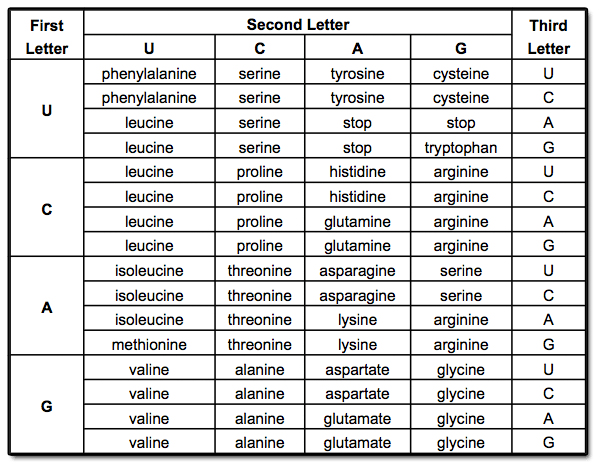
What amino acid is represented by the codon UUA?
a)
Phenylalanine
b)
Tyrosine
c)
Leucine
d)
Stop codon
54.
What process is going on in this photo? 
a)
Transcription 
b)
Translation 
c)
Replication 
d)
All the above 
55.

If a gene has 30 nucleotides, how many amino acids does it have?

a)

3

b)

10

c)

60

d)

90

56.
The following picture must be
a)
DNA because it's double stranded
b)
RNA because it's single stranded
c)
DNA because it's single stranded
d)
RNA because it's double stranded
57.
An expressed gene
a)
functions as a promoter
b)
is transcribed into RNA
c)
codes for just one amino acid
d)
is made of mRNA
58.

What is recombinant DNA

a)

DNA from 2 different organisms combined

b)

DNA from 2 different ribosomes

c)

DNA that is separated out from a vector

59.

Which of the following could be used as a vector for a human gene?

a)

Bacterial Plasmid

b)

Bacteria

c)

A mitochondria

d)

mRNA

60.

In which ways can genetic engineering can improve crops

a)

Make them pest or drought resistant

b)

Make them more nutritious

c)

Make them larger

d)

All answers are correct

61.

A circular piece of DNA, found in bacteria, is called:

a)

A plasmid

b)

mRNA

c)

Ribosome

d)

Nucleotide

62.
Polymerase chain reaction is used to
a)
determine the sequence of DNA.
b)
make copies of a DNA sequence.
c)
selectively breed plants and animals.
d)
produce mutations in bacteria.
63.
Which is used to cut DNA molecules at specific points?
a)
gel electrophoresis
b)
PCR analysis
c)
a restriction enzyme
d)
recombinant DNA
64.
Transgenic organisms contain
a)
genes from other species.
b)
cells of another organism.
c)
genes of only one parent.
d)
one or more human genes.
65.
In humans, what would the blood type of a child be if she inherited type A from Dad and type B from Mom?
a)
O
b)
A
c)
B
d)
AB
66.
Having two of the same genes for the trait (TT, tt); Both dominant or both recessive.
a)
homozygous or purebred
b)
heterozygous or hybrid
c)
twin offspring
d)
pairs of chromosomes
67.
Which of the following alleles is homozygous (purebred) recessive?
a)
Tt
b)
tt
c)
TT
d)
t
68.
Dominant alleles are represented by a:
a)
Male gene
b)
lowercase letter
c)
recessive trait
d)
capital letter
69.
Two brown eyed parents (Bb) have a baby. What is the chance the baby is blue eyed?
a)
0 %
b)
25%
c)
50%
d)
75%
70.
Which of the following is a phenotype?
a)
Aa
b)
red hair
c)
heterozygous genes
d)
mutated DNA
71.
G = green, g = yellow
The genotype for a yellow plant is...
a)
GG
b)
Gg
c)
gg
d)
all of the choices result in yellow
72.
T = tall an t = short
TT and Tt would result in  the following phenotype
a)
short
b)
tall
c)
medium sized
d)
neither tall or short
73.
What is the cause of some traits "skipping" a generation?
a)
dominant traits
b)
recessive traits
c)
mutations
d)
natural selection
74.
Pea plants can have green or yellow seeds. In a pea plant that is heterozygous for seed color, the allele for yellow seeds masks the effects of the allele of green seeds. Which of the following terms best describes the allele for yellow seeds?
a)
codominant
b)
recessive
c)
dominant
d)
sex-linked
75.
This type of inheritance pattern is a MIXTURE of both traits.
a)
incomplete dominance
b)
co-dominance
c)
complete dominance
d)
recessive pattern
76.
Colorblindness is a recessive, X chromosome sex-link disorder. Cross the parents to figure out which percentage of their offspring will be colorblind.
a)
25%
b)
0%
c)
75%
d)
50%
77.
This type of inheritance pattern shows BOTH traits in possible offspring
a)
complete dominance
b)
incomplete dominance
c)
co-dominance
d)
dominant pattern
78.
What type of heredity is shown in the pedigree?
(hint: check your notes - "modes of inheritance")
a)
Sex-Linked Dominant
b)
Sex-Linked Recessive
c)
Autosomal Dominant
d)
Autosomal Recessive 
79.
What would the genotype be for this Punnett Square?  B is dominant for brown hair.
a)
2Bb, 2bb
b)
2BB, 2Bb
c)
1BB, 2Bb, 1bb
d)
4Bb
80.
Which individual in the first generation is a carrier?
a)
The male
b)
The female
c)
individual 1
d)
None of the above
81.
Colorblindness is more common in males than in females because
a)
Fathers pass the allele for colorblindness to their sons only
b)
The allele for colorblindness is located on the Y chromosome.
c)
The allele for colorblindness is recessive and located on the X chromosome.
d)
Males who are colorblind have two copies of the allele for colorblindness.
82.
Given that this is a recessive pedigree...
What is the genotype of individual II-5?
a)
aa
b)
Aa
c)
AA
d)
Can't tell
83.

The factors which represent the contrasting pairs of characters are called

a)

Dominant and recessive

b)

Alleles

c)

Homologous pairs

d)

Determinants

84.

ABO blood grouping shows

a)

Polygenes

b)

Dominant-recessive genes

c)

Codominant genes

d)

Both codominant and dominant recessive genes

85.
An application of using DNA technology to help environmental scientists would be ___.
a)
use PCR to analyze DNA at a crime scene
b)
create a tobacco plant that glows in the dark
c)
clone the gene for human growth hormone to treat pituitary dwarfism
d)
make transgenic bacteria that can be used to clean up oil spills more quickly than do the natural bacteria
86.
Recombinant DNA are currently used to produce____.
a)
clothing dye, cheese, and laundry products
b)
human antibiotics and vaccines
c)
crops that taste better and stay fresh longer
d)
all of these
87.
A gene gun and a virus may both be classified as ____ because they are mechanisms by which foreign DNA may be transferred into a host cell.
a)
bacteria
b)
plasmids
c)
vectors
d)
splicers
88.

What cell organelle carries its own DNA passed down from the mother and is used to trace genealogy?

a)

ribosome

b)

golgi apparatus

c)

mitochondria

d)

vesicles

89.

The process used to make copies of DNA when not much is available and is often used in forensics is called

a)

gel electrophoresis

b)

cloning

c)

PCR

d)

transgenics

90.

Polymerase Chain Reaction

a)

Is used to make copies of specific regions of DNA

b)

Uses a special form of DNA polymerase and primers to copy DNA

c)

is used in crime scenes and paternity cases to compare DNA samples

d)

All of the choices are correct

e)

some of the choices are correct

91.

This seals the sticky ends of restriction fragments to make recombinant DNA

a)

restriction enzymes

b)

gene cloning

c)

DNA ligase

d)

reverse transcriptase

92.

What does hybridization produce?

a)

natural selection with a combination of the best traits from each parent

b)

artificial selection with a combination of the best traits from each parent

c)

Replication with a combination of the best traits from each parent

d)

offspring with a combination of the best traits from each parent

93.

A condition whereby an organism has more than two complete sets of chromosomes in all cells

a)

Insertion

b)

Point Mutation

c)

Polyploidy

d)

Frame-shift Mutation

94.
How can gel electrophoresis be used for identification of individuals when over 99 percent of human DNA is the same?
a)
Each person’s DNA will band in different colors in the gel tray
b)
The 99 percent of the DNA that is the same will reflect UV light differently
c)
It focuses only on the small regions of the DNA which are known to vary among individuals.
d)
Experts can determine the different genes by reading the genetic alphabet displayed in the gel.
95.
Two people believe they are related. Which would be the best technique to determine if they are related?
a)
testing blood types
b)
comparing DNA
c)
examining karyotypes
d)
testing for genetic disorders
96.
Genetically engineered bacteria are currently being used to produce certain human proteins. Which best explains the advantage associated with this process?
a)
The genetically engineered proteins can be used to produce human clones.
b)
The genetically engineered proteins have been found to cure most cancers.
c)
The genetically engineered proteins are less harmful than normal human proteins.
d)
The genetically engineered proteins can be produced in large quantities with less cost.
97.
How will advances in genetics most likely affect biotechnology?
a)
Biotechnology will provide cures for all diseases in the future.
b)
Biotechnology will gradually phase out of the field of medicine.
c)
Biotechnology will create new genes that will make certain diseases disappear from the human genome.
d)
Biotechnology will enable better prediction and treatment of various diseases.
98.
What do all organisms have in common?
a)
They use DNA and RNA to pass on information.
b)
They are all eukaryotes.
c)
They are all prokaryotes.
d)
They are genetically identical.
99.
Several procedures involved in the creation of a transgenic organism are listed. 
1. A specific gene is identified in DNA. 
2. The DNA fragment is placed in a plasmid. 
3. The DNA fragment of interest is isolated. 
4. The plasmid is transferred to a bacterial cell. 
5. A plasmid is cut by a restriction enzyme. 
Which selection represents the correct order of events in creating a transgenic organism?

a)
1, 3, 2, 4, 5
b)
3, 5, 2, 4, 1
c)
1, 3, 5, 2, 4
d)
3, 1, 4, 2, 5
100.
Which steps are in the correct order to create insulin-producing bacteria?
a)
cut bacterial plasmid with restriction enzyme, insert human insulin-producing gene, seal with ligase enzyme
b)
seal with ligase enzyme, cut bacterial plasmid with restriction enzyme, insert human insulin-producing gene
c)
cut bacterial plasmid with restriction enzyme, seal with ligase enzyme, insert human insulin-producing gene
d)
insert human insulin-producing gene, cut bacterial plasmid with restriction enzyme, seal with ligase enzyme