
 Worksheets
A&P I Lab Weeks 3-5
Total questions: 164
Worksheet time: 2hrs 26mins

Superior or Inferior Surface?
Superior
Inferior

From Left to Right, Identify the bones
Rib, Clavicle
Clavicle, Rib

What part of the Humerus is this?
Head of the humerus
Greater tubercle
Intertubercular groove / Bicipital groove
Linea aspera

Anterior or Posterior View?
Anterior
Posterior
Greater Tubercle
Head

What part is highlighted
Head of humerus
Bicipital Groove
Olecranon Fossa
Lateral epicondyle

Anterior or Posterior?
Red arrow points to what?
Anterior, Greater Tubercle
Posterior, Greater Tubercle
Anterior, Lesser Tubercle
Posterior, Head of humerus

What is highlighted in yellow?
Intertubercular groove
Olecranon fossa
Head
Lateral epicondyle

What is highlighted in orange?
Intertubercular Groove
Bicipital
Groove
Head
of
humerus
sulcus

Highlighted section?
Anterior or Posterior?
Right or Left?
Medial Epicondyle,
Posterior,
Right
Medial Epicondyle,
Anterior, Right
Lateral epicondyle,
Posterior, Left
Medial Epicondyle,
Posterior,
Left
M

What's highlighted in purple?
Anterior or Posterior?
Lateral Epicondyle, Anterior
Medial Epicondyle, Posterior
Lateral Epicondyle,
Posterior
Lateral Epicondyle, Inferior

Right or Left Clavicle? Inferior or Superior?
Left Clavicle, Superior
Right Clavicle, Superior
Right Clavicle, Inferior
Left Clavicle, Inferior

#2
styloid process of the radius
head of the radius
styloid process of the ulna
neck of the radius

11
ulnar notch
radial notch
trochlear notch
head of the radius

7
coronoid process
olecranon process
styloid process
radial tuberosity

3
styloid process of the radius
radial head
radial process
styloid process of the ulna

6
head of the ulna
head of the radius
head of the humerus
neck of the ulna

Arrow points to....?
Ulna or Radius?
Raidial Tuberosity, Radius
Radial Tuberosity, Ulna
Styloid Process, Radius
Styloid process, ulna


SPINE
ACROMION
CORACOID PROCESS
SUPRAGLENOID TUBERCLE

GLENOID CAVITY
OBLIQUE GROOVE
SUBSCAPULAR FOSSA
SUPRAGLENOID TUBERCLE

GLENOID FOSSA
SCAPULAR NOTCH
INFRASPINOUS FOSSA
INFRASPINATUS MUSCLE


RADIUS


ULNA


RADIAL NOTCH
RADIAL GROOVE
HEAD OF RADIUS
STYLOID PROCESS OF RADIUS


Name Bone 2
cuneiform
cuboid
calcaneus
talus
navicular
Name Bone 1
cuneiform
cuboid
calcaneus
talus
navicular

#2
Metacarpals
Carpals
Phalanges
Tarsals

#3-10
Tarsals
Metacarpals
Phalanges
Carpals

#1
Phalanges
Carpals
Metacarpals
Tarsals
What are the bones in the fingers called?
Phalanges
Patellas
Tarsals
Vertebrae


Identify the highlighted part on this bone
Posterior superior iliac spine
Posterior inferior iliac spine
Iliac Crest
Ilium

Identify the highlighted part on this bone
Posterior superior iliac spine
Posterior inferior iliac spine
Anterior superior iliac spine
Anterior inferior iliac spine

Identify the highlighted part on this bone (The hole)
Acetabulum
Iliac fossa
Pubis
Obturator foramen

Identify the highlighted part of this bone
Obturator foramen
Pubis
Acetabulum
Iliac fossa

Identify the circled part in the picture
Superior pubic ramus
Inferior pubic ramus
Pubis
Symphysis Pubis

Identify the highlighted part of this bone
Greater sciatic notch
Lesser sciatic notch
Ischial spine
Pubic tubercle

Identify the highlighted part of this bone
Greater sciatic notch
Lesser sciatic notch
Ischial spine
Pubic tubercle

Identify the highlighted part on this bone
Ischial tuberosity
Pubic tubercle
Ischial spine
Greater sciatic notch

Identify the highlighted part on this bone
Pubic tubercle
Ischial tuberiosity
Ischial spine
Inferior pubic ramus

Identify the highlighted part of this bone
Sacroiliac joint
Posterior inferior iliac spine
Ischial tuberosity
Iliac fossa

Identify the highlighted part of this bone
Posterior superior iliac spine
Posterior inferior iliac spine
Anterior superior iliac spine
Anterior inferior iliac spine

Identify the highlighted part of this bone
Ischial spine
Pubic tubercle
Symphysis pubis
Ischial tuberosity

Identify the highlighted part of this bone
Posterior superior iliac spine
Posterior inferior iliac spine
Anterior superior iliac spine
Anterior inferior iliac spine

Identify the highlighted part of this bone
Posterior superior iliac spine
Posterior inferior iliac spine
Anterior superior iliac spine
Anterior inferior iliac spine


What is number 9?
Head
Lesser trochanter
Fovea capitis
Neck

What is number 1?
Lesser trochanter
Greater trochanter
Diaphysis
Medial condyle

What is number 10?
Neck
Head
Fovea capitis
Lesser trochanter

What is number 3?
Lateral epicondyle
Patellar surface
Lateral condyle
Medial condyle

What is number 8?
Lesser trochanter
Greater trochanter
Diaphysis
Fovea capitis

What is number 11?
Neck
Head
Greater trochanter
Lesser trochanter

What is number 5?
Patellar surface
Lateral condyle
Medial epicondyle
Medial condyle


The orange line is the:
medial condyle of fibula
tibial tuberosity
tibial crest
medial tibial condyle

Tibial tuberocity
Medial malleolus
Lateral malleolus
Greater trochanter

What is number 7?
Anterior border
Lateral surface
Medial surface
Lateral malleolus


External Acoustic Meatus


bone highlighted in green
sphenoid
parietal
frontal
ethmoid

suture highlighted in red
coronal
squamosal
lamboidal
metopic

suture highlighted in red
frontal
sagittal
coronal
squamosal

suture highlighted in red
coronal
lamboidal
sagittal
metopic

bone highlighted in green
occipital
frontal
parietal
ethmoid

suture highlighted in red
metopic
coronal
lamboidal
squamosal

suture highlighted in red
lamboidal
frontal
sagittal
squamosal

What is the arrow pointing to?
Supraorbital Ridge
Supraorbital Foramen
Infraorbital notch
Orbit

What has been removed?
What view is this?
Calvarium, Lateral
Calvarium, Inferior
Parietal & Occipital Bones, Superior
Calvarium, Superior

Interorbital Breadth
Orbit
Supraorbital Ridge
Temporal
Occipital

What part is #12?
Incus/Anvil
Malleus/Hammer
Cochlea/Snail Shell
Stapes/Stirrup
What part is #10?
Incus/Anvil
Malleus/Hammer
Cochlea/Snail Shell
Stapes/Stirrup

What does the red arrow indicate?
Frontal Bone
Supraorbital Notch / Foramen
Frontal Sinus
Foramen Magnum
What part is #13?
Incus/Anvil
Malleus/Hammer
Cochlea/Snail Shell
Stapes/Stirrup

What is the yellow arrow indicating
External auditory meatus
External nasal spine
External jugular groove
External occipital protuberance

What part do the red lines indicate?
crista galli
perpendicular plate of the ethmoid
sinuses
olfactory foramina

What part of the ethmoid bone is B?
cribiform plate
crista galli
perpendicular plate
sella turcica

What is highlighted
Cribiform plate
sinuses
Orbital surface
Olfactory Foramina

What is the first lateral part to the Cribriform plate?
Ethmoidal Air Cells
Crista Galli
Perpendicular Plate
Olfactory Foramina

What is the red arrow pointing to?
Stylomastoid Foramen
Carotid Canal
Vaginal Process
Mastoid Notch

Name highlighted part
Formen Rotundum
Foramen Ovale
Foramen Spinosum
Greater Wing of sphenoid bone

Name highlighted part
Formen Rotundum
Foramen Ovale
Foramen Spinosum
Greater Wing of sphenoid bone

Name highlighted part
Formen Rotundum
Foramen Ovale
Foramen Spinosum
Greater Wing of sphenoid bone

Name highlighted part
Formen Rotundum
Foramen Ovale
Foramen Spinosum
Greater Wing of sphenoid bone

Highlighted Part
Lesser Wing of Sphenoid Bone
Hypophyseal fossa
Optic Canal
Sphenoid Sinus

Highlighted Part
Lesser Wing of Sphenoid Bone
Hypophyseal fossa
Optic Canal
Sphenoid Sinus

Highlighted Part
Lesser Wing of Sphenoid Bone
Hypophyseal fossa
Optic Canal
Sphenoid Sinus

Highlighted Part
Lesser Wing of Sphenoid Bone
Hypophyseal fossa
Optic Canal
Superior Orbital Fissure

Name highlighted section
Optic Canal
Carotid Canal
Sphenoid Sinus
Frontal Sinus
What part of the ethmoid bone is C?
cribiform plate
crista galli
perpendicular plate
sella turcica

Label #22
mandible
ramus
coronoid process
condylar process

Highlighted Section is what?
Coronoid Process
Mandibular Foramen
Infraoribtal Foramen
Frontal Foramen

Label #9
mandible
coronoid process
condylar process
ramus

What is the structure on this picture?
infraorbital foramen
palatine process
zygomatic arch
horizontal plate
mental foramen

sternum
sacrum
hyoid
lumbar


Identify Bone "B"
Lacrimal
Ethmoid
Sphenoid
Nasal

Use the image. Which bone is labelled #12 (dark purple)?
Sphenoid
Ethmoid
Vomer
Inferior Nasal Concha

The red-coloured paranasal sinus is
maxillary
frontal
ethmoid
sphenoid

Identify the following "green" sinuses......
ethmoid
maxillary
sphenoid
frontal
none of them

Identify the following "yellow" sinuses......
ethmoid
maxillary
sphenoid
frontal
none of them

Identify the following "blue" sinuses......
ethmoid
maxillary
sphenoid
frontal
none of them

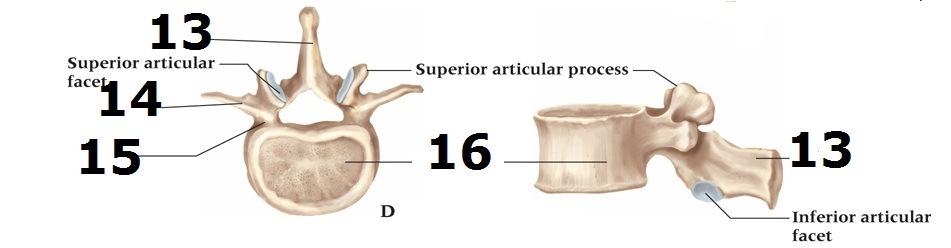
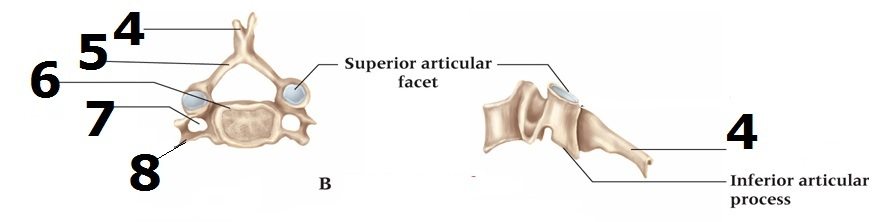
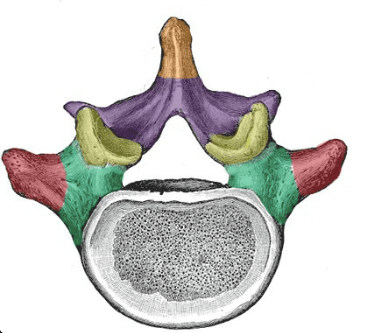

What is number 5? Bony projection that articulates with the vertebra below it.
Pedicle
Superior Articular Facet
Transverse Process
Inferior Articular Facet
What is number 2? Bony projection that articulates with the vertebra above it.
Demifacet
Superior Articular Facet
Lamina
Pedicle

These are intervertebral discs
OK
OK
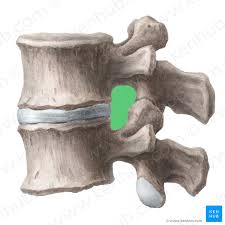
The green portion is? Where the spinal nerve roots exit the spinal cord/column.
Vertebral Foramen
Foramen
Intervertebral Foramen
Hole in vertebra

How many lumbar vertebrae bones do you have?
12
7
5
4

How many cervical vertebrae do you have?
12
7
5
4

How many thoracic vertebrae do you have?
12
5
7
4

Are the sacrum and the coccyx a part of the vertebrae?
True
False

Identify the highlighted vertebrae
Lumbar
Thoracic
Cervical
Sacral

Identify the highlighted vertebrae
Lumbar
Thoracic
Cervical
Sacral

Identify the highlighted vertebrae
Lumbar
Thoracic
Cervical
Sacral


Five vertebrae that are fused form the _______ ________.
cervical vertebrae
thoracic vertebrae
lumbar vertebrae
sacral vertebrae

What is highlighted?
sacral canal
sacral foramina
sacrum
coccyx

Highlighted what?
Odontoid process
Sacral foramina
Transverse process
Intervertebral disc


Identify the highlighted part
Articular process
Pedicle
Lamina
Facet

Identify the highlighted part
Facet
Lamina
Spinous process
Transverse process

Identify the highlighted part
Facet
Spinous process
Lamina
Transverse process

Identify this bone
Rib
Sternum
Vertebrae
Clavicle

What is number 10?
Anterior border
Interosseous border
Medial border
Medial surface

Tibial tuberocity
Medial malleolus
Lateral malleolus
Greater trochanter

Medial malleolus
Lateral malleolus
Greater trochanter
Tibial tuberocity

Tibia
Fibula
Femur
Ulna

