
 Worksheets
Accelerated Anatomy 1st Semester Final Review
Total questions: 160
Worksheet time: 2hrs 1mins
Name
Class
Date
1.
Proteins are made of monomers called ___________
a)
Nucleotides
b)
Monosaccharides
c)
Amino Acids
d)
Glycerol and fatty acids
2.
The element _______is found in all of the organic compounds.
a)
Iron
b)
Nitrogen
c)
Carbon
d)
Oxygen
3.
DNA and RNA are examples of
a)
Carbohydrates
b)
Lipids
c)
Proteins
d)
Nucleic Acids
4.
Nucleotides are monomers of
a)
Carbohydrates
b)
Lipids
c)
Proteins
d)
Nucleic Acids
5.
Monosaccharides are monomers of
a)
Carbohydrates
b)
Lipids
c)
Proteins
d)
Nucleic Acids
6.
Waxes, oils and fats are examples of
a)
Carbohydrates
b)
Lipids
c)
Proteins
d)
Nucleic Acids
7.

Which macromolecule is shown?
View Figure 1 (if not visible)
View Figure 1 (if not visible)
a)
lipid
b)
protein
c)
nucleic acid
d)
carbohydrate
8.

Which macromolecule is shown?
View Figure 2 (if not visible)
View Figure 2 (if not visible)
a)
lipid
b)
protein
c)
nucleic acid
d)
carbohydrate
9.

Which macromolecule is shown?
View Figure 3 (if not visible)
View Figure 3 (if not visible)
a)
lipid
b)
protein
c)
nucleic acid
d)
carbohydrate
10.

Which macromolecule is shown?
View Figure 4 (if not visible)
View Figure 4 (if not visible)
a)
lipid
b)
protein
c)
nucleic acid
d)
carbohydrate
11.
What type of macromolecule are enzymes?
a)
Protein
b)
Carbohydrate
c)
Lipid
d)
Nucleic Acid
12.
Which macromolecule stores energy, insulates us, and makes up the cell membrane?
a)
lipids
b)
proteins
c)
carbohydrates
d)
nucleic acids
13.

What type of macromolecule is being represented in this image?
a)
carbohydrate
b)
lipid
c)
protein
d)
nucleic acid
14.

Which macromolecule is this?
a)
carbohydrates
b)
lipids
c)
proteins
d)
nucleic acids
15.
Osmosis is the movement of _____ across a membrane.
a)
food
b)
energy
c)
oxygen
d)
water
16.
Which is true about active transport?
a)
It requires energy
b)
it does not require energy
c)
It moves substances down the concentration gradient
d)
it moves material from high to low concentration
17.
Molecules diffusing with the concentration gradient through a protein channel is...
a)
Facilitated Diffusion
b)
Simple Diffusion
c)
Active Transport
d)
Osmosis
18.

The cell below is in a _________ solution.
a)
Hypotonic
b)
Hypertonic
c)
Isotonic
19.

The cell below is in a _____________ solution.
a)
Hypertonic
b)
Hypotonic
c)
Isotonic
20.
A cell in an isotonic solution will
a)
swell
b)
shrink
c)
stay the same size
d)
impossible to tell
21.
A cell in a hypotonic solution will
a)
swell
b)
shrink
c)
stay the same size
d)
impossible to tell
22.

What type of transport is this?
a)
facilitated diffusion
b)
active transport
c)
diffusion
d)
osmosis
23.
Low to High
a)
Passive Transport
b)
Active Transport
24.
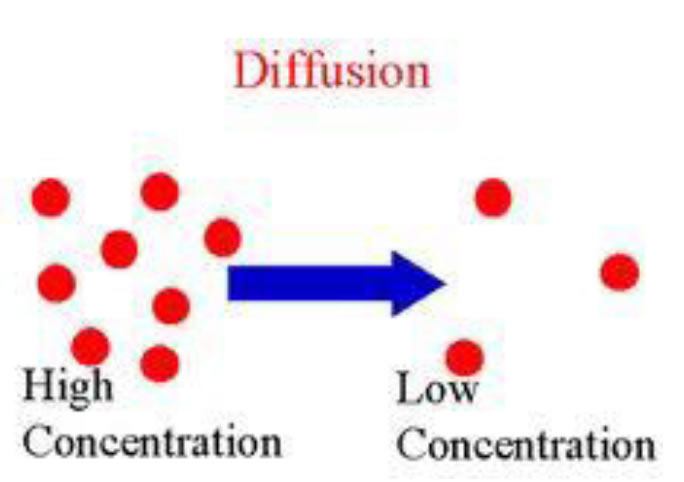
Movement of particles from high to low concentration.
a)
Passive Transport
b)
Active Transport
25.
Osmosis is a form of ______________.
a)
Passive Transport
b)
Active Transport
26.
Solutes move with the concentration gradient, therefore no energy is used.
a)
Passive Transport
b)
Active Transport
27.
What is it called when molecules move across the cell membrane from an area of high concentration to an area of low concentration through a carrier protein?
a)
Diffusion
b)
Osmosis
c)
Active Transport
d)
Facilitated Diffusion
28.
Which plane divides the body into left and right sides
a)
Frontal
b)
Coronal
c)
Sagittal
d)
Transverse
29.
Which of the following is NOT a plane of the body?
a)
Coronal
b)
Frontal
c)
Transverse
d)
Vertical
30.
Which of the following planes has a horizontal line through the body
a)
Transverse
b)
Coronal
c)
Lateral
d)
Frontal
31.
What does the coronal plane divide the body into?
a)
Front to back
b)
Side to side
c)
Left to right
d)
Top to bottom
32.
Moving your arms from your side to above your head, is which type of movement?
a)
Proximal
b)
Distal
c)
Abduction
d)
Adduction
33.
Performing a bicep curl is which type of movement?
a)
Extension
b)
Doriflexion
c)
Plantarflexion
d)
Flexion
34.
Your ears are _______ to your eyes
a)
Lateral
b)
Medial
c)
Superior
d)
Inferior
35.
Your head is ________ blank to your toes
a)
Inferior
b)
Medial
c)
Superior
d)
Sagittal
36.
Your elbow is _______ to your wrist
a)
Lateral
b)
Distal
c)
Inferior
d)
Proximal
37.
Your spine is ______ to your heart
a)
Anterior
b)
Posterior
c)
Medial
d)
Distal
38.
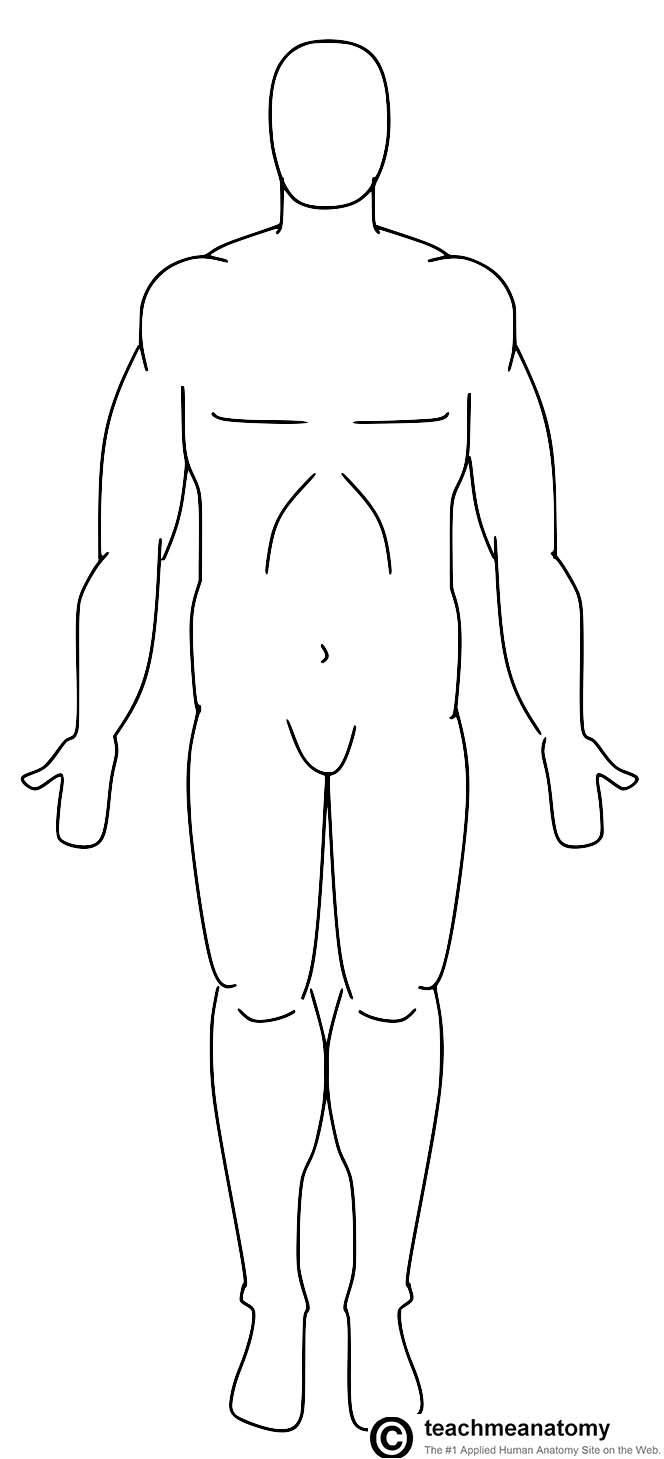
In the anatomical position, the palms are facing-
a)
forward
b)
backward
39.

The cranial cavity and the spinal (vertebral) cavity are both contained within the _______ cavity.
a)
dorsal
b)
ventral
c)
abdominal
d)
throacic
40.

The thoracic cavity and the abdominopelvic cavity are both contained within the _______ cavity.
a)
dorsal
b)
ventral
c)
cranial
d)
spinal
41.

#6
a)
diaphram
b)
abdominal
c)
thoracic
d)
pelvic
42.
Which of the following correctly describes the carpal region?
a)
elbow
b)
wrist
c)
abdomen
d)
neck
43.
Which of the following correctly describes the celiac region?
a)
elbow
b)
wrist
c)
abdomen
d)
neck
44.
Which of the following correctly describes the cervical region?
a)
elbow
b)
wrist
c)
abdomen
d)
neck
45.
Which of the following correctly describes the axillary region?
a)
armpit
b)
upper arm
c)
cheek
d)
head
46.
Which of the following correctly describes the buccal region?
a)
armpit
b)
upper arm
c)
cheek
d)
head
47.
Which of the following correctly describes the antebrachial region?
a)
forearm
b)
leg
c)
back
d)
reproductive organs
48.
The process by which the nuclear material is divided equally between two new cells
a)
mitosis
b)
cancer
c)
spindle
d)
centromere
49.

Name the phase:
a)
Anaphase
b)
Telophase
c)
Metaphase
d)
Prophase
50.
The phase in mitosis where chromosomes move away and are pulled apart by spindles to opposite sides of the cell.
a)
prophase
b)
anaphase
c)
metaphase
d)
telephase
51.

Which is Metaphase?
a)
A
b)
E
c)
C
d)
F
52.
Which of these phases of mitosis take place first?
a)
anaphase
b)
telophase
c)
prophase
d)
metaphase
53.
If the message never gets through for a cell to stop dividing and it just keeps dividing over and over again, what can form?
a)
tumor
b)
freckle
c)
goosebump
d)
scab
54.
Why does the genetic material in a cell double before it undergoes mitosis?
a)
So each new cell has a complete copy of the DNA.
b)
So each new cell has 2 complete sets of DNA.
c)
So there is an extra set in case 1 set is damaged.
d)
It is practicing so the next time it knows what to do.
55.
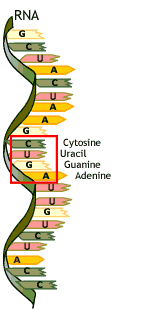
In RNA, Uracil pairs with ______.
a)
cytosine
b)
adenine
c)
guanine
d)
thymine
56.
The process to go from DNA to mRNA is _______
a)
translation
b)
transcription
c)
replication
57.
The process to go from mRNA to a protein is called ____
a)
transcription
b)
rRNA
c)
replication
d)
translation
58.
DNA holds the code for
a)
lipids
b)
carbohydrates
c)
protein
d)
sugar
59.
Choose the nucleotide sequence of the RNA strand that would be complementary to the following strand:
GTAGTCA
GTAGTCA
a)
UATUAGA
b)
ACGACTG
c)
CAUCAGU
d)
CATCAGT
60.
The main function of tRNA is to...
a)
carry a message that, when translated, forms proteins
b)
form a portion of ribosomes
c)
string together complementary RNA and DNA strands
d)
bring amino acids from the cytoplasm to the ribosomes
61.
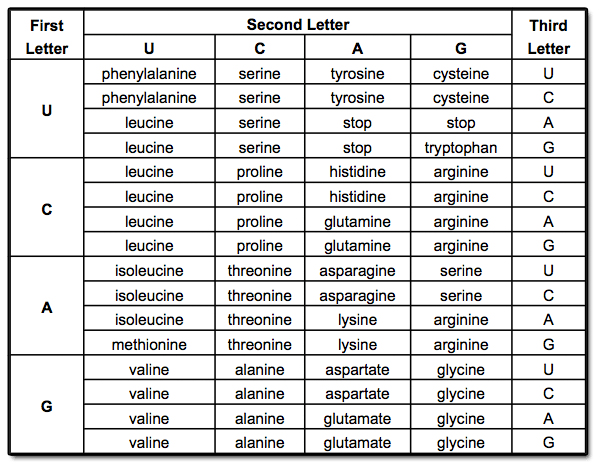
What amino acid is represented by the codon UUA?
a)
Phenylalanine
b)
Tyrosine
c)
Leucine
d)
Stop codon
62.
What is the three base sequence of mRNA that codes for a single amino acid?
a)
Anticodon
b)
Codon
c)
Protein
63.
Which is the mRNA molecule that would be transcribed from this DNA template:
TGGCAAGTACGT
TGGCAAGTACGT
a)
ACCGTTCATGCA
b)
UGGCAAGUACGU
c)
UCCGUUCUUGCU
d)
ACCGUUCAUGCA
64.
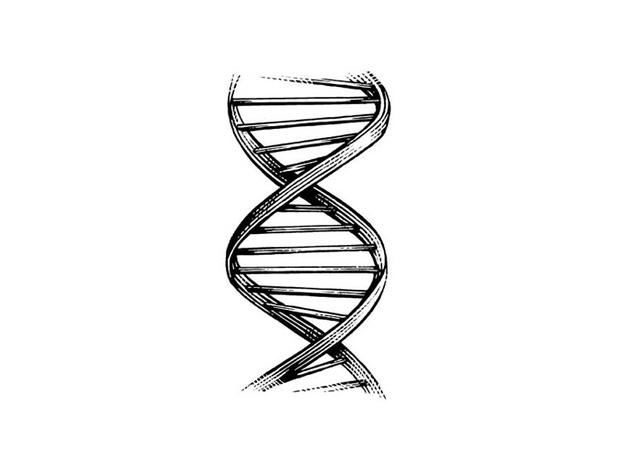
DNA has a _____________ structure.
a)
double helix
b)
single strand
c)
ring
d)
chain
65.
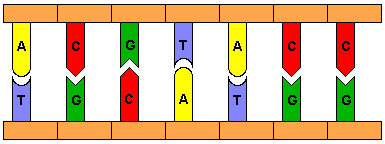
In DNA, Adenine pairs with ___________.
a)
Guanine
b)
Cytosine
c)
Thymine
d)
Uracil
66.
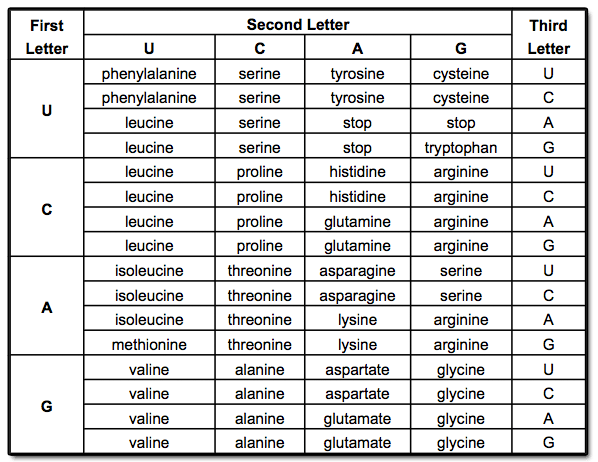
What is the correct amino acid sequence for the mRNA code AUGCCAGUAUGA
a)
Met-Pro-Ala-Val
b)
Met-Pro-Val
c)
Tyr-Gly-His
d)
Tyr-Gly-Arg-His
67.
How many amino acids are coded for by this sequence of nucleotides:
ATG GGA ACT CCA
ATG GGA ACT CCA
a)
4
b)
2
c)
6
d)
12
68.
Which of the following is NOT one of the four primary tissue types?
a)
Gastric
b)
Connective
c)
Muscle
d)
Epithelial
69.
Which of the following cell types is correctly matched with it's cell shape?
a)
Squamous - flattened, pancake
b)
Cuboidal - rectangular
c)
Columnar - flattened, pancake
d)
Columnar - cubed/square
70.
What is the general structure of cuboidal cells?
a)
Square with large central nucleus
b)
Flat, 'fried egg' appearance
c)
Rectangular with nucleus towards basal end
d)
Dead apical cells filled with keratin
71.
The common term for adipose tissue is
a)
Fat
b)
Blood
c)
Bone
d)
Cartilage
72.
Cardiac muscle is specific to which organ?
a)
Heart
b)
Brain
c)
Pancreas
d)
Lungs
73.

What tissue type is this?
a)
Adipose tissue
b)
Cardiac muscle
c)
Nervous tissue
d)
Skeletal muscle
74.
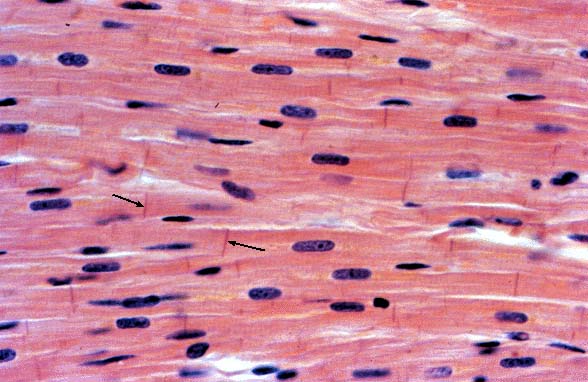
What tissue type is this? (The arrows are a clue)
a)
Cardiac muscle
b)
Skeletal muscle
c)
Smooth muscle
d)
Nervous tissue
75.
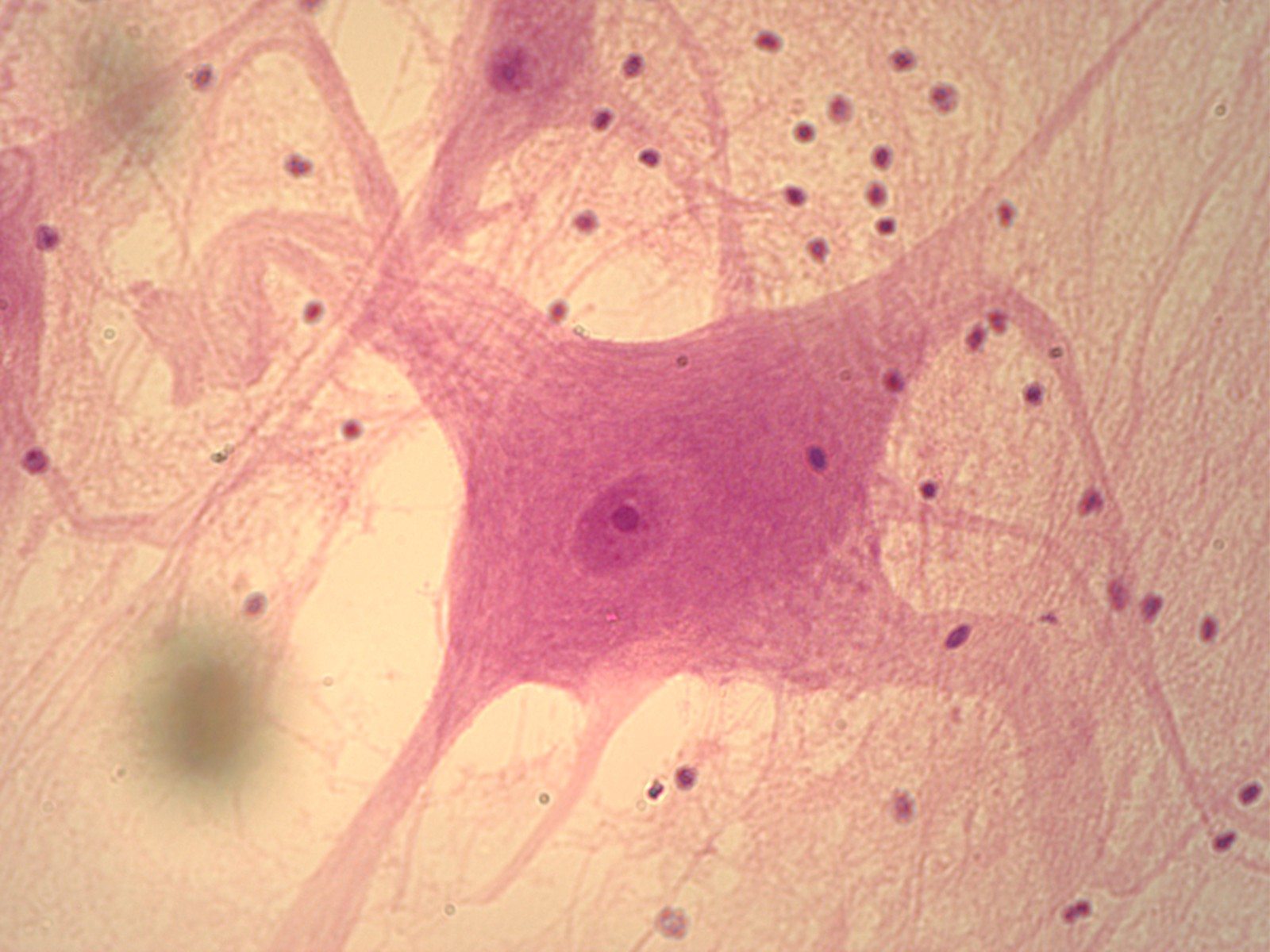
What tissue type is this?
a)
Nervous tissue
b)
Cardiac muscle
c)
Smooth muscle
d)
Connective tissue proper
76.

What tissue type is this?
a)
Skeletal muscle
b)
Nervous tissue
c)
Adipose tissue
d)
'Specialised' connective tissue
77.
Which of the following is a function of epithelial tissue?
a)
Protection
b)
Absorption
c)
Secretion
d)
All the the above
78.
This type of epithelium has only one layer of cells
a)
Stratified epithelium
b)
Simple epithelium
79.
Column shaped cells
a)
Squamous
b)
Cuboidal
c)
Columnar
80.
Pseudo stratified cells are actually layered
a)
True
b)
False
81.
This type of epithelium changes shape
a)
squamous
b)
cuboidal
c)
columnar
d)
transitional
82.
The connective tissue has an extra cellular matrix.
a)
True
b)
False
83.
Which is NOT one of the 3 components that create connective tissue??
a)
Ground substance
b)
Fibers
c)
Cells
d)
Basement membrane
84.

Name this tissue
a)
Bone
b)
Cartilage
c)
Blood
d)
Adipose
85.

Name this tissue
a)
Bone
b)
Cartilage
c)
Blood
d)
Adipose
86.
Chondrocytes are found in cavities called ___.
a)
lacunae
b)
lamellae
c)
canaliculi
87.
Loose connective tissue contains many different fibers. The thick rope-like fibers are called:
a)
Elastic Fibers
b)
Reticular Fibers
c)
Collagen
88.
Which of the following cell types creates histamines (which cause allergy symptoms)?
a)
Adipocyte
b)
Fibroblast
c)
Melanocyte
d)
Mast Cell
89.
Which type of tissue includes cells attached to a basement membrane?
a)
Connective
b)
Muscle
c)
Epithelial
d)
Nervous
90.
The outermost layer of the skin that contains no blood vessels or nerve cells.
a)
epidermis
b)
dermis
c)
subcutaneous tissue or hypodermis
91.
Corium or "true skin" that has framework of elastic connective tissue and contains blood vessels, lymph vessels,nerves, involuntary muscle, sweat, oil glands, and hair follicles.
a)
epidermis
b)
dermis
c)
subcutaneous fascia or hypodermis
92.
Innermost layer of the skin that is made of elastic connective tissue and adipose tissue. This layer connects the skin to underlying muscles.
a)
epidermis
b)
dermis
c)
subcutaneous fascia or hypodermis
93.
Which is not an accessory organ of the skin?
a)
hair
b)
nails
c)
sebaceous glands
d)
melanin
94.
The skin helps to produce _______________ by using UV rays from the sun.
a)
Vitamin A
b)
Vitamin C
c)
Vitamin D
d)
Vitamin K
95.
Brownish black pigment produced by cells in the skin.
a)
erythrocytes
b)
leukocytes
c)
melanocytes
96.
Condition where there is an absence of color pigments:
a)
jaundice
b)
erythema
c)
albinism
97.
Yellow discoloration of the skin that can indicate bile in the blood as a result of liver or gallbladder diseases.
a)
erythema
b)
jaundice
c)
cyanosis
d)
albinism
98.
Skin color is due to a pigment called
a)
Keratin
b)
Melanin
c)
Chromatin
d)
Epithelium
99.
The epidermis is composed of _____.
a)
stratified squamous epithelium
b)
simple columnar epithelium
c)
adipose tissue
d)
connective tissue
100.
A sunburn might be an example of a:
a)
1st degree burn
b)
2nd degree burn
c)
3rd degree burn
d)
4th degree burn
101.
Sweating to regulate body temperature is an example of
a)
negative feedback
b)
positive feedback
c)
a homeostatic imbalance
d)
aging
102.
Goosebumps are caused by contractions of the ______ muscle
a)
Arrector pili
b)
Apocrine
c)
Eccrine
d)
Sebaceous
103.
In which layer of the skin are melanocytes located?
a)
Dermis
b)
Subcutaneous/ hypodermis
c)
Epidermis
d)
None of the above
104.
The bottommost layer of skin that is primarily made up of adipose tissue.
a)
hypodermis
b)
dermis
c)
nasodermis
d)
epidermis
105.
All of the following are functions of the skin except
a)
pumps blood
b)
temperature regulation
c)
excretion
d)
protection
106.
Make new bone and help repair damage.
a)
Osteoblast
b)
Osteoclast
c)
Osteocytes
d)
Osetoblank
107.
attaches bone to bone
a)
tendon
b)
ligament
108.
attaches muscle to bone
a)
tendon
b)
ligament
109.
our hip joint would be considered which type of joint?
a)
hinge
b)
ball and socket
c)
ball
d)
fixed
110.
many bones form from what?
a)
bones
b)
bone tissue
c)
Cartilage
d)
skin tissue
111.
Which of the following is not a function of bones?
a)
Protection
b)
Blood cell formation
c)
Storage
d)
Absorption
112.
The shaft of the bone
a)
diaphysis
b)
epiphysis
c)
medullary cavity
d)
matrix
113.

a)
mandible
b)
skull
c)
scapula
d)
spine
114.

a)
rib
b)
spine
c)
scapula
d)
clavicle
115.

a)
ulna
b)
radius
c)
humerus
d)
clavicle
116.

a)
tibia
b)
femur
c)
fibula
d)
pelvis
117.

a)
metatarsals
b)
carpals
c)
tarsals
d)
metacarpals
118.

a)
tibia
b)
fibula
c)
radius
d)
calcaneus
119.

a)
metacarpals
b)
phelanges
c)
tarsals
d)
metatarsals
120.

How many vertebrae are there in your spine?
a)
22
b)
27
c)
33
121.

a)
cervical vertebrae
b)
thoracic vertebrae
c)
lumbar vertebrae
d)
sacrum
122.

a)
calcaneus
b)
tarsals
c)
metacarpals
d)
metatarsals
123.

what are the top 7 vertebrae called?
a)
coccyx
b)
lumbar
c)
cervical
d)
sacrum
124.
How many vertebrae in the thoracic area?
a)
12
b)
5
c)
7
d)
9
125.

what type of bone is the femur
a)
Long bone
b)
Short bone
c)
Flat bone
d)
Irregular bone
126.
Bone formation is ...
a)
ossification
b)
bone resorption
c)
fracture repair
127.

a)
cranium
b)
ribs
c)
mandible
d)
vertebrae
128.

a)
ulna
b)
humerus
c)
radius
d)
vertebrae
129.
Bones that originate within sheetlike layers of connective tissue.
a)
partial bones
b)
chondritic bones
c)
intramembranous bones
d)
endochondral bones
130.
Bones that begin as masses of cartilage later replaced by bone tissue.
a)
intramembranous bones
b)
entraspecific bones
c)
ethmodial bones
d)
endochondral bones
131.
In long bones, bone tissue begins to replace hyaline cartilage in the center of the diaphysis or the...
a)
secondary ossification center
b)
primary ossification center
c)
medullary ossification center
d)
transverse ossification center
132.
The band of cartilage in the epiphysis where secondary ossification occurs.
a)
zone of ossification
b)
ephiphyseal plate
c)
hyaline plate
d)
Z line
133.
Multinucleated cells that break down the calcified matrix of bone.
a)
osteoblasts
b)
osteoclasts
c)
osteons
d)
osteocytes
134.
What are the 3 types of muscles?
a)
Cardiac, smooth and skeletal
b)
Cardiac, skeletal, prime
c)
Flexion, extension, smooth
d)
Skeletal, smooth, stringy
135.
What is smooth muscle responsible for?
a)
Responsible for voluntary body movements.
b)
Carries out mostly involuntary processes like digestion and pumping blood through arteries.
c)
Prevents the actin from rubbing with the myosin.
d)
Rigor mortis
136.
What is skeletal muscle responsible for?
a)
Responsible for voluntary body movements.
b)
Carries out mostly involuntary processes like digestion and pumping blood through arteries.
c)
Prevents the actin from rubbing with the myosin.
d)
Rigor mortis
137.
What is the name of the thin filaments in the muscle cell?
a)
Actin
b)
Myosin
c)
Myoglobin
d)
Titan
138.
What is the name of the Thick filaments?
a)
Actin
b)
Myosin
c)
Myoglobin
d)
Titan
139.
The contractile unit of a muscle is called the __________.
a)
Sarcolemma
b)
Sarcoplasmic reticulum
c)
Sarcoplasm
d)
Sarcomere
140.
The Ions that are responsible for removing Troponin from Tropomyosin.
a)
Sodium
b)
Calcium
c)
Potassium
d)
Magnesium
141.
wasting away of muscle due to lack of use
a)
muscular dystrophy
b)
muscular atrophy
c)
muscular hypertophy
d)
myalgia
142.
True or False: Your body always displays some sort of muscle tone.
a)
True
b)
False
143.
In response to action potentials arriving along the transverse tubules, the sarcoplasmic reticulum releases
a)
acetylcholine.
b)
sodium ions.
c)
potassium ions.
d)
calcium ions.
144.
Concerning the Cross Bridge Cycle, When ADP leaves the myosin head, the ________
a)
the myosin head goes into the cocked or ready position
b)
myosin head pulls on the actin and the sarcomere shortens
c)
The myosin head enters the high energy state and only binds to the actin filament
d)
the myosin head enters the low energy state
145.
Which molecule is needed for the myosin head to release from actin?
a)
ADP
b)
ATP
c)
GTP
d)
Troponin
146.
During crossbridge formation
a)
myosin attaches to actin
b)
myosin attaches to troponin
c)
actin attaches to troponin
d)
actin attaches to tropomyosin
147.
The neurotransmitter that signals muscle contraction is called...
a)
Ach
b)
Myosin
c)
Actin
d)
Calcium
148.
Region where a motor neuron comes in close contact with a muscle cell.
a)
neurotransmitter
b)
muscular dystrophy
c)
muscle tension
d)
neuromuscular junction
149.
Anaerobic respiration in muscle cells
a)
causes fatigue
b)
produces lactic acid
c)
occurs with a lack of oxygen
d)
all of these
150.

The part of the sarcomere that A (green) refers to is the?
a)
Z Line
b)
M Line
c)
H Line
d)
A Line
151.
The part of the sarcomere that B (Orange) refers to is the?
a)
Z Line
b)
M Line
c)
H Line
d)
A Line
152.

What zone/band of the sarcomere is represented by yellow.
a)
I Zone/Band
b)
A Zone/Band
c)
H Zone/Band
d)
M Zone/Band
153.
What zone/band of the sarcomere is represented by pink.
a)
I Zone/Band
b)
A Zone/Band
c)
H Zone/Band
d)
M Zone/Band
154.
What zone/band of the sarcomere is represented by light brown.
a)
I Zone/Band
b)
A Zone/Band
c)
H Zone/Band
d)
M Zone/Band
155.

What muscle is this?
a)
Rhomboid Major
b)
Trapesiuz
c)
Internal Oblique
d)
Latissimus Dorsi
156.

What muscle is this?
a)
Triceps Brachii
b)
Biceps Brachii
c)
Biceps Femoris
d)
Rectus Femoris
157.

What muscle
is this?
is this?
a)
Gastrocnemius
b)
Tibialis Anterior
c)
Extensor Digitorum Longus
d)
Plantaris
158.

what are these?
a)
Biceps brachii
b)
Pectoralis major
c)
Trapezius
d)
Triceps brachii
159.

What muscle is this?
a)
Trapezius
b)
Erector spinae
c)
External obliques
d)
Internal obliques
160.

Name this muscle.
a)
Tricep
b)
Trapezius
c)
Biceps Brachii
d)
Tres Major
100 %

