wayground logo

Free Printable Worksheets

Font size

S
M
L
XL
Worksheets

Unit 1 Review

Total questions: 54

Worksheet time: 18mins

Name
Class
Date
1.
Something that takes up space and has mass.
a)
volume
b)
matter
c)
mass
d)
density
2.
A state of matter that has a definite volume and shape.
a)
solid
b)
liquid
c)
gas
d)
matter
3.
The amount of space something takes up
a)
density
b)
volume
c)
mass
d)
matter
4.
A watermelon has more matter than a grape, so it has more
a)
mass
b)
eat
c)
solid
d)
greater
5.
You can measure ______ with grams.
a)
mass
b)
volume
c)
conductivity
d)
melting point
6.
Solids have a definite _______________.
a)
smell
b)
shape
c)
picture
d)
sound
7.
Liquid matter takes the shape of _______.
a)
a gas
b)
water
c)
a pet
d)
Its container
8.
The amount of matter something contains is its ______________.
a)
gas
b)
solid
c)
weight
d)
mass
9.
Volume is ______________.
a)
length X width
b)
height X length
c)
length X width X height
d)
width X height
10.
What is the measure of gravity on an object?
a)
matter
b)
mass
c)
weight
d)
volume
11.
What cannot be broken down into other substances?
a)
Compound
b)
Mixture
c)
Solids
d)
Element
12.
An element is made up of only one kind of _____.
a)
isotope
b)
plastic
c)
atom
d)
metal
13.
The amount of matter something contains is its ______________.
a)
gas
b)
solid
c)
weight
d)
mass
14.
What can causes ice to transform from a solid to a liquid?
a)
The air.
b)
The cold.
c)
Shape
d)
Heat
15.
This state of matter does not have a definite size or shape.
a)
gas
b)
toys
c)
solid
d)
milk
16.
What is an example of gas?
a)
crayons
b)
paper
c)
soda
d)
air
17.
Which state of matter has particles that are tightly packed?
a)
liquid
b)
gas
c)
solid
18.
Which change can occur when  you add heat energy to water?
a)
The water can change from a liquid to a solid
b)
The water can change from a gas to a liquid
c)
The water can change from a liquid to a gas
d)
The water can change from a solid to a liquid
19.
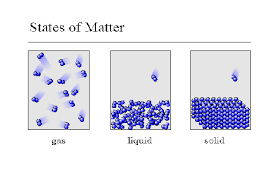
Which state of matter has particles arranged like this?
a)
solid
b)
liquid
c)
gas
20.
The amount of space something takes up
a)
density
b)
volume
c)
mass
d)
matter
21.
A pure substance that cannot be broken down into any other substance by chemical or physical means. There are about 100 of us shown in the Periodic Table
a)
compound
b)
mixture
c)
molecule
d)
element
22.
Iron + oxygen = rust is an example of a ___________.
a)
physical property/change
b)
chemical property/change
c)
mass
d)
volume
23.

The temperature at which a liquid turns to a gas is

a)

called the freezing point

b)

called the boiling point

c)

100 degrees Celsius

d)

the same for an amorphous or a crystalline solid

24.

Which describes a property of all elements?

a)

All elements are metals.

b)

All elements have six electrons.

c)

All elements exist in the solid phase.

d)

All elements are pure substances.

25.

Appearance, texture, and density are classified as

a)

physical properties

b)

chemical properties

c)

magnetic properties.

d)

thermal properties

26.

In the image, the same atoms are REARRANGED during a chemical reaction, illustrating the Law of Conservation of Matter. Which below correctly states this law?

a)

Matter is created but not destroyed.

b)

Matter is destroyed but not created.

c)

Matter is never created or destroyed, just changed.

d)

Matter cannot change form.

27.

Matter has two main properties mass and volume.

a)

True

b)

False

28.

The formula for calculating density is _______.

a)

Mass divided by Volume

b)

Volume divided by Mass

c)

Mass x Weight

d)

Mass x Volume

29.
Students placed a black block and a white block on each side of a balance.
Based on the results, what can the students say about the two blocks?

a)
The white block is wider and taller than the black block.
b)
The white block has more mass than the black block.
c)
The black block has a lower temperature than the white block.
d)
The black block has more mass than the white block.
30.
It can be observed or measured without changing the composition of matter.
a)
Physical Change
b)
Chemical Change
c)
Physical Property
d)
Chemical Property
31.
It occurs when a substance combine with another to form a new substance
a)
Physical Change
b)
Chemical Change 
c)
Physical Property
d)
Chemical Property
32.
Which of the following is not an example of Physical Change?
a)
Melting of an ice cream
b)
Water vapor formed as water boils
c)
Frying an egg
d)
Cutting the paper into pieces
33.
Which of the following is an example of physical change?
a)
an ice cream melts due to heat
b)
food digestion in stomach
c)
rusting of iron due to water exposure
d)
dynamite ignition
34.
Texture, color, states of matter, flexibility, freezing & melting points
a)
Chemical Properties
b)
Physical Properties
c)
States of Mass
d)
Scientific matterology
35.
Which of the following is an example of a chemical property?
a)
melting
b)
bending a paper clip
c)
rusting
d)
boiling water
36.
Which of the following is a pure substance? 
a)
Water
b)
Salad
c)
Chocolate milk
d)
All of them 
37.
Relationship between mass and volume
a)
Volume
b)
Density
c)
Displacement
d)
Matter
38.
When a liquid turns into a gas
a)
freezing
b)
melting
c)
evaporating
d)
condensing
39.
When a gas turns into a liquid
a)
freezing
b)
melting
c)
evaporating
d)
condensing
40.
When a solid turns into a liquid
a)
freezing
b)
melting
c)
evaporating
d)
condensing
41.
At higher temperatures
a)
particles in an object have less energy
b)
particles in an object move faster
c)
a gas contracts
42.
Define a liquid.
a)
Indefinite shape, indefinite volume
b)
Definite shape, definite volume
c)
Found in stars
d)
Definite volume, indefinite shape
43.
What is the formula for density?
a)
density = mass x volume
b)
density = mass / volume
c)
density = mass + volume
d)
density = mass - volume
44.
Which is an example of a solute?
a)
Egg whites
b)
Sugar
c)
Water
d)
Acetone
45.
Which is an example of a solvent?
a)
Salt
b)
Egg whites
c)
Water
d)
Sugar
46.

What is a solvent

a)

A liquid that will dissolve a solid solute

b)

Another word for solution

c)

A thing that make drinks change colour

d)

Usually the solid about to be dissolved

47.

The ___ is the thing being dissolved.

a)

solute

b)

solvent

c)

mixture

d)

solution

48.
Solutions are composed of __________ .
a)
salts and solutes
b)
solvents and salts
c)
solutes and alloys
d)
solutes and solvents
49.
If I dissolve sugar in water, what is the solute?
a)
Water
b)
Hydrogen
c)
Sugar
d)
Carbon
50.

If I dissolve carbon dioxide in water, what is the solvent?

a)

Carbon Dioxide

b)

There is no solvent

c)

Oxygen

d)

Water

51.

If I dissolve sugar in water, what is the solution?

a)

water

b)

sugar

c)

sugary water

d)

none of the above

52.

Define the term soluble.

a)

Can dissolve in water

b)

Cannot dissolve in water

c)

Partially dissolves in water

53.

Define the term insoluble.

a)

Can dissolve in water.

b)

Cannot dissolve in water.

c)

Partially dissolves in water.

54.

Is water the only solvent that can dissolve solutes?

a)

Yes

b)

No