wayground logo

Free Printable Worksheets

NEW

Font size

S
M
L
XL
Worksheets

21-22_S8P1 Comprehensive End-of-Unit Exam

Total questions: 62

Worksheet time: 56mins

Name
Class
Date
1.
1 m = ________ cm
a)
10
b)
100
c)
1,000
d)
10,000
2.
1 km = ________ m
a)
10
b)
100
c)
1,000
d)
10,000
3.
Choose the best measurement for length.
a)
meter
b)
gram
c)
kilogram
d)
millimeter
4.
How many people have two or less books in their desk?
a)
4
b)
5
c)
6
d)
7
5.

How many students take the bus to school?

a)

35

b)

20

c)

10

d)

15

6.

The __________________________________ is the organized way scientists answer questions and solve problems.

a)

scientific method

b)

scientific explanation

c)

scientific notation

d)

scientific guesses

7.

An atom is electrically neutral because

a)

the numbers of protons and neutrons are equal.

b)

the numbers of protons and electrons are equal.

c)

neutrons balance the protons and electrons.

8.

Which of the following does the nucleus contain?

a)

protons and electrons

b)

neutrons and electrons

c)

protons and neutrons

9.

Which of the following statements is correct?

a)

Protons are positively charged and neutrons are negatively charged.

b)

Protons are negatively charged and electrons are positively charged.

c)

Protons are positively charged and electrons are negatively charged.

10.
Where are electrons of an atom found?
a)
Nucleus
b)
Electron Cloud
c)
Some are in the nucleus and some in the electron cloud.
d)
They are moving everywhere.
11.
The atomic number tells you what?
a)
number of electrons
b)
number of protons
c)
number of neutrons
d)
both electrons and protons in an atom.
12.
Elements which are shiny, conduct electricity and heat are called
a)
metal
b)
nonmetal
c)
metalloid
d)
nonexistent
13.
The atoms along the staircase are called 
a)
metals
b)
nonmetals
c)
metalloids
d)
noble gases
14.
How many neutrons are in a Gold atom?
a)
79
b)
196
c)
118
d)
275
15.
What's a valence electron?
a)
electrons in the second energy level
b)
electrons in the outermost energy level
c)
the atomic number
d)
electrons in the first level
16.

This is a correct dot diagram for neon (Ne)

a)

true

b)

false

17.
The ability to burn is a ___ property.
a)
physical
b)
chemical
c)
conservitive
d)
reversed
18.
Physical or Chemical change:
Ice melts
a)
physical change
b)
chemical change
19.
Physical or Chemical change:
milk sours
a)
physical change
b)
chemical change
20.
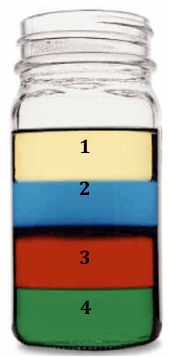
Put the liquids in order from most dense to least dense?
a)
4, 3, 2, 1
b)
1, 2, 3, 4
c)
3, 4, 2, 1, 
d)
4, 3, 1, 2
21.
What is the formula for density?
a)
density = mass x volume
b)
density = mass / volume
c)
density = mass + volume
d)
density = mass - volume
22.
Jack has a rock. The rock has a mass of 14g and a volume of 2cm3. What is the density of the rock?
a)
7 mL
b)
7 g/cm3
c)
28 g/cm3
d)
1/7 g/cm3
23.
Why do some substances float on water?
a)
they are warmer than water
b)
they are cooler than water
c)
they are more dense than water
d)
they are less dense than water
24.
What units are used to measure Density?
a)
cm3/g
b)
g
c)
g/cm3
d)
cm3
25.
A crayon has a mass of 10g and volume of 5 mL. What is the density?
a)
30 g/mL
b)
15 g/mL
c)
1 g/mL
d)
2 g/mL
26.

50 ml of water was added to the graduated cylinder. After we drop in the object, the new water level goes up to 60 ml. What is the volume of the blocks?

a)

8 ml

b)

10 ml

c)

60 ml

d)

5 ml

27.
Which factors increase the rate of a reaction.
a)
increasing temperature
b)
increasing concentration
c)
increasing surface area
d)
all of these
28.
Matter can not be created nor destroyed: it can only be
a)
Destroyed a little bit
b)
Invisible
c)
Transformed, changed
d)
None of the above
29.
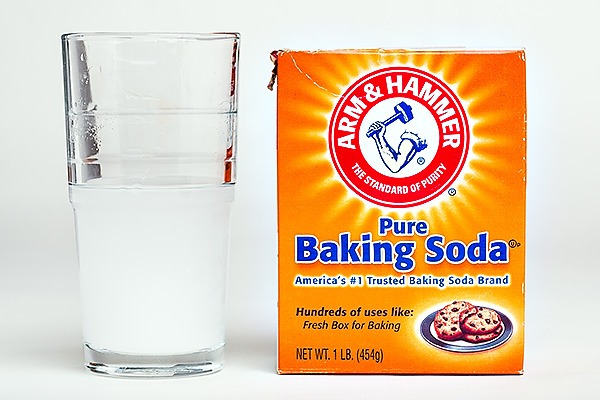
Anthony is performing an experiment. He adds 0.25 grams of baking soda to 5 grams of water and stirs. Anthony watches as the baking soda dissolves in the water. If Anthony weighs the water and baking soda solution, what will its mass be?
a)
4.75 grams
b)
5.0 grams
c)
5.25 grams
d)
7.5 grams
30.

How do covalent bonds form?

a)

by sharing electrons between atoms

b)

by donating or receiving electrons

31.

What two types of atoms make a covalent bond?

a)

2 nonmetals

b)

2 metals

c)

1 metal and 1 nonmetal`

32.

When an atom loses an electron, it becomes a

a)

positive ion

b)

negative ion

33.

Ionic bonds are between

a)

metals and nonmetals

b)

2 metals

c)

2 nonmetals

34.

How are ionic bonds formed?

a)

transfer of electrons

b)

sharing of electrons

35.

Salt is an example of what?

a)

ionic compound

b)

covalent compound

36.
The pH scale is a range from:
a)
1-7
b)
0-14
c)
1-5
d)
1-20
37.
A(n) ______ is a substance with a pH less than 7
a)
Acid
b)
Alkaline
c)
Base
d)
Buffer
38.
A(n) _______ is a substance with a pH greater than 7.
a)
Base
b)
Acid
c)
Buffer
d)
Water
39.

In a test of pH levels, a baking soda has a pH of 9 and bleach has a pH of 12. What is true about there relationship?

a)

Both of the solution are Bases

b)

Both of the solution are Acids

c)

The Baking soda is an acid and the Bleach is a base

d)

The baking soda is a base and the Bleach is an Acid.

40.

Water has a neutral because

a)

it has more H+ ions than OH-

b)

it has more OH- ions than H+

c)

it does not produce any ions

d)

it has an equal amount of H+ and OH- in solution

41.
Which one of the following would you use to separate sand from iron filings?
a)
a bar magnet
b)
filter paper
c)
chromatography paper
d)
alum
42.

This diagram represents...

a)

An element

b)

A molecule

c)

A compound

d)

A mixture of elements and compounds

43.

A cup of orange juice with pulp is poured into a glass. Which of these procedures could be done to separate the juice from the pulp?

a)

pour the juice through a coffee filter

b)

heat the juice in a pot until boiling

c)

pour the juice in another cup

d)

allow the mixture to settle, leaving the pulp at the bottom of the glass

44.

What kind of mixture is shown in the picture?

a)

Homogeneous

b)

Heterogeneous

45.
Salad is an example of a
a)
homogeneous mixture
b)
heterogeneous mixture
46.
Coloured water is an example of a
a)
homogeneous mixture
b)
heterogeneous mixture
47.

The amount of solute dissolved in a given amount of solvent.

a)

dilution

b)

concentration

c)

saturated solution

d)

supersaturated mixture

48.
You can make a solution more concentrated by adding __________.
a)
solute
b)
solvent
c)
water
49.
Sugar water is a 
a)
solution
b)
suspension
c)
colloid
50.
Milk is a 
a)
solution
b)
suspension
c)
colloid
51.
What type of mixture separates upon standing?
a)
Solution
b)
Alloy
c)
Colloid
d)
Suspension
52.
In which state of matter are particles packed tightly together in fixed positions?
a)
gas 
b)
solid
c)
liquid
d)
plasma
53.
In which state of matter do particles spread apart and fill all the space available to them? 
a)
crystal
b)
liquid
c)
gas
d)
solid
54.
Which state of matter undergoes changes in volume most easily?
a)
solid
b)
liquid
c)
gas
d)
frozen
55.
Particles in this state of matter are moving the fastest.
a)
solid
b)
liquid
c)
gas
56.

What state of matter does the picture below represent?

a)

solid

b)

liquid

c)

gas

d)

plasma

57.

The diagram shows arrangement of particles in a

a)

Solid

b)

Liquid

c)

Gas

58.

What is the phase change of a solid to a liquid?

a)

freezing

b)

melting

c)

boiling

d)

condensation

59.
5. What is it called when a solid turns directly into a gas?
a)
Sublimation
b)
Condensation
c)
Liquid
60.
Change from gas to liquid...
a)
condensation
b)
evaporation
c)
expansion
d)
movement
61.
When the temperature of matter decreases the particles ...
a)
speed up and move farther apart
b)
speed up and move closer together
c)
slow down and move farther apart
d)
slow down and move closer together
62.

Which state of matter has the highest energy?

a)

solid

b)

liquid

c)

gas

d)

plasma