

Wayground logo

Free Printable Worksheets

Font size

S
M
L
XL
Worksheets

Energy Flow Review

Total questions: 68

Worksheet time: 48mins

Name
Class
Date
1.
What is a substance called if it speeds up a chemical reaction?
a)
reusable
b)
catalyst
c)
specific
d)
fragile
2.
With what 3 letters do enzymes typically end?
a)
-ose
b)
-ase
c)
-ese
d)
-tic
3.

Enzymes are an example of

a)

Lipids

b)

Carbohydrate

c)

Protein

d)

Nucleic Acid

4.
A catalyst works by
a)
changing the order of the reaction
b)
increasing the temperature
c)
lowering the activation energy
d)
making the activated complex
5.

Which of the following do not affect enzymes ability to function?

a)

pH

b)

substrate concentration

c)

temperature

d)

water

6.

In general, enzymes do NOT:

a)

bind permanently to their substrates

b)

have names ending in -ase

c)

have their function changed with extremely high temperatures

d)

react with a specific substrate

7.

What is being represented by the letter B in the image?

a)

Substrate

b)

Enzyme

c)

reactants

d)

Product

8.
Use the diagram to answer the question. Between which parts of the molecule must the bonds be broken to form an ADP molecule?
a)
A and B
b)
A and C
c)
B and C
d)
C and D
9.
Energy is released from ATP when
a)
a phosphate group is added
b)
adenine bonds to ribose
c)
ATP is exposed to sunlight
d)
a phosphate group is removed
10.
Where is the most easily accessible energy stored in an ATP molecule?
a)
between the 1st and 2nd phosphate groups
b)
between the adenine and ribose groups
c)
between the 2nd and 3rd phosphate groups
d)
between the ribose and the 1st phosphate groups
11.
What is structure A?
a)
Substrate
b)
Active site
c)
Enzyme
d)
Products
12.
What is structure D?
a)
Substrate
b)
Active site
c)
Enzyme
d)
Products
13.
What is structure C?
a)
Substrate
b)
Active site
c)
Enzyme
d)
Products
14.
Which of the following conclusions can be drawn from this graph?
a)
The optimum pH of the enzyme is 6.6.
b)
The optimum pH of the enzyme is 5.8
c)
The enzyme’s activity increases as pH increases 5.0 to 9.0
d)
The enzyme’s activity is greater around pH of 8.0 .
15.
Enzymes need certain environmental conditions in order to function properly.  What happens when enzymes are heated to a high temperature?
a)
they die
b)
they denature
c)
they change their amino acid sequence
d)
they work better
16.

Which of the following correctly describes enzyme structure and function?

a)

The shape of an enzyme is responsible for its function.

b)

All enzymes can bind to all substrates.

c)

The substrate is responsible for the shape of the enzyme.

d)

The location of an enzyme determines its function.

17.

Identify the organelle responsible for photosynthesis.

a)

mitochondira

b)

chloroplast

c)

cell wall

d)

centriole

18.

Identify the organelle responsible for cellular respiration.

a)

mitochondria

b)

centriole

c)

chloroplast

d)

cell wall

19.

What are the reactants of photosynthesis?

a)

carbon dioxide, water, and sunlight

b)

oxygen and glucose

c)

carbon dioxide and glucose

d)

carbon dioxide, water, and ATP

20.

What are the products of photosynthesis?

a)

carbon dioxide, water, and sunlight

b)

oxygen and glucose

c)

carbon dioxide and glucose

d)

carbon dioxide, water, and ATP

21.

What are the reactants of cellular respiration?

a)

carbon dioxide, water, and sunlight

b)

oxygen and glucose

c)

carbon dioxide and glucose

d)

carbon dioxide, water, and ATP

22.

What are the products of cellular respiration?

a)

carbon dioxide, water, and sunlight

b)

oxygen and glucose

c)

carbon dioxide and glucose

d)

carbon dioxide, water, and ATP

23.

Which of the following is produced during the light dependent stage of photosynthesis?

a)

oxygen

b)

carbon dioxide

c)

water

d)

glucose

24.

Which of the following is produced during the light independent stage/Calvin Cycle of photosynthesis?

a)

oxygen

b)

carbon dioxide

c)

water

d)

glucose

25.

Which of the following types of cellular respiration does NOT require oxygen?

a)

anaerobic respiration

b)

aerobic respiration

c)

light dependent respiration

d)

light independent respiration

26.

Which of the following types of cellular respiration requires oxygen?

a)

anaerobic respiration

b)

aerobic respiration

c)

light dependent respiration

d)

light independent respiration

27.

Which of the following occurs in the cytoplasm and produces only 2 ATP molecules?

a)

glycolysis

b)

Krebs Cycle

c)

electron transport chain

d)

Calvin Cycle

28.

Which of the following occurs in the mitochondria and produces only 2 ATP molecules?

a)

glycolysis

b)

Krebs Cycle

c)

electron transport chain

d)

Calvin Cycle

29.

Which of the following occurs in the mitochondria and produces 34 ATP molecules?

a)

glycolysis

b)

Krebs Cycle

c)

electron transport chain

d)

Calvin Cycle

30.

Which of the following occurs without oxygen in animal cells?

a)

alcoholic fermentation

b)

lactic acid fermentation

31.

Which of the following occurs without oxygen in plant and yeast cells?

a)

alcoholic fermentation

b)

lactic acid fermentation

32.

Why are many plants green?

a)

plant cells are green

b)

plants absorb green light

c)

chlorophyll reflects green light

d)

rigid cell walls are green

33.
The main source of energy for all life comes from ____.
a)
the Earth
b)
the moon
c)
the sun
d)
the food we eat/make
34.

Which of the following formulas represents photosynthesis?

a)

6 H2O + 6 O2 --> C6H12O6 + 6 CO2

b)

6 H2O + 6 CO2 --> C6H12O6 + 6 O2

c)

C6H12O6 + + 6 O2 --> 6 H2O + 6 CO2

35.

Which process does this equation represent?

C6H12O6 + 6O2 --> 6CO2 + 6H2O + ATP

a)

photosynthesis

b)

cellular respiration

36.

What is A in the diagram?

a)

membrane

b)

stroma

c)

thylakoid

d)

granum

37.

What is B in the diagram?

a)

membrane

b)

stroma

c)

thylakoid

d)

grana

38.

What is D in the diagram?

a)

membrane

b)

stroma

c)

thylakoid

d)

granum

39.

Energy carriers involved in the electron transport chain in cellular respiration

a)

NADH2, FADH

b)

NADH, FADH

c)

H, O2

d)

NADH, FADH2

40.

Which of the following can be compared to a battery in need of recharging?

a)

ADP

b)

ATP

c)

Ribose

d)

Adenosine

41.
What type of energy is glucose?
a)
carbohydrate
b)
protein
c)
nucleic acid
d)
lipid
42.
Plants need carbon dioxide from their environment to produce glucose during which stage of photosynthesis? 
a)
The light-dependent stage
b)
The light-independent stage
c)
The electron transport chain
d)
ATP formation
43.
The interaction of sunlight, chlorophyll pigment and water create ______________________.
a)
low-energy electrons
b)
high-energy electrons
c)
photons
d)
wavelengths
44.
Another name for the light-independent stage is the _____________________.
a)
water cycle
b)
rock cycle
c)
Calvin cycle
d)
reproductive cycle
45.
What is the function of ATP in living things?
a)
provides energy for cells
b)
stores genetic information
c)
provides structure in the nucleus
46.
Which structures shown in the Figure make up the ADP molecule?
a)
A and B
b)
A, B and C
c)
A, B, C, and D
d)
C and D
47.
What are the parts of the ATP molecule?
a)
adenine, thylakoids, stroma
b)
stroma, grana, chlorophyll
c)
adenine, ribose, phosphate groups
d)
NADH, NAHPH, FADH
48.
Which of the following results in the storage of energy in terms of the ATP/ADP cycle?
a)
The breaking of the bond between the 5-carbon sugar and the 1st phosphate group
b)
The addition of a phosphate group
c)
The removal of a phosphate group
d)
The addition of glucose 
49.
Where is the energy stored in ATP molecules
a)
In the Ribose Sugar
b)
In the Adenine group
c)
In the Phosphate bonds
d)
In the Bank
50.
What type of macromolecule is ATP/ADP?
a)
Carbohydrate
b)
Nucleic Acid
c)
Lipid
d)
Protein
51.
Which cellular organelle is responsible for manufacturing ATP?
a)
Ribosome
b)
Nucleus
c)
Mitochondria
d)
Chloroplast
52.
The important gases, carbon dioxide and oxygen, enter and leave the leaf through the
a)
upper epidermis
b)
phloem
c)
stomata
d)
guard cells
53.
______________ produces the most ATP.
a)
photosnthesis
b)
aerobic respiration
c)
anaerobic respiration
d)
glycolysis
54.
What are the products of aerobic respiration?
a)
Glucose and oxygen
b)
Carbon dioxide and water
c)
Lactic acid
d)
Carbon monoxide
55.

True or False. The Krebs Cycle takes place within the mitochondrial matrix.

a)

True

b)

False

56.

True or False. The electron transport chain for both the mitochondria and the chloroplast occur on membranes.

a)

True

b)

False

57.
Yeast is a(n)
a)
autotroph
b)
producer
c)
heterotroph
d)
plant
58.
Why is yeast used to bake bread? 
a)
The waste gas, CO2, makes bread rise
b)
The alcohol produced makes bread dangerous
c)
The yeast consumes O2, causing bread to rise
59.
What cells in the body may undergo lactic acid fermentation during exercise? 
a)
Muscle cells
b)
Fat cells
c)
Liver cells
d)
Skin cells
60.
Fermentation is cellular respiration without which molecule?
a)
CO2
b)
O2
c)
C6H12O6
61.
How are lactic acid and alcoholic fermentation similar?
a)
They have the same products
b)
They have the same reactants
c)
They both require oxygen
d)
They occur in the same organisms
62.

The term "anaerobic" means :

a)

with oxygen.

b)

without oxygen.

c)

alive.

d)

nonliving.

63.

What are the waste products from the type of fermentation that yeast cells do? (Choose all that apply)

a)

starch

b)

carbon dioxide

c)

glucose

d)

alcohol

64.
Where is lactic acid produced?
a)
in muscles
b)
in bread
c)
in plants
d)
in cheese
65.

Which process produces CO2 as a waste product?

a)

Lactic Acid Fermentation

b)

Ethanol (Alcoholic) Fermentation

66.
What is a disadvantage of fermentation as a process? 
a)
It produces too much ATP
b)
It only produces 2 ATP
c)
It occurs in the absence of oxygen
d)
It is only for quick bursts of energy
67.

What happens to an enzyme when it denatures?

a)

The activation energy of the reaction is doubled.

b)

The activation energy of the reaction is lowered.

c)

It's optimal conditions for temperature of the enzyme are doubled.

d)

The shape of the enzyme molecule is changed.
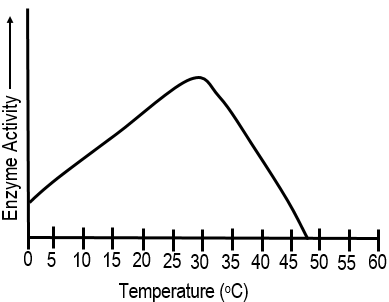
68.
Based on the graph, what is the optimal temperature for this enzyme? 
a)
15oC
b)
40oC
c)
30oC
d)
35oC
