
 Worksheets
Unit 3 Electricity and Magnetism Test Review
Total questions: 55
Worksheet time: 48mins
Electricity is ____________________.
the movement of the sun
the movement of electrons
the movement of the moon
the movement of air
The flow of electricity is an _____________________.
battery
resistor
electric current
A ________________ circuit is a circuit in which electrical current can follow only one path.
parallel
series
silver
battery
______________ are materials that electrical current cannot pass through.
resistors
circuits
conductors
insulators
A complete pathway for the flow of electricity is called a ________________.
circuit
series
parallel
current
_______________ are materials that electrical current can pass easily through.
resistors
circuits
conductors
insulators
A ______________ is sometimes added to a circuit, it opens and closes a circuit to turn resistors on and off.
battery
resistor
current
switch
When a circuit is ______________, it is complete and there is no break in the path that the charges must follow.
open
closed
series
paralell
When a circuit is ____________ it is incomplete and charges can't flow through.
open
closed
series
parallel

What is true about protons and electrons?
Protons and electrons are both positively charged.
Protons and electrons are both negatively charged.
Protons are positively charged and electrons are negatively charged.
Protons are negatively charged and electrons are positively charged.
What is true about protons and electrons?
Protons and electrons are both positively charged.
Protons and electrons are both negatively charged.
Protons are positively charged and electrons are negatively charged.
Protons are negatively charged and electrons are positively charged.
True or false? Like charges attract one another, while opposite charges repel one another.
True
False
There are 3 ways to charge an object. Which of the 3 ways is rubbing a balloon on your hair an example of?
induction
conduction
friction
_______________ electricity is the accumulation of electrons on an object.
static
current
circuit
conduction
True or false. Electric discharge is the release of static electricity.
true
false
Which way do electrons flow in a current?
Neutral to negative
Positive to negative
Negative to neutral
Negative to positive
Which of the following is true about direct current and alternating current?
In both direct and alternating current electrons flow two ways
In a direct current, electrons always flow one way and in an alternating current electrons flow two ways
In a direct current, the electrons flow two ways and in an alternating current electrons flow one way.
In both direct and alternating currents electrons flow one way
Voltage is the ____________ that causes electrons to move from negative to positive.
electricity
current
force
power
True or false. Resistance speeds up the flow of electrons.
true
false

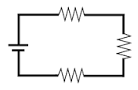
What type of circuit is the picture shown?
incomplete
switch
parallel
series

What type of circuit is shown?
series
parallel
static
open

How many resistors are in the diagram shown?
2
1
6
5
Magnetism is a force of ____________________________ that occurs between two _____________ objects.
attraction or repulsion, magnetic
external or internal, magnetic
external or repulsion, electronic
attraction or internal, electronic

The magnetic ____________ around a bar magnet is shown above.
legs
flowers
field
direction
The Earth produces its own ________ field.
spectrum
electric
magnetic
progressive
In magnetic materials, all of the ________ are pointing in the same direction.
doors
electrons
domains
orbits
Permanent magnets can be demagnetized by ___________________ them past the Curie point (approximately 1,060 °F).
heating
freezing
shaking
solidifying
Every magnet has both a _________ pole and a __________ pole.
North, South
East, West
Positive, Negative
Positive, South
Some objects that normally aren't magnetic can become magnetized when connected to a circuit. Items that are magnetized in this way are called ________.
electromagnets
electrons
electrochromic devices
permanent magnets
Probably the most useful thing about electromagnets is that they can be turned ________ and ________.
on, off
positive, negative
north, south
on, negative

What is a magnet?
a piece of rubber that draws plastic
a piece of material or rock that attracts other metals
a pole that attracts trash
a push or a pull
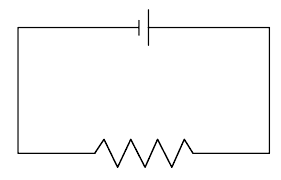

An alarm clock draws 0.5 A of current when connected to a 120 volt circuit. Calculate its resistance.
60Ω
120Ω
180Ω
240Ω

How much voltage would be necessary to generate 10 amps of current in a circuit that has 5 ohms of
resistance?
10V
50V
100V
150V
Which electromagnet would have the most strength?
An electromagnet with 8 coils of wire
An electromagnet with 35 coils of wire
An electromagnet with 67 coils of wire
An electromagnet with 105 coils of wire
The function of an electric generator is to _______________.
change electrical energy to chemical energy
change electrical to mechanical energy
change mechanical energy to electrical energy
change chemical energy to electrical energy
What is an electromagnet an example of?
permanent magnet
static electricity
temporary magnet
electric generator
Where on a magnet is the magnetic force the greatest?
the center
it is the same everywhere
outside the magnetic field
the poles

When are magnets most attracted to each other?
the north and south pole are close together
both north poles are close together
both south poles are close together
the north and south pole are far away from one another

