
 Worksheets
Covalent Bonding Mostly
Total questions: 90
Worksheet time: 1hrs 7mins
What two types of atoms usually make a covalent bond?
Carbon is in Group 4/4A, so how many bonds must it form to become more stable?
1
3
4
5
When two nonmetals do not share electrons evenly, the resulting covalent bond will be
nonpolar
polar
ionic
metallic

Which of the following is the best representation of a molecule of fluorine (F2)?
A
B
C
D
a type of metal that exists in pairs
an element made up of two different atoms bonded together
an element whose atoms exist in pairs always
an element whose atoms exist in pairs when the element is found by itself
What type of bond is usually formed between a metal and a nonmetal?
Covalent bond
Ionic bond
Hydrogen bond
Metallic bond
eight always
the number of electrons needed to reach a noble gas-like configuration
the number of bonds that is needed to form an octet always
Which formula is for phosphorus trichloride?
KCl3
PCl3
K3Cl
P3Cl
Silicon dioxide is the compound in sand. What is its formula?
SO2
NaO2
SiO2
SiO
What is the formula for diphosphorus pentoxide?
P2O5
PO5
P5O2
P2O6
NaF
What is the reason why Noble gases are so stable?
They have an even number of electrons
They have no electrons
They have the lowest energy electron configurations
They bond with other atoms
How many electrons can be held in the first shell?
1
2
4
8
Which of these is not a covalent molecule?
MgO
CO2
HCl
CH4
Chlorine has 7 electrons in it's outer shell. How many covalent bonds does it need to obtain an octet like Argon?
1
2
3
4
Carbon has 4 electrons in it's outer shell. How many covalent bonds does it need to to obtain an octet like Neon?
1
2
3
4
Why do atoms have an overall neutral charge?
So that they can't react
Because they have neutrons in their nucleus
Because they have electrons arranged in shells
Because they have the same number of protons and neutrons
How many ATOMS are in one molecule of CH4?
2
4
5
3

How can you fix this electron dot diagram?
Erase the two extra electrons on Carbon
Two more covalent bonds should be made to the oxygen on the left
Share another pair of electrons between each oxygen and the central carbon
1 more electrons should be added to each oxygen atom
Why is this diagram of bonding in carbon dioxide (CO2) incorrect?
There should be 2 carbon atoms and one oxygen
2 more electrons should be added to the carbon atom
None of the atoms have a stable octet
2 more electrons should be added to the oxygen atoms

What is the correct formula for this molecule?
CH
C1H4
CH4
C4H

Monoxygen dihydride
Hydrogen oxide
Hoh
Dihydrogen monoxide

What is a negatively charged atom called?
Anion
Cation
Ion
Which part of the atom is responsible for chemical bonding?
Core Electrons
Valence Electrons
Protons
Neutrons
What is the name of K2O?
Dipotassium monoxide
Dipotassium oxygen
Potassium oxide
Potassium oxygen
A group of covalently bonded atoms is called a _________________
crystal
molecule
salt
pod
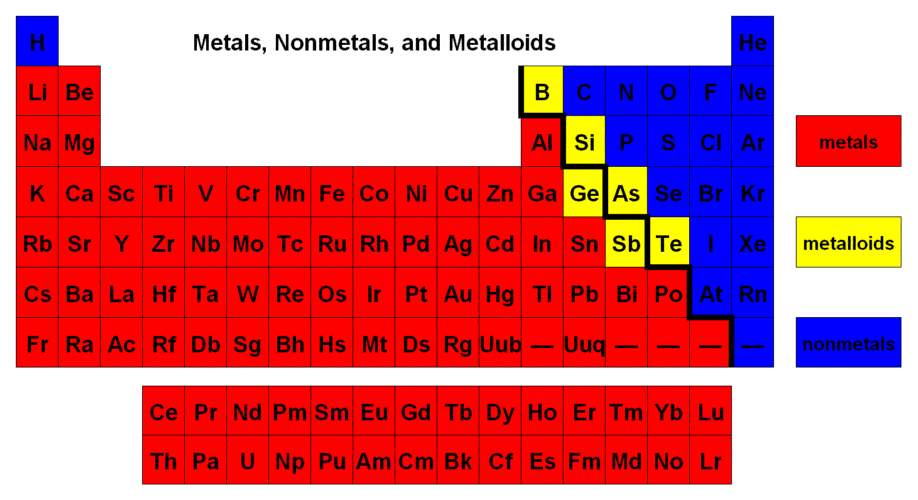

Looking at your Periodic Table, what kind of bond would NaF create?
Covalent
Molecular
Ionic
Metallic
The only time a prefix is not used in a covalent bond is when:
the first element in one
the second element is one
anytime there are more than 11
you never use prefixes in covalent bonds
Triple bonds are formed when atoms share _____ pairs of valence electrons.
two
four
three
six
What holds the atoms together in a covalent bond?
Spit
Attractions between the opposite charges
The shared electrons fly around both nuclei
nothing


What name is given to the shape shown in the picture?
bent
trigonal planar
triangular
trigonal pyramidal

This molecule has 3 bonds and 1 lone pair around the central atom. What shape is it?
bent
trigonal pyramidal
tetrahedral
linear
Which is the 3D picture of this molecule?


This molecule has 2 bonds and 2 lone pairs around the central atom. What shape is it?
bent
trigonal pyramidal
tetrahedral
linear
What shape is a carbon dioxide molecule?
bent
trigonal pyramidal
tetrahedral
linear
Which of the following shows a tetrahedral shape?

Which is the 3D picture of this molecule?

This molecule has 4 bonds and 0 lone pairs around the central atom. What shape is it?
bent
trigonal pyramidal
tetrahedral
linear

Which is the 3D picture of this molecule?
N or C?
H or F?
Cl or Al?
The electrons in a POLAR covalent bond are shared...
Evenly
Unevenly
Electrons are not shared
None of the Above
The electrons in a NONPOLAR covalent bond are shared...
Evenly
Unevenly
Electrons are not shared
None of the Above
If a bond has an electronegativity difference of 2.0 it is usually called
Nonpolar covalent
Polar covalent
Ionic

What type of bond is depicted in the image?
Nonpolar Covalent
Polar Covalent
Ionic
In Nitrogen trifluoride, which atom will the electrons spend more time with
N
F
Electronegativity is...
A measure of the amoungt an atom ATTRACTS electrons
A measure of the amount an atom REPELS electrons
the energy required to remove an electron from an atom
is a fear of all things run by electricity
What is the electronegativity difference for the bond in HBr?
0.8
2.2
3.0
5.2
If a bond has an electronegativity difference of 1.0 it is usually called
Nonpolar covalent
Polar covalent
Ionic
What is the electronegativity difference of the S-O bonds in
SO2 ?
0.5
0.8
2.5
3.4
NH3 is a covalent compound. Which atom, N or H, will electrons spend MORE time with?
N
H
Neither
What is the electronegativity difference of the bond in Chlorine gas(Cl2) molecules?
0
1
2
3.2
A polar covalent bond should have an electronegativity difference ranges from _____?
0-0.4
0.5 to 1,7
1.7 to 3.3
Which bond type does Nitrogen make with Iodine?
Nonpolar covalent
Polar covalent
Ionic
In a nonpolar covalent bond, the electrons gather around...
The atom with the Greatest Electronegativity
The atom with the Lowest Electronegativity
Each atom Equally
None of the Above
The polarity of a bond is determined by...
The sum of the electronegativities of the two atoms
The difference in the electronegativities of the two atoms
The charges of the atoms
None of the Above
'Partial'/not fully charged atoms are present in which type of bond?
Ionic
Nonpolar Covalent
Polar Covalent
Both Polar Covalent and Ionic
In a polar covalent bond, which atom will have a partial positive charge?
The atom with the greater electronegativity
The atom that attracts more electrons
The atom with the lower electronegativity
A diatomic molecule like O2 is always _____ because electrons are shared _____
nonpolar; unequally
polar; equally
nonpolar; equally
polar; unequally
To become lower in energy and thus more stable
To gain energy and thus become more stable
How many valence electrons do elements in group 1/1A have?
1
2
3
4
What shape is a HBr molecule?
bent
trigonal pyramidal
tetrahedral
linear
Which of the following shows a trigonal pyramid shape?
Which of the following shows a linear shape?
Which could be carbon dioxide?
If a bond has an electronegativity difference of 0.4 it is usually called
Nonpolar covalent
Polar covalent
Ionic
If a bond has an electronegativity difference of 3.0 it is usually called
Nonpolar covalent
Polar covalent
Ionic
If a bond has an electronegativity difference of 0.7 it is usually called
Nonpolar covalent
Polar covalent
Ionic
How many covalent bonds does oxygen usually make?
1
2
3
4
How many covalent bonds does Phosphorous usually make?
1
2
3
4
How many covalent bonds does Chlorine usually make?
1
2
3
4
How many covalent bonds does Hydrogen usually make?
1
2
3
4
How many diatomic elements are there?
3
5
6
7
8
Which of the following is a diatomic element?
Carbon
Iodine
Neon
Magneium
Which of the following is not a diatomic element?
Fluorine
Hydrogen
Sulfur
Bromine
Nitrogen
What did the covalent bond yell to the ionic bond? "Hey, didn't your dad ever teach you to
steal
share
fight
knit
Which of the following is most true
There are in reality 2-4 specific bond types that explain all bonding
Bond types actually exist as part of a spectrum though humans categorize them for study
There are two distinct types of bonding (ionic and covalent) that do not overlap
Reality tends to fall into discrete categories of things and humans falsely put things into spectrums
How many valence electrons do elements in group 3/3A have?
1
2
3
4

