
 Worksheets
Chemistry Review Section 2
Total questions: 87
Worksheet time: 1hrs 29mins
How many atoms of sulfur are in each molecule of H2SO4?
1
4
2
7
Alanine is an amino acid with formula C3H7NO2. How many atoms in all are in each molecule of alanine?
3
7
12
13

Which of the following accurately describes the chemical formula of the molecule shown above?
3CH8O
C3H7O
C4H8O2
C3H8O

A diagram to a molecule is shown above. Based on the diagram, what is the identity of this compound?
Water (H2O)
Hydronium (H3O+)
Hydrogen peroxide (H2O2)
Hydroxide (OH-)

Which elements are in the formula shown above?
Cobalt only
Carbon and Oxygen
Copper only
Carbon and Osmium
How many different elements are in an amino acid with the formula C5H11NO2S?
5
20
18
4
How does oxygen become an oxide ion?
it loses 2 electrons
it gains 2 electrons
Is the following compound ionic or molecular?
A material with a high melting point
Ionic
molecular
MgO
BeCl2
O2
Ionic bonds could be best described as:
A bond formed when 2 atoms share electrons
A firm handshake
An electrostatic attraction between oppositely charged ions
An electrostatic attraction between anions
Is the following compound ionic or moelcular?
A material that SHARES electrons
Ionic
Molecular
When dissolved in water, the solution is a good conductor of electricity.
ionic compounds
molecular compounds
Why do ionic compounds conduct electricity when dissolved in water, but most covalent compounds do not?
Covalent compounds have lower melting point than ionic compounds.
Covalent compounds are weakly bonded while ionic compounds are strongly bonded.
Covalent compounds do not dissolve in water since they are composed of non- polar molecules.
Covalent compounds dissolve into molecules, while ionic compounds dissolve into ions that conduct charge.
Why are sodium and chlorine ions attracted to each other?
they have opposite charges
they both have negative charges
they both have positive charges
Is the following compound ionic or molecular?
A material that contains a metal and a nonmetal
Ionic
molecular
Which set of elements is most likely to form an ionic compound?
Na and O
C and O
Na and K

Classify ionic or molecular
C2H2
Ionic
Molecular
Classify ionic or molecular
LiOH
Ionic
Molecular
Classify ionic or molecular
BeO
Ionic
Molecular
NaO
BeCl2
Prefixes are used only for naming _______________ compounds
covalent (molecular)
What is the chemical formula of Magnesium chloride?
MgCl
MgCl2
MgC
MgC2
What is the IUPAC name for NaF?
sodium fluoride
sodium fluorine
monosodium monofluoride
sodium monofluorine
MgF2
magnesium(II) fluoride
magnesium difluoride
Name the following compound: AlF3
aluminum fluoride
monoaluminum trifluoride
aluminum trifluoride
aluminum fluorine
What is the correct formula of phosphorus trichloride?
P2Cl3
P3Cl3
PCl3
PCl5
When sodium and nitrogen combine, this is the formula...
NaN
NA3N
Na3N
S3N
Name the following compound:
Li2S
dilithium sulfide
lithium (II) sulfide
lithium sulfide
lithium sulfate
Magnesium Chloride
Name the following: N2O
nitrogen monoxide
dinitrogen monoxide
nitrogen (II) oxide
nitrogen oxide
Write the formula: beryllium oxide
BO
BeO
BeO2
BO2
what is the correct name of the combination between fluorine and magnesium?
fluorine magnesium
fluoride magnesium
magnesium fluoride
magnesium fluorine
Name for CO
carbon monoxide
carbon oxide
monocarbon oxide
carbide monoxide

What are the products of the chemical reaction pictured?
CH4 and CO2
CH4 and O2
CO2 and 2 H2O
O2 and H2O
What are the REACTANTS :
H2O + CO2 → HCO + HO
H2O + CO2
HCO + HO
H2O ONLY
HCO ONLY

O2(g) + 2 H2 (g) → 2 H2O (g) + Energy
endothermic
exothermic
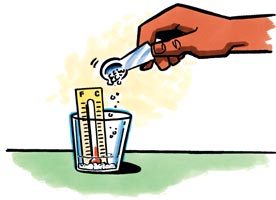

What type of reaction occurs in a hand warmer?
exothermic
endothermic
When calcium reacts with water, the temperature changes from 18°C to 39°C. Which statement is correct?
The solution at the end is acidic
The reaction is reversible
The reaction is exothermic
The reaction is endothermic
What are the products of combustion?
Hydrogen + oxygen
Carbon dioxide + water
Carbon dioxide + hydrogen
Carbon + water
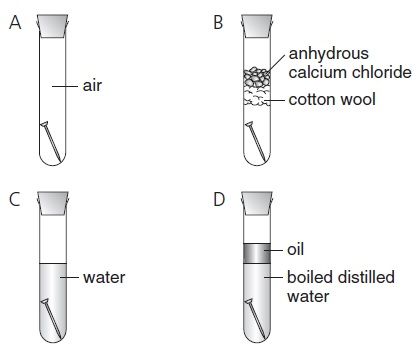
Which diagram shows the most favourable conditions for rust to appear on the nail?
A
B
C
D

Is this an example of corrosion or combustion?
corrosion
combustion
In a chemical reaction, the number of atoms in the products will always equal which amount?
the number of atoms in the reactants
half of the number of atoms in the reactants
twice the number of the atoms in the reactants
thrice the number of the atoms in the reactants
According to the Law of Conservation of Matter, what happens to the wood and oxygen when it is burned?
The wood disappears.
It stays the same chemically.
The atoms in the wood and oxygen rearrange and form smoke and ash.
Nothing.

Why does this picture demonstrate the Law of Conservation of Matter?
the number of atoms of each element are the same on both sides
they start out separate and end up combined
the same elements are used
it doesn't demonstrate the Law of Conservation of Mass

If this reaction occurs in a sealed container, will the mass of the container and everything in it increase, decrease, or stay the same and why?
Jin bought a heat pack that weighs 15 g. He shook it so it would release heat to warm his hands. The release of heat indicates a chemical reaction took place in a closed system. What would be the mass of the heat pack after the chemical reaction?
5 g
10 g
12 g
15 g

In this reaction, how much O2 is produced?
12 g
22 g
42 g
No grams are produced
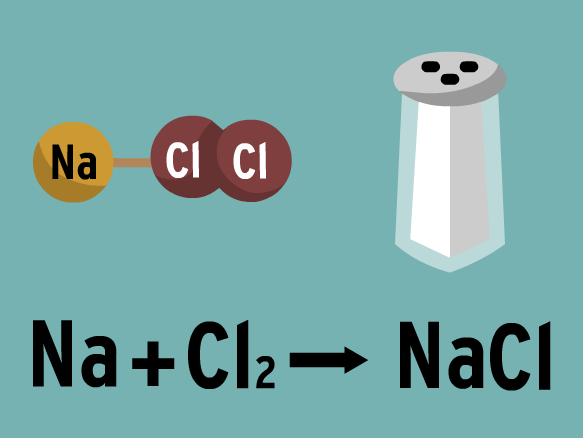
In a chemical reaction, 4 grams of sodium must combine with how many grams of chlorine to produce 10 grams of table salt?
4 grams
6 grams
8 grams
10 grams
What criteria must be met for reactant collisions to result in a successful product?
The reactants must collide with each other
The reactants must collide with enough energy and be in the right positions
The reactants must have enough energy to form the activated complex

Which factors increase the rate of a reaction?
increasing temperature
increasing concentration
increasing total surface area
All of these
Which among the following is NOT TRUE about the collision theory and the rate of reaction?
higher temperature ---> faster particle movements ---> more collision
higher concentration ---> more spaces between particles ---> more collision
higher surface area ---> more particle interactions ---> more collision
Why does a higher concentration increase the rate of reaction?
it increases the amount of reactants
it lowers the activation energy
it increases the energy of particle collisions
it increases the frequency of particle collisions
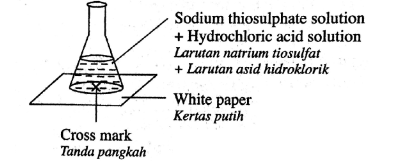
Diagram shows the apparatus set up for an experiment to determine the rate of reaction.
Which of the following techniques is the most suitable to determine the rate of reaction?
Record the time as soon as precipitate is formed
Record the time taken to obtain the maximum temperature
Record the times as soon as the cross mark cannot be seen
Record the times taken for the change of the pH value until a fixed pH value is obtained
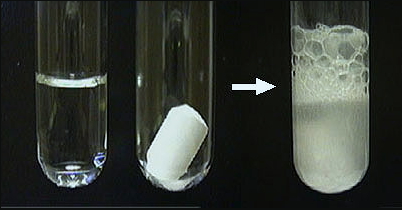
How could we make this reaction happen more quickly?
Decrease the concentration of the acid
crush the chalk to increase the surface area
Put the test tube in an ice bath

Which graph shows the effect of increasing temperature on the rate of reaction of calcium carbonate with dilute hydrochloric acid?
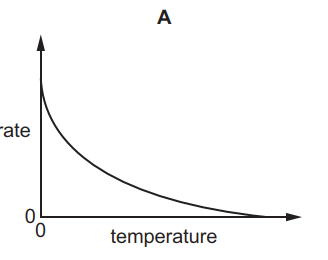
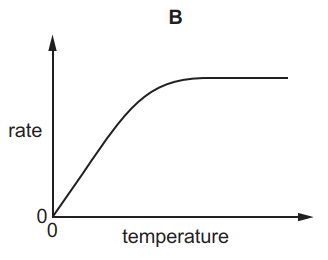
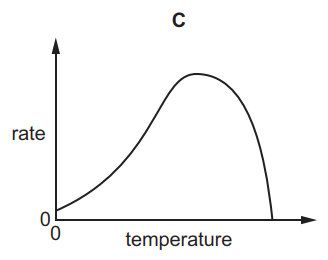

Table 9 shows the experiments carried out to study the rate of reaction between zinc carbonate and nitric acid.
Which of the following graph represents the two experiments?


Which of the following will lower the rate
of reaction?
adding an enzyme to the reaction
decreasing the temperature from 40°C to
10°C
breaking a chunk of calcium up into
smaller pieces
increasing the amount of solute
dissolved in a solution

Approximately how long did it take for the cross to disappear at 20 Degrees Celsius.
67
54
68
58
To slow down a chemical reaction you will do one of the following:
Place the reactants in hot water
Place the products in ice bath
Place the reactants in an ice bath
Keep stirring the reactants with a stirring rod
What was the manipulated variable in this experiment?
temperature
reaction time
reaction rate
effect of temperature on rate of reaction

