
 Worksheets
Forces Review
Total questions: 70
Worksheet time: 2hrs 30mins
Force = Mass x Acceleration

Is the object in equillibrium?
Yes
No
Not enough information

Is the object in equillibrium?
Yes
No
Not enough information

Is the object in equillibrium?
Yes
No
Not enough information
Your truck has a mass of 2500 kg and experiences a force of 5000 N. How fast will it accelerate?
20 m/s2
0.5 m/s2
2 m/s2
120 N
If an object was accelerating at 5 m/s2, and a force of 10 newtons was required to accelerate it, what was the object's mass?
50 kg
2 kg
0.5 kg
5 kg
A baseball player hits a ball with 400 N of force. How much force does the ball exert on the bat?
300
400
500
Not enough info to tell
A small bug splats against a car windshield. Which object experiences greater force?
The bug
The windshield
Both experience the same force
Not enough info given
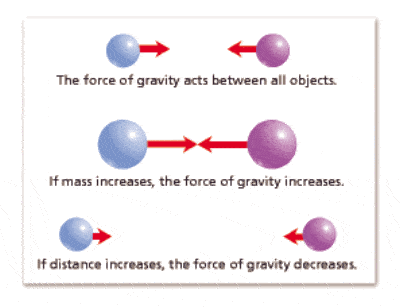
What unit do we use to indicate a measurement of Force?
kg (kilograms)
Watts (W)
Newtons (N)
m/s2

What is the net force on this object?
80 N West
80 N East
40 N West
40 N East
Example of a non-contact force or field force.
gravity
tension
friction
normal
Also called "weight".
friction force
gravitational force
normal force
tension force
Push or pull on an object
force
vector
inertia
momentum
Also called "support force"
gravitational force
normal force
tension force
elastic force
Pulling force usually by a rope or cord.
tension force
elastic force
normal force
gravitational force
Forces that add up to zero net force
unbalanced forces
normal forces
balanced forces
applied forces
Force that opposes the motion of an object
gravitational force
normal force
tension force
friction force
How much "stuff" is in an object. Measured in kg.
mass
weight
volume
gravity
What can you infer about an object moving at a constant velocity?
No forces are acting on it.
Gravity is exerting the strongest force on it.
The forces on it are balanced.
Which of the following is always true?
An object at rest has not forces acting on it.
Unbalanced forces lead to a change in speed or direction.
The net force on a moving object can never be zero.

To calculate net force you must
Add the forces
Subtract the forces

In a tug of war game, the NET FORCE is 50N to the LEFT. The winning team pulled with a force of 200N to the left. How much force did the losing team pull with?
150N right
250N right
100N right
50N right
If you go to the moon ...
your mass changes, but your weight stays the same
your weight changes, but your mass stays the same
both your mass and weight change
both your weight and mass stay the same

What type of friction is Sally experiencing as she moves down the slide?
Rolling Friction
Kinetic Friction
Fluid Friction
Static Friction
A ball with mass m is struck by a bat having a mass of 9m. How does the force exerted by the bat on the ball compare to the force exerted by the ball on the bat?
The force of the bat on the ball is less than the force of the ball on the bat.
The force of the bat on the ball is the same as the force of the ball on the bat.
The force of the bat on the ball is greater than the force of the ball on the bat.

Two blocks of equal mass are dragged across different surfaces. Which will experience the greater Normal force?
Box A
Box B
Equal
Two blocks of equal mass are dragged across different surfaces. Which will experience the greater gravitational force?
Box A
Box B
Equal
Two blocks of equal mass are dragged across different surfaces. Which will experience the greater force of friction?
Box A
Box B
Equal

Two Boxes are pulled along the same surfaces. Box C has more mass than box D. Which box feels the greater gravitational force?
Box C
Box D
Equal
Two Boxes are pulled along the same surfaces. Box C has more mass than box D. Which box feels the greater force of friction?
Box C
Box D
Equal

The object in this force diagram is...
Not moving
moving at a constant velocity
speeding up
Either not moving or moving at a constant velocity
Which of the following is true for an object in dynamic equilibrium?
It moves with constant velocity.
It has balanced forces acting on it.
It has a net force of zero acting on it.
All of these are true.
If object B has a mass of 24 kg, it will accelerate at...
2 m/s/s
0.33 m/s/s
3 m/s/s
0.5 m/s/s
Which if these will experience the greatest amount of air resistance?
motorcycle driving 90 km/h
truck driving
90 km/h
motorcycle driving 40 km/h
truck driving
40 km/h
Which of the following is NOT true about an object at terminal velocity?
It is falling as fast as it can.
It has zero net force acting on it.
It experiences balanced forces.
It has no forces acting on it.
A 2-kg book sits at rest on a desk. What is the normal force acting on the book?
0 N
2 N
20 N
40 N
Which of the following will have the greatest inertia?
0.2 kg baseball
0.05 kg golf ball
5 kg bowling ball
1 kg soccer ball
True/False? The coefficient of static friction is always greater than the coefficient of kinetic friction (for the same surface).
True
False
Which of the following is an example of an unbalanced force?


Force objects exert on each other because of their masses.
Gravity
Push
Pull
Net Force

How much force is required to accelerate a 1,800 kg truck at 3 m/s2? (a) Newtons
An object with a mass of 10 kg is accelerated upward at 2 m/s2. What force is required? (a) Newtons
A 5 kg block is pulled across a table by a force of 61 N. Calculate the acceleration of the object. (a) m/s2

The force of __________________ is a type of friction that works against the motion of falling objects.
Terminal Velocity
Gravity
Free Fall
Air Resistance

Friction is a force that acts in the ___________ direction of movement.
same
opposite
parallel
west

When a football player with high mass and a player with low mass collide, who exerts more force?
The one with high mass
The one with low mass
They are equal
there is no such thing as force

The net force (Fnet) acting on the object is (a) N.

The net force acting on the object is acting _____.
to the right
to the left
up
down

Calculate the net force.
0 N
5 N
25 N
15 N
A girl weighs 300 N on Earth. What is her mass?
40 kg
41 kg
30 kg
300 N
Sally jumps on her trampoline. She exerts a force on the trampoline and the trampoline exerts an equal but opposite force back on Sally. This represents
Law 1
Law 3
Law 2

Which law explains that it would take more force to push the car than the lawnmower?
1st
2nd
3rd

Which way would a swimmer push to move forward in the water?
To the left
Forward
Backward

The force of an object, with a certain mass accelerating at a certain rate, can be determined by the equation below:
force = mass x acceleration
Which object would have the greatest force?
a 5-kg object accelerating at 100 m/s
a 5-kg object accelerating at 20 m/s
a 20-kg object accelerating at 4 m/s
a 20-kg object accelerating at 3 m/s

