wayground logo

Free Printable Worksheets

NEW

Font size

S
M
L
XL
Worksheets

APES 1-4 Review

Total questions: 60

Worksheet time: 1hrs 27mins

Name
Class
Date
1.

The concentration of carbon dioxide in the atmosphere

a)

is increasing in part due to fossil fuel use.

b)

has not significantly changed in the past 200 years.

c)

is increasing in part due to deforestation.

d)

has been decreasing since the 1800’s.

e)

can not be reliably measured

2.

Which is NOT a non-renewable resources?

a)

aluminum

b)

oil

c)

timber

d)

copper

e)

coal

3.

The study of environmental science differs from study of other natural sciences because it

a)

doesn’t use experiments.

b)

does not require any mathematical calculations.

c)

also includes politics, law, and economics.

d)

does not require an understanding of biology.

e)

uses the scientific process.

4.

Why do algae blooms happen?

a)

there are too many nutrients in the water

b)

there are too many fish in the water

c)

there is not enough turbidity in the water

d)

all of these options

5.

Which of the following is likely to increase biodiversity within a biome?

a)

Landscape fragmentation

b)

Introduction of an invasive species

c)

Immigration of humans

d)

Speciation

e)

A disease epidemic

6.

Ocean acidification represents a key component of the

a)

nitrogen cycle

b)

hydrologic cycle

c)

phosphorus cycle

d)

carbon cycle

e)

sulfur cycle

7.

Which is NOT true regarding keystone species?

a)

Keystone species can be mutualists with other species.

b)

Keystone species are often rare individuals in a community.

c)

Keystone species are most likely to be commensalists.

d)

Keystone species can be highly lethal to several species in a community.

e)

Keystone species may interact with only a single other species

8.
The gross primary productivity of an ecosystem is
a)
the total amount of biomass.
b)
the total energy captured by photosynthesis.
c)
the energy capured after accounting for respiration.
d)
the energy available to primary consumers.
e)
the biomass of the producers.
9.
Which one of the following is fixed from the atmosphere by bacteria?
a)
Magnesium
b)
Phosphorus
c)
Sulfur
d)
Nitrogen
e)
Potassium
10.
An ecosystem that rapidly returns to its original state after a disturbance is
a)
resistant
b)
vigorous
c)
resilient
d)
stable
e)
adaptable
11.

Which represents an r-selected species?

a)

A

b)

B

c)

C

d)

D

e)

E

12.

Which represents a k-selected species?

a)

A

b)

B

c)

C

d)

D

e)

E

13.

Which represents a species that has a constant death rate

a)

a

b)

b

c)

c

d)

d

14.

Which represents a species that has many offspring but most do not reach sexual maturity?

a)

a

b)

b

c)

c

d)

d

15.

In an acre of grassland, net primary productivity is best measured as

a)

carbon taken up by plants in sunlight plus carbon released by plants in the dark

b)

carbon taken up by plants in sunlight

c)

aboveground biomass of plants

d)

aboveground and belowground biomass of plants

e)

carbon taken up by plants in sunlight minus carbon released by plants in the dark

16.

A forest has a GPP of 3.8 kilograms C/m^2/year and the rate of cellular respiration is 2.4 kilograms C/m^2/year. What is the NPP?

a)

6.2 kg C/m^2/year

b)

1.4 kg C/m^2/year

c)

1.0 kg C/m^2/year

d)

9.12 kg C/m^2/year

e)

1.58 kg C/m^2/year

17.

Which statement describes how energy moves through an ecosystem?

a)

Energy is recycled through decomposers.

b)

Energy is captured by producers and passed up the food chain.

c)

Energy is absorbed from the soil.

d)

Energy increases as you move up the food chain.

18.

If there are 35,000 kcals of energy captured by the producers from the sun, how much is available for the tertiary consumer?

a)

3,500 kcals

b)

350 kcals

c)

35 kcals

d)

3.5 kcals

19.

Which of the following is a density-independent limiting factor?

a)

food availability

b)

water availability

c)

habit availability

d)

tsunami

20.

Which of the following is not a characteristic of an r-selected species?

a)

small body size

b)

long maturation

c)

have many offspring

d)

little to no parental care

21.

Which would be a secondary consumer?

a)

rabbit

b)

mouse

c)

aphid

d)

fox

22.

Which time period has the most species richness?

a)

0-50 years

b)

50-100 years

c)

150 -200 years

d)

200-250 years

23.
Which biome receives between 0 and 25 centimeters of precipitation each year, has a temperature range from -27 to 5 degrees Celsius, has frozen soil, and is home to hares, caribou, and wolves?
a)
desert
b)
mountain
c)
savannah
d)
tundra
24.
Which biome receives between 0 to 25 centimeters of rain per year, has a temperature range of 0 to 50 degrees Celsius, has poor soil, and is home to lizards, scorpions, and snakes?
a)
desert
b)
mountain
c)
taiga
d)
tundra
25.
Have wide tolerance range; have ability to live in a wide array of habitats or use a wide array of resources
a)
Specialist
b)
Generalist
26.
This picture illustrates which concept?
a)
Ecological Succession
b)
Plant growth
c)
Different forest types
d)
None of these
27.
The _____________ succesion is the succession wich start after a natural desaster, like fire.
a)
primary 
b)
secondary 
c)
tertiary 
d)
quaternary 
28.
The efficiency of energy transfer from a lower trophic level to the next highest level is roughly
a)
1%
b)
10%
c)
100%
d)
1000%
29.

The federal legislation that sets standards for wildlife and recreation in surface bodies of water in the US

a)

Water Quality Act

b)

Clean Water Act

c)

Pollution Prevention Act

d)

National Environment Policy Act

e)

Safe Drinking Water Act

30.
Which U.S. legislation empowers the EPA to establish maximum contaminant levels in drinking water?
a)
The Clean Water Act
b)
The Superfund Act
c)
The Clean Air Act
d)
The MCL Act
e)
The Safe Drinking Water Act
31.
The three types of biodiversity are
a)
genetic, species and ecosystem
b)
medical, agricultural, ethical
c)
habitat loss, pollution, overharvesting
d)
camera traps, invasive species, cookies
32.
Which of the following requires a recovery plan for increasing endangered populations?
a)
Endangered Species Act
b)
CITES
c)
Lacey Act
d)
One Act Plays
33.
Which agreement allowed for a reduction, and eventual elimination, of CFC production and use?
a)
Montreal Protoccol
b)
Kyoto Protoccol
c)
Paris Agreement
d)
Yo MaMa
34.

an agreement that attempted to regulate greenhouse gas emissions

a)

Kyoto Protocol

b)

Nature Conservancy

c)

CITES

d)

sustainability

35.

Which nitrogen cycle process is occurring when bacteria convert ammonium to nitrite and then into nitrate?

a)

nitrogen fixation

b)

nitrification

c)

denitrification

d)

ammonification

e)

assimilation

36.

According to the Theory of Island Biogeography which of the following would be true?

a)

Small islands close to the mainland would have more species than a large island near the mainland.

b)

Large islands near the mainland would have less species than a large island far from the mainland.

c)

Small islands far from the mainland would have the same number of species as a small island close to the mainland.

d)

Large islands close to the mainland would have more species than a small island far from the mainland.

37.
Which list is in the correct order of atmospheric layers starting from Earth's surface?
a)
troposphere, stratosphere, mesosphere, thermosphere, exosphere
b)
Thermosphere, stratosphere, troposphere, mesosphere, exosphere
c)
Exosphere, troposphere, mesosphere, stratosphere, thermosphere
d)
mesosphere, stratosphere, thermosphere, exosphere, troposphere
38.
Which of the following contributes to the unequal warming of earth?
I. variation in the angle of sunlight that reaches Earth
II. variation in the amount of surface area over which the Sun's rays are distributed
III. variation in the amount of sunlight reflected from clouds
a)
I only
b)
I and II only
c)
II and III only
d)
III only
39.
High productivity and nutrient availability in the ocean occurs in the areas with
a)
gyres
b)
upwelling
c)
warm waters
d)
prevailing wersterlies
40.

What type of event will occur at this boundary?

a)

Earthquake

b)

Volcano Eruption

c)

Tornado

d)

Mountain Building

41.
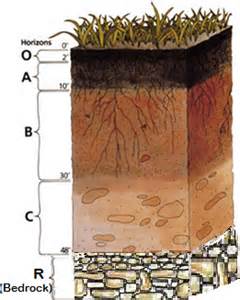
Which horizon is made up of partially weathered rocks?
a)
Horizon A
b)
Horizon B
c)
Horizon C
d)
Horizon D or R
42.
_______ is the type of soil used most often with plants. It is a mixture of clay, sand, and silt.
a)
loam
b)
humus
c)
mud
d)
dirt
43.
Soil sample that is 60% clay, 30% silt, and 10% sand has which texture? 
a)
clay
b)
clay loam
c)
sandy loam
d)
silt 
44.

The rate at which water flows through the soil is called soil percolation or ______.

a)

Groundwater

b)

Permeability

c)

Soil Pores

d)

Porosity

45.
Which soil component has the least capacity for holding water?
a)
silt
b)
clay
c)
sand
d)
humus
46.
You dig a small hole in the soil and the next day it rains. The hole fills with water, but does not empty even after several days of dry weather. What is the soil mostly made of?
a)
clay
b)
sand
c)
humus
d)
silt
47.

What are the proportions of sand, silt, and clay for the soil at point X ?

a)

5% Sand, 95% Silt, 5% Clay

b)

5% Sand, 20% Silt, 5% Clay

c)

65% Sand, 30% Silt, 10% Clay

d)

60% Sand, 30% Silt, 10% Clay

48.
This is the side of the mountain that is often drier and warmer.
a)
Leeward Side
b)
Wet Lapse Rate
c)
Windward Side
d)
Wild Side
49.
Earthquakes and volcanoes are most likely found in which locations?
a)
At plate boundaries
b)
in oceans
c)
in the middle of continents
d)
in the middle of plates
50.

During a(n) ____ event, trade winds are much stronger than usual.

a)

El Nino

b)

La Nina

c)

Normal

d)

Partly sunny

51.

Both El Nino and La Nina have this in common

a)

Influence birds that migrate over the ocean

b)

Influence rainy / dry weather world wide

c)

The weather at the polar regions

d)

The directions that ships travel in the oceans

52.

The picture represents a(n) ___ event.

a)

El Nino

b)

La Nina

c)

Non-El Nino (normal conditions)

53.

The picture below is of a(n) ____ event.

a)

Non-El Nino (Normal)

b)

El Nino

c)

La Nina

54.
The layer of atmosphere closest to the Earth is called the
a)
mesosphere
b)
stratosphere
c)
troposphere
d)
proctosphere
55.
The ozone layer
a)
is green and purple
b)
absorbs dangerous solar radiation
c)
smells like sulphur
d)
is made of carbon dioxide
56.
Most of Earth's weather occurs in the 
a)
troposphere
b)
stratosphere
c)
mesophere
d)
thermosphere
57.

What causes wind?

a)

Too much Taco Bell

b)

Differences in elevation

c)

The uneven heating of the Earth by the sun

d)

Ocean currents

58.
The curving of air to the right in the Northern hemisphere is caused by ___________ and is called the _________ effect.
a)
Earth's rotation...Coriolis
b)
Earth's revolution...Coriolis
c)
Earth's rotation...Doppler
d)
Earth's revolution...Doppler
59.
Why does warm air rise?
a)
Warm air is more dense than cooler air.
b)
Warm air has more pressure than cooler air.
c)
Warm air is less dense than cooler air.
d)
Warm air has a higher dew point than cooler air.
60.

The rotation of the Earth causes winds to bend due to the...

a)

coriolis effect

b)

doldrums

c)

trade winds

d)

westerlies