
Font size
 Worksheets
Evolution
Total questions: 40
Worksheet time: 1hrs 29mins
have the ability to interbreed.
Evolved from the same ancestor, but have different functions
Homologous structures
Analogous structures
Vestigial structures
All of the above
Evolved from different ancestors, but due to living in similar environments have a similar function.
Homologous structures
Analogous structures
Vestigial structures
All of the above

Penguin flipper and fish fin
Homologous
Vestigial
Analogous
None of the above
An anatomical feature that no longer seams to have a purpose in the current form of an organism
Homologous structure
Analogous structure
Vestigial structure
None of the above
Which of the following are vestigial structures humans have? Select all that apply.
Appendix
Tailbone
Forearm bones
Femurs

Whales have pelvic bones. What type of structure does this best represent?
Homologous structure
Analogous structure
Vestigial structure
None of the above

this type of evolution happens on a small scale, typically within a single population
microevolution
macroevolution
natural selection
artificial selection

body parts in different organisms that have the same basic structure, but may have different functions
analagous structures
homologous structures
vestigal structures

a change in a population or species over time
Common Ancestry
Evolution
Embryology
Biogeography
When a species completely dies out, it is considered...
adapted
fossilized
extinct
mutated
Genetic differences between organisms of the same species.
variation
behavior
adaptation
environment
In finches (birds), what is the biggest advantage of having different shaped beaks?
to look different from other species
to protect itself from predators
to be able to eat the food readily available in the environment
to protect itself against prey
Which characteristic of artificial selection makes it different from natural selection?
Humans, not the environment, select which organisms survive and reproduce.
Adaptations develop gradually over many generations.
The stock that are reproduced are genetically identical.
All offspring are allowed to survive and reproduce.
Fifteen iguanas survived a hurricane on a raft of uprooted trees. After a month at sea, they colonized an island. They were the first of their species to arrive there. Evolutionary biologists predict that this group of iguanas could become the ancestors of a new species.
Which statements explain why a new species would evolve from the iguanas? Choose two answer choices.
The island iguanas are geographically isolated from the original population.
The island iguanas fill exactly the same niche on the island as they did before.
The island iguanas have more genetic variation than the original population.
The island iguanas evolve through favorable adaptations and natural selection.
Some female peacocks prefer males with large, colorful tales while other female peacocks prefer males with no tail at all. Females are now mating only with the tail they prefer. What type of reproductive barrier is this?
behavioral isolation
hybrid sterility
temporal isolation
mechanical isolation
In the Great Lakes region of North America, gray wolves and coyotes are similar species but do not mate because their breeding periods occur at different times of the year.
Geographic isolation
Behavioral isolation
Temporal isolation
How is information from the field of embryology used as evidence for evolution?
It shows that organisms from the same species have similar developmental patterns.
It shows that organisms from different species have similar developmental patterns.
It shows that organisms from different species have similar DNA.
It shows that organisms from the same species have similar DNA.
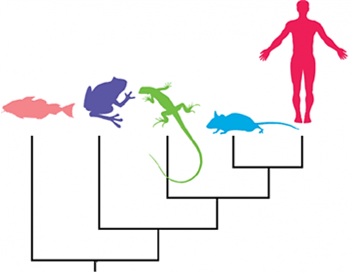
What is the human most closely related to?
Fish
mouse
Salamander
Human

Where is the alligator and T. rex's common ancestor?
Point A
Point B
Point C
Point D

What do both the squirrel and lion have in common that the other animals do not?
They are both vertebrates
They both have lungs
They are both mammals
They both lose their canine teeth.

According to the cladogram, which organism is most distantly related to the chimpanzee?
salmon
salamander
lizard
hamster

