
 Worksheets
AP Biology Metabolism
Total questions: 60
Worksheet time: 43mins
Organisms get their energy to do work from ___________ energy.
solar energy
chemical energy
thermal energy
nuclear energy
A --> B + C
Anabolic
Catabolic
A + B --> C
Anabolic
Catabolic
Net release of energy
endergonic
exergonic
A + B --> AB + Energy
This is what type of reaction?
exergonic
endergonic
To do work, living systems will pair an catabolic reaction with a(n)________________
exergonic reaction
oxidative reaction
ATP synthesis
anabolic reaction

Which statement is true according to the image?
A: endergonic; B: exergonic
A: exothermic; B: endothermic
A: exergonic; B: endergonic
A: endothermic; B: exothermic
Cyanide is a toxin that stops the mitochondria from producing ATP. If cyanide were introduced into your cells, it is probably acting as a(n)
activator
coenzyme
inhibitor
substrate
Cyanide is a toxin that stops the mitochondria from producing ATP. If cyanide got into your cells, the absence of ATP would cause
an increased chemical reactions because ATP will no longer be in the way
divergence of metabolic pathways due to lack of ATP
a decrease in chemical reactions because ATP is needed, but the cell can use carbohydrates, proteins or lipids instead
a slow down and eventual cessation of chemical reactions because ATP is absolutely needed for chemical reactions to occur


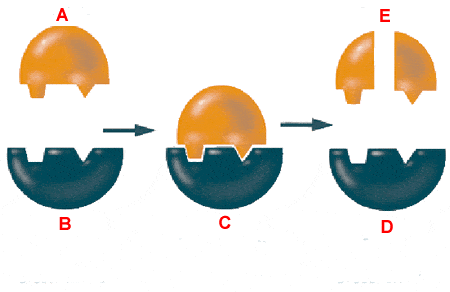
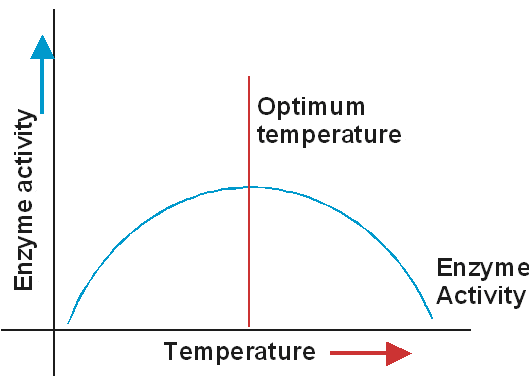
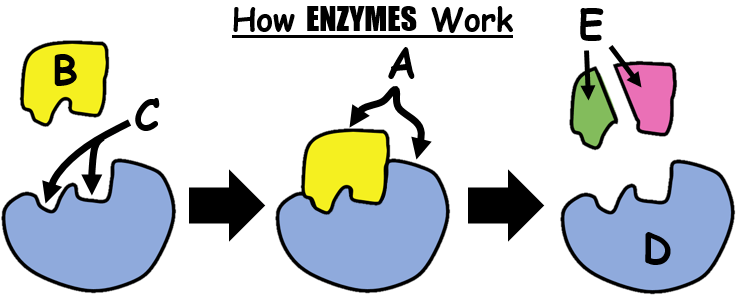
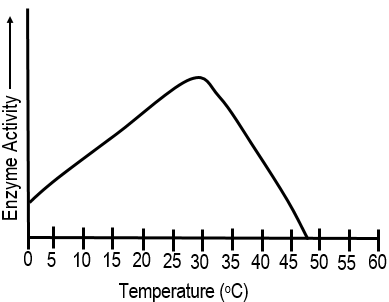
The best way to speed up an enzymatic reaction would be
Add more substrate
Add more enzyme
Increase the temperature
Increase the salinity

In order to increase the rate of reaction using an enzyme a scientist could.... (Choose all that apply)
Increase the amount of substrate
Decrease the temperature
Increase the temperartue
Introduce a competitive inhibitor
Which of the following is directly responsible for the shape of an enzyme/protein?
The amino acid sequence of the protein and the properties of the amino acids that make up the protein.
The temperature of the surrounding environment.
The pH of the surrounding environment.
The amount of substrate present.
If a mutation occurs in a DNA sequence that codes for an enzyme, what is the most likely result?
There will likely be no change in the shape and function of the enzyme.
The enzyme will most likely fold in a way that makes its shape incompatible with the substrate and the enzyme will not function correctly.
The enzyme will not be produced at all.
The enzyme will have an enhanced ability to bind with the substrate.
Each enzyme only has 1 substrate that will fit its active site. What is this called?
reusability
catalysis
specificity
fragility
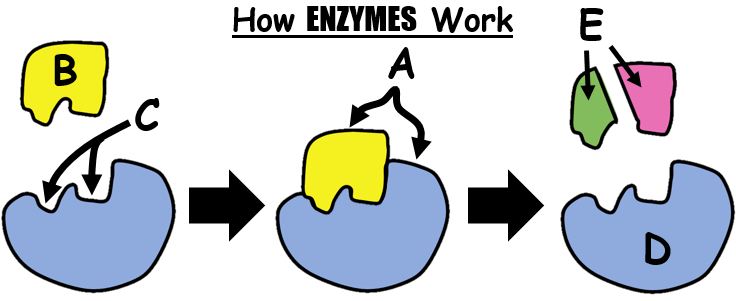
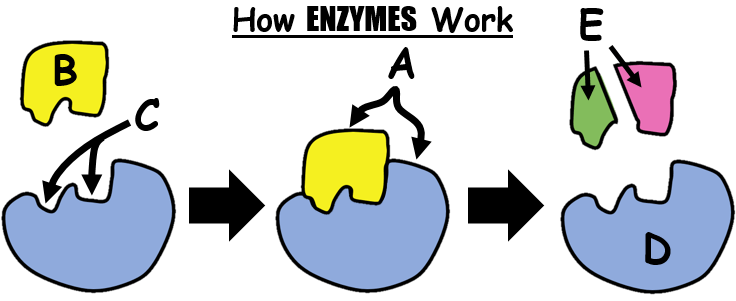
Describes the process by which an enzyme's function at the active site may be either activated or inhibited by the binding of a regulatory molecule at a separate site.
Allosteric Interactions
Feedback Inhibition
Competitive Inhibition
Noncompetitive Inhibition
A molecule that is so similar to the normal substrate that it competes for the active site of the enzyme
Allosteric Inhibition
Competitive Inhibition
Noncompetitive Inhibition
Feedback Inhibition
A molecule that binds to the enzyme at a site other than the active site, causing the enzyme to change shape and be unable to bind substrate
Allosteric Inhibition
Feedback Inhibition
Competitive Inhibition
Noncompetitive Inhibition
When Substance A was added to an enzyme reaction, product formation decreased. The addition of more substrate did not increase product formation. From this we can conclude that Substance A could be
product molecules.
an allosteric enzyme.
a competitive inhibitor.
a noncompetitive inhibitor.
Bacterial production of the enzymes needed for the synthesis of the amino acid tryptophan declines with increasing levels of tryptophan in the cell and increases with decreasing levels of tryptophan. This is an example of
Competitive Inhibition
Noncompetitive Inhibition
Feedback Inhibition
Irreversible Inhibition
In E.Coli, an enzyme called RelA catalyzes the formation of a molecule called alarmone. Alarmone binds to RelA at a location different than the active site and the binding of Alarmone to RelA increases the affinitiy of RelA for its substrate.
Positive Feedback
Allosteric Inhibition
Negative Feedback
Allosteric Activation
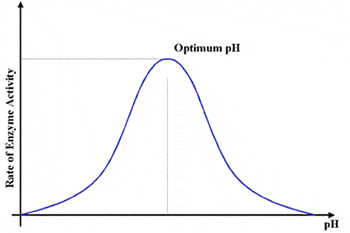
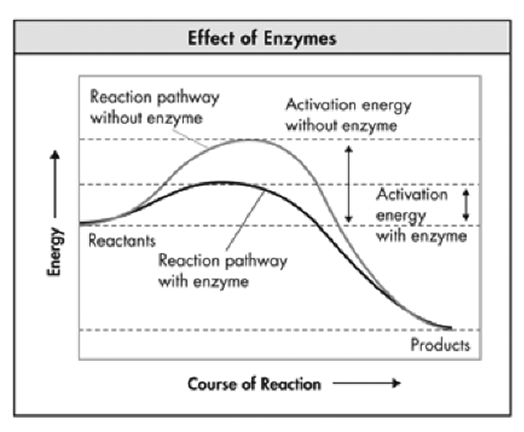

In Figure 6.2, why does the reaction rate plateau at higher reactant concentrations?
Feedback inhibition by product occurs at high reactant concentrations.
Most enzyme molecules are occupied by substrate at high reactant concentrations.
The reaction nears equilibrium at high reactant concentrations.
The activation energy for the reaction increases with reactant concentration.

The diagram represents one way an enzyme can be inhibited.
Which statement explains the effect of an inhibitor on an enzyme?
A substrate will be able to bond with the enzyme.
The enzyme will likely be attacked by immune cells.
The enzyme will be unable to produce more enzymes.
A substrate will be unable to attach to the enzyme.


Consider a scientist adding more enzyme to this sample from the graph. Explain how the rate of reaction will change when more enzyme is added.
decrease
increase
stay constant

Consider a scientist adding more enzyme to this sample from the graph. Explain how the rate of reaction will change when more enzyme is added.
decrease
increase
stay constant

