Wayground logo

Free Printable Worksheets

Font size

S
M
L
XL
Worksheets

Biology revision MCQs

Total questions: 77

Worksheet time: 4hrs 51mins

Name
Class
Date
1.

Which of the following shows the balanced chemical symbol equation for photosynthesis?

a)

A

b)

B

c)

C

d)

D

2.

What is the main energy change that happens in photosynthesis?

a)

chemical --> light

b)

light --> kinetic

c)

light --> chemical

d)

kinetic --> light

3.

Where is chlorophyll found in plant cells?

a)

cytoplasm

b)

chloroplast

c)

mitochondria

d)

vacuole

4.

What substance can glucose be converted to, which is the transport carbohydrate of plants?

a)

starch

b)

cellulose

c)

sucrose

d)

amino acids

5.

What substance can glucose be converted into, which is the energy storage carbohydrate of plants?

a)

cellulose

b)

sucrose

c)

amino acids

d)

starch

6.

Which substance can glucose be converted to, which strengthens plant cell walls?

a)

starch

b)

cellulose

c)

amino acids

d)

sucrose

7.

Which of the following organelles would you not expect to be present in onion root cells?

a)

cell wall

b)

vacuole

c)

chloroplast

d)

mitochondrion

8.

Why is the chemical sodium hydrogencarbonate given to water plants in photosynthesis practicals?

a)

it is used to produce chlorophyll

b)

it allows the plant to respire

c)

it supplies the plant with CO2 gas when it dissolves

d)

it is a source of glucose

9.

Four test-tubes are set up as shown.


Click on the picture to make it larger.


Which test-tube contains the most carbon dioxide after one hour?

a)

A

b)

B

c)

C

d)

D

10.
Not an organic molecule....
a)
Carbon Dioxide
b)
Sucrose
c)
Cellulose
d)
Protein
11.
Turns Blue-Black when testing for Non-Reducing Sugars...
a)
Benedicts soln
b)
Biuret soln
c)
Iodine soln
d)
Ethanol soln
12.
DNA stands for......
a)
Deoxy ribose Nucleus Acid
b)
Digested ribose Nutter Acid
c)
Deoxy ribulose Nucleic Acid
d)
Deoxy ribose Nucleic Acid
13.
A positive test for the Biuret test goes....
a)
Blue-black
b)
Purple
c)
White
d)
Brick red
14.
Cellulose is a....
a)
Protein
b)
Polysaccharide
c)
Lipid
d)
Mineral
15.
An organic chemical that contains Nitrogen is....
a)
Protein
b)
Lipid
c)
Saccharide
d)
Carbohydrate
16.
Makes up about 75% of a human....
a)
Carbon
b)
Hydrogen
c)
Water
d)
Oxygen
17.
Supplies most of your immediate energy....
a)
Fats
b)
Cellulose
c)
Glucose
d)
Glycogen
18.
What are the four biological molecules?
a)
proteins, carbohydrates, lipids, nucleic acids
b)
A, T, C, G
c)
water, air, earth, and fire
d)
Joe, Nick, and Kevin Jonas
19.
A group of organic molecules that includes sugars, starch, and cellulose care called...
a)
proteins
b)
carbohydrates
c)
nucleic acids
d)
lipids
20.
What is the primary function of carbohydrates in your body?
a)
Speed up chemical reactions.
b)
Give immediate energy.
c)
Help to store energy.
d)
Build cell walls in plants.
21.

What is the formula of Glucose?

a)

C3H16O36

b)

C632H123O2

c)

C6H12O6

d)

C12H6O12

22.
A class of biological molecules whose defining characteristic is their relative insolubility in water. Examples of these include steroids, oils, fats, and fatty acids.
a)
protein
b)
monomer
c)
lipids
d)
glycogen
23.
A large, folded chain of amino acids.
a)
protein
b)
steroid
c)
monosaccharide
d)
enyzme
24.

Enzymes are _____________?

a)

Hydrocarbons

b)

Hormones

c)

Lipids

d)

Proteins

25.

What is an enzyme?

a)

A protein that speeds up chemical reactions

b)

A protein that breaks apart molecules

c)

A protein needed for cell structure

d)

A neurological protein involved in cell signaling
26.
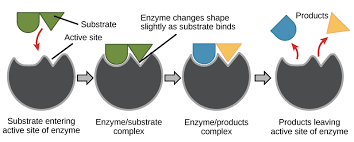
In a chemical reaction, a reactant binds to an enzyme at a region known as the
a)
catalyst.
b)
product.
c)
substrate.
d)
active site. 
27.
Which of the factors does NOT affect enzymatic activity?
a)
Temperature
b)
pH
c)
Concentration
d)
Color
28.
An enzyme is a catalyst.
a)
True
b)
False
29.
With what 3 letters do enzymes typically end?
a)
-ose
b)
-ase
c)
-ese
d)
-tic
30.

The diagram shows an image of a chloroplast.


The image is 5 cm long.

The actual length of the chloroplast is 5 μm.


What is the magnification of the image?

a)

x10

b)

x1000

c)

x10 000

d)

x100 000

31.

Which statement describes active transport?

a)

the movement of ions through proteins in a cell membrane, releasing energy

b)

the movement of ions through proteins in a cell membrane, using energy

c)

the movement of water through lipids in a cell membrane, releasing energy

d)

the movement of water through lipids in a cell membrane, using energy

32.

The diagram shows two solutions that are separated by a partially permeable membrane.


In which direction will most water molecules move in relation to their concentration gradient?

a)

from X to Y against their concentration gradient

b)

from X to Y down their concentration gradient

c)

from Y to X against their concentration gradient

d)

from Y to X down their concentration gradient

33.

The diagram represents two liquids, separated by a membrane through which osmosis can occur.


Which statement describes how the molecules will move?

a)

Molecules of dissolved substance move from left to right.

b)

Molecules of dissolved substance move from right to left.

c)

Overall, water molecules move from left to right.

d)

Overall, water molecules move from right to left.

34.

Which characteristics are correct for both osmosis and diffusion?

a)

A

b)

B

c)

C

d)

D

35.

Which of the following is true of dicotyledon plants?

a)

their leaves have parallel veins

b)

their leaves are broad and wide

c)

they have one cotyledon in their seeds

d)

they have a branched root system

36.

Four freshly cut potato cylinders were soaked for one hour in different salt solutions before being pinned to cork blocks. Two of the blocks are shown.


Which solution would cause the potato cylinder to be most flaccid?

a)

0.1 mol per dm3 salt solution

b)

0.3 mol per dm3 salt solution

c)

0.7 mol per dm3 salt solution

d)

1.0 mol per dm3 salt solution

37.
Each enzyme only has 1 substrate that will fit its active site.  What is this called?
a)
reusablility
b)
denaturation
c)
specificity
d)
fragility
38.
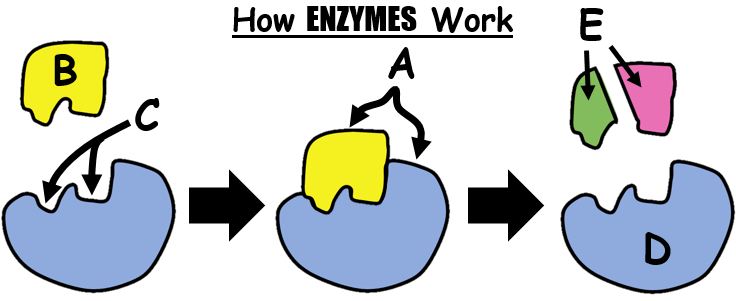
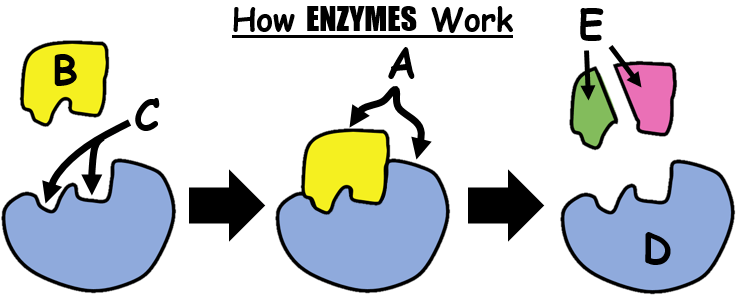
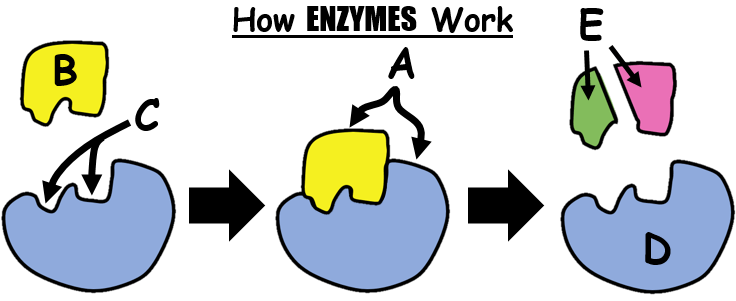
In the diagram, what is letter A? 
a)
product
b)
substrate
c)
enzyme-substrate complex
d)
active site
39.
An enzyme speeds up a chemical reaction in the cell but can only be used once.  True or False? 
a)
true
b)
false
40.
What happens when enzymes are heated to a high temperature?
a)
The enzymes die.
b)
The shapes of the enzyme are altered denature
c)
The enzymes' amino acid sequence changes.
d)
The enzymes remain the same
41.
Which of these is most likely an enzyme?  
a)
Sucrose
b)
Galactose
c)
Fructose
d)
Amylase
42.
What is another name for enzymes?
a)
chemical catalysts
b)
microorganisms
c)
biological catalysts
d)
inorganic catalysts
43.
The pH at which an enzyme is most efficient is called the _________ pH of an enzyme.
a)
neutral
b)
optimum
c)
minimum
d)
experimental 
44.
Letter D...
a)
active site
b)
enzyme
c)
substrate
d)
products
45.
Letter B...
a)
active site
b)
enzyme
c)
substrate
d)
products
46.
Letter C...
a)
active site
b)
enzymes
c)
substrate
d)
products
47.
What makes an enzyme substrate specific?
a)
Size
b)
Shape
c)
Name
d)
Location it is found in
48.
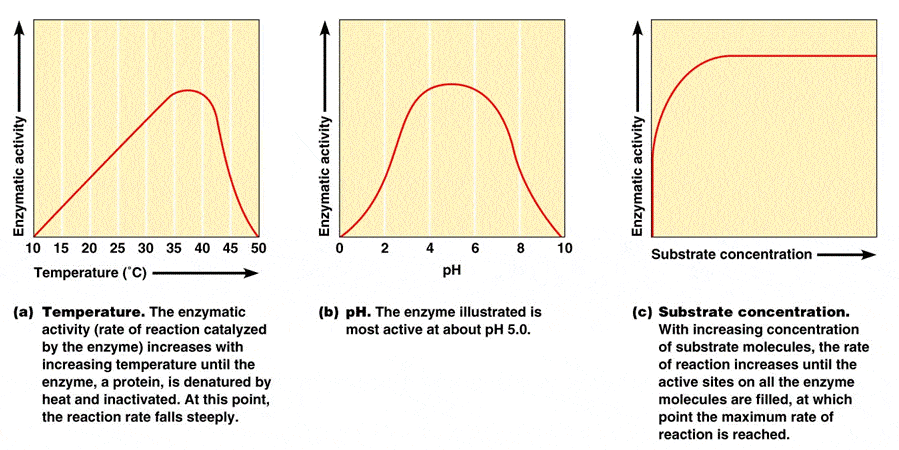
Based on the graph, what temperature does this enzyme work best? 
a)
15 C
b)
40 C
c)
30 C
49.
Which of the following binds to the active site of an enzyme? 
a)
substrate
b)
product
c)
codon
d)
none of the above
50.
Which of the following conclusions can be drawn from this graph?
a)
The optimum pH of the enzyme is 6.6.
b)
The optimum pH of the enzyme is 5.8
c)
The enzyme’s activity increases as pH increases 5.0 to 9.0
d)
The enzyme’s activity is greater around pH of 8.0 .
51.
a)
1, 2, 3 and 4
b)
1 and 3
c)
2 and 3
d)
2 and 4
52.
a)
A
b)
B
c)
C
d)
D
53.
a)
A
b)
B
c)
C
d)
D
54.
a)
cell membrane = X
cell wall = Y
cytoplasm = Z
b)
cell membrane = X
cell wall = Z
cytoplasm = Y
c)
cell membrane = Z
cell wall = Y
cytoplasm = X
d)
cell membrane = Z
cell wall = X
cytoplasm = Y
55.
carries water and minerals from roots to other parts of the plant
a)
xylem 
b)
phloem
c)
stoma
d)
guard cell
56.
Which organelle from the plant cell is primarily responsible for converting sunlight to energy?
a)
Mitochondria
b)
Nucleus
c)
Vacuole
d)
Chloroplast
57.
What is chlorophyll's main function?
a)
to make the plant a vegetable
b)
to blend into their environment
c)
to capture energy from sunlight for photosynthesis
d)
to help prevent water loss
58.
Carbon dioxide enters plant leaves through the __________.
a)
stomata
b)
chloroplasts
c)
xylem
d)
cuticle
59.
Which is NOT a reason why we should care about photosynthesis?
a)
It creates food for the plants, which then feed animals.
b)
Without it, we wouldn't be able to breathe oxygen.
c)
It uses up greenhouse gas CO2 in the atmosphere.
d)
It controls the water cycle.
60.

Which number is pointing to the stomata?

a)

6

b)

7

c)

8

d)

9

61.

Mushrooms are fungi.

a)

TRUE

b)

FALSE

62.

Yeasts are fungi.

a)

YES

b)

NO

63.

Fungi have cell walls made of cellulose, just like plants do.

a)

TRUE

b)

FALSE

64.

Many fungi grow as hyphae.

a)

TRUE

b)

FALSE

65.

The thread-like filaments of fungi are called

a)

hyphae.

b)

spores

c)

zygospores

66.

One way that fungi are similar to plants is

a)

they both have cell walls made of cellulose.

b)

they both carry out photosynthesis.

c)

they both move rapidly from place to place.

d)

have membrane-bound nuclei, which contain DNA

67.

Which levels of hierarchy form the scientific name?

a)

Class and species

b)

Order and genus

c)

Phylum and species

d)

Genus and species

68.

Which kingdom is the most diverse?

a)

Animalia

b)

Fungi

c)

Eubacteria

d)

Protista

69.
Term given to describe the 2 name naming system is:
a)
dichotmous key
b)
binomial nomenclature
c)
2 scientific names
d)
binomial key
70.
What is the most specific level of classification?
a)
Family
b)
Domain
c)
Species
d)
Carolus Linnaeus
71.

Biologists who classify living things into groups are called

a)

Biologroupist

b)

Dichotomous

c)

Taxonomists

d)

Binomial

72.
An organism with no nucleus
a)
Prokaryote
b)
Eukaryote
Eukaryote
73.

The Linnaean classification system classifies organisms from broadest to most specific in the following order:

a)

domain-->kingdom-->phylum-->class-->order--->family-->genus-->species

b)

domain-->kingdom--> class-->order-->family-->genus--->species

c)

phylum--> order-->species--->genus-->kingdom--> class--->family

d)

class--->species--->genus---->phylum--->family--->order--->kingdom

74.
What am I?
a)
Arthropod
b)
Cnidarian
c)
Mollusk
d)
Porifera
75.

All fish, all birds, all mammals are...

a)

animals with internal fertilization

b)

carnivores

c)

vertebrates

d)

warm blooded animals

76.

Mammals are warm-blooded.


Which other vertebrate group is warm-blooded?

a)

birds

b)

reptiles

c)

amphibians

d)

fish

77.

Which of the following kingdoms is always unicellular?

a)

plant

b)

fungi

c)

prokaryote

d)

animal