wayground logo

Free Printable Worksheets

Font size

S
M
L
XL
Worksheets

Practice Test for Unit 2 Exam-Chemical Reactions

Total questions: 110

Worksheet time: 9hrs 10mins

Name
Class
Date
1.
What is the Law of Conservation of mass?
a)
Mass is created in a chemical reaction
b)
Mass is created in a physical change
c)
New chemicals formed from a chemical reaction have a larger overall mass than the original reactants
d)
Mass is never created or destroyed
2.
In a reaction A + B ----> C,  reactant A has 5g and product  C has 9g. How many grams does reactant B should have? 
a)
4g
b)
5g
c)
9g
d)
14g
3.
The number in front of a compound or element is a 
a)
Subscript
b)
Coefficient
c)
Superscript
d)
Charge
4.
The number to the lower side of an element is a 
a)
Subscript
b)
Superscript
c)
Coefficient
d)
Charge
5.
Is this equation balanced or unbalanced? 
2Fe2O3 + 3C --> 4Fe + 3 CO2
a)
balanced
b)
unbalanced
6.
How many nitrogen atoms does NH3 have?
a)
1
b)
2
c)
3
d)
4
7.
How many Hydrogen are in 4H2O?
a)
6
b)
8
c)
2
d)
4
8.
How many atoms are there TOTAL in:
H2SO4
a)
6
b)
5
c)
7
d)
3
9.
How many Sodium (Na) are in 6NaCl?
a)
1
b)
12
c)
6
10.

Which element has the greatest number of atoms? AgNO3AgNO_3  

a)

Silver

b)

Gold

c)

Nitrogen

d)

Oxygen

11.
What elements generally make an ionic bond?
a)
metal and nonmetal
b)
2 or more nonmetals
c)
metal
d)
none of the above
12.
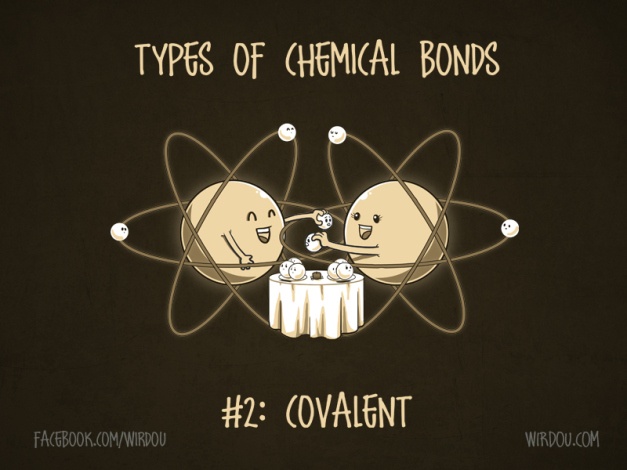
What elements generally make a covalent bond?
a)
metal and nonmetal
b)
2 or more nonmetals
c)
metal
d)
none of the above
13.
In chemical compounds, covalent bonds form when
a)
the electronegativity difference between two atoms is very large.
b)
electrons are completely transferred between two metals.
c)
pairs of electrons are shared between two nonmetal atoms.
d)
two nonmetal atoms are attracted to each other by opposite charges.
14.
An ionic bond forms when 
a)
Valence electrons are shared
b)
a sea of mobile electrons surround the cations
c)
valence electrons are transferred between atoms
d)
none of the above
15.
Predict the bond that will form between Be and F.
a)
Ionic
b)
Covalent
16.
Predict the bond that will form between Se and Cl.
a)
Ionic
b)
Covalent
17.
Predict the bond that will form between Sr and S.
a)
Ionic
b)
Covalent
18.
What is a valence electron?
a)
an electron that is found in the outermost shell of an atom. 
b)
an electron found in the innermost shell of an atom.
c)
an electron found in the middle shell.
19.

limestone (CaCO3)

a)

Element

b)

Compound

c)

Heterogeneous Mixture

d)

Homogeneous Mixture

20.

Aluminum (Al)

a)

Element

b)

Compound

c)

Heterogeneous Mixture

d)

Homogeneous Mixture

21.

magnesium (Mg)

a)

Element

b)

Compound

c)

Heterogeneous Mixture

d)

Homogeneous Mixture

22.

acetylene (C2H2)

a)

Element

b)

Compound

c)

Heterogeneous Mixture

d)

Homogeneous Mixture

23.
Substance that consists of one type of atom.  It is a pure substance. Found on the Periodic Table. 
a)
Element
b)
Compound
c)
Mixture
d)
I don't know
24.
Combinations of 2 or more substances (elements and compounds) that are physically blended together. 
a)
Compound
b)
Mixture
c)
Element
d)
Substance
25.
Pure oxygen (O) is an example of...
a)
an element
b)
a mixture
c)
a compound
26.
An example of ...
a)
A mixture
b)
A compound
c)
An element 
27.
Are these molecules also compounds?
a)
YES
b)
NO
28.
Are these molecules also compounds?
a)
YES
b)
NO
29.
Ions are: 
a)
atoms with a positive or negative charge
b)
atoms with no charge
c)
atoms with ONLY a positive charge
d)
atoms with ONLY a negative charge
30.
What is an ion?
a)
A Charged Atom
b)
A Large Atom
c)
A Small Atom
d)
A Cute Atom
31.
Why are ions formed?
a)
To make our lives difficult
b)
Because atoms want 8 valence electrons
c)
Because atoms have the same number of protons and electrons
d)
Because atoms gained neutrons
32.
An atom becomes _________ when it gains electrons.
a)
Positive
b)
Negative
c)
Neutral
d)
Invinsible
33.
Cations are...
a)
Positive
b)
Negative
c)
Neutral
d)
Purring
34.
An atom becomes _______ when it loses electrons.
a)
Positive
b)
Negative
c)
Neutral
d)
Invinsible
35.
What do we call a chemical substance made up of 2 or more different types atoms bonded together?
a)
formula
b)
atom
c)
subscript
d)
compound
36.
All ____________ are made up of two or more atoms bonded together.
a)
atoms
b)
molecules
c)
electrons
d)
elements
37.
2H2O
How many H2O molecules are present?
a)
1
b)
4
c)
2
d)
8
38.
2H2O
How many Oxygen atoms are present?
a)
2
b)
4
c)
1
d)
5
39.
 2H2O
How many Hydrogen atoms are present?
a)
2
b)
4
c)
1
d)
10
40.
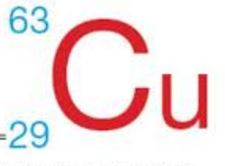
What is the atomic mass of Copper?
a)
63
b)
29
c)
34
d)
92
41.
How many electrons does Cu4+ have?
a)
29
b)
33
c)
25
d)
30
42.
How many electrons does S2- have?
a)
16
b)
18
c)
14
d)
12
43.
What does the atomic mass tell you?
a)
Basically,the number of electrons and protons
b)
The number of neutrons
c)
Basically, the number of protons and neutrons
d)
The number of protons.
44.
An element's identity is determined by the number of
a)
electrons.
b)
protons.
c)
neutrons.
d)
valence.
45.
How many valence electrons in this structure?
a)
6
b)
5
c)
4
d)
7
46.

Typically in an atom, which two subatomic particles are equal in number?

a)

protons and neutrons

b)

all subatomic particles are equal in number

c)

neutrons and electrons

d)

protons and electrons

47.

How many electrons does a Copper atom have?

a)

63

b)

29

c)

92

d)

34

48.

How many protons are present in phosphorus?

a)

15

b)

16

c)

31

d)

46

49.
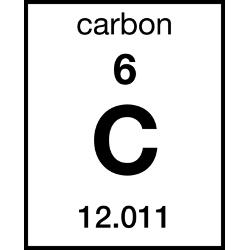
What does the 6 represent above the C
a)
Symbol 
b)
Name 
c)
Mass Number 
d)
Atomic Number 
50.

An atom with atomic number 6 would have how many neutrons?

a)

6

b)

12

c)

3

d)

cannot be determined

51.
What is the atomic number for an element with three protons?
a)
2
b)
1
c)
3
d)
6
52.
How many neutrons does Argon have in it's nucleus?
a)
39.948
b)
58
c)
22
d)
18
53.
How many protons are in Cadmium?
a)
112.411
b)
170
c)
64
d)
48
54.
Lithium is located in Group 1 of the Periodic Table, which element has similar characteristics of Lithium?
a)
Cesium (Cs)
b)
Beryllium (Be)
c)
Neon (Ne)
d)
Magnesium (Mg)
55.

What is a positive ion called?

a)

anion

b)

cation

c)

isotope

d)

covalent

56.

A Bromine ion gains 1 electron, which of the following is the correct symbol for a Bromine ion?

a)

Br-1

b)

Br+1

c)

Br+7

d)

Br-7

57.

A Nitrogen Atoms would _________ electrons to become a 

N3N^{-3}  

a)

lose 5

b)

gain 5

c)

lose 3

d)

gain 3

58.

A Mg Atoms would _________ electrons to become a 

Mg+2Mg^{+2}  

a)

lose 2

b)

gain 2

c)

lose  10

d)

gain 10

59.

how many Electrons Does 

Ca+1  Ca^{+1\ \ }  

a)

40

b)

41

c)

21

d)

20

e)

19

60.

What type of reaction involves the breaking down of a substance into simpler substances?

a)

Single Replacement Reaction

b)

Double Replacement Reaction

c)

Synthesis Reaction

d)

Decomposition Reaction

61.

What type of reaction involves one element replacing another element in a compound?

a)

Single Replacement Reaction

b)

Double Replacement Reaction

c)

Synthesis Reaction

d)

Decomposition Reaction

62.

What type of reaction involves ions from 2 compounds exchanging places to form 2 completely new compounds?

a)

Single Replacement Reaction

b)

Double Replacement Reaction

c)

Synthesis Reaction

d)

Decomposition Reaction

63.

What are the reactants in the chemical equation pictured?

a)

CH4 and CO2

b)

CH4 and O2

c)

CO2 and H2O

d)

O2 and H2O

64.

What are the products of the chemical reaction pictured?

a)

CH4 and CO2

b)

CH4 and O2

c)

CO2 and H2O

d)

O2 and H2O

65.

What type of chemical reaction is this one?

Al(OH)3 --> Al2O3 + H2O

a)

Decomposition

b)

Combustion

c)

Synthesis

d)

Single Replacement

66.

What type of chemical reaction is this one?

CUO + CO2 --> CuCO3

a)

Decomposition

b)

Combustion

c)

Synthesis

d)

Single Replacement

67.

What type of chemical reaction is this one?

Ca + MgCl2 --> CaCl2 + Mg

a)

Decomposition

b)

Combustion

c)

Synthesis

d)

Single Replacement

68.

3KOH + H3PO4 --> K3PO4 + 3H2O

a)

Combination

b)

Decomposition

c)

Single replacement

d)

Double replacement

69.
CxHy +O--> H2O + CO2
a)
Decomposition
b)
Double replacement
c)
Combustion
d)
Single Replacement
70.
Pb(NO3)2 --> PbO + NO2 + O2
a)
Synthesis (combination)
b)
Decomposition
c)
Single replacement
d)
Combustion
71.

In ionic bonding ___

a)

Valance electrons are shared between two or more atoms

b)

Valance electrons are free floating causing the compound to be electrically neutral

c)

Metals atoms transfer their valance electrons to nonmetal atoms

d)

Are insoluble and conduct electricity

72.
An ionic bond forms when 
a)
Valence electrons are shared
b)
a sea of mobile electrons surround the cations
c)
valence electrons are transferred between atoms
d)
none of the above
73.

Identify the types of bonds shown in the image.

a)

A. Covalent , B. Ionic, C. Metallic

b)

A. Covalent , B. Metallic, C. Ionic

c)

A. Ionic , B. Covalent, C. Metallic

d)

A. Ionic , B. Metallic, C. Covalent

74.
Metallic bonds join...
a)
Metals to nonmetals
b)
Metals to metals
c)
Metals to metalloids
d)
Metalloids to nonmetals
75.
In covalent bonds, atoms...
a)
share some of their valence electrons
b)
share some of their protons
c)
form malleable substances
d)
give up or gain some electrons
76.

What type of chemical bond is found in NO2?

a)

Covalent

b)

Ionic

c)

Metallic

d)

Both Covalent and Ionic

77.
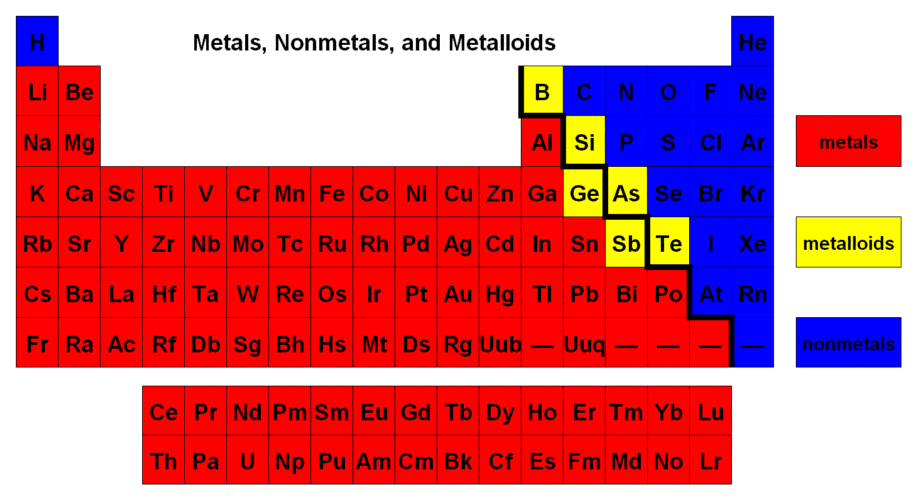
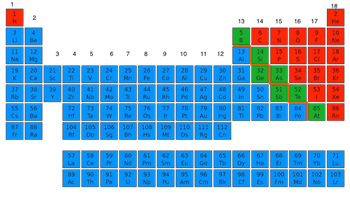
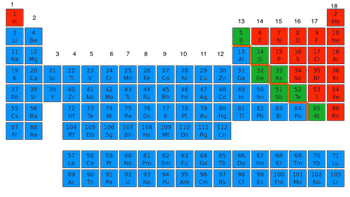
Where are the nonmetals located on the periodic table? 
a)
Blue
b)
Red
c)
Green
78.
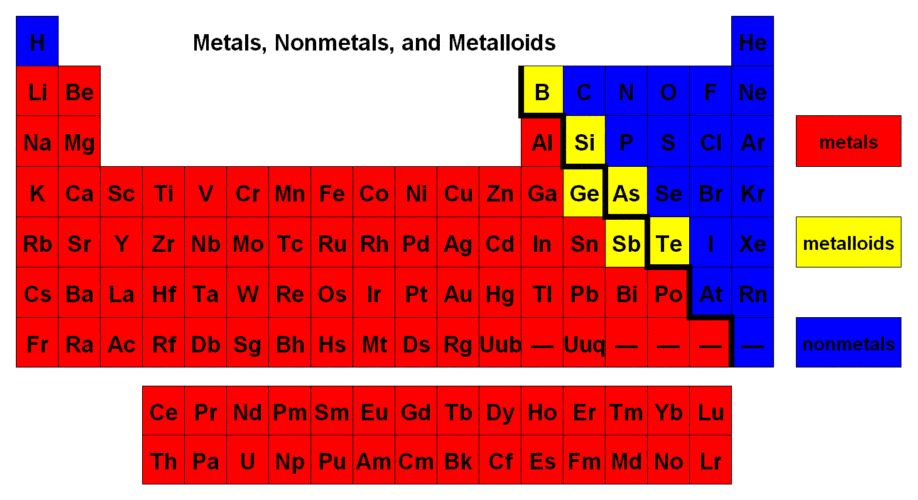
Where are metals located on the periodic table?
a)
Blue
b)
Green
c)
Red
79.
How many elements make up this compound?
a)
6
b)
4
c)
2
d)
3
80.
How many atoms of Oxygen are in this compound?
a)
4
b)
1
c)
12
d)
7
81.
Force that holds together atoms in a substance.
a)
compound
b)
ion
c)
chemical bond
d)
ionic bond
82.
How many atoms of carbon (C) are in C6H12O6?
a)
3
b)
6
c)
12
d)
24
83.
Element or compound?
H2O
a)
element
b)
compound
84.
The noble gases have how many valence electrons?
a)
1
b)
2
c)
7
d)
8
85.

When Lead Nitrate reacts with potassium iodide, Yellow precipitate of ............. is formed

a)

PbI2

b)

KNO3

c)

Pb(NO3)2

d)

PbIO3

86.

In a chemical formula, the total positive charge and negative charge must add up to equal _____.

a)

0

b)

1

c)

2

d)

3

87.
Which of these formulas contain equal numbers of nitrogen atoms?
a)
Formulas I and III
b)
Formulas I and IV
c)
Formulas II and III
d)
Formulas I, II, and V
88.
_P4+_O  _P2O3
a)
3 P4+1 O→ 2 P2O3
b)
1 P4+1 O→ 2 P2O3
c)
1 P4+ 3 O→ 2 P2O3
d)
1 P4+ 2 O→ 3 P2O3
89.
_AgNO3 + _Cu _Cu(NO3)2 + _Ag
a)
2 AgNO3 + 2 Cu → 3 Cu(NO3)2 + 1 Ag
b)
2 AgNO3 + 1 Cu → 1 Cu(NO3)2 + 2 Ag
c)
1 AgNO3 + 2 Cu → 2 Cu(NO3)2 + 1 Ag
d)
3 AgNO3 + 2 Cu → 3 Cu(NO3)2 + 2 Ag
90.
_BaS + _PtF2  _BaF2 + _PtS
a)
1 BaS + 1 PtF2 → 1 BaF2 + 1 PtS
b)
4 BaS + 2 PtF2 → 1 BaF2 +  1 PtS
c)
1 BaS + 2 PtF2→ 2 BaF2 +  2 PtS
d)
1 BaS + 3 PtF2 →1 BaF2 +  2 PtS
91.
_SO2 + _Li2Se _SSe2 + _Li2O
a)
1 SO2 + 2 Li2Se → 1 SSe2 + 2 Li2O
b)
1 SO2 + 1 Li2Se → 2 SSe2 + 2 Li2O
c)
2 SO2 + 2 Li2Se → 2 SSe2 +  2 Li2O
d)
2 SO2 + 2 Li2Se → 1 SSe2 + 1 Li2O
92.
_Al + _HCl →_H2 + _AlCl3
a)
2 Al + 2 HCl → 2 H2 + 6 AlCl3
b)
3 Al + 3 HCl → 6 H2 + 2 AlCl3
c)
1 Al + 1 HCl → 3 H2 + 1 AlCl3
d)
2 Al + 6 HCl → 3 H2 + 2 AlCl3
93.
_K + _Cl2 _KCl
a)
2 K + 16 Cl2 → 8 KCl
b)
2 K + 1 Cl2 → 2 KCl
c)
3 K + 4 Cl2 → 3 KCl
d)
1 K + 1 Cl2 →1 KCl
94.
_NaF + _Br2 _NaBr + _F2
a)
1NaF + 2 Br2 →1 NaBr + 2 F2
b)
2NaF + 2 Br2 → 2 NaBr + 2 F2
c)
2 NaF + 3 Br2 → 1 NaBr + 2 F2
d)
2 NaF + 1 Br2 → 2 NaBr + 1 F2
95.
Balance this equation,            Al2O3 ---> Al + O2 
a)
Cannot be balanced
b)
2Al2O3 ---> 2Al + 3O2 
c)
2Al2O3 ---> 4Al + 3O2 
d)
3Al2O3 ---> 2Al + O2 
96.
How many total atoms are represented?         4Al2O3
a)
2
b)
8
c)
5
d)
20
97.
The large number in front of a chemical formula or compound is the ___________. 
a)
coefficient
b)
product
c)
physical
d)
chemical
98.
In every balanced chemical equation, each side of the equation has the same number of ____.  
a)
coefficients
b)
moles
c)
molecules
d)
atoms of each element
99.
Is the following equation balanced or unbalanced?
Fe + S --> FeS
a)
balanced
b)
unbalanced
100.
When balancing equations what does
 -->
mean?
a)
subscript
b)
equals
c)
it is just an arrow
d)
yield
101.
How many atoms of aluminum are on each side of the following equation: 4Al + 3O--> 2AlO3
a)
2
b)
6
c)
1
d)
4
102.
How many atoms are there TOTAL in:
H2SO4
a)
6
b)
5
c)
7
d)
3
103.
___________________ are the elements or compounds that are formed in a chemical
reaction.
a)
Polymers
b)
Bonds
c)
Reactants
d)
Products
104.
A chemical reaction is...
a)
when a substance is mixed with another substance
b)
when a substance undergoes a change to form a new substance
c)
when a substance is dissolved into another substance
d)
when a substance is heated or exposed to another substance
105.
Aqueous means...
a)
dissolved in water/solution
b)
water
c)
liquid
d)
plasma
106.
Mass cannot be ____ or _____.
a)
made, changed
b)
created, destroyed
c)
rearranged, unmade
d)
stagnant, unchanging
107.
Balance the following equation:
____MgO + ____H2O → ____Mg(OH)2
a)
1,1,1
b)
1,2,2
c)
2,3,4
d)
2,2,2
108.
A precipitate is...
a)
a solid that falls out of a liquid solution
b)
a reactant in a reaction
c)
a clear substance
d)
the mass of a product
109.

Which of these is a balanced double replacement reaction?

a)

Al2O3 (s) + 3 CO2 (g) --> Al2(CO3)3

b)

Ba(OH)2 (s) → BaO (s) + H2O (aq)

c)

2 KF(aq) + Ca(NO3)2 (aq) → CaF2 (s) + 2 KNO3 (aq)

d)

2 AgClO3 (aq) + Cu (s) --> Cu(ClO3)2 (aq) + 2 Ag (s)

110.

Mixing Al(NO3)3 (aq) and NH4OH (aq) results in the formation of a white precipitate. What is the molecular equation for this reaction?

a)

Al3+ (aq) + 3 OH- (aq) → Al(OH)3 (s)

b)

Al(NO3)3 (aq) + 3 NH4OH (aq) → Al(OH)3 (s) + 3 NH4NO3 (aq)

c)

NH4OH (aq) → NH4+ (aq) + OH- (aq)

d)

Al(NO3)3 (aq) → Al3+ (aq) + 3 NO3-(aq)