wayground logo

Free Printable Worksheets

Font size

S
M
L
XL
Worksheets

Plate Tectonics

Total questions: 101

Worksheet time: 3hrs 43mins
Name
Class
Date
1.
Which of these explains that Earth's outer layer is broken into large slowly moving pieces? 
a)
Plate Tectonic Theory
b)
Continental Drift 
2.
Which explains that the continents were once joined together and over time they broke up and then drifted apart?
a)
Plate Tectonic Theory
b)
Continental Drift 
3.
A ______ is a section of the lithosphere that slowly moves over the asthenosphere, carrying large slabs of continental and oceanic crust.
a)
wedge
b)
plate
c)
chunk
d)
fault
4.
A break in Earth's crust along which rocks move is called a ________.
a)
plate
b)
rift
c)
fault
d)
breach
5.
_________ are vibrations that travel through Earth carrying the energy released during an earthquake.
a)
Seismic Waves
b)
Rumbles
c)
Plate Tectonics
d)
Convection Currents
6.
What is the name of the single landmass that began to break apart 200 million years ago?
a)
Panthalassa
b)
Laurasia
c)
Gondwanna
d)
Pangaea
7.
The movement of fluid, caused by differences in temperature, that transfers heat from one part of the fluid to another is _____________.
a)
Convection current
b)
Seismic waves
c)
Sea-floor spreading
d)
Conduction current
8.
The process by which molten material adds new oceanic crust to the ocean floor is called ___________.
a)
Divergent boundary
b)
Sea-floor spreading
c)
Convergent boundary
d)
Renovating 
9.
What is an undersea mountain chain where new ocean floor is produced?
a)
Rift valley
b)
Deep-ocean trench
c)
Mid-ocean ridge
d)
Transform bounda
10.
A __________ is a deep valley along the ocean floor beneath which oceanic crust slowly sinks toward the mantle.
a)
deep-ocean trench
b)
rift valley
c)
sea-floor spreading
d)
mid-ocean ridge
11.
What is the process by which oceanic crust sinks beneath a deep-ocean trench and back into the mantle at a convergent plate boundary?
a)
Subduction
b)
Induction
c)
Abduction 
d)
Reduction
12.
_____________ is a plate boundary where two plates move away from each other.
a)
Convergent boundary
b)
Transform boundary
c)
Divergent boundary
d)
Insurgent boundary
13.
_____________ is when two plates move toward each other.
a)
Convergent boundary
b)
Allegiant boundary
c)
Transform boundary
d)
Sliding boundary
14.
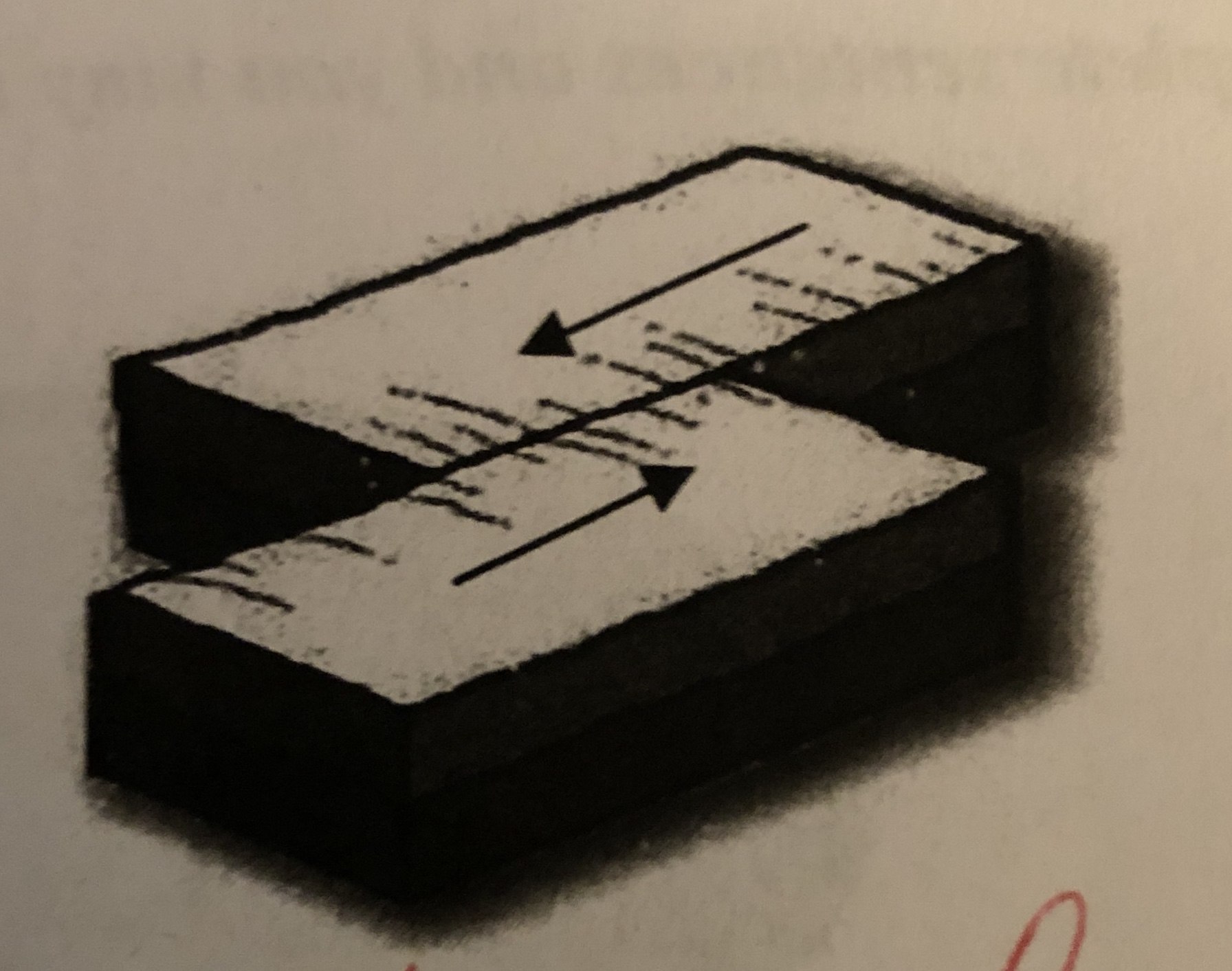
A _____________ is when two plates move past each other in opposite directions.
a)
emergent boundary
b)
divergent boundary
c)
transform boundary
d)
convergent boundary
15.

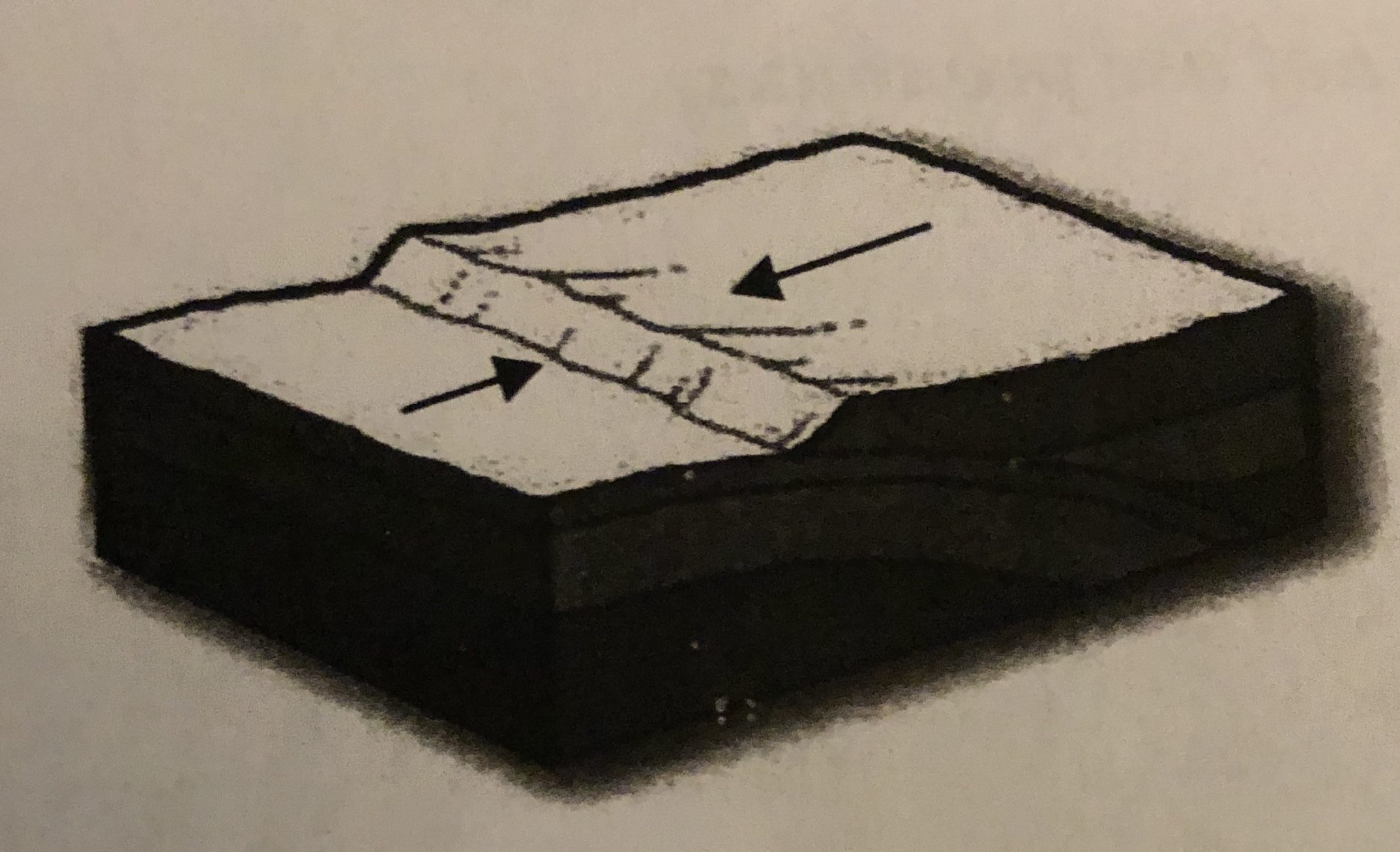
What type of boundary is this?

a)

convergent

b)

divergent

c)

transform

16.

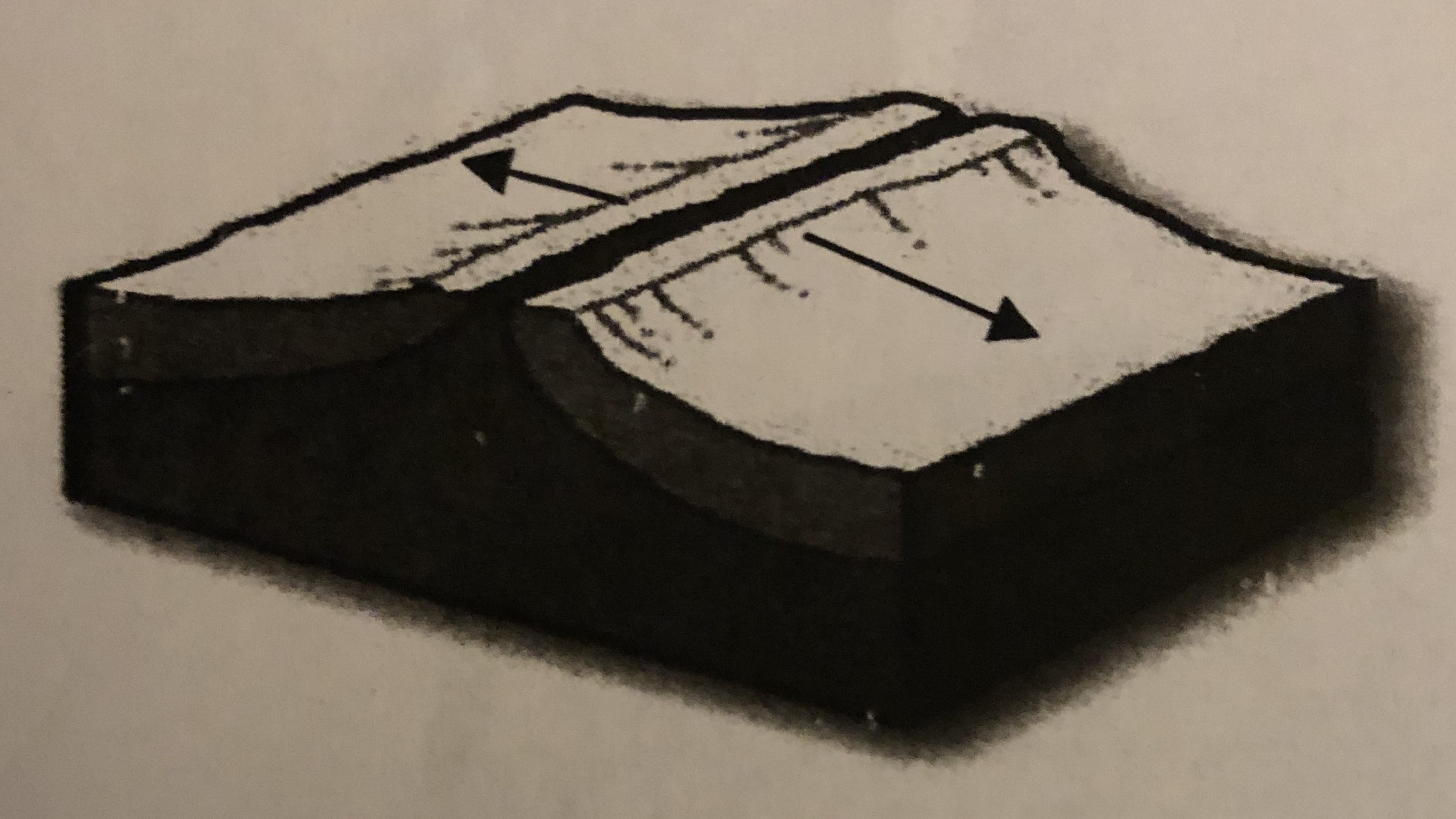
What type of boundary is this?

a)

convergent

b)

transform

c)

divergent

17.

What type of boundary is this?

a)

convergent

b)

divergent

c)

transform

18.

What evidence was NOT used by Wegener as proof of continental drift?

a)

land features

b)

erosion

c)

climate

d)

fossils

19.

What is a plate boundary where both plates move away from each other?

a)

divergent

b)

plate

c)

convergent

d)

transform

20.

What is the correct order (starting from the surface) of Earth’s layers?

a)

crust, outer core, inner core, mantle

b)

mantle, outer core, inner core, crust

c)

crust, mantle, outer core, inner core

d)

outer core, inner core, crust, mantle

21.

In sea-floor spreading, molten material rises from the mantle and erupts

a)

along the edges of all the continents.

b)

along mid-ocean ridges.

c)

in deep-ocean trenches.

d)

at the north and south poles.

22.

The process by which the ocean floor sinks beneath a deep-ocean trench and back into the mantle is known as _______

a)

convection.

b)

continental drift.

c)

subduction.

d)

conduction.

23.

Most geologists think that the movement of Earth’s plates is caused by _______

a)

convection.

b)

continental drift.

c)

subduction.

d)

conduction.

24.

The geological theory of _______ states that pieces of Earth’s lithosphere are in constant, slow motion.

a)

subduction

b)

plate tectonics

c)

deep-ocean trenches

d)

sea-floor spreading

25.

A place where two plates slip past each other, moving in opposite directions, is known as a _______

a)

transform boundary

b)

divergent boundary.

c)

convergent boundary.

d)

rift valley.

26.

Scientists think that convection currents flow in Earth’s

a)

continents.

b)

mantle.

c)

lithosphere.

d)

inner core.

27.

The place where two plates come together is known as a _______

a)

transform boundary.

b)

divergent boundary.

c)

convergent boundary.

d)

rift valley.

28.

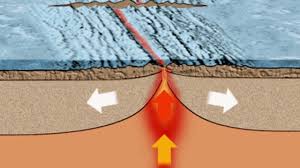
Below is a picture of sea-floor spreading. How are the ocean crusts moving?

a)

Converging

b)

Diverging

c)

Sliding

d)

No movement

29.

The San Andreas Fault in California is known as an active earthquake area. What type of

boundary is it?

a)

Converging

b)

Diverging

c)

Transform

d)

Sea Floor Spreading

30.
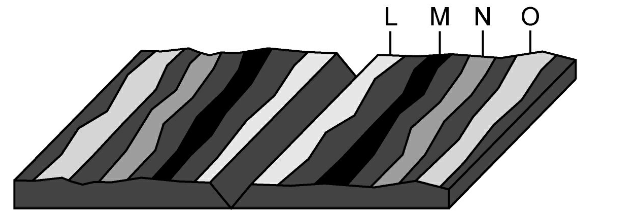
Where would the oldest rock be found?
a)
L
b)
M
c)
N
d)
O
31.
How is it possible for new crust to be formed without increasing the surface area of the Earth?
a)
Crust is destroyed at the same time it is created
b)
New crust is underwater where it sinks
c)
New crust breaks more easily than old crust
32.
This layer of Earth is the thickest part
a)
crust
b)
outer core
c)
mantle
d)
inner core
33.
What are the two types of crust
a)
continental and oceanic
b)
ocean and upper
c)
lower and upper
d)
pizza and subway
34.
The Himalayas in Asia are an example of what type of plate boundary?
a)
divergent
b)
continent-to-continent convergent
c)
ocean-to-continent convergent
d)
transform
35.
What type of boundary is the SAN ANDREAS FAULT on?
a)
Covergent
b)
Transformers
c)
Divergent
d)
Transform
36.
What are Tectonic Plates?
a)
A continent 
b)
The Trees in Vietnam 
c)
ThE PlaTES That MoVE uNdERGRound :)
d)
The Plates that move the Continents
37.
What is Pangaea?
a)
the name of a German scientist
b)
the name of the super-continent that existed millions of years ago
c)
another name for continental drift
d)
the name of an ancient fossil
38.
What are the two types of crust?
a)
continental and oceanic
b)
ocean and basin
c)
lower and upper
d)
thick and thin
39.
Mountains form from ...
a)
plates sliding past one another
b)
collision of plates
c)
plates moving away from each other
40.
Created by a divergent boundary.
a)
Rocky Mountains
b)
Mariana Trench
c)
Mid Atlantic ridge
41.
Mountains form from ...
a)
plates sliding past one another
b)
collision of plates
c)
plates moving away from each other
42.
During sea floor spreading, molten material rises up from the mantle...
a)
along the continents
b)
at the mid ocean ridges
c)
deep ocean trenches
d)
at north and south poles
43.
Which of the following is where one plate slides under another plate?
a)
submarine zone
b)
divergence zone
c)
subduction zone
d)
lower zone
44.
The area around the pacific plate where boundaries form is called...
a)
death ring
b)
fire zone
c)
ring of fire
d)
zone of fire
45.
Associated with transform boundaries.
a)
Volcanoes
b)
mountains
c)
trenches
d)
earthquakes
46.
This land formation occurs at a divergent continental/ continental boundary.
a)
mid ocean ridge
b)
deep ocean trench
c)
pacific hot spot
d)
rift valley
47.
A plate boundary where two plates move away from each other is called
a)
Divergent Boundary
b)
Convergent Boundary
c)
Transform Boundary
d)
Subduction
48.
A plate boundary where two plates move away from each other is called
a)
Divergent Boundary
b)
Convergent Boundary
c)
Transform Boundary
d)
Subduction
49.
A boy touches a hot cup and burns his finger.  This is an example of
a)
Radiation
b)
Conduction
c)
Convection
d)
Convection Current
50.
Scientists hypothesize that a super continent existed 200 million years ago.  This continent is called
a)
America
b)
Super Earth
c)
Pangea
d)
Eurasia
51.
A Plate Boundary where two plates move toward each other is called
a)
Convergent Boundary
b)
Divergent Boundary
c)
Transform Boundary
d)
Subduction
52.
What is the difference between the lithosphere and asthenosphere that makes up the mantle?
a)
The lithosphere is ismade of dense solid meal whle the asthenosphere is made of liquid molten metal
b)
The lithosphere is a mixture of gasses while the asthenosphere is made of solid rock
c)
The lithosphere is molten rock that moves while the asthenosphere is ridid and thin
d)
The lithosphere is made of solid rock while the asthenosphere is more flexible hot rock that moves.
53.
Convergent Plate Movement can create
a)
Rifts
b)
Mountains
c)
Ocean Ridges
d)
Radiation
54.
A Plate Boundary where two plates move toward each other is called
a)
Convergent Boundary
b)
Divergent Boundary
c)
Transform Boundary
d)
Subduction
55.
You an feel the sun's rays on your face as you lay by the beach on a warm summer day.  Which type of heat transfer is this an example of?
a)
Conduction
b)
Convection
c)
Radiation
d)
Radioactive
56.
_______________ Currents within the mantle cause the earth's plates to move and shift s molten material rises and falls due to density and gravity
a)
Convection
b)
Radiation
c)
Conduction
d)
Wind
57.
Divergent Plate movement can create
a)
Convection Currents
b)
Conduction
c)
Mountains
d)
Rifts and ocean ridges
58.
The movement of metals within the earth's outer core cause a ____________________________ that is detectable on the earth's surface using a compass
a)
Gravitational Pull
b)
Volcanic Eruption
c)
Magnetic field
d)
Convection Current
59.
The thinnest layer of the Earth is the ___________.
a)
mantle
b)
crust
c)
core
60.
What is the thickest layer of the Earth?
a)
the crust
b)
the mantle
c)
the outer core
d)
the inner core
61.
What is the core made of?
a)
steel
b)
iron 
c)
aluminum
d)
iron and nickel
62.
What is the correct order (starting from the surface) of Earth's layers?
a)
crust, outer core, inner core, mantle
b)
mantle, outer core, inner core, crust
c)
crust, mantle, outer core, inner core
d)
outer core, inner core, crust, mantle
63.
What describes the outer core?
a)
solid
b)
liquid
c)
viscous
d)
gas
64.
What happens to pressure as we move from the crust down into the inner core?
a)
Pressure Decreases
b)
Pressure Increases
c)
Nothing
65.
What happens to temperature as we move from the crust down into the inner core?
a)
Decreases
b)
Increases
66.
What happens to temperature as we move from the crust down into the inner core?
a)
Decreases
b)
Increases
67.
Which layer of the earth has the lowest temperature?
a)
Crust
b)
Mantle
c)
Outer Core
d)
Inner Core
68.
Which layer of the earth is under the highest pressure?
a)
Crust
b)
Mantle
c)
Outer Core
d)
Inner Core
69.
which one is hotter?
a)
the crust
b)
mantle 
c)
Inner core
70.
This layer contains the upper mantle and the crust.
a)
Mesosphere
b)
Asthenosphere
c)
Lithosphere
d)
Core
71.
What layer has a solid inner part and a liquid outer part?
a)
Crust
b)
Mantle
c)
Core
d)
none
72.
Which layer has the highest density?
a)
Crust
b)
Mantle
c)
Core
d)
All the same
73.
True or False...You can touch only one of the Earth's layers.
a)
True
b)
False
74.
What is the outermost layer of the Earth?
a)
crust
b)
mantle
c)
outer core
d)
inner core
75.
True or False. The Earth's crust is thick melted rock
a)
True
b)
False
76.
True or False.  The Earth's crust is made of rock
a)
True
b)
False
77.
True or False. The Earth's crust is thicker than the inner layers.
a)
True 
b)
False
78.
True or False. The mantle is hotter than the crust.
a)
True
b)
False
79.
If you traveled from the center of Earth to the surface, the pressure would...
a)
increase
b)
decrease
c)
stay the same
d)
unsure
80.

The crust is about ______ km on continental masses.

a)

5

b)

0.35

c)

3.05

d)

35

81.

What's the volume of the crust on Earth?

a)

0.01%

b)

1%

c)

10%

d)

0.1%

82.
What is the heat source for convection in the mantle?
a)
the Crust
b)
the Mantle
c)
the Core
83.
What is the cooling source for convection in the mantle?
a)
the Crust
b)
the Mantle
c)
the Core
84.
This layer contains the upper mantle and the crust.
a)
Mesosphere
b)
Asthenosphere
c)
Lithosphere
d)
Core
85.
This is the plastic layer of the mantle on which pieces of the lithosphere move.
a)
Lithosphere
b)
Asthenosphere
c)
Mesosphere
d)
Crust
86.
What is the lithosphere made of?
a)
the upper mantle
b)
the crust & part of upper mantle
c)
the crust and mantle
d)
the crust
87.
The driving force of the tectonic plates are convection currents, where can these be found?
a)
inner core
inner core
b)
crust
c)
mantle
d)
outer core
88.
7. The Asthenosphere is the_________part of the mantle.
a)
Solid
b)
Plastic
c)
Gaseous
89.
Scientists think that convection currents that move the plates flow in Earth's
a)
Continental crust
b)
oceanic crust
c)
Asthenosphere
d)
Lithosphere
90.
In convection, COOL air
a)
Rises
b)
Sinks
91.
In convection, WARM air
a)
Rises
b)
Sinks
92.
Where does the heat come from that drives this convection current in the mantle?
a)
The sun
b)
The crust
c)
the mantle
d)
the core
93.
What observation can we make about Earth’s lithosphere AND asthenosphere?
a)
The asthenosphere floats on top of the lithosphere.
b)
The crust and the core make up the lithosphere.
c)
The crust and mantle make up the asthenosphere. 
d)
The lithosphere floats on top of the asthenosphere
94.
The lithosphere combines what two layers?
a)
Asthenosphere & Crust
b)
Crust & Upper Mantle
c)
Mantel & Asthenosphere
95.
Which of these is the Mesosphere?
a)
Upper Mantle
b)
Middle Mantle
c)
Lower Mantle
d)
Oceanic Crust
96.
The diagram below gives an example of what type of heat transfer?
a)
Conduction
b)
Convection
c)
Radiation
d)
I don't know
97.
What is the transfer of heat through fluids...
a)
Conduction
b)
Convection
c)
Radiation
d)
I don't know
98.

Which crust is more dense?

a)

Oceanic

b)

Continental

c)

Convergent

d)

Divergent

99.

Which crust is thicker?

a)

Oceanic

b)

Continental

c)

Divergent

d)

Convergent

100.

Continental crust is mostly made of.........

a)

Granite

b)

Basalt

c)

Limestone

d)

Sedimentary

101.

Oceanic Crust is mostly made of...

a)

Shells

b)

Sand

c)

Basalt

d)

Obsidian