
 Worksheets
Chapter 5 thru 7 Review
Total questions: 64
Worksheet time: 59mins
Name
Class
Date
1.
A measure of the size of an atom, and is generally defined as the distance from the nucleus to the outermost electron orbit
a)
chemical reactivity
b)
atomic radius
c)
energy levels
d)
orbit
2.
The core of an atom where most of the mass of an atom exists; contains protons and neutrons
a)
nucleus
b)
electron shell
c)
proton
d)
electron
3.
The minimum energy required to remove an electron from the ground state of an atom
a)
electron configuration
b)
energy levels
c)
ionization energy
d)
ionic bond
4.
A negatively charged subatomic particle that exists in various energy levels outside the nucleus of an atom
a)
neutron
b)
electron
c)
proton
d)
subatomic particle
5.
The chart scientists use to organize and classify all the known elements
a)
elements chart
b)
the chart
c)
Periodic Table of the Elements
d)
Period table
6.
The tendency of an atom to attract electrons and acquire a negative charge
a)
electronegativity
b)
charge
c)
bonding ability
d)
electron configuration
7.
The energies of electrons as they orbit the nucleus of an atom
a)
energy levels
b)
orbits
c)
shells
d)
electron area
8.
Vertical columns of elements (families) on the periodic table with similar valence electron configurations and similar properties
a)
groups
b)
periods
c)
quadrants
d)
rows
9.
An electron that resides in the outermost shell, or principal quantum level, of an atom
a)
periodic trend
b)
electron shell
c)
ionic radius
d)
valence electron
10.
Which has the greater EN:
Cl or Al?
Cl or Al?
a)
Cl
b)
Al
11.
Which has the greater EN:
N or C?
N or C?
a)
C
b)
N
12.
Which has the greater EN:
H or F?
H or F?
a)
H
b)
F
13.
Which of the following will have a larger radius than Zinc?
a)
Gallium
b)
Aluminum
c)
Magnesium
d)
Strontium
14.
Which of the following will have a higher electronegativity than arsenic (As)?
a)
Carbon (C)
b)
Neon (Ne)
c)
Antimony (Sb)
d)
Germanium (Ge)
15.
As atoms of elements in group 16 are considered in order from top to bottom, the electronegativity of each successive element....
a)
decreases
b)
increases
c)
remains the same
d)
none of the above
16.
Which atom has the largest atomic radius?
a)
potassium
b)
rubidium
c)
francium
d)
cesium
17.
As you move down the periodic table atoms get bigger. This is because ____________.
a)
The atoms have more mass.
b)
The atoms have more protons.
c)
The atoms have more energy levels
d)
The atoms have more nuetrons
18.
As you move across the periodic table atoms tend to get smaller because, ______________.
a)
the atoms have more mass.
b)
the atoms have less mass
c)
the atoms have more protons.
d)
the atoms have less electrons.
19.
Electronegativity is...
a)
how good an atom is at attracting electrons
b)
the ability of an atom to lose electrons
c)
the energy required to remove an electron from a specific atom
d)
how easy it is to make friends.
20.
The atom with the largest atomic radius in Group 18 is -
a)
Ar
b)
He
c)
Kr
d)
Rn
21.
The element with the largest electronegativity in the halogens is -
a)
At
b)
F
c)
Cl
d)
Br
22.
The element with the lowest electronegativity in Period 3 is -
a)
Na
b)
Cl
c)
Ar
d)
Mg
23.
Which periodic group has the smallest atomic radius?
a)
Alkali metals
b)
Halogens
c)
Noble Gases
d)
Transition metals
24.
Which orbital block corresponds to transition metals in the periodic table?
a)
s
b)
p
c)
d
d)
f
25.
Which of the following atoms would you expect to have the largest atomic radius?
a)
Li
b)
K
c)
Ca
d)
Br
26.
A group of elements that includes the most active of the elements is the -
a)
halogens.
b)
noble gases.
c)
nitrogen group.
d)
alkaline earth metals.
27.
Put the following elements in order of decreasing ionization energy:
O, Te, Po, S.
O, Te, Po, S.
a)
O, S, Po, Te
b)
O, S, Te, Po
c)
O, Te, Po, S
d)
O, Po, Te, S
28.
Which is larger:
Ca or Ca+2
Ca or Ca+2
a)
Ca
b)
Ca+2
c)
both are same size
29.
Which is larger:
P or P-3
P or P-3
a)
P
b)
P-3
c)
both are same size
30.

The atoms along the staircase are called
a)
metals
b)
nonmetals
c)
metalloids
d)
noble gases
31.
For an electron to change from ground state to an excited stated it must...
a)
Absorb energy
b)
Release energy
32.

Which element is depicted from this orbital diagram
a)
Fluorine
b)
Neon
c)
Chlorine
d)
Argon
33.

This image is an illustration of
a)
photoelectric effect
b)
Dalton's atomic theory
c)
Bohr model
d)
Quantum mechanical model
34.
In the Bohr model, the orbit closest to the nucleus is
a)
called the ground state and is lowest in energy
b)
called the ground state and is highest in energy
c)
called the excited state and is lowest in energy
d)
called the excited state and is highest in energy
35.

The characteristic color bands that a hot, dilute gas emits are called...
a)
emission spectra
b)
absorption spectra
c)
continuous spectra
d)
black body radiation
36.
Which has the SHORTEST wavelength and, therefore, the highest frequency/most energy
a)
Radio waves
b)
Ultraviolet Rays
c)
Gamma Rays
d)
X-rays
37.
Which section of the spectrum is the ONLY one we can see?
a)
X-rays
b)
Visible Light
c)
Gamma Rays
d)
Ultraviolet Rays
38.
As the frequency of an electromagnetic wave increases, the amount of energy in that wave...
a)
increases.
b)
decreases.
c)
stays the same.
39.
Which color has the highest frequency?
a)
red
b)
orange
c)
green
d)
blue
40.
Which color has the least amount of energy?
a)
red
b)
orange
c)
green
d)
blue
41.

High frequency waves have _________ wavelengths.
a)
varying
b)
long
c)
the same
d)
short
42.
What atom matches this electron configuration?
1s22s22p63s2
1s22s22p63s2
a)
Neon
b)
Magnesium
c)
Aluminum
d)
Potassium
43.
"Electrons in the same orbital have opposite spin."
a)
Aufbau principle
b)
Hund's Rule
c)
Pauli Exclusion Principle
d)
Uncertainty Principle
44.
"Electrons fill lower energy orbitals before filling higher energy orbitals."
a)
Aufbau principle
b)
Hund's Rule
c)
Pauli Exclusion Principle
d)
Uncertainty Principle
45.
"Electrons fill equal energy orbitals singly before pairing."
a)
Aufbau principle
b)
Hund's Rule
c)
Pauli Exclusion Principle
d)
Uncertainty Principle
46.
Emission of light from an atom occurs when an electron
a)
drops from a higher to a lower energy level.
b)
jumps from a lower to a higher energy level.
c)
moves within its atomic orbital.
d)
falls into the nucleus.
47.
The _______________ determines the color of visible light.
a)
wavelength
b)
speed
c)
amplitude
d)
light
48.

a)
helium and hydrogen
b)
helium and calcium
c)
hydrogen and calcium
d)
hydrogen and helium
49.
Maximum number of electrons that can be placed in an s orbital.
a)
2
b)
6
c)
10
d)
14
50.
The maximum number of electrons that can be placed in an p orbital.
a)
2
b)
6
c)
10
d)
14
51.
The maximum number of electrons that can be placed in an d orbital.
a)
2
b)
6
c)
10
d)
14
52.
The maximum number of electrons that can be placed in an f orbital.
a)
2
b)
6
c)
10
d)
14
53.
Spherical orbital, also the lowest energy orbital.
a)
s
b)
p
c)
d
d)
f
54.
In an orbital diagram, an arrow represents:
a)
an electron
b)
an orbital
c)
an element
55.

This orbital diagram represents:
a)
C
b)
B
c)
N
d)
O
56.
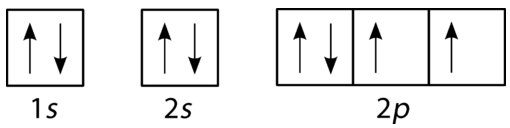
This orbital diagram represents:
a)
C
b)
B
c)
N
d)
O
57.

What is incorrect about this orbital diagram?
a)
Both arrows in the 2p box should be pointing up
b)
There is nothing incorrect with this diagram
c)
In the there should only be 1 orbital in the first 2p box and one in the 2nd 2p box
d)
All the arrows should be pointing up.
58.

Which is associated with the most energy?
a)
2p
b)
2s
c)
3p
d)
1s
59.
Which has the LONGEST wavelength and, therefore, the lowest frequency/energy
a)
Gamma Rays
b)
Radio Waves
c)
Visible Light
d)
Infrared rays
60.
What electron configuration matches an oxygen ion?
a)
1s22s22p63s2, 3p64s23d104p5
b)
1s22s22p4
c)
1s22s22p6
d)
1s22s22p63s23p64s23d1
61.
The frequency of violet light is 7.5x10¹⁴ Hz. What is its wavelength?
a)
4.0x10⁻⁷ m
b)
4.0x10⁷ m
c)
2.25x10²³m
d)
2.25x10²³ Hz
62.
Red light has a wavelength of 6.75 x 10⁻⁷ m. What is its frequency?
a)
2.03x10¹¹ m
b)
4.44x10¹⁴ Hz
c)
4.44x10¹⁴ nm
d)
2.03x10¹¹ Hz
63.
What is the energy of a quantum of light with a frequency of 7.39 x 10¹⁴ Hz? (E=hv)
a)
4.88x10¹⁹ J
b)
4.88x10⁻¹⁹ J
c)
2.22x10²³ J
d)
2.22x10⁻²³ J
64.
The speed of electromagnetic radiation:
a)
depends on the form of radiation
b)
is always 3 x 10⁸ m/s, regardless of the type
c)
decreases as distance increases
d)
is 6.626 x 10⁻³⁴ J x s
100 %

