wayground logo

Free Printable Worksheets

Font size

S
M
L
XL
Worksheets

2024 Fall Semester Exam Review Quizizz #1

Total questions: 135

Worksheet time: 2hrs 11mins

Name
Class
Date
1.

Anything that has weight and takes up space is called

(a)  

2.

What is volume?

a)

when an ice cream melts in a sunny day

b)

The amount of space taken up by something

3.

What is the definition of matter?

a)

Anything that has mass and takes up space

b)

A substance that is liquid, solid, or gas

c)

Anything that is pure

d)

Anything that you can see or hold

4.

What is the smallest unit of matter in the world?

a)

an Atom

b)

a Molecule

c)

a piece of dirt

d)

an element

5.

When two or more atoms come together, they form a what?

a)

Another Atom

b)

A Solid

c)

An Element

d)

A Molecule

6.

What state of matter has molecules spaced apart from one another and changes its shape depending on its container?

a)

Solid

b)

Liquid

c)

Gas

d)

Water

7.

What state of matter has molecules that bounce around at high speeds and are not close together?

a)

Solid

b)

Gas

c)

Smoke

d)

Liquid

8.

When two or more things are mixed together and you can see the different parts or could easily take it apart, it is called a _______________.

a)

Mixture

b)

Solution

c)

Compound

d)

Molecule

9.

When two or more parts are mixed together and chemically combine so that you cannot see the different parts (or different ingredients), it is called a ______________.

a)

Mixture

b)

Solution

c)

Compound

d)

Molecule

10.

Which picture is a mixture?

a)
b)
c)
d)
11.

What process takes place when a gas becomes a liquid? (Think clouds)

a)

Melting

b)

Freezing

c)

Evaporation

d)

Condensation

12.

Compound or Just a Molecule?

a)

Compound

b)

Molecule

13.

Which one of these is a compound?

a)

H2

b)

NaCl

c)

He

d)

O2

14.
Solids have a definite _______________.
a)
smell
b)
shape
c)
picture
d)
sound
15.
When a solid is turned into a liquid, the solid _______________.
a)
melts
b)
freezes
c)
turns into a gas
d)
floats
16.
The amount of matter something contains is its ______________.
a)
gas
b)
solid
c)
weight
d)
mass
17.
This state of matter does not have a definite size or shape.
a)
gas
b)
toys
c)
solid
d)
milk
18.
I am 2 or more elements chemically bonded.
a)
atom
b)
molecule
c)
compound
d)
mixture
19.

A physical change...

a)

changes the physical properties of an object, but does not create a new substance.

b)

creates a new substance and cannot be undone.

20.

A chemical change

a)

changes the physical properties of an object, but does not create a new substance.

b)

creates a new substance and cannot be undone.

21.

Is this an example of a physical or chemical change?

a)

physical

b)

chemical

22.

Is this an example of a physical or chemical change?

a)

physical

b)

chemical

23.

Is this an example of a physical or chemical change?

a)

physical

b)

chemical

24.

Is this an example of a physical or chemical change?

a)

physical

b)

chemical

25.

Is this an example of a physical or chemical change?

a)

physical

b)

chemical

26.

Is this an example of a physical or chemical change?

a)

physical

b)

chemical

27.

Is this an example of a physical or chemical change?

a)

physical

b)

chemical

28.

Is this an example of a physical or chemical change?

a)

physical

b)

chemical

29.

Is this an example of a physical or chemical change?

a)

physical

b)

chemical

30.

Why is tearing a sheet of paper into pieces a physical change?

a)

Tearing of a paper is a physical change because when the paper is torn only the shape and size of the paper is changed, no new substance is formed.

b)

Tearing of a paper is a physical change because when the paper is torn only the shape and size of the paper does not change and new substance is formed.

31.

A chemical change

a)

changes the physical properties of an object, but does not create a new substance.

b)

creates a new substance and cannot be undone.

32.
Which scientist developed the atomic theory
a)
Aristotle
b)
Dalton
c)
Democritus
33.
The smallest unit of a pure substance that has the properties of that substance
a)
element
b)
atom
c)
neutron
d)
compound
34.
Atoms are made up of three basic parts, which are -
a)
Protons, neutrons, electrons
b)
neutrinos, protons, neutrons
c)
quarks, protons, electrons
d)
electrons, neutrons, and quarks
35.
The nucleus is made up of -
a)
neutrons and electrons
b)
protons and neutrons
c)
protons and electrons
d)
electrons and quarks
36.
Protons have this charge -
a)
positive
b)
negative
c)
neutral
d)
no charge
37.
Electrons have this charge - 
a)
positive
b)
negative
c)
neutral
d)
no charge
38.
Neutrons have this charge -
a)
positive
b)
negative
c)
neutral
d)
They don't exist
39.
What scientist is best known for his "Plum Pudding" model of the atom?
a)
J.J. Tomson
b)
Ernest Rutherford
c)
John Dalton
d)
Democritus
40.
Place the following scientists in order, from earliest to latest: 
A) Ernest Rutherford
B) J.J. Thomson
C) John Dalton
a)
B,C,A
b)
C,A,B
c)
A,C,B
d)
C,B,A
41.
An atom's overall charge is ________.
a)
positive 
b)
depends
c)
neutral 
d)
negative 
42.
J.J. Thomson provided evidence that an atom...
a)
is the smallest particle of matter
b)
contains negatively charged particles
c)
has an overall negative charge
d)
has an overall positive charge
43.
Rutherford's gold foil experiment provided evidence that...
a)
negative and positive charges are spread evenly throughout the atom.
b)
alpha particles have a positive charge.
c)
gold is not a dense as previously thought.
d)
there is a dense positively charged nucleus at the center of an atom.
44.
Ernst Rutherford discovered which part of the atom through the use of gold foil?
a)
Proton
b)
Neutron
c)
Electron
d)
Orbitals
45.
He developed the planetary model of the atom.
a)
Rutherford
b)
Bohr
c)
Chadwick
d)
Dalton
46.
What did Thomson discover?
a)
electron
b)
proton
c)
neutron
d)
electron cloud
47.
A tiny but very dense, positively charged portion of the atom that holds most of the atomic mass
a)
Electron Shells
b)
Orbitals
c)
Electron Cloud
d)
Nucleus
48.
Where electrons are likely to be found as they travel around the nucleus
a)
Nucleus
b)
Electron Cloud
c)
Within a Proton
d)
Within a Neutron
49.
The scientist responsible for "discovering" the nucleus is:
a)
Bohr
b)
Rutherford
c)
Schroedinger
d)
Einstein
50.

John Dalton stated:

a)

Atoms are tiny, invisible particles.

b)

Atoms of one element are all the same.

c)

Atoms of different elements are different.

d)

Compounds form by combining atoms.

e)

All of the statements listed.

51.

Isotopes of an element have a different number of...

a)

Protons

b)

Neutrons

c)

Electrons

d)

Mass

52.

Potassium-39 has how many neutrons?

a)

19

b)

18

c)

20

d)

21

53.

Nickel-59 has how many neutrons?

a)

30

b)

31

c)

32

d)

33

54.

Bromine-80 has how many neutrons?

a)

41

b)

42

c)

44

d)

45

55.

76 protons and 114 neutrons

a)

Osmium-114

b)

Osmium-76

c)

Osmium-190

d)

Osmium-190.23

56.

12 protons and 13 neutrons

a)

Mg-12

b)

Mg-13

c)

Mg-25

d)

Mg-24.305

57.

9 protons and 9 neutrons

a)

Fluorine-18

b)

Fluorine-9

c)

Fluorine-16

d)

Fluorine-18.998

58.

Rubidium has two common isotopes, 85Rb and 87Rb. If the abundance of 85Rb is 72.2% and the abundance of 87Rb is 27.8%, what is the average atomic mass of rubidium?

a)

85.468 amu

b)

37 amu

c)

85.6 amu

d)

86.4 amu

59.

There are two primary isotopes found in any sample of copper: copper-63 and copper-65. The isotope 65Cu composes 69.2% of the sample and 63Cu comprises the other 30.8%. Based on this data, what is the atomic mass of copper?

a)

29 amu

b)

63.546 amu

c)

64.4 amu

d)

63.6 amu

60.

How do you calculate mass number?

a)

Mass x percent

b)

Protons + Electrons

c)

Protons + Neutrons

d)

Neutrons + Protons + Electrons

61.
How many neutrons does the isotope of lithium have?
a)
8
b)
3
c)
4
d)
5
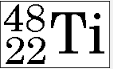
62.
How many protons does this isotope of titanium have?
a)
48
b)
22
c)
26
d)
70
63.
24.1% of all the isotopes of a an element have a mass of 75.23 amu, 48.7% have a mass of 74.61 amu, and 27.2% have a mass of 75.20 amu.
What is the average mass of this element?
a)
74.92 amu
b)
24.97 amu
c)
75.01 amu
d)
74.51 amu
64.

Lucky Charms

a)

Heterogeneous

b)

Homogeneous

65.

Dirt

a)

Heterogeneous

b)

Homogeneous

66.

Air

a)

Heterogeneous

b)

Homogeneous

67.

M&Ms

a)

Heterogeneous

b)

Homogeneous

68.
Air
a)
Heterogeneous
b)
Homogeneous
69.
Sugar water
a)
Heterogeneous
b)
Homogeneous
70.
Se
a)
2-
b)
2+
c)
3+
d)
4+
71.
F
a)
1-
b)
1+
c)
3+
d)
2-
72.
K
a)
1+
b)
1-
c)
3+
d)
2-
73.
N
a)
3-
b)
3+
c)
2-
d)
2+
74.
S
a)
2-
b)
2+
c)
3-
d)
4+
75.
C
a)
4+/4-
b)
0
c)
1+
d)
2-
76.
P
a)
3-
b)
3+
c)
3-
d)
2-
77.
Li
a)
1+
b)
1-
c)
3+
d)
2-
78.
Name the following ionic compound: BeCl2
a)
beryllium chlorine
b)
beryllium II chloride
c)
beryllium chloride
d)
beryllium dichloride
79.
Name the following ionic compound: MgSO4
a)
magnesium sulfoxide
b)
magnesium sulfide
c)
magnesium sulfate
d)
magnesium oxide
80.
copper(II) chloride
a)
CuCl2
b)
CuCl
c)
Cu2Cl
d)
Cu2Cl2
81.

What is the correct formula of magnesium sulfide?

a)

MgSO4

b)

MgS

c)

MgSO3

d)

Mg2S2

82.

What is the correct name of Cs3N?

a)

cesium nitrate

b)

cesium nitrite

c)

cesium nitride

d)

tricesium nitride

83.

What is the correct name of Mg(C2H3O2)2?

a)

magnesium acetate

b)

magnesium carbohydroxide

c)

magnesium glucose

d)

magnesium diacetate

84.

What is the correct name of Ag2SO4?

a)

silver sulfoxide

b)

silver sulfate

c)

silver sulfite

d)

silver tetrasulfoate

85.

Name this formula:

KNO3

a)

Potassium Nitrogen Oxide

b)

Potassium Nitride

c)

Potassium Nitrate

d)

Potassium (I) Nitrite

86.

Name the compound CuO

a)

copper (II) oxide

b)

copper oxide

c)

copper (I) oxide

d)

carbon uranium oxide

87.

FePO4

a)

iron phosphite

b)

iron (III) phosphite

c)

iron (III) phosphate

d)

iron (II) phosphite

88.

Cr2O3

a)

chromium oxide

b)

chromium hydroxide

c)

chromium (II) oxide

d)

chromium (III) oxide

89.

Na3PO4

a)

sodium phosphide

b)

sodium phosphate

c)

sodium phosphite

d)

sodium (III) phosphate

90.

Unlike Ionic compounds, Covalent compounds require what when naming them?

a)

A roman numeral

b)

A charge

c)

A prefix

91.

When naming covalent compounds: Di is the prefix for....

a)

1

b)

2

c)

3

d)

4

e)

5

92.

When naming covalent compounds: Tri is the prefix for....

a)

1

b)

2

c)

3

d)

4

e)

5

93.

When is the prefix mono not used?

a)

It is never used when naming covalent compounds

b)

It is never used on the second element

c)

It is never used when on the first element

94.

What is the name for NI3?

a)

Mononitrogen TretraIodide

b)

Nitrogen Triiodide

c)

Nitrogen (III) Triiodide

d)

Nitrogen Iodide

95.

What is the name for CCl4?

a)

Carbon (IIII) Chloride

b)

Carbon Trichloride

c)

Monocarbon Tetrachloride

d)

Carbon Tetrachloride

96.

What is the name for P2O5?

a)

Diphosphorous Pentaoxide

b)

Phosphorous Oxide

c)

Phosphorous (III) Oxide

d)

Diphosphide Oxide

97.

What are covalent compounds made up of?

a)

metal(s)

b)

nonmetal(s)

c)

transition metals

d)

noble gasses

98.

In covalent bonds elements ____________ electrons.

a)

donate

b)

give

c)

share

99.

What would be the formula for Phosphorous Petaflouride?

a)

P1F6

b)

P1F5

c)

PF6

d)

PF5

100.

What is the formula for Phosphorous Trichloride?

a)

P1Cl3

b)

PCl4

c)

PCl3

d)

PCl5

101.

When using scientific notation, a negative exponent means ...

a)

the standard number is greater than one

b)

the standard number is less than one

c)

the negative sign doesn't have a meaning

d)

None of the above

102.

Convert this number to standard notation: 7.1 x 10⁴

(a)  

103.

Convert this number into scientific notation: 0.068

a)

6.9 x 10⁶

b)

6.8 x 10⁻⁹

c)

6.8 x 10⁻²

d)

None of the above

104.

When using scientific notation, a positive exponent means ...

a)

the standard number is greater than one

b)

the standard number is less than one

c)

the negative sign doesn't have a meaning

d)

None of the above

105.

Convert this number to standard notation: 1.4 x 10⁻²

(a)  

106.

Convert this number into scientific notation: 950,000

a)

9.5 x 10⁵

b)

9.5 x 10⁻⁹

c)

9.5 x 10²

d)

None of the above

107.
Write 6,700 in scientific notation.
a)
6.7 x 10³
b)
6.7 x10⁻³
c)
67 x 102
d)
67 x 10-2
108.
What is scientific notation?
a)
A long way to write really short  numbers
b)
A short way to write really long numbers
c)
I don't know...
d)
None of the above
109.
7.82 x 10⁻⁶ is an example of scientific notation. The exponent of -6 tells you your number will be very ________.
a)
Large
b)
Small
c)
Basic
110.

How close a measurement is to the true value is called..

a)

Accuracy

b)

Precision

c)

Significant

d)

Estimate

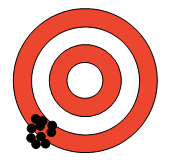
111.
This bullseye demonstrates...
a)
High Accuracy & High Precision
b)
High Accuracy & Low Precision
c)
Low Accuracy & High Precision
d)
Low Accuracy & Low Precision
112.
When a measurement is repeatable and consistent it is said to have...
a)
High precision
b)
Low precision
c)
High accuracy
d)
Low accuracy
113.
A set of data are all close to each other, but they are not close to the actual value.  This set of data can be described as...
a)
accurate
b)
precise
c)
both precise and accurate
114.
A set of data are not close to each other, but the average of the data is very close to the actual value.  This set of data can be described as...
a)
accurate
b)
precise
c)
both precise and accurate
115.
A passenger jet has a speed of 900 km/h.
What is its speed in m/s?
(1 km = 1000 m)
a)
250 m/s
b)
324 m/s
c)
1,500 m/s
d)
2,500 m/s
116.
A bicycle has a speed of 6 m/s. What is its speed in km/h?  (1 km=1000 m)
a)
21.6 km/h
b)
16.67 km/h
c)
2.16 km/h
d)
1.67 km/h
117.

Convert 62 miles/hour to feet/second

a)

5,456 feet/second

b)

.003 feet/second

c)

90.9 feet/second

d)

909 feet/second

118.
Why do ice cubes float in a  glass of water?
a)
the ice cubes are more dense than the water
b)
the water is more dense than the ice cubes
c)
the water is more dense than the glass
d)
the ice is more dense than the glass
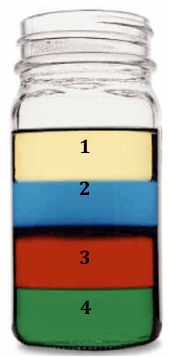
119.
Put the liquids in order from most dense to least dense?
a)
4, 3, 2, 1
b)
1, 2, 3, 4
c)
3, 4, 2, 1, 
d)
4, 3, 1, 2
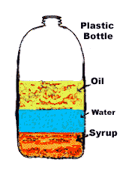
120.
Which liquid is the least dense?
a)
oil
b)
water
c)
syrup 
d)
plastic bottle
121.
Why do objects sink or float in H2O
a)
Because their densities are higher or lower than compared to water
b)
Because their densities are using gravity to pull down
c)
Because their densities are heavier or lighter
d)
Because their mass and volumes are equal 
122.
What two types of measurements make up DENSITY
a)
Mass and Volume
b)
Temperature and Mass
c)
Grams and Centimeters
d)
Volume and Weight
123.
Jack has a rock. The rock has a mass of 14g and a volume of 2cm3. What is the density of the rock?
a)
7 mL
b)
7 g/cm3
c)
28 g/cm3
d)
1/7 g/cm3
124.
If an object has a density of .6 g/mL and you put it into water, will it sink or float?  
a)
sink
b)
float
125.
What units are used to measure mass?
a)
g
b)
cm3
c)
g/cm3
d)
cm3/g
126.
What is the formula for density?
a)
density = mass x volume
b)
density = mass / volume
c)
density = mass + volume
d)
density = mass - volume
127.
What units are used to measure Density?
a)
cm3/g
b)
g
c)
g/cm3
d)
cm3
128.

What is the formula for Mass?

a)

Mass/Volume

b)

Density x Volume

c)

Mass/Density

129.
How many significant figures: 216 m
a)
1
b)
2
c)
3
d)
0
130.
How many significant figures: 2016 m
a)
1
b)
2
c)
3
d)
4
131.
How many significant figures: 0.012 km
a)
1
b)
2
c)
3
d)
4
132.
How many significant figures: 1000 mL
a)
1
b)
2
c)
3
d)
4
133.
How many significant figures: 100.000 cL
a)
1
b)
3
c)
5
d)
6
134.
How many significant figures: 0.001 g
a)
4
b)
3
c)
2
d)
1
135.
How many significant figures: 4.20 cm
a)
1
b)
2
c)
3
d)
4