
 Worksheets
Elements, Compounds, Mixtures and Solubility Quiz Review
Total questions: 76
Worksheet time: 48mins
A pure substance that cannot be broken down into any other substance.
Elements
Compounds
Mixtures
A chemical formula is used to represent a(n) _________________.
Element
Compound
Mixture
H2O
Element
Compound
Mixture
CO2
Element
Compound
mixture
Cl
Element
Compound
Mixture
A ___________ is a combination of many different elements not chemically combined.
Element
Compound
Mixture
Which are examples of a mixture?
Table salt
Salt water
Oxygen
Air
What is a substance made of two or more elements that are chemically combined called?
A. element
B. compound
C. mixture
D. solution
Two or more physically combined substances form
a compound.
an acid.
an element.
a mixture.
A substance that contains only one type of atom is a(n)
compound
element
heterogeneous mixture
homogeneous mixture
A compound is made of ________ atoms.
big
similar
different


The smallest unit of an element is
a compound.
a molecule.
an atom.
a mixture.
The smallest unit of a compound is
an element.
a molecule.
an atom.
a mixture.
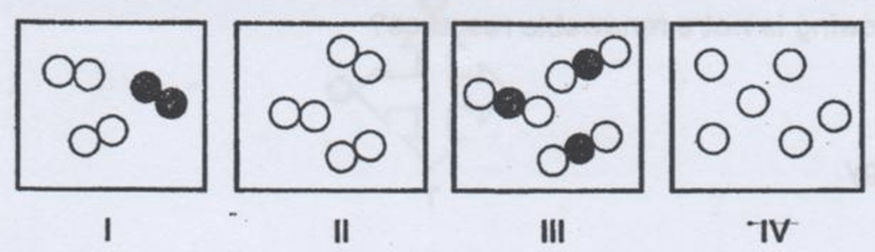
In the diagrams provided, the circles of different colors represent the atoms of different elements. Which diagram represents a mixture?
I
II
III
IV
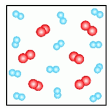


Mixtures
can be separated physically
are chemically combined
have a chemical formula
are only one thing.
three hydrogen (H)
one sulfur (S)
four oxygen (O)
H2SO4


The image above shows a...
molecules
compounds
pure substance
mixture of atoms


Element, mixture, or compound?
element
mixture
compound

Element, mixture, or compound?
element
mixture
compound

How many molecules are in this picture?
1
2
3
4
How many elements are in this picture?
1
2
3
4
How many compounds are in this picture?
1
2
3
4

What do you see in this picture?
A pure element
A pure compound
A mixture of two elements
A mixture of two compounds
A mixture of an element and a compound

What do you see in this picture?
A pure element
A pure compound
A mixture of two elements
A mixture of two compounds
A mixture of an element and a compound
How many different types of elements are found in
CuSO4?
(Type only in numbers!)
(a)
How many atoms in total are found in
CuSO4?
(Type only in numbers!)
(a)

What does this illustrate
Elements
Compunds
Mixture of Elements and Compunds
Mixture of Compounds
A mixture of iron filings and chalk dust is placed on a plate. Which of the following could be done to gather the iron filings?
Pour the mixture into a funnel
Put the mixture in a pot on the stove
Run a magnet over the mixture
Filter the mixture through a strainer

What is the BEST tool to separate gravel from sand?
use a magnet
use tweezers
pour the mixture through filter paper
use a strainer or sieve
Which of the following mixtures may be separated using filtration?
oil and water
salt from salt water
sand and iron fillings
coconut milk from shredded coconut fruit (a solid)
Salt is dissolved in water. How can you separate the salt from water?
add more salt
filter the water
dispose the water
boil the water and let it evaporate
The properties of a compound are the same as the properties of the elements making up the compound.
True
False
A change in matter that makes a new substance is called _____.
chemical reaction
mixture
physical change
solution
The simplest unit of a chemical compound that can exist; formed when two or more atoms join together chemically
Atom
Compound
Molecule
Fish breathe oxygen, which is dissolved in water. Is the oxygen the fish breathe considered to be the solute or solvent?
Solute
Solvent
You make a pitcher of lemonade by adding lemon juice, sugar, ice and water. Which of the following are the solutes in the solution? Click all that apply.
Lemon juice
Sugar
Water
Ice
If I dissolve carbon dioxide in water, what is the solvent?
Carbon Dioxide
There is no solvent
Oxygen
Water
Solutes dissolve quicker if you stir them.
true
false
Solutes dissolve quicker in _________ water.
cold
warm

Which of the following statements is true?
B is a saturated solution
A is a supersaturated solution
C is an unsaturated solution
None of the above
As the temperature increases, the rate at which the solute dissolves ____________
remains the same
decreases
also increases
none of the above
What do you call a solution that contains less than the maximum amount of solute that is capable of being dissolved?
unsaturated solution
saturated solution
supersaturated solution
insoluble solution
Which of the following best describes a supersaturated solution?
a solution that contains the maximum amount of solute that is capable of being dissolved
a solution that contains less than the maximum amount of solute that is capable of being dissolved.
a solution that contains more than the maximum amount of solute that is capable of being dissolved.
none of the above
How do you know when you have a saturated solution?
You don't see anymore material in the solution. It has dissolved.
The material dissolves and no more will dissolve because you see it collect at the bottom.
The solution is bubbling and cloudy.
The solution is clear and there is nothing at the bottom.
To separate a solution (example: salt water), you can ________________ it.
filter
evaporate
solute
saturate
If the solution contains the maximum amount it can dissolve by a given amount of solvent, it is ___________
Supersaturated
Unsaturated
Solubility
Saturated
If you add a solute to a solution and the solution crystalizes is this solution saturated, unsaturated or supersaturated?
saturated
unsaturated
supersaturated
Define the term insoluble.
Can dissolve in water.
Cannot dissolve in water.
Partially dissolves in water.
Define the term soluble.
Can dissolve in water
Cannot dissolve in water
Partially dissolves in water
True or False: Splitting a compound requires a chemical reaction to occur.
True
False

When using the Hoffman apparatus to split the compound water, we noticed that compounds have _________ properties as the elements that make them.
the same
different

Water (H2O), which is a colorless liquid, was split into _____________ (colorless gas(es)) when using the Hoffman Apparatus.
just hydrogen gas
CO2
hydrogen gas and oxygen gas
just oxygen gas

