
 Worksheets
Q2_PHYSICS_REVIEW QUESTIONS
Total questions: 90
Worksheet time: 4hrs 39mins
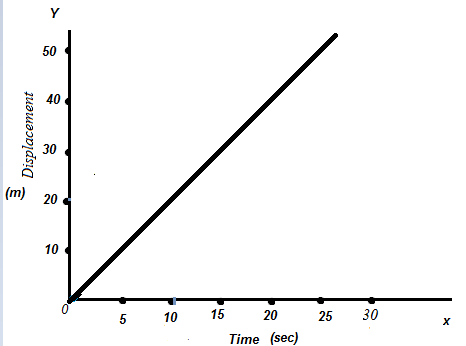
What is shown in this displacement vs time graph?
uniform velocity
uniform speed
no speed (at rest)
acceleration
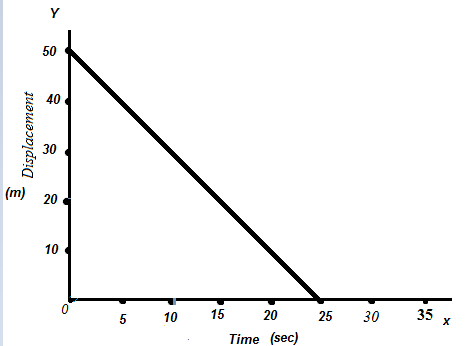
What is happening in this graph?
constant positive velocity
constant negative velocity
negative acceleration
the object moves away from its origin
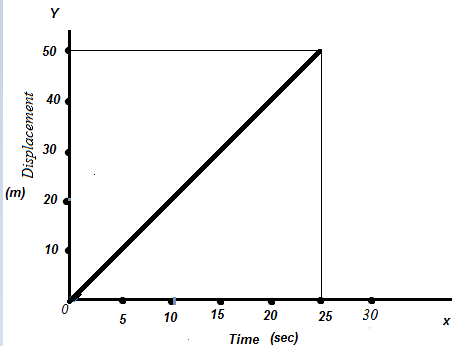
Find the velocity from the given graph.
2 m/s
21 m/s
100 m/s
-2m/s
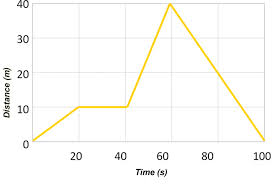
Match the description to the graph:
"The speed of the car is decreasing."


Describe the motion from B - C.
Standing still
Constant velocity of 60 m/min
Constant velocity of 0 m/min
Accelerating

Part C of the graph is from 35s to 55s. Which of these statements is true about Part C?
The object is at rest.
The object is accelerating (its velocity is increasing)
The object is decelerating (its velocity is decreasing)
The object is moving at a constant velocity.

Which section represents a steady speed?
A
B
C
D


How does the initial vertical velocity, Viy, compare to the final vertical velocity, Vfy, when a ball is thrown up into the air and caught at the same height ?
Vi y and Vfy are exactly the same, this is because of symmetry
Viy and Vfiy are close but Vfy is larger because you would fall faster than you would rise, since you are slowing down
Viy and Vfy are the same in magnitude, but different in direction.
Viy and Vfy are different in magnitude and direction.
Which of the following statements applies to the motion of a ball rising and then falling in free fall?
I. The ball has constant acceleration as it moves upward.
II. The ball has constant acceleration at the top of its path.
III. The ball has constant acceleration as it moves downward.
I only
III only
I and III
I, II, and III
Which would hit the ground first if dropped from the same height in a vacuum—a feather or a metal bolt?
the feather
the metal bolt
They would hit the ground at the same time.
They would be suspended (floating) in a vacuum.

If you throw a baseball straight up, what is its vertical velocity at the highest point?
9.8 m/s2
9.8 m/s
0 m/s2
0 m/s


A horizontally-launched projectile arcs out and hits the ground below. The vertical displacement and the horizontal displacement are measured. What is the best equation to use to find the time the projectile was in the air?
dx=vx⋅t
dy=+21⋅g⋅t2+vyi⋅t
vyf=vyi+g⋅t
t=g2⋅dy

In the diagram, which letter represents the vertical displacement dy ?
A
B
C
D

In the diagram, which letter represents the horizontal displacement dx ?
A
B
C
D

A ball rolls off a table top and strikes the floor as shown. Given the measurements made, the time the projectile spent in the air is ---.
17 s
0.34 s
0.58 s
0.49 s

A ball rolls off a table and strikes the floor, as shown. If the time the ball spent in the air was 0.58 s, how fast did the ball leave the table?
3.6 m/s
1.2 m/s
2.9 m/s
0.99 m/s

In a projectile motion we always have...
1 component (x)
3 components (x,y, and z)
2 components (x and y)
0 components
If a ball thrown straight up into the air takes 4 seconds to reach the top (peak), how long will it take to travel from the peak back to the original position?
0s
1s
3s
4s

Which graph/s represents that the object’s velocity is increasing?
graphs D, I
graphs E, J
graphs D, G, I
graphs D, G, I, J
Which graph/s represents that the object’s velocity is constant?
graphs A, F
graphs A, B, C
graphs B, C, F
graphs A, B, C, F
Which graph/s represents that the object’s velocity is decreasing?
graphs C, H
graphs E, J
graphs E, H
graphs E, H, J
Which graph/s represents that the object is not accelerating?
graphs A, C
graphs A, F
graphs A, B, C
graphs A, B, C, F
Which graph/s represents that the object is decelerating?
graphs E, J
graphs E, H
graphs E, H, J
graphs C, E, H, J
What variable or quantity should you plot along the X-axis in a graph?
time
velocity
independent
dependent
What quantity does the slope of the displacement-time graph and velocity-time graph represent, respectively?
time, acceleration
velocity, speed
velocity, acceleration
speed, acceleration
What happens to the velocity of a ball as it is drop off from a cliff?
It is constant.
It increases at a uniform rate.
It decreases at a uniform rate.
It increases at a non-uniform rate.

A skydiver jumps out of a plane and is falling towards the Earth before she opens her parachute. Which of the following statements is true?
She is in free fall because nothing is holding her up.
She is in free fall because gravity is pulling her down.
She is not in free fall because skydiving is not affected by gravity.
She is not in free fall because gravity is not the only force she is experiencing.
What happens to the stone’s velocity and acceleration when it reaches its highest point after being thrown upwards?
velocity is zero, acceleration is -9.8 m/s2
both its velocity and acceleration is zero.
velocity is not zero, acceleration is +9.8 m/s2
neither its velocity nor its acceleration is zero
What happens to the object's velocity as it goes downwards and upwards, respectively?
increases, decreases
decreases, increases
increases, increases
decreases, decreases
What happens to the velocity of a projectile moving downwards in a horizontal and vertical component?
constant, decreasing
zero, constant
constant, increasing
zero, zero

What happens to the acceleration of a projectile moving upwards in a horizontal and vertical component?
constant, decreasing
constant, increasing
zero, constant -9.8 m/s2
constant -9.8 m/s2, zero

What happens to the range of a projectile when the height of release is increased?
accelerates
increases
decreases
no change
What happens to the range of a projectile when the angle of release is from 45 to 90 degrees?
accelerates
increases
decreases
no change

What is the displacement of the object at point D?
100 m
100 km
100,000 m
100,000 cm
How far did the object cover after 8 hours?
120 km
140 km
160 km
180 km
What is the object’s average speed for the entire trip?
4.54 m/s
4.55 m/s
16.36 km/hr
16.37 km/hr
What is the total distance and displacement covered by the car at segment BE?
0 km & 40 km
40 km & 0 km
40,000 m & 40,000 km
40,000 m & 40,000 m
How far is the car from its origin after it stops at point F?
0 km
60 km
60,000 m
60,000 km

How much distance covered by the bus at segments AB and EF, respectively
40 m & 45 km
45 m & 40 m
40 km & 45 m
40 m & 45 m
How fast did the bus travel at segments BC and DE?
0 m/s & 25 m/s
0 m/s & 15 m/s
15 m/s & 25 m/s
25 m/s & 15 m/s
How far did the object travel after 6 seconds?
30 m
60 m
120 m
240 m
How long did it take for the object to reach point D?
8 s
4 s
10 s
5 s
What to the car at segment BE?
moving at an icreasing speed
moving at a decreasing speed
doesn't accelerate
accelerating
A cannonball is projected at 360 angle on top of a building that is 33 m high with an initial velocity of 12 m/s. How long is the cannonball in the air?
3.41 s
3.42 s
1.97 s
1.98 s
A cannonball is projected at 360 angle on top of a building that is 33 m high with an initial velocity of 12 m/s. How long will it take to reach its peak before it falls to the ground?
0.72 s
0.73 s
1.44 s
1.46 s
A cannonball is projected at 360 angle on top of a building that is 33 m high with an initial velocity of 12 m/s. How far will the cannonball be from the building to its peak?
2.54 m
1.54 m
0.54 m
3.54 m
A cannonball is projected at 360 angle on top of a building that is 33 m high with an initial velocity of 12 m/s. How high will cannonball be from the top of the building to its peak?
(a)
A cannonball is projected at 360 angle on top of a building that is 33 m high with an initial velocity of 12 m/s. How fast will it strike the ground?
(a)
A cannonball is projected at 360 angle on top of a building that is 33 m high with an initial velocity of 12 m/s. How long will it take to reach the ground from its peak?
(a)
A stone is dropped from a rooftop of a building. How fast will the stone go at it strikes the ground?
(a)
A stone is dropped from a rooftop of a building. How far will the stone reach after 3 seconds?
(a)
A marble is thrown vertically upward at a rate of 25 m/s.
How long will it take for the marble to go back to its point of release?
(a)
A marble is thrown vertically upward at a rate of 25 m/s.
How high will the marble rise?
(a)
A baseball is thrown horizontally at a rate of 20 m/s from a building of 15 m. How long will the baseball go to reach the ground?
(a)
A soccer ball was hit and moved upward at 50 degrees with an initial velocity of 40 m/s. How high is the soccer ball from the ground to its peak?
(a)

A skateboarder rolls off a bridge into the river as shown. If the skateboarder was originally moving at 7.0 m/s, how much time did the skateboarder spend in the air?
1.3 s
0.79 s
38.5 s
0.70 s
Not enough information given.
A skateboarder rolls off a bridge into the river as shown. If the skateboarder spent 0.79 s in the air, how far above the river is the edge of the bridge?
5.5 m
0.70 m
1.3 m
3.1 m
Not enough information given.


At what point is vy= 0 m/s?
A
B
C
D
None of these points
At what point is vx= 0 m/s?
A
B
C
D
None of these points
Which vector pair (arrow pair) correctly represents the acceleration and velocity at point P?


Who do you agree with?
Anita: “A projectile’s vx changes because of gravity, and its vy remains constant.”
Barry: “Both vx and vy are constant.”
Chris: “A projectile has no acceleration in the vertical dimension but it does accelerate horizontally.”
Dave: “A projectile has vertical acceleration and a constant horizontal velocity”

Suppose Lemming A runs off the edge of the cliff at 2 m/s and Lemming B runs off the edge at 1 m/s. Which will hit the ground first?
A
B
Both at the same time
A ball is thrown into the air at some angle, with initial velocities vx (horizontal) and vy (vertical). At the very top of the ball’s path:
What is its velocity in the horizontal direction?
vx
Greater than vx
Zero
A ball is thrown into the air at some angle, with initial velocities vx (horizontal) and vy (vertical). At the very top of the ball’s path:
What is its velocity in the vertical direction?
vy
Greater than vy
Zero
In the absence of air resistance, the angle at which a thrown ball will go the farthest is?
90°
30°
60°
45°
At which of the following places does a projectile have the least velocity?
At the peak of its trajectory
Half way to the peak
At the instant it is launched
All points have the same velocity

The acceleration during the whole trip, on the horizontal component, is always...
0 m/s2
3.6 m/s2
5 m/s2
-9.8 m/s2

If the time to get to the highest point is 2.6 s, what would be the total time in the air?
2.6 s
3.8 s
5.2 s
4.9 s

What is the direction of the acceleration for any projectile?
The direction the projectile is traveling.
Down
Up
Sideways
The initial horizontal velocity of a projectile is ____ its final horizontal velocity.
less than
equal to
greater than

