
 Worksheets
Populations
Total questions: 41
Worksheet time: 24mins

Populations consist of
a single species
multiple species
the biotic and abiotic factors of an environment
a grouping of ecosystems

What decreases the size of a population
immigration and births
emigration and deaths

exponential growth curve
logistic growth curve

logistic growth curve
exponential growth curve
Which of the following is NOT an example of a Density Dependent Factor?
Parasitism
Natural Disasters
Predation
Competition
The movement of individuals into an area is known as:
Supplementation
Emigration
Immigration
Eradication
Emigration is:
When a population continues to increase.
When individuals move into an area.
When individuals move out of an area.
The study of human popuations.
In a given area, if the population of predators increases, the population of prey will _____________.
increase
decrease
remain about the same
go extinct
Which factor would contribute to an exponential growth rate in a given population?
higher death rates
less competition
less resources
lower birth rates
All of the following are density-independent factors except:
seasonal changes
hurricanes
less space
deforestation
Population density can be best described as:
The amount of deaths that occur in a population
The amount of births that occur in a population
The amount of individuals in a given space.
The amount of available nutrients in an ecosystem
The maximum amount of organisms of a species that can be supported by an environment is:
exponential growth
logistic growth
population growth
carrying capacity
One of the main characteristics of a population is its:
it stays the same always
it is dynamic, meaning it changes over time
geographic distribution
parasites and disease
A density-independent factor happens:
depending on the number of predators hunting prey
depending on the size of the population
if there are no resources left in a habitat
regardless of the size of the population
The range or area occupied by a population is its
growth rate
geographic distribution
age structure
population density
A biotic or abiotic resource in the environment that causes population size to decrease is a
growth factor
limiting factor
carrying capacity
limiting nutrient

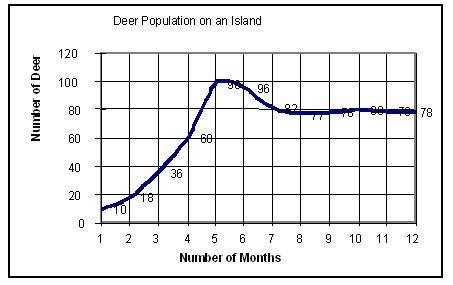
Which choice most closely approximates the deer population's carrying capacity based on the graph?
100
80
60
10

The Florida Panther is a large cat that is native to the southern parts of Florida. Recently, the panther's main food source, rabbits, have been infected with a deadly disease that only affects rabbits. How would this most likely affect the population of panthers in the coming years?
The panther population will decrease since they won't have access to as much food
The panther population will not be affected because they will adapt to eating other food
The panther population will increase because they will produce more offspring to make up the difference
The panther population will decrease because they will contract the disease.

A graph that shows the number or proportion of individuals surviving to each age for a given species or group.
survivorship curve
exponential
linear
logistic

Tracks organisms that tend to live long lives (low death rate and high survivorship rate); toward the end of their life expectancies, however, there is a dramatic increase in the death rate.
Type I
Type II
Type III
Type IV
Describes organisms with a high death rate (or low survivorship rate) immediately following birth. Examples include bacteria, fishes, and invertebrates.
Type I
Type II
Type III
Type IV

What happens if a population grows past its carrying capacity?
The population keeps growing
The population will overshoot its carrying capacity then starts to die off
The entire species will go extinct
The carrying capacity just increases
These organisms occupy stable environments, are larger in size and have longer life expectancies. They produce, during their life spans, fewer offspring, but place a greater investment in each.
big bang reproducers
repeated reproducers
b strategists
z strategists
These organisms typically live in unstable, unpredictable environments & are able to reproduce rapidly (exponentially). They do not take care of their young & are subject to predation.
repeated reproducers
big bang reproducers
m-strategist
s-strategist
Click density independent factor(s).
competition for resources
predator-prey relationships
parasitism and disease
weather, natural disaster and man made disturbances
Click density dependent factor(s).
competition for resources
predator-prey relationships
parasitism and disease
weather

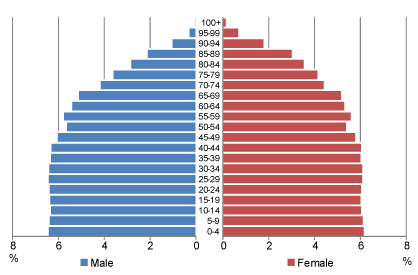
The following population pyramid shows a population that is....
Exponentially growing
Declining
Rapid Growth
Stable Growth

