wayground logo

Free Printable Worksheets

NEW

Font size

S
M
L
XL
Worksheets

TNReady Review #2

Total questions: 62

Worksheet time: 42mins

Name
Class
Date
1.

The diffusion of water across a selectively permeable membrane.

a)

hypotonic solution

b)

isotonic solution

c)

osmosis

d)

passive transport

2.

The movement of a substance across a cell membrane against a concentration gradient; requires the cell to expend energy.

a)

active transport

b)

passive transport

c)

diffusion

d)

osmosis

3.

A process in which substances move down their concentration gradient across the cell membrane with the assistance of carrier proteins.

a)

Diffusion

b)

Facilitated diffusion

c)

Osmosis

d)

Active transport

4.

Water pressure within a cell.

a)

Turgor pressure

b)

Osmotic pressure

c)

Cellular pressure

d)

none of the above

5.

A state that exists when the concentration of a substance is the same throughout a space.

a)

Dynamic pressure

b)

cell transport

c)

dynamic equilibrium

d)

facilitated diffusion

6.

Water moves into a cell placed in a(n) ____________ solution.

a)

Osmotic

b)

Hypertonic

c)

Hypotonic

d)

Isotonic

7.

Water moves out of a cell if the cell is placed in a(n) _____________ solution.

a)

Hypertonic

b)

Isotonic

c)

Hypotonic

d)

Passive

8.

A red blood cell that is placed into a 3% salt solution will

a)

Swell, then burst

b)

Shrink

c)

Maintain its normal shape

d)

Shrink, then swell back to normal

9.

The polar heads of the phospholipid that make up a plasma membrane are:

a)

Hydrophobic

b)

Hydrophilic

c)

Neutral

d)

Acidic

10.

When some molecules are able to pass through a membrane while others are not, the membrane is said to be ________________.

a)

Impermeable

b)

Selectively permeable

c)

Permeable

d)

Defective

11.

A cell moves particles from a region of lesser concentration to a region of greater concentration by ____________________.

a)

Facilitated diffusion

b)

Passive transport

c)

Osmosis

d)

Active transport

12.

If a tulip is not watered, it wilts because

a)

It increases active transport

b)

It increases turgor pressure

c)

It loses active transport

d)

It loses turgor pressure

13.

If a cell is placed in salt water, water leaves the cell by ______________.

a)

Osmosis

b)

Diffusion

c)

Active transport

d)

Phagocytosis

14.

Diffusion continues until there is no ____________________.

a)

dynamic equilibrium

b)

turgor pressure

c)

concentration gradient

d)

homeostasis

15.

A plasma membrane is made up of a(n):

a)

cholesterol layer

b)

enzyme layer

c)

lipid bilayer

d)

protein bilayer

16.

The main structural component(s) of the plasma membrane is (are)

a)

Carbs

b)

Cholesterol

c)

Phospholipids

d)

Proteins

17.

What kind of particles cross the lipid bilayer easily?

a)

large carbohydrates

b)

small sugars

c)

charged molecules

d)

small, uncharged particles

18.

A membrane that is more fluid would contain more _____________.

a)

Proteins

b)

Cholesterol

c)

Saturated fatty acids

d)

Unsaturated fatty acids

19.

In the plasma membrane, cholesterol _____________.

a)

Binds to carrier proteins

b)

Allows insertion of proteins

c)

Makes the membrane more stable and less fluid

d)

Allows diffusion of nonpolar substances.

20.

What is the eventual result of diffusion?

a)

a gradient

b)

dynamic equilibrium

c)

the cell gains energy

d)

osmosis of water

21.

True or False: The tails of phospholipids love water.

a)

True

b)

False

22.

What is the ratio of cholesterol to phospholipids?

a)

1:2

b)

1:1

c)

1:4

d)

1:3

23.

What is Brownian Motion?

a)

Facilitated diffusion

b)

Osmosis

c)

Diffusion

d)

Active transport

24.

True or False: Active and Passive Transport both require the use of ATP.

a)

True

b)

False

25.

True or False: The ability for a phospholipid to pop out of the structure, swim sideways up the layers, and pop back into place is called Dynamic Equilibrium.

a)

True

b)

False

26.
Which of the following is the correct equation for PHOTOSYNTHESIS?
a)
CO+ light + H2O --> O+ Sugar
b)
CO+ sugar + H2O --> O+ light
c)
O2 + light + H2O --> CO+ Sugar
d)
CO+ O2 + H2O --> Light+ Sugar
27.
What process occurs when light energy is captured in autotrophs and converted into sugar?
a)
Photosynthesis
b)
Cellular Respiration
28.
What is the ultimate ORIGINAL source of energy for living things
a)
Sugar
b)
Sun
c)
Moon
d)
Carbon Dioxide
29.
What is the pigment in chloroplasts that performs photosynthesis?
a)
Chlorosynthesis
b)
Chlorophyll
c)
ADP
d)
Electron Transport
30.
Which gas is removed from the atmosphere during photosynthesis?
a)
hydrogen
b)
oxygen
c)
nitrogen
d)
carbon dioxide
31.
What are the products of photosynthesis?
a)
water and carbon dioxide
b)
oxygen and glucose
c)
oxygen and carbon dioxide
d)
oxygen and water
32.
Which of the following go through the process of photosynthesis?
a)
bees
b)
algae
c)
humans
d)
mushrooms
33.
What is the correct equation for photosynthesis?
a)
C6H12O+ 6O--> 6CO2 + 6H2O
b)
6CO2 + 6O--> C6H12O + 6H2O
c)
 6CO+ 6O--> 6H2O + C6H12O6
d)
6CO2 + 6H2O  -->  6O+ C6H12O6
34.
Which of the following is an example of a HETEROTROPH?
a)
Grass
b)
Algae
c)
Lemon Tree
d)
Bear
35.
Which statement about photosynthesis is correct?
a)
Plants get the energy they need for photosynthesis from water.
b)
Plants get the energy they need for photosynthesis from soil.
c)
Plants get the energy they need for photosynthesis from sunlight.
d)
Plants get the energy they need for photosynthesis from carbon dioxide.
36.
What molecule absorbs sunlight for photosynthesis?
a)
chloroplast
b)
thylakoid
c)
grana
d)
chlorophyll
37.
What is the name of the simple sugar that is produced in photosynthesis?
a)
Sucrose
b)
Dextrose
c)
Glucose
d)
Lactose
38.
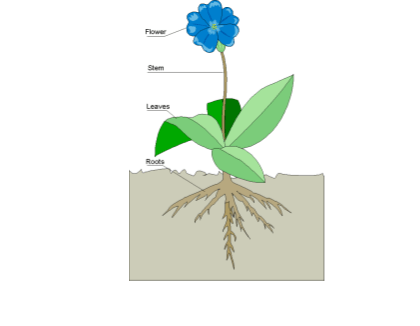
Which plant part absorbs water and nutrients?
a)
Leaf
b)
Stem
c)
Roots
d)
Flower
39.
What is the function of ATP in living things?
a)
provides energy for cells
b)
stores genetic information
c)
provides structure in the nucleus
40.
Using the figure, which parts of the molecule must the bonds be broken to form an ADP molecule?
a)
A and B
b)
B and C
c)
C and D
d)
all of the above
41.
Energy is released from ATP when
a)
a phosphate group is added
b)
adenine bonds to ribose
c)
ATP is exposed to sunlight
d)
a phosphate group is removed
42.
Which structures shown in the Figure make up the ADP molecule?
a)
A and B
b)
A, B and C
c)
A, B, C, and D
d)
C and D
43.
Autotroph or Heterotroph?
a)
Autotroph
b)
Heterotroph
44.
Which of the following is not a requirement for glycolysis?
a)
Oxygen
b)
ATP
c)
NAD+
d)
Glucose
45.
Which is not part of the net products of Glycolysis?
a)
2 ATP
b)
2 NADH
c)
2 Pyruvate
d)
2 CO2
46.
Glycolysis results in the net gain of:
a)
2 ATP
b)
4 ATP
c)
4 NADH
d)
2 Acetyl CoA
47.
What is the starting molecule for glycolysis?
a)
Glucose
b)
ADP
c)
Oxygen
d)
Pyruvic Acid
48.
Glycolysis requires
a)
ATP
b)
Oxygen
c)
sunlight
d)
NADP+
49.
Where does glycolysis occur?
a)
mitochondrial matrix
b)
cytoplasm
c)
inner membrane of mitochondria
d)
outer membrane of mitochondria
50.
Glycolysis literally translates to:
a)
sugar-taking
b)
Glucose-making
c)
sugar-baking
d)
Glucose-breaking
51.
In glycolysis, glucose is converted into two molecules of _____. 
a)
citric acid
b)
oxaloacetic acid
c)
pyruvic acid
d)
Acetyl CoA
52.
What is Anaerobic Respiration?
a)
process of producing energy without oxygen.
b)
process of producing energy with oxygen.
53.
The number of ATP molecules produced out of Krebs Cycle is:
a)
2
b)
3
c)
4
d)
0
54.
Krebs Cycle is part of_______________ respiration.
a)
Aerobic
b)
Anaerobic
55.
After the Krebs Cycle only a small portion of the energy of glucose has been converted to ATP. At this point the majority of usable energy is contained in
a)
NADH and FADH2
b)
Carbon Dioxide 
c)
Acetyl-CoA
d)
Citrate
56.
What is the correct equation for cellular respiration?
a)
6O2 + C6H12O6 -> 6CO2 + 6H2O + Energy
b)
6O2 + C6H12O6 + Energy -> 6CO2 + 6H2O
c)
6CO2 + 6H2O -> 6O2 + C6H12O6 + Energy
d)
6CO2 + 6H2O + Energy -> 6O2 + C6H12O6
57.
NADH and FADH
a)
carry electrons to the ETC.
b)
bind with Acetyl CoA.
c)
supply energy for the cell.
d)
make water.
58.
Which of the following is not an end product of the Kreb's cycle?
a)
FADH2
b)
CO2
c)
pyruvate
d)
ATP
59.
The mitochondria is responsible for ...
a)
photosynthesis
b)
anaerobic respiration
c)
aerobic respiration
d)
fermentation
60.
Aerobic respiration is different from anaerobic respiration in that aerobic respiration needs...
a)
chlorophyll
b)
carbon dioxide
c)
glucose
d)
oxygen
61.
Where does the Krebs Cycle take place?
a)
mitochondria
b)
chloroplast
c)
cytoplasm
d)
nucleus
62.
The energy carrier that the cell uses to power its day to day activities is 
a)
ATP
b)
NADH
c)
FADH2
d)
glucose