wayground logo

Free Printable Worksheets

Font size

S
M
L
XL
Worksheets

PMA 2 Review

Total questions: 116

Worksheet time: 2hrs 52mins

Name
Class
Date
1.

___________ are the smallest unit of an element that maintains the properties of that element.

a)

Atoms

b)

Elements

c)

Compounds

d)

Mixtures

2.

An _______________ is made up of one or more of the same kind of atom chemically combined.

a)

atom

b)

element

c)

molecule

d)

compound

3.

A _____________ contains a variety of elements and compounds that are not chemically combined with each other.

a)

compound

b)

element

c)

molecule

d)

mixture

4.

A __________________ is a substance that has definite physical and chemical properties such as appearance, melting point, and reactivity.

a)

mixture

b)

pure substance

c)

compound

d)

element

5.

A ______________ mixture is one that does not have a uniform composition.

a)

heterogeneous

b)

homogenous

c)

pure substance

6.

A _________________ mixture is one where the substances are evenly spread throughout.

a)

heterogeneous

b)

homogeneous

c)

pure substance

7.

Tea and air are examples of ________________.

a)

solutions

b)

compounds

c)

heterogeneous mixtures

8.

Fruit Loops, pizza, and Skittles are examples of ____________________ mixtures.

a)

heterogeneous

b)

homogeneous

c)

pure

9.

Coffee, mouthwash, and vinegar are examples of __________________ mixtures.

a)

heterogeneous

b)

homogeneous

c)

pure

10.

Which of these is an element?

a)

Salt (NaCl)

b)

Water (H20)

c)

Oxygen (O)

d)

Carbon Dioxide (CO2)

11.

Which of these is a compound?

a)

Aluminium (Al)

b)

Carbon Dioxide (CO2)

c)

Nitrogen (N)

d)

Sand

12.
Ammonia has a pH of 12.  Ammonia is __________.
a)
an acid
b)
a base
c)
an element
d)
a metal
13.
Soap is a weak base.  What is true about the taste of bases?
a)
they taste sour
b)
they taste sweet
c)
they taste bitter
d)
they taste salty
14.
Explain what happens when a strong acid and a strong base are poured into the same container.
a)
they form separate layers
b)
they mix physically but not chemically
c)
they break apart into separate elements
d)
they react chemically to form a salt
15.
Which of these solutions is an acid?
a)
Dish Soap: pH of 12
b)
Tomato Soup: pH of 4
c)
Baking Soda: pH of 9
d)
Drain Cleaner: pH of 14
16.
The pH of vinegar is 2.5.  Vinegar is a _____________.
a)
strong acid
b)
strong base
c)
weak base
d)
weak acid
17.
Which of the following is true about acids and bases?
a)
The lower the pH, the stronger the acid
b)
the higher the pH, the stronger the acid
c)
The lower the pH, the more neutral the acid
d)
The higher the pH, the weaker the base
18.
Which statement is true when acids and bases are mixed together?
a)
acids become stronger
b)
bases become stronger
c)
there is no change
d)
they neutralize each other
19.
Ranging from 0 to 14, a pH value indicates how acidic or basic a solution is.  Which of these pH values would be a strong acid?
a)
2
b)
6
c)
9
d)
13
20.
What is the pH of water?
a)
0
b)
4
c)
7
d)
14
21.
Williams collected a rain sample and measured its pH to be 5.6.  What does this mean?
a)
the rain water is a weak base
b)
the rain water is neutral
c)
the rain water is a strong acid
d)
the rain water is a weak acid
22.
What is the pH of a neutral substance?
a)
0
b)
5
c)
7
d)
10
23.
Which of these pH values would indicate that a solution is a weak base?
a)
4
b)
5.6
c)
8
d)
13
24.
What are the products of photosynthesis?
a)
water and carbon dioxide
b)
oxygen and glucose
c)
oxygen and carbon dioxide
d)
oxygen and water
25.
Which gas is removed from the atmosphere during photosynthesis?
a)
hydrogen
b)
oxygen
c)
nitrogen
d)
carbon dioxide
26.
Which statement about photosynthesis is correct?
a)
Plants get the energy they need for photosynthesis from water.
b)
Plants get the energy they need for photosynthesis from soil.
c)
Plants get the energy they need for photosynthesis from sunlight.
d)
Plants do not require energy to perform photosynthesis.
27.
Which sentence correctly describes photosynthesis. (assume there is enough sunlight)
a)
CO2 and water combine and make O2 and glucose
b)
O2 and water combine to make glucose and CO2
c)
O2 and CO2 combine to make water and glucose
d)
CO2 and glucose combine to make O2 and water
28.
What is the organelle that contains the chlorophyll used in photosynthesis ?
a)
mitochondria
b)
ribosome
c)
chloroplast
d)
nucleus
29.
What is the "waste" gas (product) produced during photosynthesis?
a)
oxygen
b)
nitrogen
c)
helium
d)
hydrogen
30.
What is the end product of photosynthesis ?
a)
carbon dioxide
b)
water
c)
glucose
d)
methane
31.
Which of the following is the correct equation for PHOTOSYNTHESIS?
a)
CO+ light + H2O --> O+ glucose
b)
CO+ glucose + H2O --> O+ light
c)
O2 + light + H2O --> CO+ glucose
d)
CO+ O2 + H2O --> Light+ glucose
32.

In which way are photosynthesis and cellular respiration similar?

a)

Both processes destroy energy.

b)

Both create energy.

c)

Photosynthesis breaks down sugar while cellular respiration produces sugar.

d)

Both processes transfer energy from one form to another.

33.

What is the correct equation for cellular respiration?

a)

oxygen + sugar -> carbon dioxide + water + Energy

b)

carbon dioxide + sugar + Energy -> carbon dioxide + water

c)

carbon dioxide + water -> oxygen + sugar + Energy

d)

carbon dioxide + water + Energy -> oxygen + sugar

34.

What is important about cellular respiration?

a)

It produces energy from the sun.

b)

It forms sugar.

c)

It transforms sugar into a usable form of energy (ATP)

d)

Only plants perform this process.

35.

One molecule needed for cellular respiration is

a)

carbon dioxide

b)

glucose

c)

water

d)

chlorophyll

36.

One molecule produced by animals during cellular respiration is

a)

carbon dioxide

b)

glucose

c)

oxygen

d)

chlorophyll

37.

Cellular respiration is

a)

a chemical reaction and NOT the same as breathing

b)

the movement of air in and out of the lungs

c)

not a chemical reaction

38.
The following diagram shows the relationship between photosynthesis and respiration.  What products of photosynthesis are starting material for cellular respiration?
a)
glucose and oxygen
b)
heat energy and ATP
c)
carbon dioxide and water
d)
light energy and chlorophyll
39.
When humans burn fossil fuels, most of the carbon quickly enters the                       as carbon dioxide.
a)
Water
b)
Atmosphere
c)
Sun
d)
Air
40.
What does not produce carbon dioxide?
a)
Photosynthesis
b)
Burning Fossil Fuels
c)
Animal respiration
d)
Plants decaying
41.
How do living organisms return carbon to the atmosphere in the carbon cycle?
a)
respiration and photosynthesis
b)
 decomposition and respiration
42.
In the carbon cycle, producers take in the gas __
a)
carbon dioxide
b)
oxygen
c)
nitrogen
d)
carbon monoxide
43.
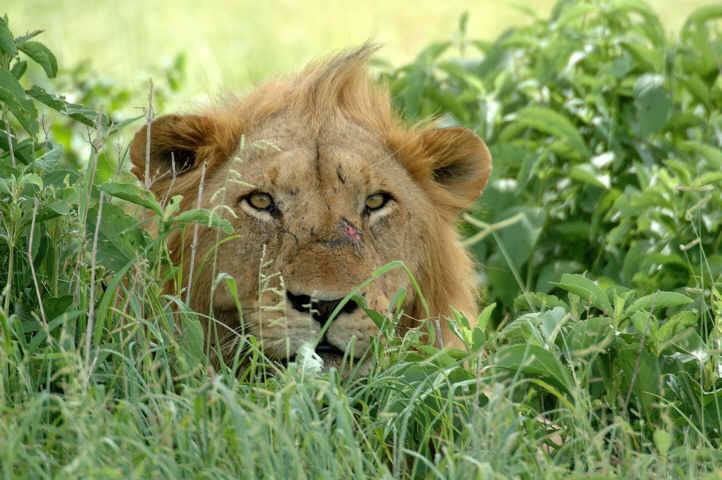
How does the carbon in grass become part of a lion?
a)
The lion eats the grass
b)
Carbon from grass doesn't end up in a lion. 
c)
The carbon ends up in the lion's food chain. 
d)
The lion breathes in carbon given out by the plant
44.
All of the carbon in existence is continually recycled in the carbon cycle
a)
True
b)
False
45.
Organisms that do not decompose can be buried and become what?
a)
water
b)
nutrients
c)
air
d)
fossil fuels
46.

If the plant population decreased, the amount of atmospheric carbon would _________.

a)

Stay the same

b)

Increase

c)

Decrease

47.
Combustion is another word for __________.
a)
Transportation
b)
Respiration
c)
Fossil Fuels
d)
Burning
48.
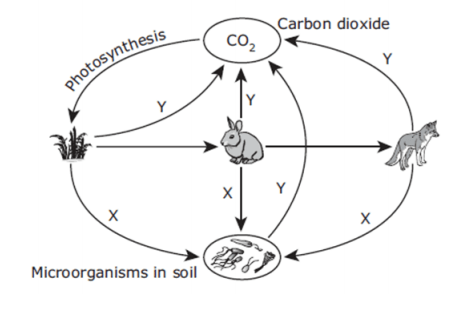
The diagram shows the flow of organic molecules through an ecosystem. What two processes are identified by the labels X and Y?
a)
X : Respiration
Y : Predation
b)
X : Adaptation
Y : Decomposition
c)
X : Fermentation
Y : Nitrogen Fixation
d)
X : Decomposition
Y : Respiration
49.
The average temperature of the surface of Earth has increased approximately 1°C in the past century. Which reason best explains this increase in temperature?
a)
lower levels of ozone in the atmosphere
b)
lower levels of nitrogen in the atmosphere
c)
higher levels of carbon dioxide and other greenhouse gases in the atmosphere
d)
higher levels of oxygen in the atmosphere
50.
A 500-gram block of solid cheese is melted in a pot. Which is most likely the mass of the cheese after it is melted?
a)
500 grams, because the cheese does not gain or lose mass just because it was melted
b)
499 grams, because some of the cheese evaporates as it melts
c)
502 grams, because the cheese absorbs heat as it melts
51.
A student notices that an inflated balloon gets larger when it is warmed by a lamp. Which best describes the mass of the balloon as a result of this change?
a)
The mass of the balloon increases because the size of the balloon has increased.
b)
The mass of the balloon increases because the temperature of the balloon has increased.
c)
The mass of the balloon stays the same because the gas inside the balloon still has the same mass after it warms up.
52.
What is the Law of Conservation of mass?
a)
Mass is created in a chemical reaction
b)
Mass is created in a physical change
c)
New chemicals formed from a chemical reaction have a larger overall mass than the original reactants
d)
Mass is never created or destroyed
53.

The Law of Conservation of Energy states:

a)

Energy can created or destroyed but not transformed

b)

Energy cannot be created or destroyed, it can only transformed

c)

Energy can't be created, destroyed or transformed

d)

Energy cannot be created or destroyed.

54.
All of the inner planets--
a)
have rings
b)
are rocky
c)
have deep atmospheres
d)
are large
55.
Which planet is the hottest?
a)
Mercury
b)
Venus
c)
Earth
d)
Neptune
56.
All of the outer planets--
a)
have many moons
b)
are small
c)
have a short orbit around the Sun
d)
are rocky
57.

Which group of planets have shorter years?

a)

inner

b)

outer

58.
The average surface temperature of Earth is a moderate 15 degrees C. because of...
a)
its oceans
b)
its distance from the Sun
c)
its atmosphere with small amounts of greenhouse gases
d)
all of these reasons
59.

What would happen if earth didn't have a atmosphere?

a)

We wouldn't be able to breathe

b)

We would have no protection from rocks in space

c)

We would have no protection from the sun

d)

Everything would fly into space

60.
What is the Moon?
a)
It is a planet
b)
It is a satellite
c)
It is a star
d)
It is a comet
61.

Which property makes Earth unique compared to other planets in the solar system?

a)

It orbits the Sun.

b)

It is a rocky planet

c)

It has liquid water

d)

It rotates on its axis.

62.

Which planet has extreme temperatures because it has no atmosphere?

a)

Earth

b)

Jupiter

c)

Saturn

d)

Mercury

63.

The four inner planets are rocky and small. Which description best fits the next four outer planets?

a)

They are also rocky and small.

b)

They are very large and has no moons

c)

They are small and made of ice.

d)

They are very large, made of gases with no solid surface

64.

A student is looking at a model of the solar system noted there is a belt of objects in orbit in between Mars and Jupiter. What are these orbiting objects?

a)

Comets

b)

Moons

c)

Asteroids

d)

Pluto

65.

Which of the these planets would have the greatest gravitational pull on a nearby object?

a)

Mars

b)

Mercury

c)

Jupiter

d)

Neptune

66.

What are comets made of?

a)

mud, rock, water

b)

ice and rock

c)

ice, dust, water

d)

gas and dust

67.

Comets do not tend to travel on an orbit.

a)

True

b)

False

68.

The most recent definition of a planet was adopted by the International Astronomical Union in 2006. It says a planet must do three things, one of those things are...

a)

It must have cleared away any other objects of a similar size near its orbit around the Sun.

b)

It must have organic life forms.

c)

It must have an an orbit inside the asteroid belt.

d)

It must have at least one moon.

69.

Pluto was declassified has a planet because...

a)

it's too small.

b)

it's not a sphere.

c)

it hasn't cleared it's orbit of debris.

d)

it's orbit around the Sun is so strange.

70.
A force of attraction between 2 object that is directly related to mass and indirectly related to distance.
a)
mass
b)
weight
c)
gravity
d)
kilogram
71.
As the distance between 2 objects increases, what happens to gravitational force?
a)
increases
b)
decreases
c)
stays the same
d)
i don't know
72.
Which of the following will not change in different gravitational fields?
a)
wieght
b)
force
c)
mass
d)
pounds
73.
What would happen to your weight if Earth's mass was cut in half?
a)
increase because gravitational force increases
b)
decrease because gravitational force decreases
c)
decrease because gravitational force increases
d)
increase because gravitational force decreases
74.
Geocentrism is the theory that says that the Earth is the centre of the universe. 
a)
True
b)
False
75.

According to Copernicous orbits are perfectly circular, is it true?

a)

Yes.

b)

No, Kepler shown that are squared

c)

No, Kepler shown that are elliptical

d)

Yes, but Kepler said this, not Copernicous,

76.

In the geocentric model of the universe, where is the earth located in the solar system?

a)

3rd planet from the Sun

b)

1st planet from the Sun

c)

Center of the Solar System

d)

Last planet

77.

What is Heliocentrism?

a)

sun revolves around the Earth

b)

Earth revolves around the sun

c)

sun & Earth are both motionless

d)

the planet Helio is the center of the universe

78.
The characteristic temperature at which a pure solid changes to a liquid is its __________ point.
a)
melting
b)
boiling
c)
Schaffer
d)
pressure
79.
The change from liquid to solid is called ________________.
a)
Melting
b)
Freezing
c)
Evaporation
d)
Condensation
80.

Condensation occurs when _____________ water vapour comes into contact with a cooler surface, loses heat and condenses into water droplets.

a)

warm

b)

warmer

c)

cold

d)

colder

81.
Taking energy away from a substance will make its particles move
a)
more slowly
b)
more quickly
c)
at the same speed
82.

It rained yesterday, but today there are no puddles left on the ground. What process caused this to happen?

a)

condensation

b)

vaporization

c)

sublimation

d)

deposition

83.
What variable is on the y-axis?
a)
Time
b)
Temperature
c)
Heat
d)
Phases
84.
What is the state of the substance at point C?
a)
Liquid
b)
Solid
c)
Gas
d)
Plasma
85.
What phase change is happening at point D?
a)
Vaporization
b)
Sublimation
c)
Freezing
d)
Melting
86.
What two types of measurements make up DENSITY
a)
Mass and Volume
b)
Temperature and Mass
c)
Grams and Centimeters
d)
Volume and Weight
87.
Jack has a rock. The rock has a mass of 14g and a volume of 2cm3. What is the density of the rock?
a)
7 mL
b)
7 g/cm3
c)
28 g/cm3
d)
1/7 g/cm3
88.
Which of the following is a sign that a chemical reaction has occurred?
a)
change in shape
b)
melting
c)
formation of a gas
d)
dissolving
89.
Is melting butter for popcorn a chemical or physical change?
a)
chemical
b)
physical
90.
Which of the following is NOT an example of a physical change?
a)
crumpled paper
b)
pencil sharpening
c)
shrunken clothing
d)
rust
91.
A change where one or more new substances are created.
a)
Physical Change 
b)
Chemical Change 
92.
Wood burned in a fireplace
a)
Chemical Change
b)
Physical Change
93.
Water freezing
a)
Chemical Change
b)
Physical Change
94.
What is at the center of every atom?
a)
an electron
b)
a compound
c)
a molecule
d)
a nucleus
95.
Particles in an atom that are neutral and have no charge are 
a)
negatrons 
b)
electrons 
c)
neutrons 
d)
protons 
96.
Which of the following is a negatively charged subatomic particle?
a)
Electron
b)
Proton
c)
Neutron
d)
Quark
97.
Where are electrons of an atom found?
a)
Nucleus
b)
Electron Cloud
c)
Some are in the nucleus and some in the electron cloud.
d)
They are moving everywhere.
98.
The atomic number tells you what?
a)
number of electrons
b)
number of protons
c)
number of neutrons
d)
both electrons and protons in an atom.
99.
Atoms with similar properties are most likely located...
a)
in the same period.
b)
in the same group.
c)
in different periods.
d)
to the right and left of each other.
100.
The atomic number of this pictured element is
a)
28
b)
58.6934
c)
Ni
d)
Nickel
101.
what does the 6 represent?
a)
Atomic mass
b)
atomic number
c)
chemical symbol
d)
element name
102.
What is the atomic mass of Neon?
a)
10
b)
30
c)
10.18
d)
20.18
103.
What causes the moon's phases
a)
Where you are standing on Earth
b)
the amt of sunlight reflected onto the moon from the sun
c)
The tilt of Earth
d)
how fast the moon is moving
104.
Define Full Moon
a)
None of moon is visible
b)
Half moon phase is visible
c)
Complete moon face is visible
d)
Less Than half of moon is visible
105.
Define New Moon
a)
None of moon is visible from Earth
b)
All of moon visible from Earth
c)
Moon is 1/2 visible from Earth
d)
Moon is more than Half Visible from Earth
106.

Define Quarter Moon

a)

None of moon visible

b)

Less than Half the moon is visible

c)

More than half of moon is visible

d)

Half of the lit part of the moon is visible

107.
The moon seems to change shape from day to day in a cycle that lasts about a month as it goes through _.
a)
revolutions
b)
phases
c)
rotations
d)
eclipses
108.
What causes the phase of the Moon to change each night?
a)
The Moon changes its acutal shape throughout the course of the month.
b)
The alignment between the Earth, Moon, and Sun determines the amount of light reflected by the Moon.
c)
The season of the year determines the phase of the Moon.
d)
The closer the Moon is to Earth, the more light the Moon reflects.
109.
What must occur for an solar eclipse to occur?
a)
Sun-Earth-Moon in line
b)
Sun-Moon-Earth in line
110.
In thinking about a solar eclipse, what does the ball in the diagram represent?
a)
the Earth
b)
the Moon
c)
the Sun
111.
During which part of the lunar cycle can a solar eclipse occur?
a)
New Moon
b)
First Quarter
c)
Full Moon
d)
Third Quarter
112.
A lunar eclipse occurs when the Moon casts a shadow on Earth.
a)
True
b)
False
113.
What type of eclipse occurs when the moon blocks the sun's light and cast a shadow on earth?
a)
solar
b)
lunar
114.
What type of eclipse occurs when the earth's shadow is cast on a full moon?
a)
solar
b)
lunar
115.
What moon phase occurs during a lunar eclipse?
a)
full moon
b)
new moon
c)
3rd quarter
d)
waxing crescent
116.
What moon phase occurs during a solar eclipse?
a)
Full moon
b)
new moon
c)
1st quarter
d)
waxing gibbous