
 Worksheets
Science Olympiad - Green Generation
Total questions: 59
Worksheet time: 1hrs 4mins

How would the removal of earthworms from the food chain affect the other organisms?
The number of bass will increase.
The number of crayfish will decrease.
The crayfish will get their energy directly from the sun.
The number of bass and ospreys (bird) will increase.

The diagram shows part of an aquatic food web for a stable lake ecosystem in Connecticut. What is the source of energy for the algae?
waves
sunlight
bacteria
rotifers, water fleas and tadpoles

The diagram provided shows a marine food chain. In this food chain, the zooplankton are
primary producers.
primary consumers.
secondary consumers.
tertiary consumers.

The picture provided shows an ocean bay food chain. Sea otters move into the ocean bay. They eat all of the sea urchins. This change will cause the
kelp to have less food.
crabs to have more food.
sea ducks to have less food.
arctic foxes to have more food.
Which of these organisms would most likely be found at the top of an energy pyramid?
clams
sardines
sharks
kelp (seaweed)


A population is...
A group of one species in one area
Multiple species that live in one area
All of the living and nonliving things in an area
None of these
The nonliving parts of an ecosystem.
Abiotic factors
Biotic factors

What are the abiotic factors in this image?
water, sunlight, dirt, air
birds and plants
birds, water, dirt
plants, water


All of the squirrels living in Hubbard Park would be considered a
population
community
ecosystem
organism
Acid rain can damage
Drinking water sources
Aquatic (water) life
Architecture / buildings
All options are correct

When the Ozone Layer loses Ozone what happens to organisms on the earth's surface?
They are exposed to Smog
Nothing happens
They are exposed to Acid Rain
They are exposed to Ultraviolet B Radiation
Air pollution causes all of the following, except
holes in the ozone layer
increased particles in the air
acid rain
healthy air to breath
smog
A radioactive gas that can build up in homes.
uranium
helium
oxygen
radon
Exposure to too much radon gas can cause
lung cancer
sun burn
blindness
acne
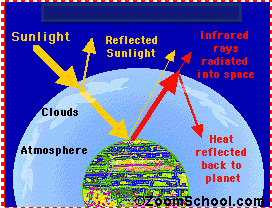
Climate change caused by extra carbon dioxide in the air that causes heat to get trapped in the atmosphere is called
global warming
photosynthesis
smog
Which are the sources of chlorofluorocarbon?
refrigerator
agriculture
power plant
air conditioner
aerosol spray
Which pollutant will cause thinning of ozone layer
carbon dioxide
plumbum
nitrogen dioxide
chlorofluorocarbon
What is global climate change?
A world-wide change in weather patterns
A depletion of the ozone layer
An unexplainable phenomenon
An increase in storms in North Carolina
How does an increase in carbon dioxide affect global temperature?
decreases
increases
does not affect temperature
temperature stays the same

In Graph A, Atmosphereic CO2 Concentrations, what is the highest historical CO2 level recorded before 1950
180 ppm
220 ppm
300 pmm
380 ppm
Which is a MAJOR cause of acid rain?
spraying pesticides on crops
burning fossil fuels for energy
dumping sewage in rivers
using Nuclear power stations
A high concentration of phosphates and nitrates is found in samples of a pond. Which is most likely the source?
lake turnover
acid rain
runoff form agricultural fields
This is the most productive ecosystem in the ocean. It is formed as the result of a tiny animal and algae living in a mutualistic relationship.
Mudflat
Sandy shore
Rocky shore
Coral reef

An autotroph
is a self feeding organism that does photosynthesis
Is an organism that eats other organisms for energy
is the name for all bacteria
is a being that eats meat only

Water from rain or melting snow that flows over the surface of the ground into streams.
Slush
Acid Rain
estuary
Runoff
It can be harmful to have too many nutrients in a water source. How do excess nutrients enter a water source?
rain water washes lawn and agricultural fertilizers in to the ecosystem
Scientists are adding fertilizer to the ecosystem
Nitrogen fixing bacteria are creating an excess of organic nitrogen compounds
algae are causing denitrification in the water source


______________________ is the buildup of pollutants at higher levels of the food chain.
porosity
water pollution
wastewater
biomagnification
If water temperature goes UP, what happens to the level of dissolved oxygen?
It goes up
It goes down

What does pH measure?
temperture
air pressure
How acidic or alkaline a substance is
speed


Below is a chart of test results from water samples taken at various sites. Which of the following best describes the results from these sites?
Site 1 is unhealthy because of its dissolved oxygen levels are too high.
Site 3 and 4 are unhealthy because the temperature is too low.
Site 2 is unhealthy because the pH is too high and the temperature is too low.
Site 5 is unhealthy because the temperature is too high and the dissolved oxygen is too low.
Acid rain decreases this in an aquatic ecosystem.
dissolved oxygen
pH
temperature
phosphates
What is the function of the Ozone Layer?
It protects the surface of the Earth from the ultraviolet radiation
It protects the Earth's surface from the infrared radiation
It decreases greenhouse emissions
It builds reservoirs of carbon
What are possible effect(s) of the thinning of the Ozone?
cataracts
skin cancer
increased sunburns
destroys phytoplankton

The following image shows the amount of Nitrogen released in the atmosphere in China. from January and February 2020. In China, the coronavirus shutdown factories as well as the number of workers present. Which statement best describes the effect of human activity on Nitrogen emissions?
Human activity decreases the amount of NO 2 in the atmosphere
Human activity has no impact on the amount of NO 2 in the atmosphere
Human activity increases the amount of NO 2 in the atmosphere
Human activity impacted the amount of NO 2 in the atmosphere in the past but has no impact now.

This graph shows the concentration of carbon dioxide in the ocean at Mauna Lao, Hawaii since 1960. Due to excess carbon being absorbed by the ocean, ocean acidification can and have negative impacts on aquatic plants and life. Which statement predicts the effect of ocean acidification on biodiversity?
Biodiversity has been unaffected by ocean acidification
Biodiversity has been unaffected because there has been no ocean acidification
Biodiversity has increased because acidification leads to new opportunities to fill niches
Biodiversity has decreased because ocean acidification has made the ocean uninhabitable by some life

Which two are greenhouse gases.
Carbon and ethanol gas
Carbon monoxide and ethane gas
Carbon dioxide and methane gas
Nitrogen and hydrogen
What is the difference between weather and climate? (CHOOSE 2 ANSWERS)
Weather is the temperature outside now
Climate is total snowfall
Climate is the average weather over a long period of time
Weather is more accurate
What is the greenhouse effect?
The trapping of warmth in the atmosphere due to greenhouse gasses
The average weather over a long period of time
The current conditions in the atmosphere
An instagram filter that makes everything look green
Which is an example of weather? (SELECT 2)
It is raining and 42o outside
We had an unusually hot summer
Utah has 4 seasons
Today will be partly cloudy with a high temperature of around 50 degrees
Which is an example of climate? (SELECT 2)
There is a tornado advisory is Kansas
The dry season is from July-September every year
A storm is coming in from the west
It is usually hot in August

