wayground logo

Free Printable Worksheets

NEW

Font size

S
M
L
XL
Worksheets

Biology CP Midterm Review 2

Total questions: 46

Worksheet time: 41mins

Name
Class
Date
1.

A series of steps designed to help you solve problems and answer questions is

a)

the scientific method

b)

results

c)

observations

d)

the two step

2.
Anything in an experiment that can  be changed.
a)
models
b)
variables
c)
explanation
d)
qualitative data
3.

The variables you keep the same in the experiment are called

a)

independent variables

b)

dependent variables

c)

controlled variables

d)

hypothesis

4.
What is the most basic unit of life?
a)
cell
b)
tissue
c)
organ
d)
organ system
5.
It is hot outside. You start sweating. In this case, the hot weather is the...
a)
stimulus
b)
response
c)
cause and effect
d)
responder
6.

The combination of chemical reactions through

which an organism builds up or breaks down

materials as it carries out its life processes is called ...

a)

absorption

b)

metabolism

c)

digestion

d)

consumption

7.

Maintaining a stable internal

environment is called

a)

homeostasis

b)

equilibrium

c)

balance

d)

evenness

8.

Over three years, Tim's height has increased from 5'4" to 5'11". Which characteristic of life does this represent?

a)

All living things contain cells

b)

All living things maintain homeostasis

c)

All living things use energy

d)

All living things grow

9.

Over many hundreds of years, a population of rabbits living in the woods adapts to its surrounding with brown fur. Which characteristic of life does this represent?

a)

All living things adapt to their environment

b)

All living things grow

c)

All living things use energy

d)

All living things have cells

10.

The smallest particles of matter are called

a)

neutrons

b)

atoms

c)

electrons

d)

protons

11.

Which particles are contained in the nucleus of an atom?

a)

neutrons and electrons

b)

protons and neutons

c)

protons, neutron, and electrons

12.

What is a subatomic particle with a positive charge?

a)

Proton

b)

Neutron

c)

Electron

13.

What type of bond is found BETWEEN water molecules?

a)

hydrogen bonds

b)

ionic bonds

c)

nonpolar covalent bonds

d)

polar covalent bonds

14.
Which end of the water molecule has a slightly positive charge?
a)
the oxygen end
b)
the hydrogen end
c)
both ends are slightly positive
d)
neither end is positive
15.
What word describes when water is attracted to other substances?
a)
cohesion
b)
adhesion
c)
capillary action
d)
surface tension
16.
When water molecules stick easily to other water molecules, this is called what?
a)
cohesion
b)
adhesion
c)
solution
d)
polar molecule
17.

What is the correct chemical formula for water?

a)

H2O

b)

HO2

c)

H2O2

d)

2H1O

18.

Label the part of the microscope. What is part D?

a)

body

b)

foot

c)

objective lens

d)

turret

19.

Label the part of the microscope. What is part E?

a)

stage

b)

stage clips

c)

focus knob

d)

eyepiece tube

20.

Label the part of the microscope. What is part F?

a)

stage

b)

stage clips

c)

body

d)

focus knob

21.
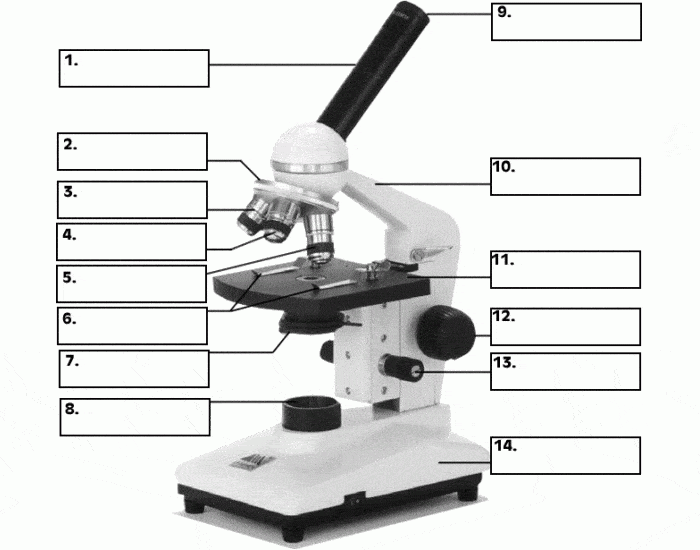
Part 12
a)
Fine Adjustment Knob
b)
Coarse Adjustment Knob
c)
Diaphragm
d)
Objective
22.
Part 13
a)
Fine Adjustment Knob
b)
Course Adjustment Knob
c)
Stage
d)
Diaphragm
23.
English scientist who observed thin slices of dead cork and called the little compartments "cells"
a)
Robert Hooke
b)
Anton van Leeuwenhoek
c)
Theodor Schwann
24.

The scientist who discovered a free living cell for the first time :-

a)

Robert Hooke

b)

Robert Brown

c)

Anton van Leeuwenhoek

d)

Theodor Schwann

25.

These cells have no nucleus

a)

Prokaryotic

b)

Eukaryotic

c)

Both

26.

These cells HAVE a nucleus

a)

Prokaryotic

b)

Eukaryotic

c)

Both

27.
Bacteria is what kind of cell?
a)
Eukaryotic
b)
Prokaryotic
28.
Proteins are produced at which cellular structures?
a)
nuclei
b)
ribosomes
c)
mitochondria
d)
chloroplasts
29.
What organelle helps with cell digestion?
a)
Lysosomes
b)
Ribosomes
c)
Golgi Complex
d)
ER
30.
This is a rigid structure that give plant cell protection support and shape; it is made of cellulose
a)
Cell membrane
b)
Cell wall
c)
Vacuole
d)
Endoplasmic reticulum
31.
Which organelle releases the energy stored inside food
a)
Chloroplast
b)
Mitochondria
c)
Lysosomes
d)
Nucleus
32.

Which statement is part of the cell theory?

a)

All cells come from existing cells

b)

All cells are prokaryotic or eukaryotic

c)

All cells can make a tissue

d)

All cells grow and develop

33.
I store water in both plant and animal cells. What am I?
a)
cytoplasm
b)
ribosomes
c)
vacuole
d)
lysosomes
34.
What does "bilayer" mean?
a)
one layer
b)
two layers
c)
laminated
d)
bilateral
35.
Most of the cell membrane is made of...
a)
Lipids
b)
Carbohydrates
c)
Proteins
d)
Nucleic acids
36.

Which is not a form of passive transport?

a)

Osmosis

b)

Facilitated diffusion

c)

Active transport

d)

Diffusion

37.

Passive transport moves molecules from...

a)

low concentration to high concentration

b)

high concentration to low concentration

38.

Which type of Passive transport uses the help of a transport protein?

a)

Osmosis

b)

Facilitated diffusion

c)

Simple diffusion

39.
Osmosis is the movement of _____ across a membrane.
a)
food
b)
energy
c)
oxygen
d)
water
40.
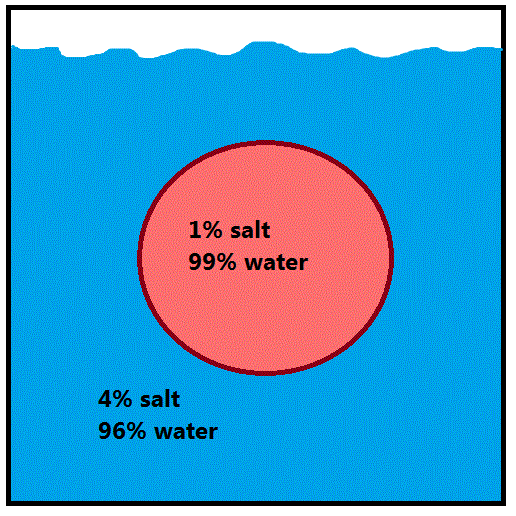
Where will the water go?
a)
Into the cell
b)
Out of the cell
c)
Equally in & out - it's isotonic
d)
There is no water
41.
 An animal cell placed in a hypertonic (salty) solution will
a)
Stay the same
b)
Shrink- get smaller
c)
Swell- get bigger
42.
Why can't you drink salt water?
a)
It's hypertonic to your cells
b)
It's hypotonic to your cells
c)
It's isotonic to your cells
d)
It's paratonic to your cells
43.
Exocytosis is the movement of
a)
any type of substance from outside the cell to the inside of the cell. 
b)
very large substances from outside the cell to the inside of the cell. 
c)
any type of substance from inside the cell to the outside.
d)
very large substances from inside the cell to the outside.
44.

Identify the stage of mitosis.

a)

interphase

b)

prophase

c)

metaphase

d)

anaphase

45.

Identify the stage of the cell cycle.

a)

interphase

b)

metaphase

c)

anaphase

d)

telophase

46.

The correct order of mitosis is...

a)

prophase, metaphase, anaphase, telophase

b)

metaphase, telophase, anaphase, prophase

c)

prophase, metaphase, telophase, anaphase

d)

anaphase, prophase, telophase, metaphase