
 Worksheets
EARTH SCIENCE-FINAL EXAM
Total questions: 61
Worksheet time: 30mins



Students were tasked with making a model of how natural forces can change the surface
features of Earth. They make a pile of sand in front of an electric fan and turn it on. This model best represents which of the following changes to the surface of Earth?
The formation of a delta at the mouth of a river.
The building of a mountain on the edge of a continent.
The movement of dunes caused by the blowing wind.
The creation of a canyon by flowing water.

Stalagmites are structures that form on the floor of some caves. Most scientists explain this by saying that stalagmites form when minerals dissolved in water are left behind where water drips. Which evidence would support this explanation?
Freezing water turns it into a solid.
Water found in caves has minerals in it.
Some stalagmites are taller than others.
Many caves are found deep underground.

Over many years, the depth of a lake gets more shallow. What could cause this change?
The climate in the area gets warmer.
Sediments are deposited in the lake.
The Sun evaporates the water.
A hurricane brings heavy rains.
What is the breakdown of the Earth’s crust into sediment called?
Weathering
Raining
Erosion
Whooshing
What does physical weathering involve?
Water
Wind
Temperature
All of the Above
How long does the weathering process take?
A few days.
No more than a month.
Exactly one year.
Years and Years.
What is it called when weathered rock is carried away?
Weathering
Raining
Erosion
Breaking
Which of these is an example of erosion?
Light shining on a mountain
Wind blowing away sediment.
Rain breaking down rock.
All of the above.
What is a good way to prevent erosion?
Blocking the wind.
Planting trees.
Preventing rainfall.
Preventing the flow of rivers.
1. Where does the oldest layer of a rock is located according to the Principle of Superposition?
bottom
middle
random
top
3. Rock strata can be the most closely correlated if they have contained the same _____.
elements
fossils
shapes
types of rocks
5. If a sandstone in contact with a granite contains fragments of the granite, what can you infer?
The sandstone and granite are the same age.
The granite was intruded into the sandstone.
The sandstone is older than the granite.
The granite is older than the sandstone.
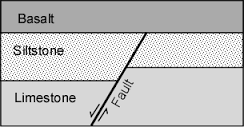
7. Dikes and faults are being used for establishing sequences of events. This activity applies the principle of ___________________.
faunal succession
lateral continuity
original horizontality
superposition

Which of the statement about the age of the fossil is most likely correct based on the diagram?
Fossil A and C are of the same age
Fossils A is older than fossil B
Fossil B is older than fossil C
Fossil D is older than fossil C
Which layer is the youngest?
A
B
C
D
Which of the following stores magma and located in a region just beneath the
crust all the way to the core?
crust
inner core
mantle
outer core
What heat transfer of fluid in the earth’s interior results to the movement of
rocky mantle up to the surface of the earth?
Conduction
Convection
Insolation
Radiation
What is produced by the radioactive decay of isotopes in the mantle and crust?
heat from the sun
primordial heat
radiogenic heat
superheating
Internal heat accumulated by dissipation of planet.
Primordial Heat
Radiogenic Heat
2. What are the two most abundant elements in magma?
A. oxygen and iron
B. oxygen and magnesium
C. silicon and aluminum
D. silicon and oxygen
10. In what part of the earth does magmatism happen?
A. Asthenosphere
B. Earth’s crust
C. Earth’s core
D. Lithosphere
12. Why does radioactive decay play a very important role in earth’s internal heat?
A. Spontaneous nuclear disintegration of radioactive elements produced thermal energy.
B. Radioactive element can be found anywhere in the planet.
C. When radioactive element decays, it produces heat.
D. All of the above


Lichens are -
Specialized plants
Flat, crusty mushrooms
A fungus living together with an algae or a bacteria
The surfaces of old concrete statues are often covered with small holes or pits. Which of these MOST LIKELY causes these holes or pits?
The concrete becomes pitted as water freezes in small cracks in the statue.
The concrete is chemically weathered by acid rain.
The concrete is chipped away by sand particles blown by strong winds
Long exposure to sunlight causes the pits to form.
Which type of climate would cause the greatest rate of weathering?
Cold and dry
Warm and humid (wet)
Cold and humid (wet)
Warm and dry

The diagrams shows a rock with water trapped in the cracks during the day and at night.
Which statement best explains why this process results in weathering?
frozen water acts as a solute
the mass of water increases when it freezes
water expands when it freezes
frozen water dissolves most types of rock
The deepest parts of the ocean are called
trenches
submarine canyons
abyssal plains
continental rise
At the edge of the continental shelf where there is a steep drop off
Abyssal plains
Continental slope
Continental rise
Submarine canyon
Underwater volcanoes taller than 1km
Trenches
Guyot
Seamount
Atoll
Flat-topped underwater mound
Trenches
Guyot
Seamount
Atoll
What is created when two plates move away from each other?
Mid ocean ridge
Trench
Guyot
Abyssal plains

Which part of the ocean floor is shown?
Seamount
Trench
Volcanic Island
Continental margin
In the early 1900’s scientists started using this to get a more accurate map of the ocean floor.
A long pole to feel the bottom
A submarine
Sonar
Scuba
Half-life is a measurement of
fossil age
radioactive breakdown
cold climates
relative age

Which layer is OLDER? Layer M or Intrusion P?
Layer M
Intrusion P

Which layer is OLDER? Intrusion M or Layer D?
Intrusion M
Layer D
By saying "my dad is 48 and I am 13", it would be...
relative dating (time)
absolute dating (time)
law of superposition

Which of the following is the oldest period in the Paleozoic Era?
Cambrian
Ordovician
Silurian
Devonian

Which of the following is the oldest period in the Mesozoic Era?
Silurian
Triassic
Jurassic
Cretaceous

During which period did the first amphibians appear?
Cambrian
Devonian
Silurian
Ordovician

During which period did the first flowering plants (angiosperms) appear?
Triassic
Silurian
Jurassic
Cretaceous

What are your learnings and realizations in this subject?

