wayground logo

Free Printable Worksheets

Font size

S
M
L
XL
Worksheets

Physical Science Practice Final Exam

Total questions: 62

Worksheet time: 2hrs 49mins

Name
Class
Date
1.
Matter changes state when...
a)
energy is added or removed
b)
energy is added
c)
energy is removed
d)
there is no energy
2.
Which is needed for both boiling and melting to occur?
a)
solids
b)
gases
c)
heat
d)
pressure
3.

Which of the following graphs represents pressure versus volume (V) for a real gas at a constant temperature

a)

A

b)

B

c)

C

d)

D

4.

If a hairspray can is heated, what can be expected of the pressure of the gas inside the can?

a)

The pressure will increase

b)

The pressure will decrease

c)

The pressure will remain constant

d)

The pressure will equalize

5.

What type of substance is shown?

a)

compound

b)

heterogeneous mixture

c)

homogeneous mixture

d)

element

6.

What type of mixture is shown?

a)

Homogeneous

b)

Heterogeneous

7.
Place the following scientists in order, from earliest to latest: 
A) Ernest Rutherford
B) J.J. Thomson
C) John Dalton
a)
B,C,A
b)
C,A,B
c)
A,C,B
d)
C,B,A
8.
Rutherford's gold foil experiment provided evidence that...
a)
negative and positive charges are spread evenly throughout the atom.
b)
alpha particles have a positive charge.
c)
gold is not a dense as previously thought.
d)
there is a dense positively charged nucleus at the center of an atom.
9.
The element with the smallest ionization energy in Period 6 is - 
a)
Rn
b)
Cs
c)
Os
d)
Tm
10.
The atom with the largest atomic radius in Period 4 (row 4) is - 
a)
K
b)
Kr
c)
Fe
d)
Fe
11.

Why do elements form bonds?

a)

to get a charge

b)

so they can make friends

c)

to become stable by getting a full valence shell

d)

to become stable by increasing their mass

12.

How many electrons would a Calcium ion gain/lose?

a)

lose 1

b)

gain 1

c)

lose 2

d)

gain 2

13.

What is the chemical formula of sulfur hexabromide?

a)

SBr₆

b)

S₆Br

c)

S(VI)Br

d)

SBr4

14.

Name the ionic compound, CaCO3

a)

calcium carbide

b)

calcium carbon trioxide

c)

calcium carbon oxide

d)

calcium carbonate

15.

Which equation is balanced?

a)

PbO2 + 2H2--> H2SO4

b)

SO2 + H20 --> H2SO4

c)

2Na + 2H2O --> 2NaOH + H2

d)

2Na + 2H2O --> 2NaOH + H

16.

Fill in the blanks with coefficient:

PCl5+_ H2O→_ HCl+H3PO4

a)

4, 5

b)

1, 6

c)

3, 8

d)

2,2

17.
The following is what type of reaction:
NH3 + HCl  → NH4Cl
a)
Synthesis
b)
Decomposition
c)
Single Replacement Replacement
d)
Double Replacement Replacement
18.
The following is what type of reaction:
PbCl2 + AgNO3 → Pb(NO3)2 + AgCl
a)
Synthesis
b)
Decomposition
c)
Single Replacement
d)
Double Replacement
19.
Carrie's teacher hands out test tubes filled with different chemicals and tells the students to identify their liquid as an acid, base, or neutral chemical. Carrie's test tube contains a clear chemical. She adds phenolpthalein to her test tube and gently moves the tube from side to side. A few moments later, the chemical in the test tube turns bright pink.
What type of chemical does Carrie have?
a)
Carrie has a neutral chemical.
b)
Carrie has an acidic chemical.
c)
Carrie has a basic chemical.
d)
The type of chemical Carrie has cannot be determined.
20.
Values from 0-14 that determine the acidity of a solution
a)
Punnett Square
b)
Matrix
c)
pH scale
d)
Math number line 
21.
Which of these is a MAJOR cause of acid rain?
a)
spraying pesticides on crops
b)
burning fossil fuels for energy
c)
dumping sewage in river systems
d)
using uranium to generate electricity
22.

Which is NOT caused by acid rain?

a)

damage to statues

b)

dying fish

c)

spread of disease

d)

weakened trees

23.
Where does fusion occur naturally?
a)
Underwater
b)
All around us
c)
In the radioactive waste
d)
On the sun
24.
The splitting of a nucleus into smaller nuclei is
a)
fusion
b)
fission
c)
half-life
d)
gamma radiation
25.
What is an advantage  of nuclear energy?
a)
radioactive waste
b)
no pollution
c)
we will never run out
d)
it is the safest way to make energy
26.
Nuclear power uses ____ for fuel.
a)
steel
b)
coal
c)
uranium
d)
hydrogen
27.

Isotopes of an element have a different number of...

a)

Protons

b)

Neutrons

c)

Electrons

d)

Mass

28.
How many neutrons does an Iodine-133 isotope have?
a)
80
b)
133
c)
53
d)
77
29.
Is glass breaking a chemical or phyiscal change?
a)
chemical
b)
physical
30.

Which of the following is an indication of chemical change

a)

Melting

b)

Freezing

c)

Burning

d)

Evaporating

31.
You run from your house to a friend's house that is 3 km away. You then walk home. The distance you traveled is 6 km. What is your displacement? 
a)
6  km
b)
0 km
32.
At 60 seconds, how far had this object traveled? 
a)
0 m
b)
10 m
c)
20 m
d)
40 m
33.
A ball is thrown downward from the top of a roof with a speed of 25 m/s. After 2 s, its velocity will be:
a)
19.6 m/s
b)
-5.4 m/s
c)
-44.6 m/s
d)
44.6 m/s
34.
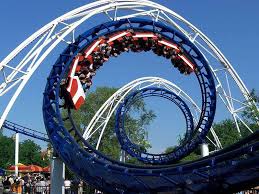
A roller coasters accelerates from an initial velocity of 6.0 m/s to a final velocity of 70 m/s over 4 seconds.  What's the acceleration?
a)
24 m/s2
b)
18 m/s2
c)
16 m/s2
d)
16 m/s
35.
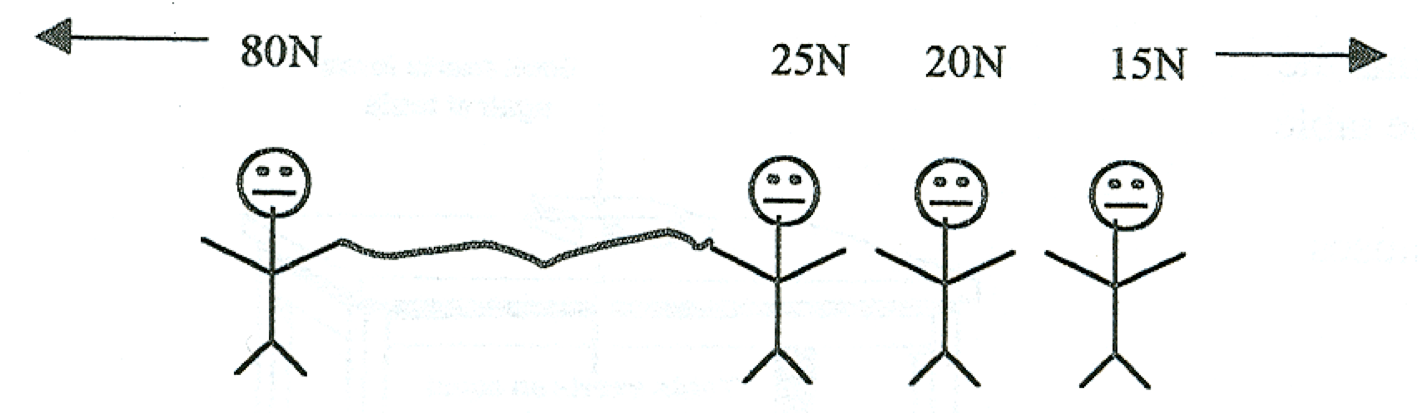
Who wins the tug of war with what net force?
a)
The person on the left with 20 N
b)
The person on the left with 80 N
c)
The people on the right with 20 N
d)
The people on the right with 100 N
36.

A ____________ is a push or a pull on an object.

a)

friction

b)

force

c)

magnet

d)

gravity

37.

How much force is needed to accelerate a 3kg skateboard at 5m/s2.

a)

8N

b)

1.6N

c)

0.6N

d)

15N

38.
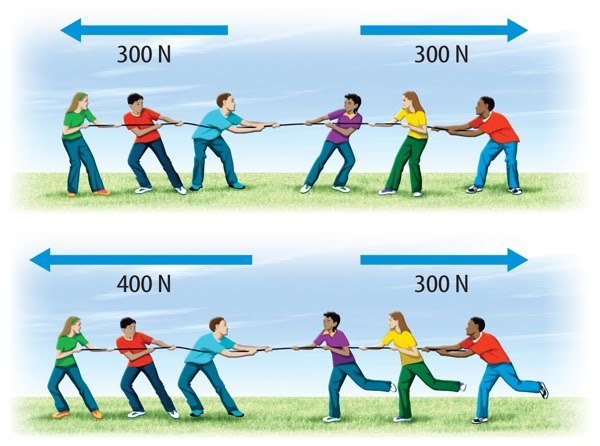
Which one is balanced?
a)
top
b)
bottom
c)
both
39.
What happens to the speed of the wagon as the rain collects inside of it?
a)
it decreases
b)
it remains constant
c)
it increases
40.
Most modern vehicles have padded dashboards. This reduces collision injuries by...
a)
reducing the driver's change in momentum
b)
increasing the driver's change in momentum
c)
increasing the force of impact
d)
increasing the time of impact
41.

What happens when two objects collide?

a)

Energy is changed into force.

b)

Energy is transferred from one object to another.

c)

Energy is created and the objects move faster.

42.

What effects the amount of energy transferred in a collision?

a)

the speed

b)

the weight

c)

the speed AND weight

43.
As mass increases, KE ...
a)
increases
b)
decreases
c)
stays the same
44.
Calculate the kinetic energy of a moving 4 kg object travelling at a velocity of 3 m/s.
a)
18 J
b)
36 J
c)
12 J
d)
6 J
45.
What type of simple machine is shown here?
a)
Pulley
b)
Wheel and Axle
c)
Lever
d)
Wedge
46.

The ______________ is a flat surface that is raised so one end is higher than the other.

a)

inclined plane

b)

lever

c)

pulley

d)

wedge

47.

A box of weight W is lifted by a force F using a lever as shown below.

What is the mechanical advantage of the lever (MA=Input Distance/Output Distance)?

a)

0.5

b)

2

c)

3

d)

6

48.
Which situation is work not done?
a)
lifting a 20 pound box off the floor
b)
holding a 20 pound box above the floor
c)
sliding a 20 pound box across the floor
d)
sliding a 20 pound box up an inclined plane
49.
The efficiency of a machine can be increased by reducing __________________________. 
a)
effort
b)
resistance friction
c)
fulcrum
d)
friction
50.

A machine is any object that we use to perform a task...

a)

... with less effort or more speed.

b)

... with more speed.

c)

... in a natural way.

d)

... more effort.

51.

Scissors are an example of which simple machine?

a)

screw

b)

pulley

c)

inclined plane

d)

lever

52.
what is radiation?
a)
direct touch
b)
air or liquids
c)
heat waves/ light waves
d)
touching the cookies out of the oven
53.

Hot things have ____________ thermal energy than cold things

a)

more

b)

less

c)

same

d)

potato

54.
When does a chemical reaction stop?
a)
When the lab is finished
b)
When the excess reactant is used up
c)
When the limiting reactant is used up
d)
Chemical reactions never stop
55.
The reactants are on the left side of the chemical equation.
a)
True
b)
False
56.

A wave in which the movement of the wave’s medium is perpendicular to the movement of the wave traveling through the medium

a)

Transverse waves

b)

Compression waves

c)

Nodular Waves

d)

Ocean Waves

57.

A wave in which the wave’s medium is compressed in the same direction as the movement of the wave

a)

Transversal wave

b)

Transverse wave

c)

Frequency wave

d)

compression wave

58.

All Waves

a)

Have troughs and nodes

b)

Move back and forth

c)

Transfer energy

d)

are big

59.

The highest point on a transverse wave is the

a)

compression

b)

crest

c)

rest position

d)

trough

60.

The number of waves that pass somewhere in a second is:

a)

amplitude

b)

frequency

c)

wavelength

61.
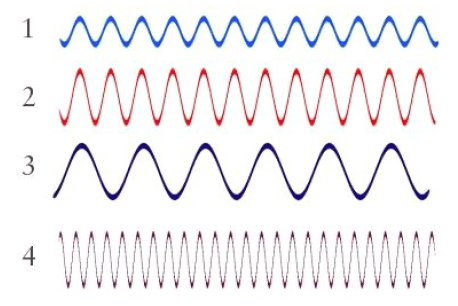
Which wave in the diagram has the greatest wavelength?
a)
1
b)
2
c)
3
d)
4
62.
One end of the rope is vibrated to produce a wave with a wavelength of .25 m.  The Frequency of the wave is 3.0 Hz.  What is the speed of the wave?
a)
3.00 m/s
b)
2.50 m/s
c)
.75 m/s
d)
1.25 m/s