wayground logo

Free Printable Worksheets

Font size

S
M
L
XL
Worksheets

CSI 1st Semester Final Review Study Guide

Total questions: 98

Worksheet time: 1hrs 12mins

Name
Class
Date
1.

Physical evidence found in small, measurable amounts

a)

trace evidence

b)

biological evidence

c)

primary evidence

d)

secondary evidence

2.

What pattern of fingerprint is shown?

a)

Loop

b)

Arch

c)

Whorl

3.
Which type of fingerprint is shown in the image below?
a)
arch
b)
whorl
c)
loop
d)
none of these
4.

Identify the fingerprint pattern shown.

a)

loop

b)

arch

c)

whorl

5.
A footprint is left in dust at a crime scene and was only found due to electrostatic lifting.  What type of impression is this?
a)
Patent
b)
Latent
c)
Plastic
d)
Lasting
6.
A tire track is left sunk into the mud.  What type of impression is this?
a)
Patent
b)
Latent
c)
Plastic
d)
Lasting
7.
Forensic dentistry involves the study of teeth with the intention of providing facts to be used as evidence in court. What is another name for this field of study?
a)
forensic anthropology
b)
forensic odontology
c)
forensic palynology
d)
forensic entomology
8.
Entomologists studies _______
a)
fossils
b)
insects
c)
animals
d)
plants
9.

The application of a broad range of sciences to answer legal questions

a)

Health Science

b)

Biology

c)

Physical Science

d)

Forensic Science

10.
Use dental marks for identification of corpses
a)
Entomology
b)
Odontology
c)
Biology
d)
Criminalistics
11.
Use insects to determine time and location of death
a)
Psychology
b)
Toxicology
c)
Pathology
d)
Entomology
12.

A specialized examiner of human skeletal remains for law enforcement.

(They help with the recovery of the remains, identifying the remains, interpreting trauma, and estimating the time of death.)

a)

forensics

b)

forensic anthropologist

c)

crime scene

d)

approach the scene

e)

autopsy

13.

The place where something unlawful happened and where forensic evidence can be gathered.

a)

secure and protect the scene

b)

initiate preliminary survey

c)

prepare a narrative of the scene

d)

crime scene

14.

A specialized surgical procedure that is used to determine the cause and manner of death.

a)

forensics

b)

forensic anthropologist

c)

crime scene

d)

approach the scene

e)

autopsy

15.
How many categories of finger prints are there?
a)
1
b)
2
c)
3
d)
4
16.
Not everyone's fingerprints are unique?
a)
True
b)
False
17.
Dactyloscopy is the study of fingerprint investigation.
a)
True
b)
False
18.
The ridges on your finger tips stay the same throughout your life?
a)
True
b)
False
19.
this is a concentric pattern. The pattern is slanted towards the radial bone, the thick bone on the thumb side of the hand. 
a)
radial loop
b)
ulnar loop
c)
double loop
d)
plain whorl
20.
this the most common pattern and is made up of ridges that resemble hairpins or staples. It slants towards the small bone of the arm, the ulna, on the same side as the little finger. 
a)
radial loop
b)
ulnar loop
c)
central pocket
d)
plain whorl
21.
65% of the population has this type of pattern
a)
loops
b)
whorls
c)
arches
d)
ripples
22.
30% of the population has this type of pattern
a)
loops
b)
whorls
c)
arches
d)
ripples
23.
5% of the population has this type of pattern
a)
loops
b)
whorls
c)
arches
d)
ripples
24.
right hand
a)
accidental whorl
b)
double loop
c)
tented arch
d)
plain arch
25.
right hand
a)
accidental whorl
b)
double loop
c)
tented arch
d)
plain arch
26.
right hand
a)
accidental whorl
b)
double loop
c)
ying-yang 
d)
plain whorl
27.
right hand
a)
accidental whorl
b)
central pocket 
c)
plain whorl
d)
teneted arch
28.
right hand
a)
accidental whorl
b)
central pocket 
c)
plain whorl
d)
teneted arch
29.
right hand
a)
radial loop
b)
plain whorl
c)
accidental loop
d)
ulnar loop
30.
right hand
a)
radial loop
b)
plain whorl
c)
accidental loop
d)
ulnar loop
31.
right hand
a)
plain arch
b)
tented arch
c)
double arch
d)
accidental loop
32.
prints left in a medium, such as wax or clay.
a)
latent
b)
impressionist
c)
patent
d)
plastic
33.

The person who documents the scene and collects evidence:

a)

Crime Scene Investigator (CSI)

b)

District Attorney

c)

medical examiner

d)

detective

34.

The person who determines the preliminary cause of death, and helps establish a timeline:

a)

Crime Scene Investigator (CSI)

b)

District Attorney

c)

Medical Examiner

d)

Detective

35.
Blood-stained materials should be store in what type of container
a)
paper bags
b)
air-tight new paint can
c)
mason jar with a lid
d)
plastic bag with a seal
36.
"With contact between two items, there will be an exchange." This is known as _____
a)
physical evdience
b)
Locard's exchange principle
c)
Forensic exchange principle
d)
the law of forensics 
37.
Correct collection of evidence requires which of the following?
a)
documenting the location where the evidence was found
b)
correct packaging of evidence
c)
maintaining proper chain of custody
d)
all of the above
38.

What is the most common type of fingerprint? (65%)

a)

Arch

b)

Loop

c)

Whorl

39.

Which type of fingerprint can be seen by the naked eye?

a)

patent fingerprint

b)

latent fingerprint

c)

visible fingerprint

40.
What type of fingerprint is this? It is made in a soft medium.
a)
plastic
b)
patent
c)
latent
d)
visible
41.

Which LAYER of the skin is responsible for making the ridges that form fingerprints?

a)

Dermis

b)

Epidermis

c)

Papillae

d)

Sebaceous Gland

42.
material that can be related to a single source
a)
individual evidence
b)
control evidence
c)
trace evidence
43.
Evidence that (if true) proves an alleged fact, such as an eyewitness account of a crime
a)
circumstantial
b)
direct
c)
class evidence
d)
trace evidence
44.

A folded paper used to hold trace evidence

a)

envelope

b)

baggie

c)

bindle

d)

chain of custody

45.

evidence used to imply a fact bust not prove it directly.

a)

individual evidence

b)

circumstantial evidence

c)

trace evidence

d)

direct evidence

46.

a location other than the primary crime scene, but that is in someway related to the crime, where evidence is found

a)

original crime scene

b)

primary crime scene

c)

secondary crime scene

47.

The location where the crime took place

a)

secondary crime scene

b)

original crime scene

c)

primary crime scene

48.

small but measurable amounts of physical or biological material found at a crime scene

a)

individual evidence

b)

class evidence

c)

direct evidence

d)

trace evidence

49.

material that connects an individual or thing to a certain group

a)

trace evidence

b)

class evidence

c)

individual evidence

d)

direct evidence

50.

An opinion is something that can be proven.

a)

True

b)

False

51.

Eyewitness accounts vary from person to person and may be inaccurate.

a)

True

b)

False

52.

Broken glass is considered to be (a)   (physical or biological) evidence.

53.

What size of search is the Spiral Search most effective in?

a)

small area

b)

large area

54.

Biological evidence is used in forensics for DNA identification purposes. Biological evidence includes ...

a)

blood

b)

saliva

c)

urine

d)

all of these

55.
Which of the following is a part of the 3 facets of guilt?
a)
Means
b)
Mode
c)
Opportunity
d)
All of these
56.

Which of the following is an example of testimonial evidence?

a)

A witness statement

b)

DNA samples

c)

A weapon

d)

Footprints

57.

Which of the following is an example of physical evidence?

a)

Witness Statement

b)

Testimony given in court

c)

Footprints

d)

Small glass fragments

58.

A list if all people who came into contact with an item of evidence.

a)

detectives

b)

chain of custody

c)

log

d)

evidence counter

59.
The ability to establish the exact whereabouts of an item of evidence and under whose control it was from its collection at the crime scene to its presentation in the courtroom and everywhere in between is called
a)
chain of command
b)
record of evidence
c)
chain of custody
60.

Which came first?


Arraignment. Hearing. Arrest. Indictment.

a)

Arrest

b)

Arraignmnet

c)

Hearing

d)

Indictment

61.

An eyewitness statement is an example of

a)

direct evidence

b)

circumstantial evidence

62.
AFIS is a(n): 
a)
method used to determine the age of latent print
b)
computer software designed to track fingerprint evidence within the chain of custody
c)
assay technique used to identify drugs
d)
computerized system for storing and retrieving fingerprint records
63.
The tiny details in fingerprints used to match one fingerprint to another are called
a)
ridges
b)
hills
c)
match points
d)
minutiae
64.
Fingerprints are left behind by: 
a)
Oil and Sweat on our fingers
b)
By the softness of the things we touch
c)
Always left Invisibly 
d)
Only on the paper we touch
65.

What is the first step in processing a crime scene?

a)

Photography

b)

Collecting evidence

c)

Sketching

d)

Securing the perimeter (safety of first responder and victims)

66.
Which of the following does NOT need to be included in a crime scene sketch?
a)
A scale of distance
b)
Date and location of crime scene
c)
A north heading
d)
A record of everyone at the crime scene
67.
What type of search pattern is shown?
a)
Grid
b)
Quadrant
c)
Spiral
d)
Linear
68.
What type of search pattern is shown?
a)
Grid
b)
Quadrant
c)
Spiral
d)
Linear
69.

Who considered to be the father of modern forensic science?

a)

James Marsh

b)

Edmond Locard

c)

Sherlock Holmes

d)

Anthony Browning

70.

Which of the following categories of the crime is the most severe?

a)

infraction

b)

misdemeanor

c)

felony

71.

A personal judgment based on past experiences or personal beliefs.

a)

bias

b)

observation

c)

objective thinking

d)

investigation

72.

When an investigator documents a crime scene, what should they include? Choose the answer with the 4 correct answers

a)

Videography, tape recording, photography, Notes

b)

Tape recording, Videography, Sketch, Photography

c)

Photography, Notes, Videography, Sketch

d)

Detailed account, Photography, Videography, sketch

73.

Describe the line search pattern...

a)

Best in large outdoor scenes

b)

May move inward or outward, best to use when there are no physical barriers

c)

Best for small indoor spaces

d)

Most effective in houses with large spaces

74.
 What is one of the best kinds of searches for detailed searching of large areas, and can be modified depending on the number of searchers and the area covered? When done correctly each area will be searched twice. 
a)
a) Strip Method
b)
b) Spiral Method
c)
c) Wheel Method 
d)
 d) Grid Method
75.

Where can evidence be found?

a)

a) At the points of entry or exit

b)

b) On the ground

c)

c) On clothing

d)

d) All of the above

76.
What pattern is this?
a)
Tented Arch
b)
Plain Arch
c)
Loop
d)
Whorl
77.

One of more ridges entering from one side of the print and recurving and exiting from the same side are known as:

a)

Arches

b)

Loops

c)

Whorls

d)

Central Pocket Whorls

78.
Name this minutiae type
a)
Enclosure
b)
Island (pick me! pick me! you know you want to)
c)
Bifurcation (fork) 
d)
Ridge ending 
79.

What are the red triangles?

a)

deltas

b)

useless

c)

forks

d)

loops

80.
Name this minutiae type
a)
Sludge
b)
Island (dot) 
c)
Bifurcation (fork) 
d)
Pore
81.
Name this minutiae type
a)
Delta
b)
Core
c)
Enclosure (eye) 
d)
Hook (spur)
82.
Minutiae type?
a)
Short ridge
b)
Bifurcation
c)
Hook
d)
Delta
83.

Identify circle 3

a)

bifurcation

b)

ridge ending

c)

spur

d)

lake

84.

Identify circle 6

a)

lake

b)

bridge

c)

bifurcation

d)

spur

85.

Identify circle 5

a)

Short Ridge

b)

Bridge

c)

Ridge Ending

d)

Spur

86.

Identify circle 2

a)

dot

b)

Spur

c)

Bifurcation

d)

Bridge

87.

Identify circle 3

a)

Ridge ending

b)

Bridge

c)

Dot

d)

Bifurcation

88.
The area indicated by "A" in the diagram is known as a 
a)
Core
b)
Delta
c)
Whorl
d)
Arch
89.

Which type of fingerprint cannot be seen the naked eye?

a)

Patent fingerprint

b)

Latent fingerprint

c)

Visible fingerprint

d)

Plastic fingerprint

90.

Which one of the following is a visible print?

a)
b)
c)
91.
Minutiae type?
a)
Bifurcation
b)
Bridge
c)
Delta
d)
Hook
92.
The picture is for the minutiae _______.
a)
ridge ending
b)
bifurcation
c)
delta
d)
island
93.
A person thought to be guilty of a crime or offense
a)
victim
b)
officer
c)
suspect
d)
bad guy
94.
Where do we read the level of liquid?
a)
The highest point the liquid touches
b)
The bottom of the meniscus
c)
Half way between, we make an educated guess and round it
d)
Somewhere about there
95.
What is the volume of the liquid in this graduated cylinder?
a)
19 mL 
b)
35 mL 
c)
24 mL 
d)
1.9 mL
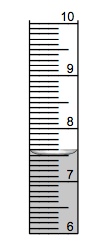
96.
What is the volume of the liquid in this graduated cylinder?
a)
8.5 mL 
b)
7.5 mL 
c)
8 mL 
d)
.1 mL
97.
What is the volume of the liquid in the cylinder?
a)
20.5 mL
b)
25 mL
c)
22 mL
d)
20.4 mL
98.
What is the volume of the liquid in the cylinder?
a)
9 mL
b)
10 mL
c)
8 mL
d)
6 mL