Wayground logo

Free Printable Worksheets

Font size

S
M
L
XL
Worksheets

Taxonomy Practice Questions

Total questions: 53

Worksheet time: 2hrs 46mins

Name
Class
Date
1.
The scientific name for an organism is made from the:
a)
class and family name
b)
genus and species name
c)
domain and kingdom name
d)
kingdom and phylum name
2.
An illustration and a dichotomous key are given. What is the correct classification for this organism?
a)
Class Insecta
b)
Order Amblygygi
c)
Order Araneae
d)
Order Scorpiones
3.
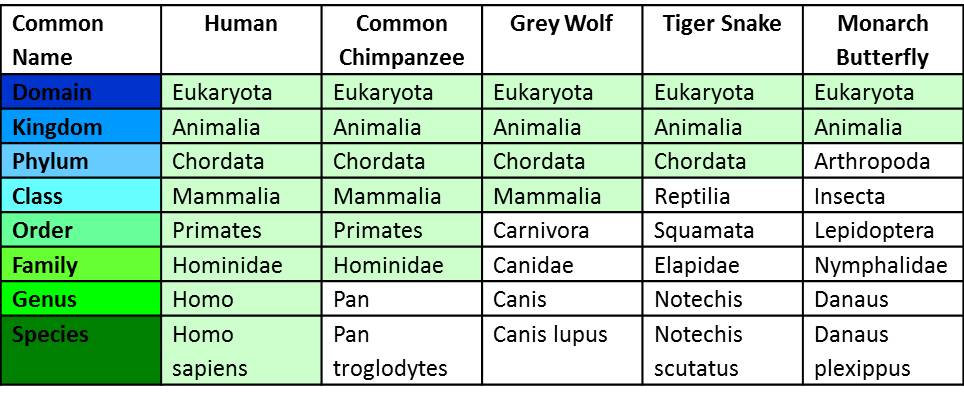
Which organism in the table shown is most closely related to the common dolphin?
a)
human
b)
killer whale
c)
giant kelp
d)
bat star
4.
Which organism in the table is least closely related to the chimpanzee?
a)
human
b)
grey wolf
c)
tiger snake
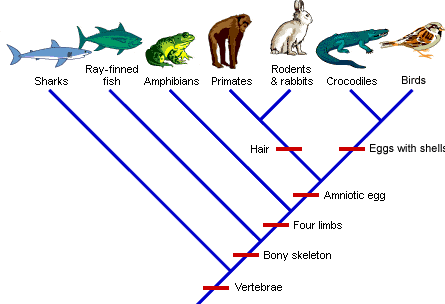
d)
monarch butterfly
5.

Unicellular, prokaryotic organisms that live in extreme environments, describes...

a)

Animal

b)

Archaea

c)

Bacteria

d)

Plant

6.

I'm motile and have no cell walls. What am I?

a)

Animal

b)

Archaea

c)

Bacteria

d)

Plant

7.
The science of describing, classifying, and naming living things is called:
a)
Geology
b)
Biology
c)
Taxonomy
d)
Chemistry
8.
The 8 levels of classification, broadest to most specific.
a)
Domain, Genus, Family, Order, Class, Phylum, Kingdom, Species
b)
Domain, Species, Kingdom, Genus, Phylum, Family, Class, Order
c)
Domain, Kingdom, Phylum, Class, Order, Family, Genus, Species
d)
Order, Kingdom, Species, Domain, Phylum, Family, Class, Genus
9.
An example of an unicellular organism would be:
a)
monkey
b)
bacteria
c)
spider
d)
human
10.

This organism are sometimes multicellular, heterotroph, that has a cell wall made of chitin. What kingdom does it belong in?

a)

fungi

b)

plantae

c)

animalia

d)

eubacteria

11.
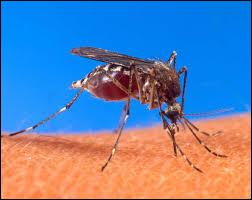
Mosquitos belongs to what kingdom?
a)
Animal Kingdom
b)
Plant Kingdom
c)
Fungi Kingdom
d)
Protista Kingdom
12.
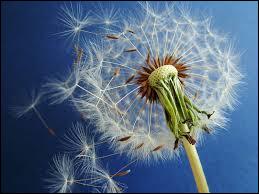
Dandelion, what kingdom does it belongs to?
a)
Plant Kingdom
b)
Animal Kingdom
c)
Fungi Kingdom
d)
Protista Kingdom
13.

Which organisms are most closely related?

a)

Equus caballas (Horse) & Equus burchellii (Zebra)

b)

Cyanea artica (Jellyfish) &

Ctenodiscus crispatus (Mud Starfish)

c)

Naja naja (cobra) & Glycine max (soya bean)

d)

Ophiocomina nigra (black brittle star) & Brassica nigra (black mustard)

14.

Organisms in this smallest taxonomic group share many characteristics.

a)

domain

b)

kingdom

c)

species

d)

class

15.

Which 2 organisms would be able to reproduce and produce fertile offspring?

a)

2 organisms in the same class

b)

2 organisms in the same family

c)

2 organisms in the same genus

d)

2 organisms in the same species

16.

Which of the following scientific names is written correctly? Assume all are in italics!

a)

Homo Sapien

b)

Homo sapien

c)

homo sapien

d)

Homosapien

17.
Which of the following organisms are LEAST closely related?
a)
organisms that share a domain
b)
organisms that share a family 
c)
organisms that share a genus 
d)
organisms that share a species 
18.
Term given to describe the 2 name naming system is:
a)
dichotmous key
b)
binomial nomenclature
c)
2 scientific names
d)
binomial key
19.
Cells that do not have a true nucleus are called....
a)
eukaryote
b)
prokaryote
c)
unicellular
d)
multicellular
20.
Cells that have a true nucleus are called....
a)
eukaryotes
b)
prokaryotes
c)
unicellular
d)
multicellular
21.
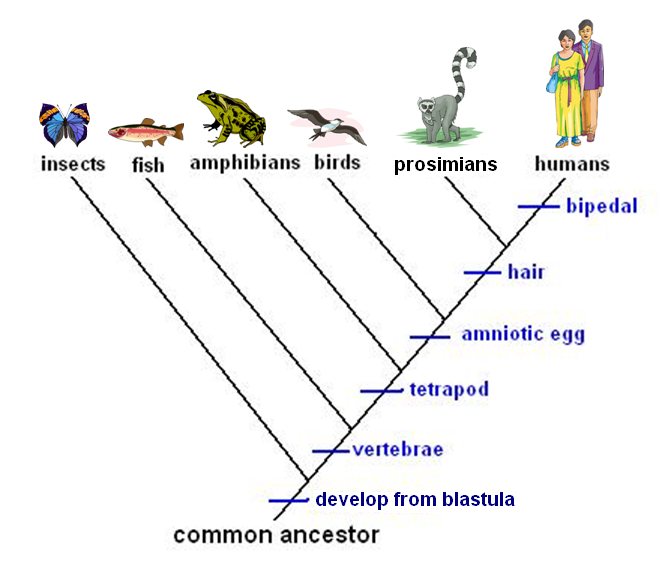
Which organisms pictured on the cladogram have hair?
a)
prosimians only
b)
prosimians and humans
c)
humans only
d)
prosimians and birds
22.

Which is the correct order?

a)

Kingdom Phylum Order Class

b)

Class Order Family Genus

c)

Domain Phylum Kingdom Species

d)

Order Family Species Genus

23.

You identify a small living organism that is eating something at your feet. It's visible but pretty tiny, you take it to a lab and find that it has cell walls made of chitin. Which is its domain and kingdom?

a)

Prokaryote, Fungi

b)

Eukaryote, Fungi

c)

Prokaryote, Plant

d)

Eukaryote, Plant

24.

How are mammals different from all the other classes of vertebrates?

a)

They don't have keratin

b)

They don't have a backbone

c)

They don't lay eggs (except two)

d)

They aren't animals

25.

Which best explains why a sponge is an animal?

a)
b)

All animals breath and sponges breath

c)

Animals live underwater and so do sponges

d)

Animals are multicellular heterotrophs and so are sponges

26.
A heterotroph means?
a)
feeds itself
b)
feeds on other organisms
c)
2 word name
d)
8 legged
27.
Which term means "True Nucleus" or cell(s) with a nucleus?
a)
Eukaryotes
b)
Prokaryotes
c)
Multi-cellular
28.
The 2 kingdoms that make up Prokaryotes are?
a)
Animals and Plants 
b)
Protists and Fungi
c)
Archea and Bacteria
29.
Mushrooms are an example of this Kingdom?
a)
Animalia
b)
Protista 
c)
Archea 
d)
Fungi
30.
Kingdom, Phylum, Class, _______
a)
Family 
b)
Order
c)
Genus 
d)
Species
31.
Our fish is ......
a)
An animal and a Heterotroph
b)
An animal and an Autotroph
c)
A bacteria and multicellular
32.
A tool used by a taxonomist to identify an unknown organism is known as a __________.
a)
dichotomous key
b)
binomial nomenclature
c)
scientific name
d)
binomial key
33.
Which of the following is not true when comparing scientific and common names?
a)
Scientific names vary from place to place.
b)
Common names can vary from place to place.
c)
Scientific names are written in Latin.
d)
Common names can inaccurately describe the organism and be confusing.
34.
The taxon with the largest amount of organisms grouped together...
a)
Species
b)
Phylum
c)
Kingdom
d)
Domain
35.
A student discovers an arachnid with a segmented abdomen, long legs, and a tail with no stinger. The student uses the dichotomous key below to identify it. Which arachnid has the student found?
a)
Whip Scorpion
b)
Wind Scorpion
c)
Daddy long legs
d)
Scorpion
36.
What is the most primitive organism shown on the cladogram?
a)
chimp
b)
perch
c)
hagfish
d)
salamander
37.
Vertebrates can be classified in......
a)
5 groups: Mammals, Birds, Fish, Reptiles and Amphibians
b)
5 Groups: Dogs, Birds, Fish, Reptiles, and Amphibians
c)
4 Groups: Mammals, Birds, Fish and Ampbibians
38.
Vertebrate have:
a)
Fur and Gills
b)
Cold-Blood
c)
A spine and an internal skeleton
39.
A table of arachnid and insect characteristics is shown. Which characteristic could be used to distinguish between
arachnids and insects?
a)
Jointed legs
b)
Body segments
c)
Presence of eyes
d)
Presence of antennae
40.
A botanist discovers a new plant in the jungle. Which of the
following observations of the plant’s characteristics would be useful in determining its identity with a dichotomous key?
a)
It was discovered in the summertime
b)
It is wet from a recent rain storm.
c)
Its leaves curl up on the edges.
d)
It is eaten by native jungle ants.
41.
A dichotomous key for trees is provided. Hikers found a tree that has large brown cones and single sharp needles. What species of tree have the hikers found?
a)
Juniper
b)
Pine
c)
Spruce
d)
Fir
42.
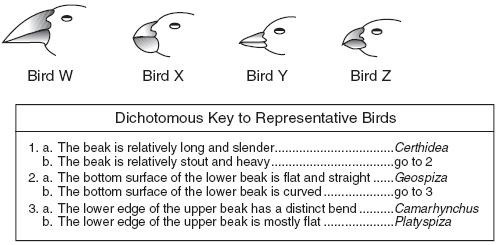
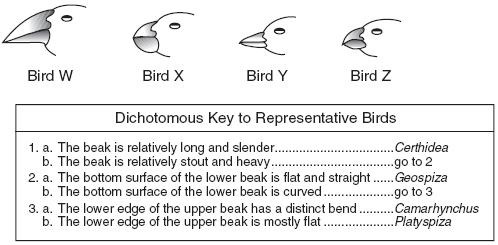
What is the name of bird W?
a)
Certhidea
b)
Geospiza
c)
Camarhynchus
d)
Platyspiza
43.
What is the name of bird Z?
a)
Certhidea
b)
Geospiza
c)
Camarhynchus
d)
Platyspiza
44.
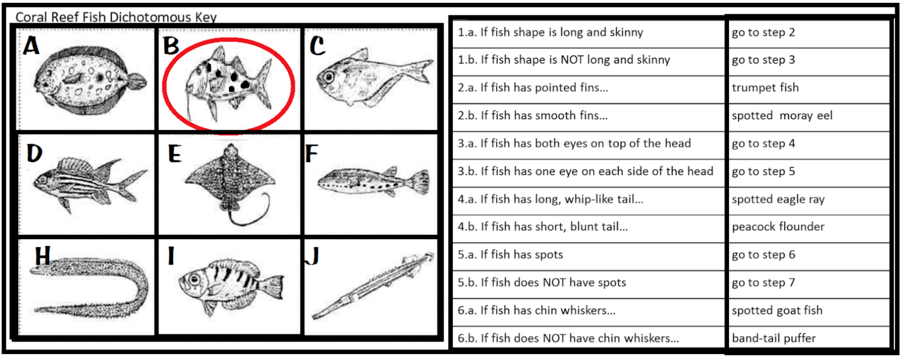
Using this dichotomous key, identify the name of the circled Fish, J.
a)
peacock flounder
b)
band-tail puffer
c)
trumpet fish
d)
spotted goat fish
45.
Using this dichotomous key, identity the name of the circled fish.
a)
band-tail puffer
b)
spotted goat fish
c)
peacock flounder
d)
trumpet fish
46.
A dichotomous key for insects is given. To what order does an insect with two pairs of scaly wings belong?
a)
Coleoptera
b)
Heteroptera
c)
Diptera
d)
Lepidoptera
47.

What is the genus name here:

Canis lupus

a)

Canis

b)

lupus

48.

Which term describes an animal without a

backbone?

a)

chordate

b)

invertebrate

c)

protozoan

d)

vertebrate

49.

Identify leaf F

a)

Cydonia

b)

Magnolia

c)

Aesculus

d)

Fraxinus

e)

Ilex

50.
The three Domains are:
a)
Plant, Animal, Bacteria
b)
Bacteria, Archaea, Eukarya
c)
Fungi, Animal, Plant
d)
Invertebrates, Vertebrates, Plants
51.
Which organisms are closely related? 
a)
American badger and leopard
b)
coyote and gray wolf
c)
european otter and leopard
d)
coyote and american badger
52.
According to this cladogram, sharks are MOST closely related to which organism? 
a)
Amphibians
b)
Ray finned fish
c)
Crocodiles
d)
Birds
53.

Are humans related to tuna?

a)

yes

b)

no