
NEW
Font size
 Worksheets
Chemistry 1st Semester Review Units 4-6
Total questions: 69
Worksheet time: 46mins
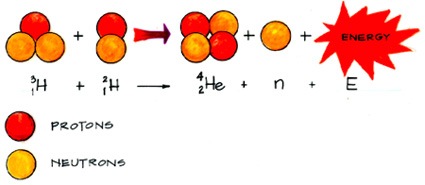



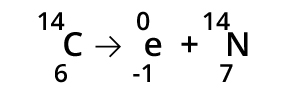
What % of the parent isotope remains after 2 Half Lives?
50%
25%
12.5%
6.25%
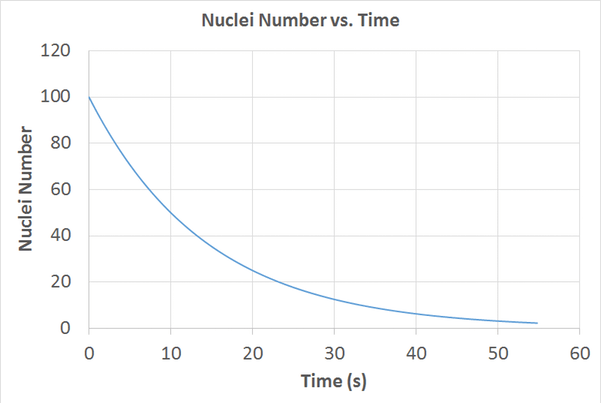
What is the Half life of this isotope?
5 seconds
10 seconds
15 seconds
20 seconds
Which of the following are imporant uses of nuclear technology at this time?
Produce Electricity
Medical Treatments
Military Uses
All of the above
Which of the following is not an important consideration when trying to find a location to store nuclear waste?
The area is very dry
The area is far from where people live
The area should be at the bottom of the ocean
The area must be geologically stable
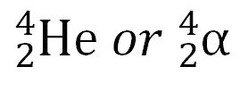
Which particle is missing in this equation:
23994Pu ==> 42He + ____
24396Cm
23592U
0-1e-
23995Am
Light is emitted when electrons
move from one atom to another.
collide with one another, releasing energy.
move from a lower energy level to a higher energy level.
move from a higher energy level to a lower energy level.
Flame tests can be used to identify an element. Each element emits characteristic waves of light when it is heated in a flame. What describes how the light is produced?
Protons in the ground state lose energy and give off light.
Protons in the ground state gain energy and are emitted from the nucleus, giving off light.
Electrons in the ground state lose energy and move to an excited state, giving off light.
Electrons in the ground state gain energy, move to an excited state, and give off light when they return to the ground state.
The atomic number of aluminum is 13. What is the correct designation of the electron configuration of aluminum?
1s21p62s22p1
1s22s22p63s3
1s22s22p62d3
1s22s22p63s23p1
What atom matches this electron configuration?
1s22s22p63s23p64s23d10
Zinc
Copper
Nickel
Germanium
What element has the following electron configuration? [Ar] 4s23d104p3

What type of orbital does this image represent?
S
P
D
F

What type of orbital does this image represent?
S
P
D
F

Which area on this periodic table represents the D sublevel?
A
B
C
D
Which area on this periodic table represents the P sublevel?
A
B
C
D
Which area on this periodic table represents the S sublevel?
A
B
C
D


Which of the following is written correctly?
A
B
C
D
Which shows the correct orbital diagram for Cobalt?


What element's orbital notation is pictured here?
Ar
Br
Cu
Cl
What is the octet rule?
Elements can only have 8 electrons in its outermost shell
The elements must form an octopus like structure
How would you draw a Lewis dot diagram for Magnesium?


How many valence electrons does Tin (Sn) have?
8
7
5
4

This is a correct dot diagram for neon (Ne)
true
false


Which term best describes the behavior of electrons?
Waves
Particles
Both waves and particles
Atoms of elements that are in the same group have the same number of
protons.
neutrons.
valence electrons.
protons and neutrons.
Which of the following elements is an alkali metal?
calcium
magnesium
mercury
sodium
How was Mendeleev's periodic table arranged?
by increasing atomic mass
by decreasing atomic mass
by increasing atomic number
by decreasing atomic number
Each column of the periodic table is
an element.
a group.
an isotope.
a period.
Elements in an elemental family have similar
atomic symbols.
atomic sizes.
atomic weights.
chemical properties.
The order of elements in the modern periodic table is based on an element's
atomic number.
name.
chemical symbol.
atomic mass.
Which statement about the alkali metals is correct?
They are located in the left-most column of the periodic table.
They are extremely nonreactive.
They are usually gases.
They form negative ions with a 1- charge.
Metals tend to be
gases.
dull.
brittle.
good conductors.
Which group is very stable due to the fact that they have a full outermost energy level?
alkali metals
halogens
alkaline-earth metals
noble gases
Which of the following is a property of group 18 elements?
malleable
brittleness
high electrical conductivity
unlikely to react with other elements
Based on its location on the periodic table, which of these elements most likely has physical and chemical properties most similar to boron (B)?
magnesium (Mg)
aluminum (Al)
neon (Ne)
chlorine (Cl)
Which of the following groups on the Periodic Table is likely to form positively charged ions (or cations)?
group 1
group 14
group 17
group 18
Which of the following elements would most likely be a shiny, gray-colored solid at room temperature, conduct electricity, and dent when hit with a hammer?
argon (Ar)
chlorine (Cl)
sulfur (S)
aluminum (Al)
Alkali metals are extremely reactive because they
have every small atomic masses.
are not solid at room temperature.
have one valence electron that is easily removed to form a positive ion.
have two valence electrons that form compounds with calcium and magnesium.
Which scientist is given credit for the arrangement of elements on the modern periodic table?
Moseley
Mendeleev
Bohr
Rutherford

In the image, which column are the halogens located?
A
B
C
D
In the image, which column are the alkali metals located?
A
B
C
D
In the image, which column are the noble gases located?
A
B
C
D
In the image, which column are the alkaline Earth metals located?
A
B
C
D
What is the name of the group of elements which are not pictured in the image?
Metalloids
Transition Metals
Chalcogens
Carbonates
Which column represents elements whose electron configuration ends with s2?
A
B
C
D
Reactivity in a group will generally decrease as you go down a group?
True
False
The electronegativity of halogens is higher than transition metals?
True
False
A sodium ion is smaller than a sodium atom?
True
False

Which diagram correctly shows the trend for electronegativity?
A
B
C
D
Which diagram correctly shows the trend for atomic radius?
A
B
C
D

