wayground logo

Free Printable Worksheets

Font size

S
M
L
XL
Worksheets

Savvas Unit 2 Test Study Deck

Total questions: 80

Worksheet time: 57mins
Name
Class
Date
1.
What type of clouds are called "fair weather clouds" and look like floating cotton?
a)
Cumulus
b)
Stratus
c)
Nimbus
d)
Cumulonimbus
2.
Are stratus clouds or cirrus clouds found closer to the ground?
a)
Cirrus
b)
Stratus
3.
Name the two types of low level clouds
a)
Altostratus and Altocumulus
b)
Cirrus and Cumulus
c)
Cirrocumulus and Cumulonimbus
d)
Stratus and Nimbostratus
4.
This type of cloud is thin, wispy, and made of ice crystals
a)
cumulus cloud
b)
stratus cloud
c)
cirrus cloud
d)
cumulonimbus cloud
5.

Which type of cloud is white and puffy?

a)

cumulus

b)

cirrus

c)

stratus

d)

cumulonimbus

6.

Clouds form during the process of...

a)

evaporation

b)

condensation

c)

precipitation

d)

runoff

7.

Which type of cloud is highest in the sky?

a)

Cirrus

b)

Cumulus

c)

Stratus

8.

Which type of cloud is lowest in the sky?

a)

Cirrus

b)

Cumulus

c)

Stratus

9.

Which statement about clouds is true?

a)

Cumulus clouds mean a change of weather is coming in the next 24 hours.

b)

There is only one kind of cloud in the sky at a time.

c)

Fog is not a cloud.

d)

Cirrus clouds are the highest in the sky.

10.

Which term best describes water vapor?

a)

Solid

b)

Liquid

c)

Gas

11.

What are clouds made out of?

a)

Molecules of pure oxygen

b)

ozone and carbon dioxide

c)

water droplets, dust, and smoke particles

d)

78% nitrogen, 21% oxygen, and 1% other gases

12.

Cirrus is Latin for

a)

ice crystal

b)

water droplet

c)

curl-like

d)

heaps

13.

Clouds are classified by altitude and precipitation types.

a)

True

b)

False

14.

That Latin root alto means

a)

precipitation

b)

high altitude

c)

low altitude

d)

middle altitude

15.

The dew point is

a)

the point at which water vapor evaporates.

b)

the point at which water vapor condenses.

c)

the point at which hail starts.

d)

the point that water vapor becomes saturated.

16.
How do we characterize an air mass that forms over the ocean?
a)
Dry
b)
Wet
c)
Cold
d)
Warm
17.
How do we characterize an air mass that forms over land?
a)
Dry
b)
Wet
c)
Cold
d)
Warm
18.
How do we characterize an air mass that forms near the poles?
a)
Dry
b)
Wet
c)
Warm
d)
Cold
19.
What types of air masses form over oceans?
a)
Maritime
b)
Continental
c)
Polar
d)
Tropical
20.
What's the humidity and temperature of a continental tropical air mass?
a)
Wet and cold
b)
Dry and warm
c)
Wet and warm
d)
Dry and cold
21.
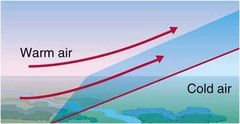
Which type of front is displayed?
a)
Cold
b)
Warm
c)
Stationary
d)
Occluded
22.
Which type of front is displayed?
a)
Cold
b)
Warm
c)
Stationary
d)
Occluded
23.
Which type of front is displayed?
a)
Cold
b)
Warm
c)
Stationary
d)
Occluded
24.
When two different air masses collide...
a)
A front forms
b)
They casually become one
c)
A new planet evolves
d)
Dinosaurs become extinct
25.
Which type of front is displayed?
a)
Cold
b)
Warm
c)
Stationary
d)
Occluded
26.
When a cold front is approaching, what happens?
a)
warm air is pushing under cold air causing humid weather and lower temperatures
b)
warm air is pushing under cold air causing humid weather and higher temperatures
c)
warm air rises, cools, and causes rain and thunderstorms
d)
cold air is pushed over warm air causing rain and thunderstorms
27.
What type of storm front is this?
a)
warm front
b)
cold front
c)
stationary front
d)
occluded front
28.
What type of weather would you expect to see after a cold front has passed through an area?
a)
cool and clear skies
b)
warm and humid
c)
thunderstorms
d)
foggy
29.
What type of weather would you expect to see after a warm front has passed through an area?
a)
cool and clear skies
b)
warm and humid
c)
thunderstorms
d)
foggy
30.
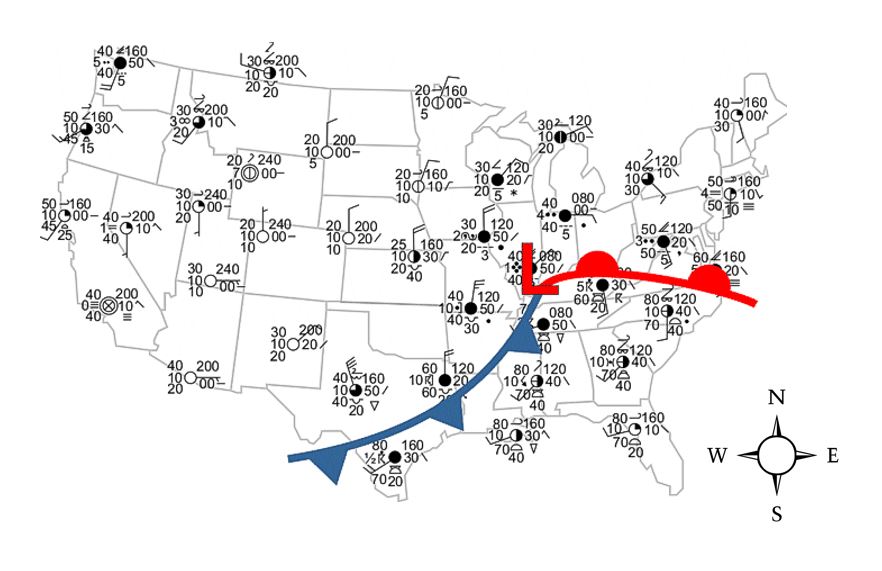
What direction is the warm front moving on the map? 
a)
North
b)
South
c)
East
d)
West
31.
What direction is the cold front moving on the map? 
a)
Southwest
b)
Northwest
c)
Southeast
d)
Northeast
32.

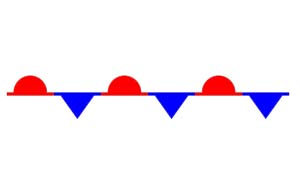
Which is the correct symbol for an occluded front?

a)
b)
c)
d)
33.

Which is the correct symbol for a stationary front?

a)
b)
c)
d)
34.

What type of front occurs when a warm air mass and a cold air mass do not have enough energy to move the other one out of the way?

a)

Warm front

b)

Cold front

c)

Stationary front

d)

Occluded front

35.
What's the humidity and temperature of a continental tropical air mass?
a)
Wet and cold
b)
Dry and warm
c)
Wet and warm
d)
Dry and cold
36.
These clouds are the closest to the ground. Their name means layer- or sheet like. They bring rain or snow and cover most of the sky. 
a)
Cirrus
b)
Stratus
c)
Cumulonimbus
d)
Cumulus
37.
A rain gauge measures what?
a)
Air pressure
b)
Wind speed
wind speed
c)
Amount of rain fall
d)
Wind direction
38.
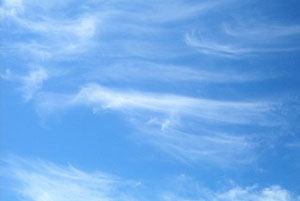
Which cloud is this?
a)
cumulus
b)
cumulonimbus
c)
cirrus
d)
stratus
39.
These clouds can bring thunderstorms, heavy rain, lightening, and sometimes hail.
a)
cumulus
b)
cumulonimbus
c)
cirrus
d)
stratus
40.
True or False: Cirrus clouds often produce rain or drizzle.
a)
True
b)
False
41.
This type of cloud is thick and puffy on top, and generally flat on the bottom. It has well-defined edges and can change shape rapidly.
a)
cumulus cloud
b)
stratus cloud
c)
cirrus cloud
d)
cloud 9
42.
Cumulus and cirrus clouds can signal what type of upcoming weather?
a)
fair skies
b)
hot, sunny weather
c)
windy weather
d)
rainy weather
43.
What kind of clouds are most likely to produce thunderstorms?
a)
cumulonimbus
b)
cirrus
c)
cumulus
d)
nimbostratus
44.
What tool is used to measure wind speed? 
a)
Wind Vane
b)
Anemometer
c)
Thermometer
d)
Barometer
45.
What tool is used to determine wind direction? 
a)
Barometer
b)
Hygrometer
c)
Anemeometer
d)
Wind Vane
46.
What does a barometer measure? 
a)
measures high and low pressure in the air
b)
measures humidity in the air
c)
measures speed of the wind 
d)
measures the amount of rain that has fallen
47.
What tool measures humidity in the air? 
a)
anemometer
b)
water gauge
c)
hygrometer
d)
barometer
48.
Fog is what type of cloud?
a)
Stratus
b)
Cumulus
c)
Cirrus
d)
Cumulonimbus
49.
When are you most likely to see cumulus clouds?
a)
On a foggy day
b)
On a rainy day
c)
Before a thunderstorm
d)
On a sunny day
50.
What tool do we use to measure temperature?
a)
Thermometer
b)
Ruler
c)
Balance
d)
Magnifying Glass
51.

True or False: Thunderstorms, winter storms, tornadoes, and hurricanes are four types of severe weather storms?

a)

True

b)

False

52.

Which type of storm always forms over and pulls energy from a large body of warm water?

a)

tornado

b)

thunderstorm

c)

hurricane

d)

winter storm

53.

Which of the following are not used to prevent flooding during storms?

a)

dams

b)

boats

c)

levees

d)

sandbags

54.

What type of storm is associated with the term, "lake effect?"

a)

hurricanes

b)

thunderstorms

c)

tornado

d)

winter storm

55.

True or False: There is no difference between a watch and a warning?

a)

True

b)

False

56.

True or False: Hurricanes are long-lasting storms, existing for a week or more?

a)

True

b)

False

57.

True or False: Thunderstorms never cause severe damage to an area?

a)

True

b)

False

58.

Which of the following storms can stretch more than 600 kilometers across and it may have winds as strong as 320 km/h?

a)

Tornadoes

b)

Winter storms

c)

Hurricanes

d)

Thunderstorms

59.

Which of the following storms can produce large amounts of snowfall due to the "lake effect"?

a)

Tornadoes

b)

Winter storms

c)

Hurricanes

d)

Thunderstorms

60.

Which of the following storms normally occur during spring and summer with clear, warm weather, but can also heat the air up to 30,000 degrees C with lightning?

a)

Tornadoes

b)

Winter storms

c)

Hurricanes

d)

Thunderstorms

61.

True or False: A storm is a violent disturbance in the atmosphere.

a)

True

b)

False

62.

True or False: During a thunderstorm, it is okay to continue swimming in a pool?

a)

True

b)

False

63.

True or False: During a severe winter storm, there is no need to have extra water, food, batteries, and medical supplies on hand?

a)

True

b)

False

64.

The human body can't go more than 2-3 days without, which of the following....

a)

food

b)

heat

c)

water

d)

batteries

65.

True or False: Hurricane Sandy was very destructive to New York?

a)

True

b)

False

66.

Which gas is represented by Gas #1?

a)

Oxygen

b)

Carbon dioxide

c)

Argon

d)

NItrogen

67.

Which of the following is found in our atmosphere?

a)

water vapor

b)

dust and pollen

c)

gases

d)

all of the above

68.

Which gas makes up the largest component of the Earth’s atmosphere?

a)

argon (Ar)

b)

oxygen (O2)

c)

nitrogen (N2)

d)

carbon dioxide (CO2)

69.

Which layer of the atmosphere has the highest density of gas molecules?

a)

Exosphere

b)

Mesosphere

c)

Stratosphere

d)

Thermosphere

e)

Troposphere

70.
What is the percentage of oxygen in Earth's atmosphere?
a)
1%
b)
21%
c)
78%
d)
90%
71.

What layer does most weather occur in?

a)

mesosphere

b)

stratosphere

c)

thermosphere

d)

troposphere

72.

What does the ozone layer do for us?

a)

It protects us from meteors

b)

It protects us from ultraviolet (UV) radiation

c)

It protects us from violet solar flares

d)

It does not help us at all

73.

6. In which layer is the ozone layer found? Jet streams (fast-moving currents of air) also occur here.

a)

mesosphere

b)

stratosphere

c)

exosphere

d)

thermosphere

74.

Which atmospheric layer is very hot and contains "light showers" known as auroras?

a)

stratosphere

b)

exosphere

c)

mesosphere

d)

thermosphere

75.

In which layer of the atmosphere do we live?

a)

thermosphere

b)

troposphere

c)

stratosphere

d)

mesosphere

76.

Which layer is coldest? Meteors are also visible here.

a)

mesosphere

b)

stratosphere

c)

thermosphere

d)

troposphere

77.
. Earth is surrounded by an envelope of gases called the _____________.  
a)
Thermosphere
b)
Stratosphere
c)
Troposphere
d)
 Atmosphere
78.
What is the lower layer of the thermosphere called?  
a)
Exosphere
b)
 Ionosphere
c)
Atmosphere 
d)
Mesosphere
79.
Which of the following is NOT one of the four main layers of Earth’s atmosphere? 
a)
 Exosphere
b)
Troposphere
c)
Thermosphere
d)
 Mesosphere
80.

Which layer contains the Aurora Borealis and the Aurora Astralis?

a)

Exosphere

b)

Troposphere

c)

Thermosphere

d)

Mesosphere