wayground logo

Free Printable Worksheets

NEW

Font size

S
M
L
XL
Worksheets

1st Semester Review

Total questions: 79

Worksheet time: 2hrs 59mins

Name
Class
Date
1.

The positive particles of an atom are

a)

electrons

b)

positrons

c)

neutrons

d)

protons

2.

The central region of an atom where its neutrons and protons are is its

a)

nucleus

b)

electron cloud

c)

core

d)

center

3.
A particle that moves around the nucleus is a(n)...
a)
Proton
b)
Neutron
c)
Electron
d)
Quark
4.

An atom with atomic number 6 would have how many protons

a)

6

b)

12

c)

3

d)

cannot be determined

5.

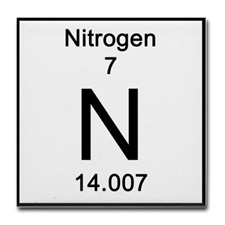
What is the number of protons that the element in this image contain?

a)

14

b)

7

c)

15

d)

18

6.

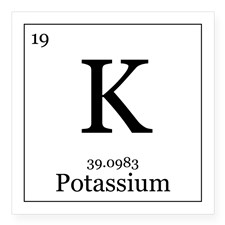
How many neutrons are in the atom "K"?

a)

7

b)

2

c)

39

d)

20

7.

Which elements have properties in common?

a)

elements in a group

b)

elements in a period

8.

The period number tells you the number of

a)

protons

b)

energy levels

c)

valence electrons

9.

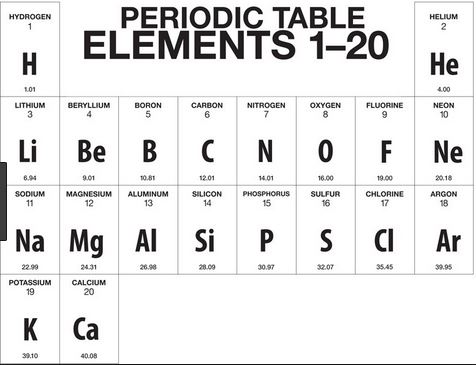
These elements are in a:

a)

group

b)

period

10.

Do these elements have properties in common?

a)

yes

b)

no

11.

Electrons have a _____ charge.

a)

neutral

b)

negative

c)

positive

d)

both positive and negative

12.
Which of the following is a good conductor of heat?
a)
Metal
b)
Nonmetal
c)
Metalloid
13.
Non-metals are good conductors of heat and electricity. 
a)
TRUE
b)
FALSE
14.

The elements argon, krypton, and xenon are all nonmetals. What property would these elements have in common?

a)

Good conductors of thermal energy

b)

Unreactive

c)

Soft and malleable

15.
a)
2
b)
8
c)
3
d)
13
16.
a)
2
b)
3
c)
5
17.

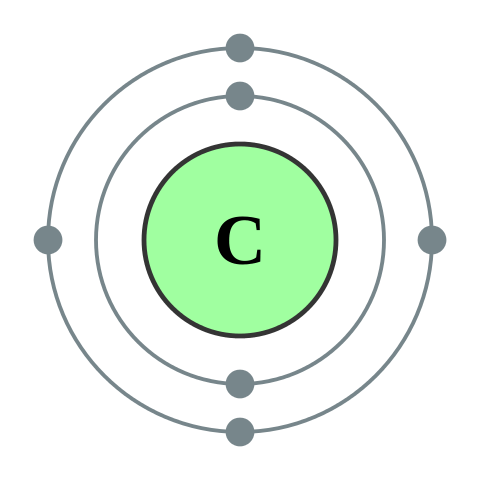
How many valence electrons does carbon have?

a)

4

b)

5

c)

6

d)

7

18.

How many valence electrons does Nitrogen Have?

a)

1 Valence electron

b)

2 Valence electron

c)

3 Valence electron

d)

4 Valence electron

e)

5 Valence electron

19.
How many atoms of carbon (C) are in C6H12O6?
a)
3
b)
6
c)
12
d)
24
20.
Element or compound?
H2O
a)
element
b)
compound
21.
How many magnesium atoms in 
Mg(NO3)2
a)
1
b)
2
c)
3
d)
6
22.
How many nitrogen atoms are in 
(NH4)3PO4
a)
1
b)
4
c)
3
d)
12
23.
Which of the following reactions is balanced?
a)
2CH4 + O2 -> CO2 + H2O
b)
CH4 + 2O2 -> CO2 + H2O
c)
CH4 + 2O2 -> CO2 + 2H2O
d)
None of the chemical equations are balanced.
24.
The substances listed on the right side of a chemical equation are the
a)
Yields
b)
Reactants
c)
Products
d)
Precipitates
25.
The substances listed on the left side of a chemical equation are the
a)
Products
b)
Coefficients
c)
Precipitates
d)
Reactants
26.
Which one is a compound?
a)
Co
b)
Br
c)
Fe
d)
CO
27.
Which one is an element?
a)
Co
b)
CO
c)
CO2
d)
CO3-2
28.
How many elements are found in the following molecule? Mg(ClO3)2
a)
1
b)
4
c)
3
d)
5
29.
a)
1st
b)
2nd
c)
3rd
d)
law of motion
30.
8 N to the left , and 4 N to the right. Find the net force. Is this balanced 
a)
12 N Right  No
b)
4 N Left  No
c)
12 N Right  Yes
d)
4 N Left  Yes
31.
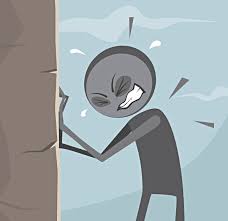
You hit a wall with a stick.  The equal but opposite reaction is _____
a)
the wall pushes against you
b)
the stick pushes against you
c)
you push against the stick
d)
the wall pushes against the stick
32.

When a student runs and kicks a ball, they have applied an ___________ force to move the ball.

a)

Balanced

b)

Magnetic

c)

Spring

d)

Unbalanced

33.

Walking down the hall and speeding up when you turn and go down the stairs is an example of ____________.

a)

acceleration

b)

weight

c)

gravity

d)

friction

34.
The picture of the position vs. time graph shows an object that is...
a)
accelerating/speeding up
b)
moving at a constant speed 
c)
not moving 
d)
accelerating/slowing down. 
35.
Which graph represents zero acceleration (constant velocity)?
a)
A
b)
B
c)
C
d)
D
36.
Which graph shows the object standing still?
a)
A
b)
B
c)
C
d)
D
37.

Pushing a box across the room

a)

Work

b)

No Work

38.

Holding a backpack

a)

Work

b)

No Work

39.

Is this an example of work?

a)

Yes

b)

No

40.

Is this an example of work?

a)

Yes

b)

No!

41.

Chewing food into smaller pieces.

a)

Physical

b)

Chemical

42.

Saliva breaking down carbohydrates.

a)

Physical

b)

Chemical

43.

Enzymes break down food nutrients.

a)

Physical

b)

Chemical

44.

Your stomach mixes acid and enzymes with the food to break down protein in the pizza.

a)

Physical

b)

Chemical

45.

Your esophagus is a tube that moves the food from your mouth to your stomach.

a)

Physical

b)

Chemical

46.
Which of the following examples shows that a chemical reaction has occurred? 
a)
A rock breaks into smaller pieces when it is struck with a hammer.
b)
Rust forms on a hammer that has been left outside to long. 
c)
A cup of water turns pink when a few drops of red food coloring are added. 
d)
A solid is formed when heat is removed from a sample of water. 
47.
A clear liquid from a flask is poured into another clear liquid in a beaker. Which of the following results of this procedure would indicate a new substance was formed?
a)
The level of the substance in the beaker is higher after the other liquid is added.
b)
A yellow solid forms and then settles to the bottom of the beaker.
c)
Small white crystals are left behind in the flask that held the first liquid.
48.
Evidence of a chemical reactions is anything that shows - 
a)
a new substance has formed
b)
a solid dissolved in a liquid
c)
interaction between 2 gases
d)
a change in the state of matter
49.

Jane jogs 18 km in 2 hours. Then she walks for 6 km in 2 hours. Find her jogging speed.

a)

9

b)

3

c)

12

d)

6

50.

A girl on a bike rides down a hill 500 meters long in 50 seconds. What is her speed?

a)

100 m/s

b)

10 m/s

c)

1,000 m/s

d)

10 mph

51.
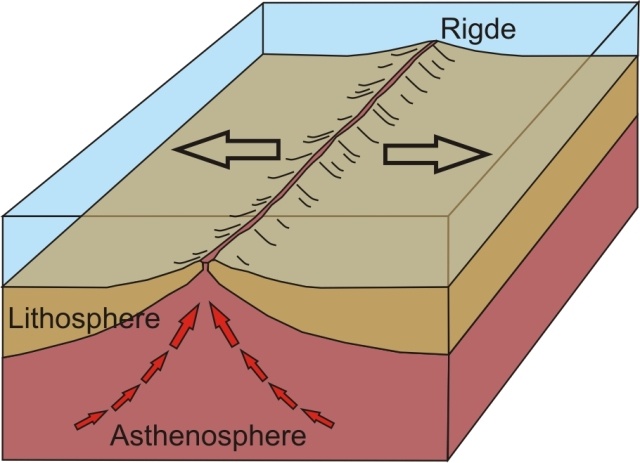
What kind of plate boundary is shown here?
a)
divergent
b)
convergent
c)
transform
d)
subducting
52.
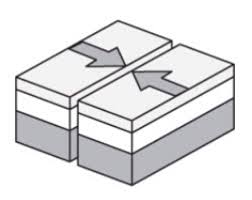
What kind of plate boundary is shown here?
a)
divergent
b)
convergent
c)
transform
d)
submergent
53.
What geologic feature/event you be most likely to find at a transform boundary?
a)
Earthquakes
b)
Volcanoes
c)
Mountains
d)
Rift Valleys
54.
What geologic feature/event would you most likely to find at a divergent boundary between two pieces of oceanic crust?
a)
Rift Valley
b)
Mid-Ocean Ridge
c)
Island Arc
d)
Flat land
55.
Name the boundary
a)
convergent boundary
b)
divergent boundary
c)
transform boundary
d)
sergent boundary
56.
Name the boundary
a)
convergent boundary
b)
divergent boundary
c)
transform boundary
d)
sergent boundary
57.

Where are hurricanes formed?

a)

On cold water

b)

On Warm water

c)

Anywhere near the ocean

d)

In the clouds

58.

How are hurricanes categorized?

a)

based on their destination

b)

based on their wind speed

c)

based on where they form

59.
a)
Warm Front
b)
High Air Pressure
c)
Cold Front
d)
High Temperatures
60.
a)
Low Clouds
b)
Low Temperatures
c)
Light Wind
d)
Low Air Pressure
61.
a)
High Air Pressure
b)
High Temperatures
c)
Heavy Rain
d)
Hail
62.
a)
High Pressure
b)
Warm Front
c)
Cold Front
d)
Mountains
63.
High Pressure is associated with this type of weather...
a)
Cloudy/Overcast Weather
b)
Cold Weather
c)
Warm Weather
d)
Fair Weather
64.
Low Pressure is associated with this type of weather...
a)
Cloudy/Overcast Weather
b)
Cold Weather
c)
Warm Weather
d)
Fair Weather
65.
Which city is currently experiencing a snow storm?
a)
Seattle
b)
Los Angeles
c)
Chicago
d)
New York
66.
Which city is experiencing thunderstorms?
a)
Denver
b)
New York 
c)
Miami 
d)
Boise
67.
A cold front is approaching Minneapolis. What will happen to the air temperature?
a)
stay the same
b)
increase
c)
decrease
68.

The roller coaster cart has the most kinetic energy at position-

a)

W

b)

X

c)

Y

d)

Z

69.
A hairdryer converts -- 
a)
electrical energy into chemical
b)
electrical energy into thermal
c)
chemical energy into mechanical
d)
thermal energy into mechanical
70.
Electrical Energy is transferred to _____ Energy.
a)
Thermal
b)
Solar
c)
Electrical
d)
None
71.
What kind of energy is represented in the picture?
a)
Thermal
b)
Chemical
c)
Sound
d)
Nuclear
72.
According to the Law of Conservation of Energy, energy cannot be _________ or ____________. 
a)
destroyed, destroyed
b)
created, saved
c)
created, destroyed
d)
lost, found
73.

What type of energy transformation occurs, when a hawk eats a mouse and then uses the energy from the mouse to fly?

a)

mechanical energy to chemical energy

b)

thermal energy to mechanical energy

c)

chemical energy to mechanical energy

d)

mechanical energy to thermal energy

74.

Where is the kinetic energy the greatest?

a)

A

b)

B

c)

C

d)

D

75.

Look at the diagram. At which point does the ball have the maximum kinetic energy?

a)

B

b)

C

c)

D

d)

E

76.
Look at the diagram. Which point does the ball have the maximum potential energy?
a)
A
b)
B
c)
C
d)
D
77.
A cell phone battery dies.  It gets plugged into an electrical outlet to recharge. Which of the following energy transformations occur during the charging?
a)
mechanical to chemical
b)
electrical to solar
c)
chemical to light
d)
electrical to chemical
78.
What is the formula for density?
a)
density = mass x volume
b)
density = mass / volume
c)
density = mass + volume
d)
density = mass - volume
79.
Frank has an eraser. It has a mass of 4g, and a volume of 2cm3. What is its density?
a)
8 g/cm3
b)
2 g/cm3
c)
1/2 g/cm3
d)
24 g/cm3