wayground logo

Free Printable Worksheets

Font size

S
M
L
XL
Worksheets

Midterm Review

Total questions: 75

Worksheet time: 3hrs 15mins
Name
Class
Date
1.
How many significant figures: 2016 m
a)
1
b)
2
c)
3
d)
4
2.
How many significant figures: 0.012 km
a)
1
b)
2
c)
3
d)
4
3.
Calculate 923 g ÷ 20312 cm3 and give your answer with the correct number of significant figures.
a)
0.04 g/cm3
b)
0.045 g/cm3
c)
0.0454 g/cm3
d)
0.05 g/cm3
4.
Calculate 1.23 m x 0.89 m and give your answer with the correct number of significant figures.
a)
1.0 m2
b)
1.1 m2
c)
1.0947 m2
d)
1.095 m2
5.
Calculate 7.987 m - 0.54 m and give your answer with the correct number of significant figures.
a)
7.45 m
b)
7.447 m
c)
7.4 m
d)
7.5 m
6.
The nucleus is made up of -
a)
neutrons and electrons
b)
protons and neutrons
c)
protons and electrons
d)
electrons and quarks
7.
An atom's overall charge is ________.
a)
positive 
b)
depends
c)
neutral 
d)
negative 
8.

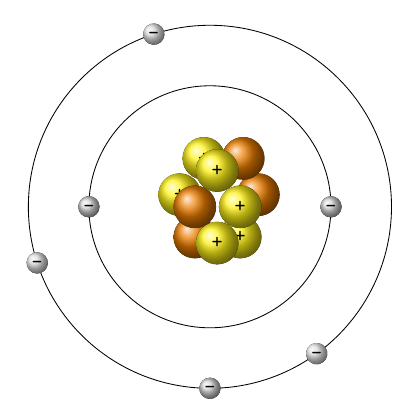
How many electrons does this atom have?

a)

2

b)

4

c)

6

d)

10

9.

What is the mass number?

a)

the number of protons in the nucleus

b)

the number of protons and neutrons in the nucleus

c)

the number of neutrons in the nucleus

d)

the number of protons and electrons in the atom

10.
How is the number of neutrons in the nucleus of an atom calculated?
a)
Add the number of e- and p+ together
b)
Subtract the number of e- from p+
c)
Subtract the number of p+ from the mass number
d)
Add the mass number to the number of e-
11.

An atom has 10 protons, 15 neutrons and 10 electrons what is its mass number.

a)

20

b)

10

c)

35

d)

25

12.
An element with a mass number of 11 and an atomic number of 5 has how many neutrons?
a)
11
b)
5
c)
6
d)
16
13.
4.35% of all X atoms have a mass of 39.946 amu. 83.79% have a mass of 41.941 amu, 9.50% have a mass of 42.941 amu, and 2.36% have a mass of 43.939 amu. What is the average atomic mass of atom X?
a)
41.97 amu
b)
42.19 amu
c)
10.43 amu
d)
40.04 amu
14.
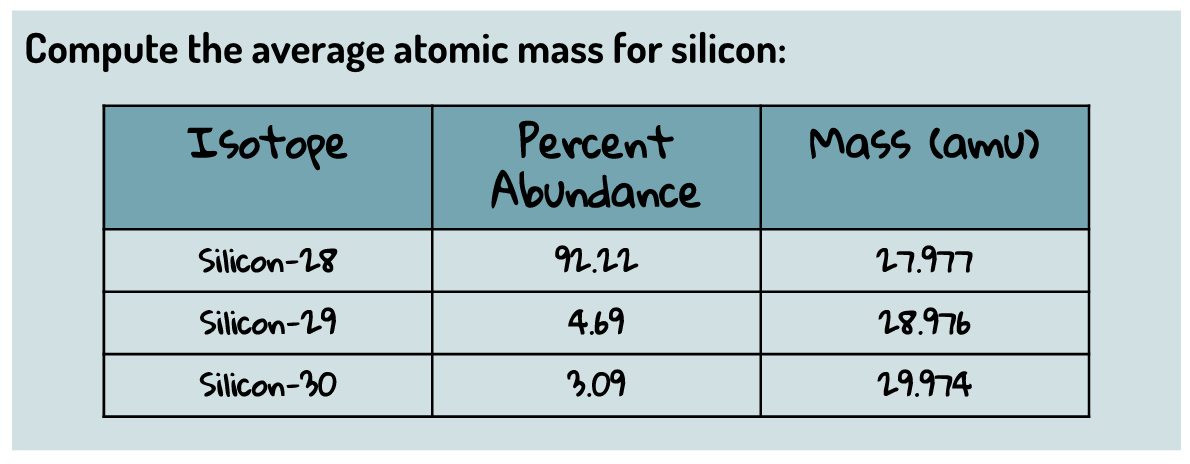
Compute the average atomic mass for silicon:
a)
27.977
b)
28.09
c)
28.976
d)
The average mass cannot be determined from provided information.
15.
An element has two naturally occurring isotopes. One is 10.013 amu and is 19.9% abundant. The other is 11.01 amu and is 80.1% abundant. What is the average atomic mass? What element is it?
a)
9.012, Beryllium
b)
12.011, Carbon
c)
6.941, Lithium
d)
10.812, Boron
16.

The frequency of violet light is 7.5x10¹⁴ Hz. What is its wavelength?

a)

4.0x10⁻⁷ m

b)

4.0x10⁷ m

c)

2.25x10²³m

d)

2.25x10²³ Hz

17.
Violet light has a wavelength of
4.10 x 10⁻¹²  m. What is the frequency?
a)
1.23 x 10^ -3 Hz
b)
7.31 x 10^ 19 Hz
c)
1.37 x 10^12 Hz
d)
3.0 x 10^ 8 Hz
18.

Ground state means that an electron is...

a)

at its lowest possible potential energy

b)

in the first shell of an atom

c)

laying low for the weekend

d)

removed from an atom

19.

When an electron returns to ground state from an excited state, the atom will

a)

emit energy

b)

absorb energy

c)

rotate

d)

wiggle

20.
What atom matches this electron configuration?
1s22s22p63s23p64s23d10
a)
Zinc
b)
Copper
c)
Nickel
d)
Germanium
21.
Electrons occupy orbitals of lowest energy first is part of what electron configuration rule?
a)
Hund’s Rule
b)
Aufbau Principle
c)
Pauli Exclusion Principle
22.

What is the maximum number of electrons that an S orbital can have?

a)

1 electron

b)

2 electrons

c)

3 electrons

d)

4 electrons

23.

How many electrons can the d sublevel(orbital) hold?

a)

8

b)

10

c)

2

d)

4

24.

What is this element?

1s22s22p63s23p64s23d104p6

a)

Argon

b)

Krypton

c)

Selenium

d)

Bromide

25.
Anions are _______ that form ____________ ions and __________ electrons.
a)
nonmetals, positive, lose
b)
nonmetals, negative, gain
c)
metals, positive, gain
d)
metals, positive, lose
26.
How many electron can be found in a p orbital?
a)
2
b)
3
c)
4
d)
6
27.
What atom matches this electron configuration?
[Xe] 6s2 4f14 5d9
a)
Mercury
b)
Gold
c)
Platinum
d)
Thallium
28.
What is the shorthand electron configuration for Sulfur atom?
a)
[Ar] 3p4
b)
[He] 3s23p4
c)
[Ne] 3s23p4
d)
[Na] 3s23p3
29.
How are elements arranged in the periodic table?
a)
in alphabetical order
b)
in the order in which they were discovered
c)
 in order of increasing atomic number
d)
 in order of increasing melting points
30.
The vertical columns in the periodic table are known as:
a)
groups
b)
periods
c)
valences
d)
isotopes
31.
Group 18 of the periodic table contains nonreactive elements like helium, neon, and argon. The elements in this group are called:
a)
alkali metsls
b)
transition metals
c)
halogens
d)
noble gases
32.
 Use the periodic table to answer the question.
Out of all the lists below, which list contains the three elements that are most alike in their chemical properties?
a)
O, F, Ne
b)
Li, Mg, Sc
c)
Li, Na, K
d)
H, He, Li
33.
Alkali metals are located where on the periodic table?
a)

Group 1

b)
Group 8 and Period 4
c)
Period 7
34.
Which of the following will have a higher electronegativity than arsenic (As)?
a)
Carbon (C)
b)
Neon (Ne)
c)
Antimony (Sb)
d)
Germanium (Ge)
35.
Which of the following will have a lower ionization energy than Scandium (Sc)?
a)
Helium (He)
b)
Titanium (Ti)
c)
Calcium (Ca)
d)
Magnesium (Mg)
36.
As you move down the periodic table atoms get bigger.  This is because ____________.
a)
The atoms have more mass.
b)
The atoms have more protons.
c)
The atoms have more energy levels
d)
The atoms have more neutrons
37.
Ionization energy is...
a)
the energy required to add an electron to a specific atom
b)
how much energy it takes to remove an electron from an atom
c)
the energy required to shield the outer electrons from the nucleus
d)
a measure of the ability of an atom to attract electrons
38.
The atom with the largest atomic radius in Group 18 is - 
a)
Ar
b)
He
c)
Kr
d)
Rn
39.

True or false? In naming ionic compounds,

the cation is always named first and the anion

second.

a)

True

b)

False

40.

The correct name for LiCl is _______.

a)

lithium monochloride

b)

lithium(I) chloride

c)

monolithium chloride

d)

lithium chloride

e)

monolithium monochloride

41.

The correct name for FeO is _____.

a)

iron oxide

b)

iron (II) oxide

c)

iron (III) oxide

d)

iron (IV) oxide

e)

iron (I) oxide

42.

Which of the following is not the correct

combination of compound name and its formula?

a)

hydrobromic acid; HBr

b)

calcium sulfate; CaSO4

c)

beryllium oxide; BeO

d)

nickel(II) peroxide; Ni2O

e)

ammonium chromate; (NH4)2CrO4

43.

The correct name for P2O5 is

a)

phosphorus(II) oxide

b)

phosphorus(V) oxide

c)

diphosphorus oxide

d)

diphosphorus pentoxide

e)

phosphorus pentoxide

44.

The substance ClO3is best described as

a)

a molecule

b)

a polyatomic ion

c)

a polyatomic molecule

d)

a mixture

45.

Potassium chlorate has the formula

a)

KCl

b)

KClO

c)

KClO2

d)

KClO3

e)

KClO4

46.

The name for Al(OH)3 is

a)

aluminum(III) hydroxide

b)

aluminum trihydroxide

c)

aluminum hydroxide

d)

monaluminum trihydroxide

e)

aluminum(I) hydroxide

47.

A chemical bond where electrons are shared.

a)

Ionic Bond

b)

James Bond

c)

Covalent Bond

d)

Polar Bond

48.

What type of bond is NaCl?

a)

Ionic Bond

b)

James Bond

c)

Covalent Bond

d)

Polar Bond

49.
Name the following:
Mg3P2
a)
Magnesium Phosphide
b)
Magnesium Phosphorus
c)
Magnamide Phosphide
d)
Magnamide Phosphorus
50.
The bond between Na & F.   Ionic or covalent?
a)
Ionic
b)
Covalent
51.
The bond between N & H.   Ionic or covalent?
a)
Ionic
b)
Covalent
52.

What does the word "polar" refer to?

a)

together, mutually, in common

b)

valence electrons

c)

an atom or molecule with a net electric charge due to the loss or gain of one or more electrons.

d)

To have a positive and negative end like a magnet

53.

The difference in electronegativity affects the type of bond will be formed. What type of bond would be formed with a difference of 0.6?

a)

Covalent

b)

Polar Covalent

c)

Ionic

54.

What type of bond is depicted in the image?

a)

Covalent

b)

Polar Covalent

c)

Ionic

55.

What type of bond is depicted in the image?

a)

Covalent

b)

Polar Covalent

c)

Ionic

56.

What type of bond is depicted in the image?

a)

Covalent

b)

Polar Covalent

c)

Ionic

57.
According to the octet rule most elements need _______ valence electrons.
a)
2
b)
8
c)
6
d)
18
58.
Which of the following is the correct Lewis dot structure for the molecule fluorine (F2)?
a)
A
b)
B
c)
C
d)
D
59.
Which of the following is the correct Lewis structure for the compound PBr3?
a)
structure A
b)
structure B
c)
structure C
d)
structure D
60.

What is the correct Lewis Dot Structure for ammonia NH3

a)
b)
c)
d)
61.

Which is the correct molecular structure for carbon dioxide?

a)
b)
c)
d)
62.
How many moles are in 4.5x1024 particles?
a)
0.747 particles
b)
0.747 mol
c)
2.71x1047 mol
d)
2.71x1047 particles
63.
What is the molar mass of Mg3N2?
a)
191.6 g/mol
b)
76.64 g/mol
c)
38.32 g/mol
d)
100.95 g/mol
64.
What is the mass of one mole of Al2(SO4)3?
a)
75.04 g
b)
342.14 g 
c)
75.04 mol
d)
342.14 mol
65.
How many molecules are there in 5.9 moles of NaCl?
a)
3.5x1024molecules
b)
9.79x10⁻²⁴molecules
c)
1.02x10²³molecules
66.
How many moles are there in 12.7g of CaF2?
a)
0.20 mol
b)
1,000.76 mol
c)
6.14 mol
d)
0.16 mol
67.
What is the mass of 9.4 moles of B2(Cr2O7)3?
a)
6.41 x 10²²g
b)
5.67x1024 g
c)
49.11 g
d)
4,339.23 g
68.
What is the mass of 54.3x1045molecules of BeO?
a)
3.27x1070 g
b)
9.01 x10²²g
c)
2.25 x1024 g
d)
1.31 x1069g
69.
What is the empirical formula for C3H8
a)
CH
b)
C3H8
c)
C6H16
d)
CH2.7
70.

You are given the following percentages: 40.05% S and 59.95% O. Find the empirical formula for these elements.

a)

SO

b)

SO2

c)

SO3

d)

SO4

71.

A compound consists of 72.2% magnesium and 27.8% nitrogen by mass. What is the empirical formula?

a)

Mg4N3

b)

MgN2

c)

Mg3N2

d)

MgN

72.
What is the molecular formula if the empirical formula is C2H5 and the molecular molar mass is 58.14 g/mol?
a)
C2H5
b)
C4H10
c)
C1H2.5
d)
C4H8
73.
What is the molecular formula if the empirical formula is CH2O and the molecular molar mass is 180.18?
a)
CH2O
b)
C2H4O2
c)
C4H8O4
d)
C6H12O6
74.
What is the percent composition by mass of sulfur in the compound MgSO4 (gram formula mass = 120 g/mol)?
a)
20%
b)
27%
c)
46%
d)
53%
75.
What is the percentage of iron in iron(III)oxide?
a)
30%
b)
70%
c)
40%
d)
60%