
 Worksheets
Fall Final Exam Review
Total questions: 60
Worksheet time: 56mins
Name
Class
Date
1.
Which biomolecule is the key source of energy?
Quick Energy!
Quick Energy!
a)
Lipid
b)
Protein
c)
Carbohydrate
d)
Nucleic Acid
2.
What are the functions of lipids?
a)
Quick source of energy
b)
Builds muscles, skin, enzymes
c)
Stores genetic information
d)
Long-term energy, insulation, found in cell membrane
3.
What is the function of nucleic acids?
a)
Store genetic information
b)
Store long-energy
c)
Quick source of energy
d)
Builds structures
4.
Which of the following is NOT a function of proteins?
a)
Enzymes speed up chemical reactions
b)
Transport molecules throughout cell membrane
c)
Build muscle
d)
Give energy
5.
Choose the similarity between prokaryotes and eukaryotes.
a)
Both have cell walls.
b)
Both are able to reproduce by mitosis.
c)
Both contains cytoplasm, ribosomes, and DNA
d)
Both are found in the same organizm
6.
The maintenance of an organism’s internal environment is called:
a)
compensating
b)
homeostasis
c)
balancing
d)
routine
7.
Osmosis is the movement of _____ across a membrane.
a)
food
b)
energy
c)
oxygen
d)
water
8.

The cell below is in a _________ solution.
a)
Hypotonic
b)
Hypertonic
c)
Isotonic
9.
This cellular structure helps organisms maintain homeostasis by controlling what substances may enter or leave cells.
a)
vacuole
b)
nucleus
c)
cell membrane
d)
cell wall
10.

The cell below is in a _____________ solution.
a)
Hypertonic
b)
Hypotonic
c)
Isotonic
11.

What type of transport is this? Note the use of a channel protein.
a)
facilitated diffusion
b)
active transport
c)
diffusion
d)
osmosis
12.

What type of transport is this?
a)
Endocytosis
b)
Facilitated Diffusion
c)
Active Transport Pump
d)
Osmosis
13.
In the S stage of interphase_______________
a)
the cell grows
b)
the nucleus divides
c)
the cell membrane divides
d)
the DNA is replicated
14.

During the growth/gap 1 stage of the cell cycle, a cell
a)
splits into two new cells
b)
doubles in size and growth
c)
Duplicates its DNA
d)
divides its cytoplasm
15.

Substage of Interphase in which the cell copies its DNA in preparation for cell division
a)
G1
b)
Synthesis
c)
G2
d)
Interphase
16.
True or False? Meiosis involves on cell division that produces two cells.
a)
True
b)
False
17.
True or False? Meiosis involves two cell divisions that produce four cells.
a)
True
b)
False
18.
What is the result of one cell undergoing mitosis in humans?
a)
two cells, each with 23 chromosomes
b)
two cells, each with 46 chromosomes
c)
four cells, each with 23 chromosomes
d)
four cells, each with 46 chromosomes
19.

Which sequence of bases match the DNA model?
a)
CATC
b)
GTAG
c)
CAAG
d)
GTAC
20.

Name this structure
a)
double helix
b)
nucelotide
c)
twisted ladder
d)
hydrogen bond
21.
Which of the following complementary base pairs are correct?
a)
A - T
b)
A - G
c)
T - C
d)
G - U
22.

What is the correct order of DNA replication?
a)
3, 2, 1, 4
b)
2, 1, 4, 3
c)
2, 3, 1, 4
d)
3, 4, 1, 2
23.
What is the correct complimentary strand for the following DNA? ATCGAG
a)
TACGAG
b)
ATCGAG
c)
TAGCTG
d)
TAGCTC
24.
Which of these nitrogenous bases is NOT seen in DNA?
a)
Uracil
b)
Thymine
c)
Cytosine
d)
Guanine
25.
Transcription takes place in the
a)
cytoplasm
b)
chloroplast
c)
nucleus
d)
mitochondria
26.
Translation takes place in the
a)
cytoplasm (ribosome)
b)
chloroplast
c)
nucleus
d)
mitochondria
27.
Which is the mRNA molecule that would be transcribed from this DNA template:
TGGCAA
TGGCAA
a)
ACCGTT
b)
UGGCAA
c)
UCCGUU
d)
ACCGUU
28.
What carries the genetic code to the ribosome?
a)
mRNA
b)
tRNA
c)
rRNA
d)
DNA
29.

UUU codes for
a)
Phe
b)
Leu
c)
Ser
d)
Pro
30.

GAA codes for
a)
Asp
b)
Glu
c)
Gly
d)
Ala
31.
What mutation has occurred here?
T-G-A-C-C-A
T-G-A-G-C-A
T-G-A-C-C-A
T-G-A-G-C-A
a)
Substitution
b)
Deletion
c)
Insertion
d)
Frameshift
32.
ATTTGAGCC- Original
ATTGAGCC - Mutated
The example above is an example of a
ATTGAGCC - Mutated
The example above is an example of a
a)
Insertion- Frameshift
b)
Deletion- Substitution
c)
Deletion -Frameshift
d)
All of the above
33.
Which of the following is a phenotype?
a)
BB
b)
Bb
c)
bb
d)
Blue eyes
34.
G = green, g = yellow
The genotype for a yellow plant is...
The genotype for a yellow plant is...
a)
GG
b)
Gg
c)
gg
d)
all of the choices result in yellow
35.
Lactase ends in "ase", this means it is a(n).......
a)
Lipid
b)
Enzyme
c)
Carbohydrate
d)
Sugar
36.
Cellular respiration breaks down ______________ to release energy (ATP).
a)
Glucose
b)
Oxygen
c)
Carbon Dioxide
d)
Water
37.

Which process is shown in the picture?
a)
translocation
b)
crossing over
c)
dihybrid cross
d)
monohybrid cross
38.

Term for homozygous organisms that display two dominant phenotypes at the same time
a)
codominance
b)
incomplete dominance
c)
multiple alleles
d)
linked genes
39.

An offspring will receive how many alleles from each parent to determine a specific trait?
a)
one
b)
two
c)
three
d)
five
40.

Brown fur color is dominant over black fur color. Which of the following is the actual genotype of ALL of the offspring in the next generation of this cross for fur color?
AA x aa
AA x aa
a)
AA
b)
Aa
c)
aa
d)
brown fur
41.
Purple is dominant to white. A heterozygous purple flower is crossed with a white flower. What are the genotypes and phenotypes of the offspring?
a)
100% Pp (purple)
b)
50% Pp (purple); 50% pp (white)
c)
75% Pp (purple); 25% pp (white)
d)
25% PP, 50% Pp, 25% pp
75% purple, 25% white
75% purple, 25% white
42.

What genotype is missing from this Punnett Square?
a)
RrYy
b)
RRYY
c)
rryy
d)
RrYY
43.
In meiosis, the haploid number of chromosomes in a human sex cell is:
a)
46
b)
92
c)
22
d)
23
44.
What is the diploid number of cells found in a human body cell?
a)
23
b)
46
c)
92
d)
47
45.

The process on the left is:
The process on the right is:
The process on the right is:
a)
Left: meiosis
Right: meiosis
Right: meiosis
b)
Left: meiosis
Right: cloning
Right: cloning
c)
Left: mitosis
Right: meiosis
Right: meiosis
d)
Left: mitosis
Right: mitosis
Right: mitosis
46.

The term used to describe DNA Replication is:
a)
Semi-Conservative
b)
Conservative
c)
AntiParallel
d)
Dispersive
47.
How many nucleotides make a codon?
a)
1
b)
2
c)
3
d)
6
48.
Which RNA aides in protein synthesis by putting amino acids in order.
a)
rRNA
b)
mRNA
c)
tRNA
d)
idkRNA
49.

This diagram can be used to -
a)
translate codon into protein
b)
transcribe DNA into RNA
c)
duplicate DNA
d)
cell division
50.
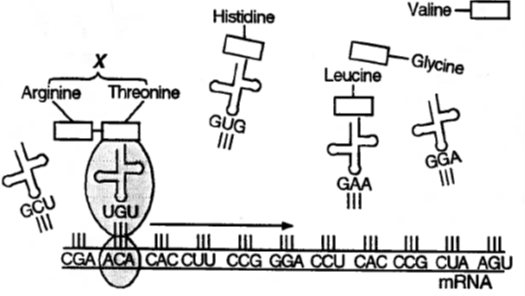
What process is going on in this photo?
a)
Transcription
b)
Translation
c)
Replication
d)
All the above
51.

The picture best represents what important cell process?
a)
cellular respiration
b)
photosynthesis
c)
fermentation
d)
osmosis
52.

The picture best represents what process?
a)
photosynthesis
b)
osmosis
c)
cellular respiration
d)
fermentation
53.
What is the formula for glucose?
a)
C6H12O6
b)
H2O
c)
H6C12O12
d)
CO2
54.
What are the products of photosynthesis?
a)
water and carbon dioxide
b)
oxygen and glucose
c)
oxygen and carbon dioxide
d)
oxygen and water
55.
Which of the following is the correct equation for PHOTOSYNTHESIS?
a)
6CO2 + 6H2O --> 6O2 + C6H12O6
b)
6CO2 + C6H12O6 + 6H2O --> O2
c)
6O2 + 6H2O --> 6CO2 + C6H12O6
d)
C6H12O6 + 6O2 ---> 6H2O + 6CO2
56.
What is the correct equation for cellular respiration?
a)
6O2 + C6H12O6 -> 6CO2 + 6H2O + Energy
b)
6O2 + C6H12O6 + Energy -> 6CO2 + 6H2O
c)
6CO2 + 6H2O -> 6O2 + C6H12O6 + Energy
d)
6CO2 + 6H2O + Energy -> 6O2 + C6H12O6
57.
Controlling what goes into or out of the cell without energy is called
a)
active transport
b)
endocytosis
c)
passive transport
d)
exocytosis
58.

This picture represents what type of cell transport?
a)
endocytosis
b)
exocytosis
c)
osmosis
d)
passive transport
59.
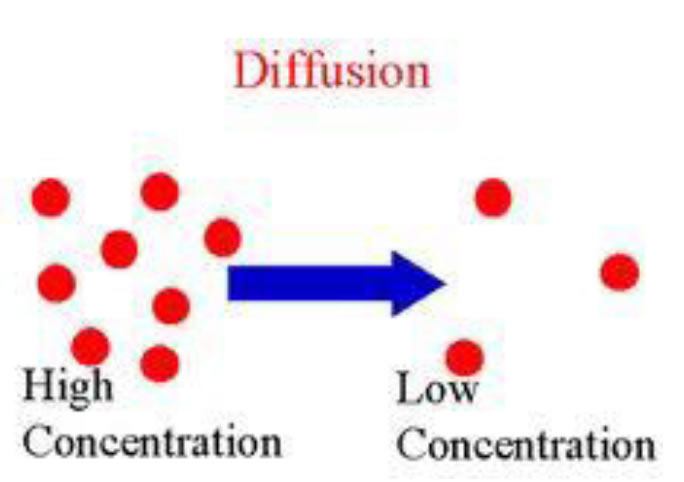
Movement of particles from high to low concentration.
a)
Passive Transport
b)
Active Transport
60.

What type of transport is this?
a)
facilitated diffusion
b)
active transport
c)
diffusion
d)
osmosis
100 %

